Running a global stipend program means accounting for two kinds of complexity: employees need benefits that fit where and how they work, and HR needs to be able to easily manage all the details, such as eligibility rules, budgets, currencies, and payroll requirements.
A worker commuting to an office in Japan needs different support than a remote employee setting up a home office in the UK. A new hire would benefit from equipment funding immediately, while an employee celebrating 10 years with the company could qualify for vacation reimbursement as part of its sabbatical benefit.
The challenge is supporting those differences without creating a separate administrative process for every employee population.
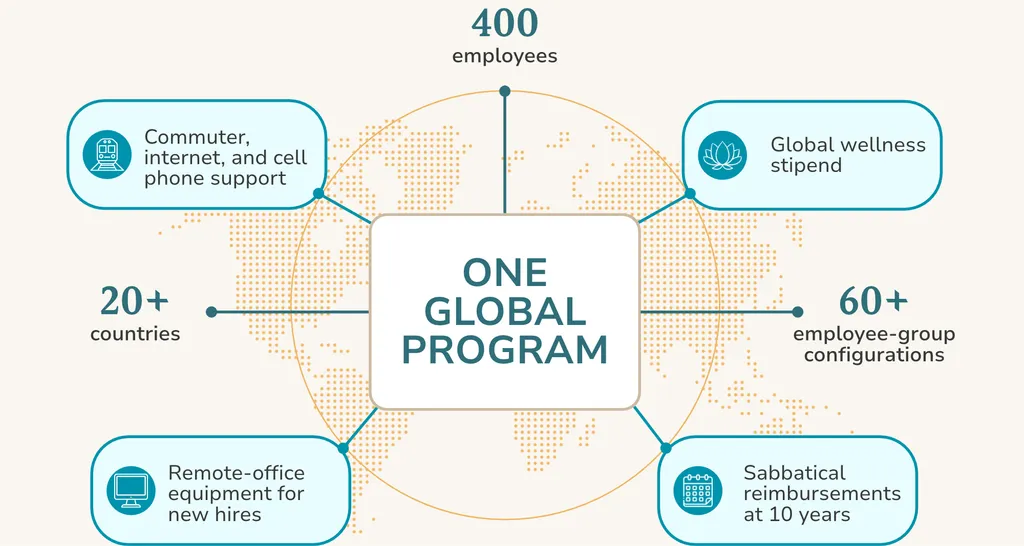
We highlighted one customer doing exactly that in Compt’s 2026 Midyear Lifestyle Benefits Benchmark Report. The company supports approximately 400 employees across more than 20 countries, with 60+ employee-group configurations that account for different stipend eligibility rules, funding amounts, and eligible expenses.
And employees are using their benefits. In the first half of 2026, this company achieved 100% account activation and 93% employee participation, with approximately 5,000 expenses submitted.
Here’s a closer look at how the program works, where employees are spending their benefits, and what other global employers can learn from its design.
What does a global stipend program with 60+ employee configurations look like?
Those 60+ configurations reflect different employee stipend eligibility and funding rules tailored by region, role, employee tier, and work arrangement, all managed through Compt.
Some benefits are available companywide, while others depend on more specific criteria, such as how frequently employees travel or how long they’ve been with the company.
Here are a few examples from the actual program:
| Employee need | How the company addresses it |
|---|---|
| Commuting and connectivity | One stipend combining commuter benefits, internet allowances, and cell phone stipends, with eligibility based on employee role and whether they travel for work |
| Remote-work support | Internet and cell phone reimbursements, plus separate home-office equipment funding |
| Health and wellness | A dedicated health and wellness stipend with eligibility determined by country |
| New-hire equipment | A dedicated home-office equipment stipend that expires two months after hire |
| Country-specific transportation | A transportation-only stipend for eligible employees in Japan |
| Local vision benefits | Dedicated vision reimbursements for eligible employees in Japan and Singapore |
| Employee milestones | Vacation reimbursement as part of the company’s 10-year sabbatical benefit |
This isn’t one universal allowance with the same rules for everyone. Rather, it’s a collection of benefits designed around different needs, administered through the same reimbursement platform.
For a global employer, the advantage is being able to manage those differences within one system. HR can establish eligibility rules and funding schedules for different employee populations without managing each configuration through a separate platform.
“Rather than worrying if we have the right benefits for a global population, Compt allows our full-time team across the world the power of choice.”
— VP of People Operations at another midmarket tech company, via G2
How does the company manage different stipend budgets and eligibility rules?
The company’s configurations are managed through Compt’s custom eligibility rules, which use employee information to determine who qualifies for each stipend.
Country and work arrangement are two important factors in this program. Travel frequency adds another layer, allowing the company to distinguish between employees who regularly commute, work remotely, or travel for business.
For example, some employees qualify for a combined commuter, internet, and cell phone stipend. Others receive internet and cell phone support without the commuter component.
The company also uses different funding schedules depending on what each benefit is intended to cover:
- Recurring expenses: Several commuter and connectivity stipends operate on quarterly cycles, with funding accruing monthly.
- Global wellness: The company’s wellness stipend is funded annually, with eligibility determined by country rather than work arrangement.
- Home-office equipment: Eligible employees receive annual equipment funding, while new hires have a separate allowance that expires two months after their hire date.
Compt separates these decisions. Employee-group rules determine who qualifies for a stipend, while the stipend’s settings determine its funding amount, renewal schedule, and expiration rules.
Employees can then view their available stipends, balances, and eligible expense categories in Compt.
See how it works here:
For this global customer, Compt applies more than 60 custom eligibility and funding configurations based on each employee’s assigned group, without requiring HR to manage every variation manually or through a separate system.
What happens when an employee changes countries or work arrangements?
Employees don’t stay in the same eligibility group forever. Workers may transfer to another country, change their work arrangement, or become eligible for a different stipend.
For a company managing more than 60 possible configurations, those changes need clear rules, too.
Compt makes this easy because it supports HRIS integrations that synchronize employee information used for eligibility, including location, employment status, and custom group attributes. When that information changes, an employee’s group assignment can be updated according to the configured rules. Administrators can also update employee information through roster uploads or directly in Compt.
But when a new stipend takes effect is a separate decision. Compt supports three options for group changes:
- Immediately
- At the beginning of the following month
- At the beginning of the next stipend cycle
This customer uses the beginning of the next cycle as its default.
If an employee moves to another country or changes work arrangements, the stipends they’re no longer eligible for end with the current cycle. Newly eligible stipends begin at the start of the following cycle.
Country changes can require additional attention, especially when employees have existing balances in one currency and will receive new stipends in another. Administrators can make funding corrections when an adjustment is needed, and Compt’s Customer Success team can assist with exceptions that require additional configuration.
How are employees using the global stipend program?
Despite all those configurations, employee participation is high.
In H1 2026, the company had a participation rate of 93%, or how many employees submitted at least one stipend expense.
Here’s what that employee activity looked like:
| H1 2026 metric | Result |
|---|---|
| Account activation | 100% |
| Employee participation | 93% |
| Expenses submitted | ~5,000 |
| Vendors used | 1,000+ |
| Currencies represented | 14 |
| Average submissions | ~14.6 per participating employee |
The vendor diversity is especially interesting: Employees used their benefits with transportation providers, telecommunications companies, fitness businesses, retailers, and local merchants.
Employees submitted expenses for train fares, parking, mobile service, and internet bills. Those purchases look different across countries, but they all fit within the company’s defined stipend policies.
Those options are possible for employees because Compt uses a reimbursement model. Employees make purchases with their own money from businesses that fit their needs, then submit eligible expenses through Compt for reimbursement. They aren’t required to shop through a fixed vendor catalog or according to merchant category codes.
The company’s results reflect a broader pattern across Compt’s customer base.
According to the 2026 Midyear Lifestyle Benefits Benchmark Report, employees spent their stipends across thousands of businesses in H1 2026, with approximately 70% of spending going to vendors outside the top 10. That pattern has remained consistent since Compt began tracking it in 2022, when the figure was about 75%.
A company with employees in multiple countries doesn’t need to select a different network of approved merchants for every location. With Compt, employees can choose eligible purchases from businesses that work for them, while HR maintains control over the categories and amounts the company reimburses.
Participation tells you whether employees are using the program. Funding utilization tells you whether they’re using the money available to them. Both matter when evaluating benefits design.
Which stipends are employees using most?
Participation across the program is high, but funding utilization rates — or the percentage of available stipend dollars employees actually spend — vary considerably by benefit.
Here’s a snapshot of how employees used their available stipend dollars in the first half of 2026:
| Stipend program | H1 funding utilization |
|---|---|
| Commuter, internet, and cell phone | 81% |
| New-hire home office equipment | 75% |
| Internet and cell phone | 72% |
| Wellness | 49% |
| Home-office equipment | 33% |
| Overall funding utilization | 64% |
The commuter and connectivity stipends see some of the highest utilization. That’s not particularly surprising: those stipend categories often involve recurring expenses.
Home-office equipment works differently. Once an employee purchases a desk, monitor, or chair, they may not need to use that allowance again for some time.
Wellness presents another interesting example. Employees submitted hundreds of wellness expenses during H1, including fitness memberships and other eligible purchases. But only 49% of available wellness funding had been used by June 30.
That doesn’t necessarily indicate a problem. Employees may use annual benefits later in the year, and some categories naturally involve less frequent spending.
Still, the differences give HR useful questions to investigate.
Do employees understand which expenses are eligible? Are the funding schedules appropriate for the purchases they’re intended to cover? Would a reminder encourage more employees to submit expenses they’ve already incurred?
Compt’s reporting allows administrators to review participation, funding utilization, and spending by stipend and category. The midyear results give the company two areas to evaluate: whether employees need additional reminders about their wellness benefits and whether lower equipment utilization reflects a lack of awareness or simply a lack of need.
In short, the company can evaluate each benefit according to its purpose rather than treating the entire global program as one undifferentiated allowance.
Manage global employee stipends and Lifestyle Spending Accounts (LSAs) with Compt.
This customer’s experience shows that consistent benefits administration doesn’t require identical benefits.
Its employees have different needs based on location, work arrangement, travel frequency, and tenure. With Compt, the company can manage those differences through defined eligibility groups, stipend-specific funding rules, and a shared reimbursement process.
Compt is a reimbursement-based platform for managing flexible employee stipends and Lifestyle Spending Accounts (LSAs). HR creates the program by defining eligible expenses, budgets, funding schedules, and employee groups. Employees then submit expenses for reimbursement, while Compt supports claim review, configured tax treatment, and payroll reporting.
Whether you’re managing a few international employee groups or dozens of distinct configurations, the goal is the same: offer benefits that fit your workforce without creating an entirely separate administrative process for each one.
Want to see how Compt could support your global stipend program? Request a Compt demo today.
FAQs: Managing global employee stipend programs
Yes. Compt supports employees across multiple countries, with configurable stipend eligibility, funding amounts, currencies, and expense categories.
According to Compt’s 2026 Annual Lifestyle Benefits Benchmark Report, 20% of Compt customers supported employees outside the U.S. in 2025.
The customer featured here supports approximately 400 employees in more than 20 countries through Compt. Its program includes wellness, commuter, connectivity, equipment, and country-specific reimbursements, all managed through the same platform.
Can employers set different stipend budgets and eligibility rules for different employee groups?
Yes. Compt lets employers define eligibility groups using employee attributes such as location, department, employment type, and custom HRIS fields. Different groups can receive different stipends or funding amounts without requiring separate benefits platforms.
This approach fits an emerging global benefits trend. According to Compt’s 2026 Midyear Lifestyle Benefits Benchmark Report, 61% of customers supporting international employees offered an all-inclusive Lifestyle Spending Account (LSA) in H1 2026, compared with 57% in 2025.
A shared benefits framework doesn’t have to mean identical benefits for everyone. The customer featured here uses more than 60 configurations to account for country, work arrangement, travel frequency, and other program requirements.
Can global employees receive different stipend categories and funding schedules?
Yes. Compt supports different eligible categories, funding amounts, and renewal schedules for different employee groups. Funding can be provided upfront or accrued over time, depending on the stipend’s configuration.
In H1 2026, the most common offerings among Compt customers supporting international employees included wellness (42%), office equipment (31%), professional development (22%), and cell and internet benefits (19%). Professional development adoption among these customers increased from 14% in 2025, reflecting growing investment in employee learning across global workforces.
Funding schedules vary, too. Across all Compt customers, 58% used annual funding in H1 2026, while 39% used quarterly funding. Companies can use more than one schedule across their stipend and LSA programs.
The employer featured here demonstrates that flexibility: some connectivity and commuter stipends operate on quarterly cycles with monthly accrual, while home-office equipment has annual funding and separate rules for new hires.
How does Compt handle stipend taxes and payroll across countries?
Compt supports country-specific tax configurations and payroll reporting for global stipend programs. Employers establish the applicable tax treatment for each benefit category and country, and Compt applies those configured classifications to reimbursement records.
For some context: In Compt’s full-year 2025 dataset, 78% of total stipend spending was taxable and 22% was nontaxable. Those figures represent spending across Compt customer programs, not tax rates or classifications specific to international employees.
Compt can generate reimbursement reports separated by country or payroll provider, with payroll-ready exports and supported integration options.
Employers remain responsible for determining the correct local tax treatment with their tax and payroll advisors. Compt doesn’t independently determine every country’s tax requirements, remit local payroll taxes, or replace a local payroll provider.
Editor’s note: Compt software supports the categorization and proper reporting of benefits according to IRS guidelines, helping businesses maintain compliance. However, Compt cannot provide tax advice, and users should consult their own tax, legal, and accounting advisors when necessary.

 No receipt chasing