
In 2018, I traveled to Microsoft’s campus in Redmond to cover its global hackathon. More than 18,000 people across 4,000 cities and 75 countries participated. The main event took place under giant white tents. There was a science fair, a petting zoo, cool swag (like organic basil seeds I grew on my windowsill later that summer), and Microsoft CEO Satya Nadella wandering through the demos.
Truthfully, I didn’t learn much about the actual technology behind the builds.
In 2026, Compt’s AI hackathon looked very different.
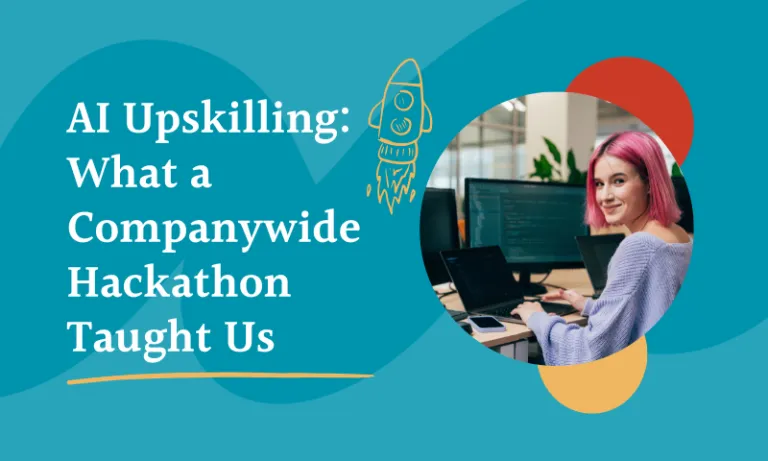
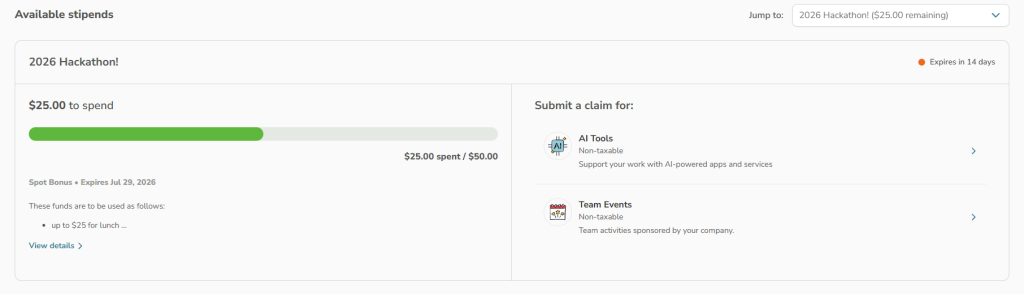
We spent a few days in July building projects with AI and vibe-coding tools like ChatGPT, Claude, Lovable, Replit, and v0, using a $50 AI tools stipend to cover both credits for our tool of choice and lunch on the day of presentations. Then we gathered on one (very long) Zoom call to show each other what we made.
Our partnerships manager built an AI sales win-plan generator. A customer success manager turned weekly grocery-store sales into a meal-planning app. My marketing teammate pulled three different data sources into one dashboard. A software engineer resurrected Clippy inside the Compt platform, taught it Medieval English, and added pirate mode before the meeting ended.
And I actually got to build.
This wasn’t an engineering hackathon that the rest of the company was invited to watch. Customer success, sales, marketing, product, finance, engineering, and our CEO all built alongside one another, with the goal of teaching us how much smaller the distance between “someone should build this” and “here, click the link” has truly become.
A sales win-plan generator set the bar immediately.
Jenna, our partnerships manager, kicked off the demos with an internal sales tool.
You give it basic lead information, including company size, competitor context, and call notes, and it produces a full win plan. It anticipates the questions the prospect might ask. It explains how Compt integrates with the company’s HR systems. It drafts the follow-up email. It even serves up downloadable materials so nobody has to go digging through folders for the right flyer in the middle of a deal.
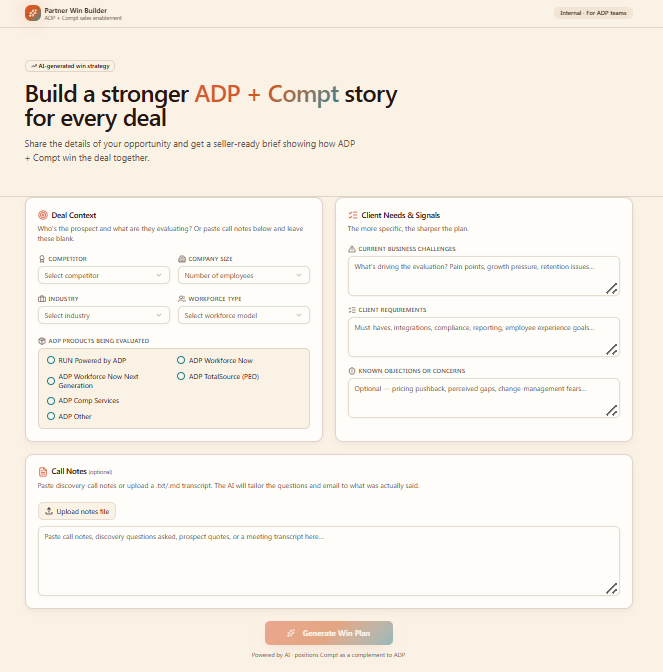
Jenna built it with ChatGPT and Claude in an afternoon to solve a problem she encounters every week. About six minutes into a two-hour call, our VP of Product Joe declared, “Jenna wins for actual practical use.”
The rest of us had not presented yet.
But he was right: I ultimately voted for Jenna’s project. I spent half a decade in enablement before joining Compt, and I immediately saw the value. Jenna started with a process she knew well: the questions prospects ask, the information salespeople need, and the annoying little tasks that slow down a follow-up.
She already had the expertise. AI did not give her that. Instead, vibe coding helped her turn her expertise into a tool to help the rest of us.
A vibe-coded Clippy revival won the Compt AI hackathon.
The most practical AI tool got my vote, but a vibe-coded Clippy revival won the popular vote, because of course it did.
Lilian built a tiny companion that lives inside the Compt platform, follows your cursor with its eyes, and comments on the page you’re viewing. Hover over your LSA or stipend history and it will tell you how much you’ve received in lifetime reimbursements. Leave it alone too long and it starts playing Snake, complete with a tiny victory spin every time it eats a star.
Then she showed us the themes.
In medieval mode, the entire platform changes register. “Hark, thy stipends are beautiful,” it told us, before reporting that “nigh nineteen thousand gold pieces have flowed forth to thy loyal subjects.”
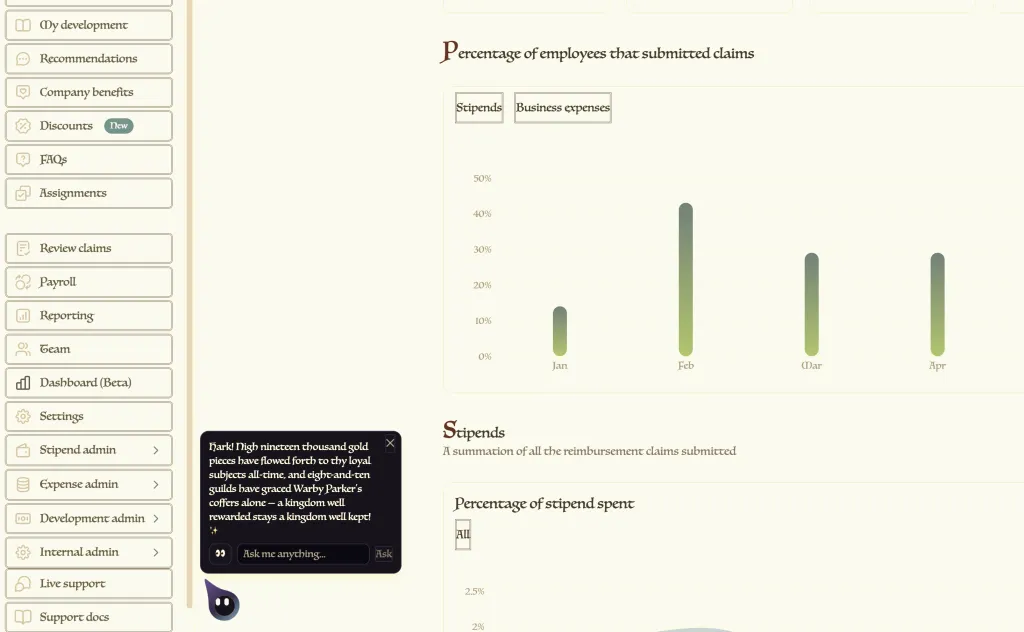
There was a Matrix theme. A noir theme. A GeoCities theme for the portion of the workforce that remembers teaching themselves basic HTML by stealing source code from other people’s websites (hi, it’s me). A Windows 95 theme that turned the companion back into literal Clippy.
Never satisfied, the room demanded pirate mode.
And before the call ended … Lilian added pirate mode.
Lilian’s project may not have solved the biggest operational sticking point presented that day, but it reminded us that people also want software to be fun. Companies are rightfully obsessed with creating delightful product experiences. Lilian made delight visible, clickable, and dressed like a pirate within hours.
And she won an extra PTO day for it.
The companywide AI hackathon became an AI upskilling program.
The projects kept coming.
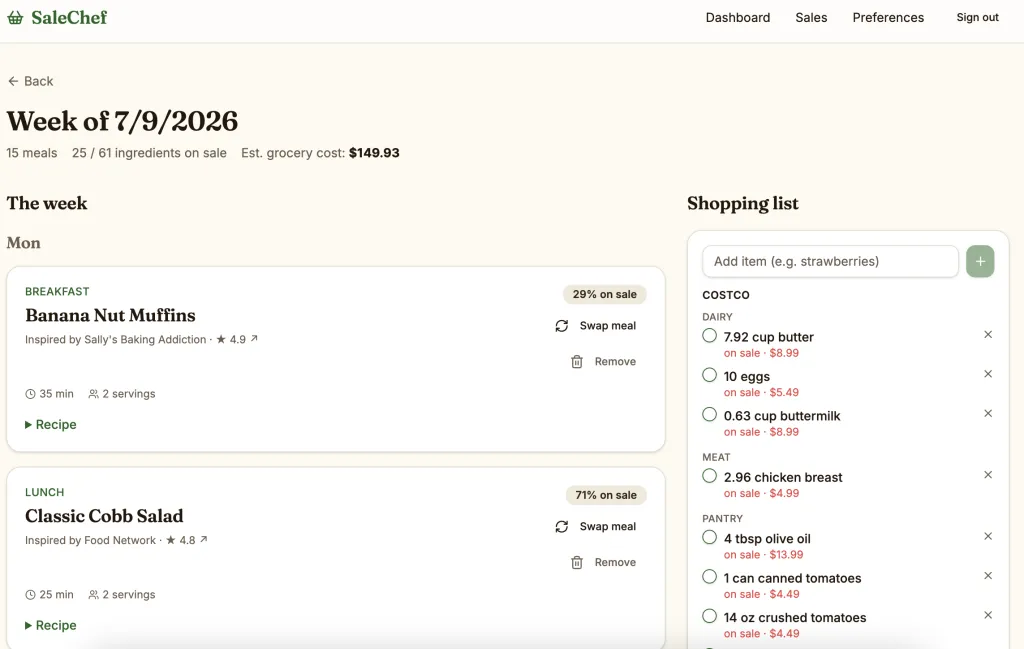
Customer Success Manager Amber generated the most enthusiastic audience response of the day for a non-product-focused project with her app that takes your grocery list and that week’s store sales, then creates a meal plan around what is actually discounted.
Half the team asked for the link. Muni proposed connecting it to Instacart so it could round ingredient quantities and link directly to the correct item and coupon. Our CEO Amy told Amber to monetize it immediately. My own husband visits roughly 74 grocery stores a week looking for the best prices (only a slight exaggeration), so I also had a clear target user in mind.
My marketing teammate Lauren built a dashboard that pulls GA4, HubSpot, and AI-visibility data into one view of what is converting by channel and page across seven-, 30-, and 90-day periods. It also tells you what to do next.
“No one ever has to think anymore,” Joe said while watching the recommendations load. “We did it.”
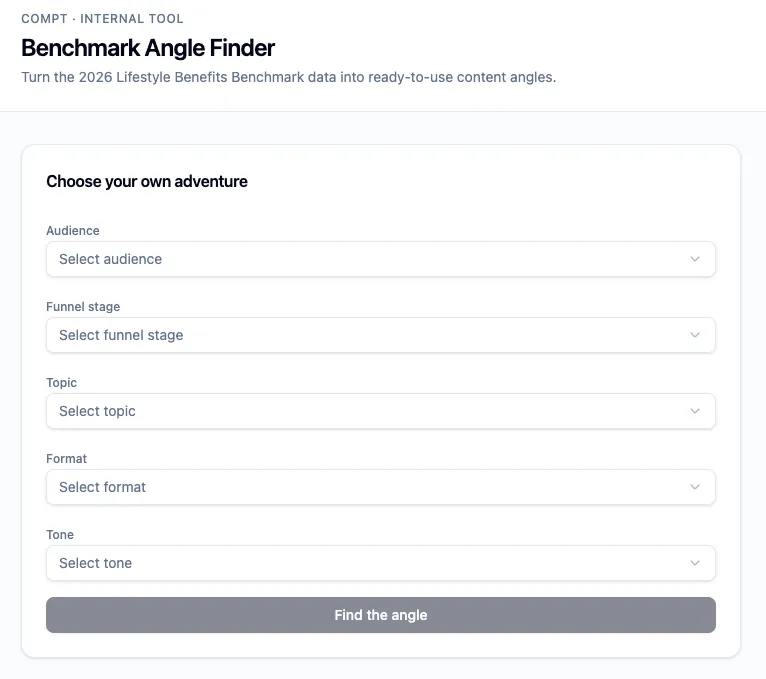
My own project, an internal tool vibe coded between Claude and Lovable, mined our benchmark data and customer stories to surface content angles for different audiences and use cases. It included a reminder not to overclaim product capabilities, which felt prudent for both the tool and my continued employment.
Mary built three projects in a single afternoon and presented them through an AI-generated voiceover while her slides played. One project automatically blocked duplicate browser tabs. Another reversed the traditional allowance model: kids start the week holding their money and keep it by completing their chores. Her third project assessed people across five tiers of AI fluency and produced a role-specific learning path, complete with calendar scheduling.
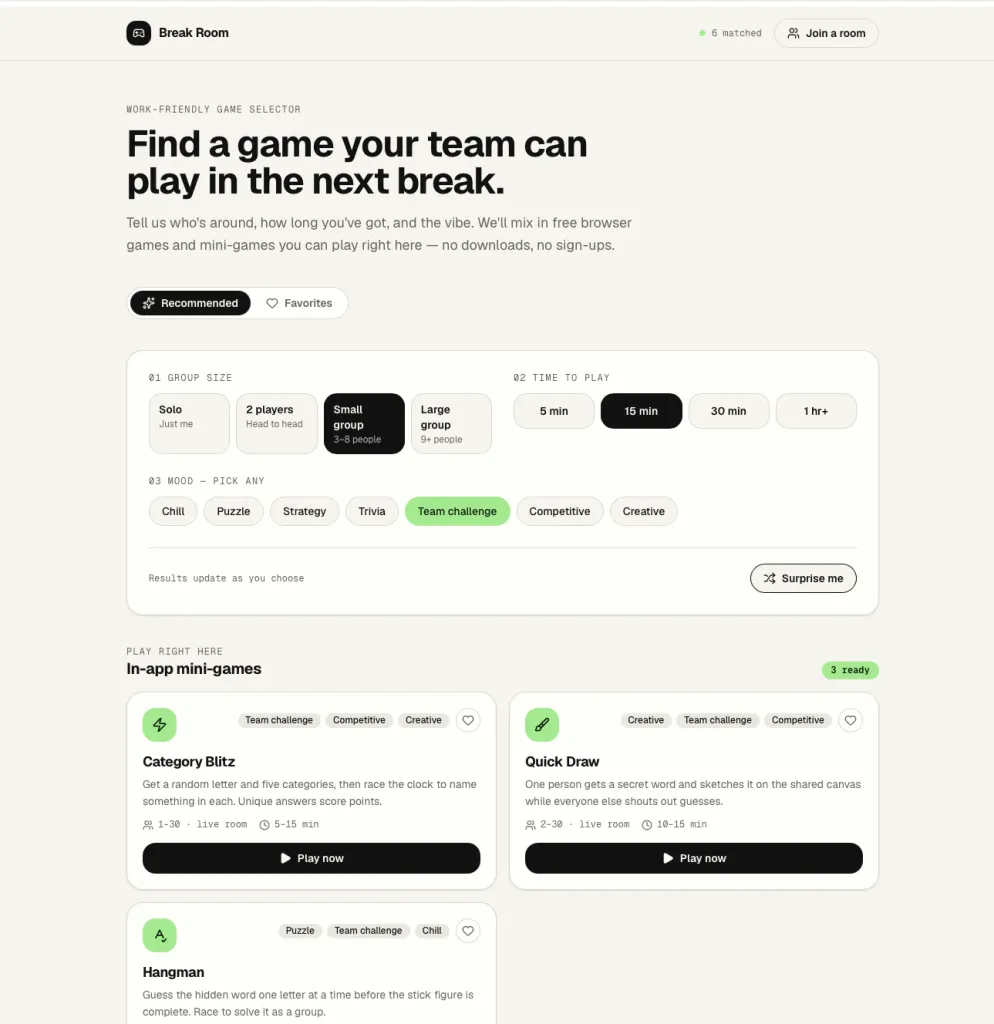
Elsewhere in the room, my colleagues built a workout recommender that adjusts to your energy level and the weather; an app called Ridecast, which plans motorcycle routes around rain and construction (and flags good restaurants on your journey); games for our Friday team chats; an app to help students write kind notes to each other; and a date scheduler for single parents that pulls in work and kid calendars before offering options.
One engineer vibe-coded a solution to a real platform request, then made it clear that he wanted to review the generated code himself before anything shipped.
Nobody fully understood what Fran built. Everyone wanted to.
This hackathon may not have been formally designed as an AI upskilling program, but it met several core facets of one. People had to choose which AI tools fit their ideas, explain what they wanted, troubleshoot broken outputs (sometimes live on Zoom while presenting), revise their prompts, evaluate what the models produced, and decide when the technology had reached the limits of what they could trust.
It was a much more revealing measure of employee AI adoption than whether someone had logged into a tool or completed a generic course. We could see people’s AI literacy growing as they experimented and tweaked and talked about their projects with each other.
Vibe coding collapsed the product feedback loop.
Mary summed up the day best:
“The real hack isn’t any one of these builds. It’s what a single afternoon can produce now.”
The speed of the initial builds was impressive. But one of my biggest notes as a participant and observer is that vibe coding with AI didn’t only make the building faster — it also enabled us to pull feedback into the same conversation.
Mary’s Duplicate Tab Killer initially blocked every duplicate. We pointed out that, occasionally, you actually DO need two versions of the same tab open. Ten minutes later, the tool had a manual override.
Amber presented a grocery app. The room started proposing integrations and product features.
We requested pirate mode. Lilian added pirate mode.
In a traditional product process, someone identifies a problem, documents it, explains it, waits for it to be prioritized, and eventually sees the first version. During the hackathon, the idea, prototype, feedback, and next iteration frequently happened inside the same Zoom call.
Vibe-coded AI prototypes still need human judgment.
The meeting also gave us a useful reminder: a vibe-coded tool can be impressive and also nowhere near ready to ship.
Megan built a global benefits tax checker. You can search by country and benefit type, then receive plain-English guidance on whether the benefit is taxable, what the employer and employee need to report, and which verified IRS sources support the answer. It also included a currency converter for calculating parity across countries.
The room immediately saw the potential.
Customer-facing teams wanted to send it to clients. I wanted it so I could stop pinging Megan with every tax question that comes up while drafting content. Amy’s response was simple: “I want this.”
A rough interface, however, is very different from a reliable global tax product. Before we develop it and take it live, the information will need expert review. The sources will need to be authoritative and current, and the system will need ongoing maintenance as regulations change. A convincing AI answer is not automatically a correct one, especially when taxes, compliance, and paychecks are involved.
Need answers today? See our full guide to global tax compliance for LSAs.
The same applies to the code generated during the hackathon. AI helped an engineer, Stephen, reach a possible solution to a product request faster, but he still wants to fully understand and review that solution before putting it into our platform.
Vibe coding made it possible to demonstrate what a tool could do, and how quickly it could do it. But human judgment still determines what we put resources into and make real.
The AI skills gap is easier to see when people start building.
A few of the projects connected directly to work already happening at Compt.
Muni showed us an AI-upskilling platform in active development. It assesses where someone sits across five levels of AI fluency, customizes the assessment by role, and produces a score with a personalized learning path.
We’re continuing to develop this because HR leaders are trying to understand the AI skills already inside their organizations, where the gaps are, and how employees can continue to grow.
That need is already showing up in how companies fund learning. According to data that will be featured in Compt’s upcoming 2026 Midyear Lifestyle Benefits Benchmark Report, professional development adoption increased 26% since January 2026, the largest increase among the major stipend categories we studied. Median professional development stipend funding across our data set also doubled.
And employees are using that flexibility to build AI skills. Nearly one-fifth of traditional professional development stipend spend on our platform in the first half of 2026 was AI-related, including expenses for Claude Code, agent-builder courses, MCP, prompt engineering, and other emerging agentic-coding skills.
Flexible professional development is becoming part of companies’ AI upskilling infrastructure.
Assigning the same introductory course to the entire company assumes a senior engineer, a salesperson, and a VP of finance need to learn the same things in the same way. Our hackathon made those differences visible.
Some people were already combining multiple tools and building complex workflows. Others were experimenting with vibe coding for the first time. Some knew exactly when an output required expert verification. Others learned by watching their colleagues question, test, and improve what the AI had produced.
AI literacy is not a single skill someone either has or doesn’t. It includes knowing how to frame a problem, choose the right tool, evaluate an answer, incorporate feedback, and recognize when AI has reached the edge of its competence.
Those abilities are difficult to measure through course completion alone. They become much, much easier to see when people actually take a few hours out of their workday to try it.
AI gave more people a way into the building process.
When I covered Microsoft’s hackathon eight years ago, my role was to observe, ask questions, and write about how user researchers were innovating.
At Compt, I still did plenty of observing and note-taking. Obviously. But I also made something.
So did Jenna. And Amber. And Tim. And Lauren. And Mary. And Megan. And more colleagues across customer success, sales, marketing, finance, product, and engineering.
AI did not make all of us software engineers. It did not eliminate the need for design, security, technical review, subject-matter expertise, or an actual product strategy. But it gave all of us a practical way to learn and actually participate before an idea reached those experts.
The people closest to a problem can now do more than submit a request and wait. They can test an idea, make their assumptions visible, and give the people responsible for making it real something concrete to react to.
Not every vibe-coded prototype will become a product. Most probably shouldn’t. But more people can now build enough to discover whether an idea is useful, possible, or worth pursuing — and that’s a pretty significant change in who gets to participate in shaping what companies build next.
See how companies are funding AI upskilling and professional development.
Register to receive Compt’s 2026 Midyear Lifestyle Benefits Benchmark Report when it launches in September to explore how companies are funding professional development and AI upskilling with flexible stipends and Lifestyle Spending Accounts (LSAs).
Ready to get started? Request a Compt demo.
FAQs: AI upskilling and stipends
Compt’s flexible professional development stipends let employees choose AI learning opportunities that match their roles, existing skills, and day-to-day work instead of assigning the same course to everyone. Employers can provide clear eligible-expense guidelines while allowing employees to select relevant tools, courses, certifications, events, and hands-on learning resources.
The stipend should be paired with role-specific guidance and opportunities to apply what employees learn through hackathons, workflow experiments, or small internal projects. The goal is to help employees learn how to frame problems, choose appropriate tools, evaluate outputs, incorporate feedback, and recognize when AI has reached the limits of what they can safely trust.
How should companies structure an AI upskilling program funded through flexible stipends?
Compt helps companies fund AI upskilling while giving employees controlled flexibility over how they learn. A strong program combines an employer-defined professional development budget with clear spending guidelines, role-specific learning goals, and practical opportunities to use new skills.
Start by assessing employees’ current AI fluency and identifying the capabilities each role actually needs. Then clarify which tools, subscriptions, courses, certifications, and events qualify for reimbursement. Employees should have enough choice to build relevant skills without having to guess what the company will approve. For global programs, employers should also confirm the tax and reporting requirements in each applicable country and consult their own tax, legal, and accounting advisors when necessary.
How can HR track employee AI adoption and skill growth outside a traditional LMS?
Compt can help HR track participation in professional development programs and understand how employees are using their learning funds. That spending data should be combined with evidence of what employees can do, rather than treating course completion or tool logins as proof of AI literacy.
Useful indicators include whether employees can select an appropriate tool, build a functional workflow, troubleshoot an output, revise their approach after feedback, and explain when human or subject-matter expert review is required. HR can gather that evidence through role-specific assessments, hackathons, applied projects, manager feedback, and employee demonstrations. Measuring these abilities over time provides a clearer picture of adoption and skill growth than LMS completion rates alone.
How can companies measure the impact of an AI upskilling program?
Compt gives HR and Finance visibility into the program’s funding, participation, utilization, and employee spending patterns. Companies can then connect that information to three additional layers of measurement: demonstrated skill growth, application on the job, and business results.
Relevant measures might include pre- and post-program assessments, the number of useful workflows or projects created, time saved, faster completion of repetitive tasks, reduced rework, and manager-reported improvements. Course completion and total spending can show activity, but they do not establish ROI on their own. Compt’s first-half 2026 data found that professional development adoption increased 26% and nearly one-fifth of traditional professional development spending was AI-related, demonstrating growing demand; each employer still needs to measure what employees accomplish with that investment.
Editor’s note: Compt software supports the categorization and proper reporting of benefits according to IRS guidelines, helping businesses maintain compliance. However, Compt cannot provide tax advice, and users should consult their own tax, legal, and accounting advisors when necessary.

 No receipt chasing