A dedicated debit card has become a familiar selling point for employee stipend platforms.
Set a spending limit, hand them a card, and let them buy what they need. Employees don’t have to wait for reimbursement. And, in theory, HR doesn’t have to review receipts.
As a leader who spent 20 years as a CFO and COO, I fully see the appeal.
Yet, while more benefit platforms are pushing dedicated debit cards as an easy solution for lifestyle perks, they pass a significant burden onto HR and lock up valuable cash flow.
For example, what happens when an eligible purchase is declined?
When an ineligible purchase goes through?
When an admin still needs to collect a receipt, interpret the policy, or explain the outcome to an employee?
That work still lands with HR. And even worse, it’s sometimes uncovered after the company’s money has already been spent.
Among the options available today, I consider reimbursement the gold standard. And if you care about maximum employee choice, policy control, and keeping company funds in the business until they’re needed, then you will too.
This isn’t some niche approach, either. For all the attention benefits cards get, reimbursement has long been the workhorse of LSAs. Even HSA Bank’s chief revenue officer, whose company itself offers benefits cards, told HR Brew that receipt reimbursement was more common than debit cards.
Just look at the platforms promoting benefits cards today: most of them offer reimbursement, too. The card may be the selling point, but it’s far from the whole solution.
That’s why we built Compt around reimbursement, and being the very best at it, rather than treating it as an alternative to a card.
And now Compt AI is making that approach even easier to administer. It can read receipts, check expenses against your written policy, and identify claims that need a closer look, reducing much of the manual work that historically came with reimbursement.
Which brings me back to the promise of benefits cards: how much work do they actually remove, and how much do they leave for your team?
Benefits cards can’t always tell what’s eligible.
Let’s say your company offers a wellness stipend, and an employee wants to buy a yoga mat at Target.
Yoga mats fit within your policy, the employee has enough money in their account, and you’ve already committed the budget.
But the transaction is still declined at the register when they go to use their benefits debit card.
Why?
Many benefits cards use merchant category codes (MCCs) to determine where employees can spend. Target is categorized as a general merchandise retailer, so a card restricted to specific wellness-related merchants may block the transaction. Even if the card recognizes the merchant, it doesn’t necessarily know what the employee is buying.
On a recent call with our team, one administrator whose company uses a card-first platform described a frustration we’ve heard from others, too: “I’ve tried to use it six times at the point of sale. It’s been rejected every time.”
They ended up paying out of pocket and submitting the claims for reimbursement afterward anyway.
The reverse can happen, too.
Say you configure your benefits card to allow purchases at Target so employees can buy eligible wellness items. Now an employee could use that same card to buy a lamp for their living room, even though home decor isn’t explicitly covered by your wellness policy.
The card recognizes an approved merchant, but it still doesn’t necessarily know what’s in your employee’s shopping cart. That’s why some card programs still require receipts and audits after the transactions occur. (So much for eliminating that paperwork.)
We hear about these frustrations every week on calls with benefits administrators, and they show up in online reviews too. One reviewer described finding that “some purchases were approved outside of the intended eligible categories” during monthly audits. They said they wished they had more granular controls so those audits wouldn’t be necessary.
So now HR is dealing with declined purchases that should have been allowed and purchases that went through when they shouldn’t have.
And in the latter case, they’re resolving the problem after the company’s money has already been spent.
The administrative back-and-forth isn’t hypothetical, either.
Our team recently spoke with an employer that had been using a popular card-based vendor for years. Employees liked their benefits, but when the vendor rejected claims, the administrator regularly had to step in, question the decisions, and work to get them resolved.
Think about that.
You’re paying a platform to make benefits easier to administer, yet HR is spending time resolving problems created by the platform itself.
That company is now evaluating reimbursement-based alternatives.
Prefunding ties up cash before employees even spend it.
That same company raised another issue: their current vendor requires them to prefund multiple benefits wallets, moving company money into vendor-managed accounts before employees even spend it.
What might look like a routine vendor requirement to HR is truly a much bigger cash-management decision for Finance. After years of managing company budgets, I respect that concern.
Imagine offering a $1,000 annual Lifestyle Spending Account (LSA) to 500 employees. That’s $500,000 in potential benefits spending. But there’s a huge difference between committing that budget and actually paying out a cool $500k.
Some employees will use every dollar. Others won’t.
And CFOs have to think about more than the timing of those payments. I know I did. When a company moves money into a vendor-managed account, they’re giving up control over when and how they can access it. Depending on the arrangement, that cash could be sitting with a third party when I’d rather have it available for other business priorities.
As CFOs plan for 2027, cost efficiency and capital allocation are among their top priorities. I don’t see any value in moving money out of the business earlier than necessary just so employees can carry around yet another card.
The tax consequences of benefits cards can show up months after the purchase.
There’s one more complication with benefits debit cards that your employees may not anticipate: how taxation works. Just because they completed their purchase doesn’t mean the tax implications have been settled.
Imagine an employee uses their benefits debit card for a gym membership in July. The purchase goes through without a problem, but the employer processes taxable card spending for payroll quarterly, after each quarter ends. So the associated taxes aren’t withheld from the employee’s paycheck until October.
That paycheck comes and the employee’s take-home pay is lower than they expect because they’re paying taxes on a benefit they used months ago.
What an unpleasant surprise when you’re budgeting for rent, a mortgage, childcare, or groceries!
The card itself isn’t what makes that purchase taxable. In the U.S., most lifestyle benefits are taxable unless a specific IRS exclusion applies. A gym membership, for example, is generally taxable, while certain work-related expenses may qualify for tax-free treatment. The payment method doesn’t change those rules.
And on your side of things, HR and Finance still need to make sure purchases are classified correctly, the appropriate amounts reach payroll, and employee questions get answered when paychecks don’t match what people expect.
Not every card-based platform handles tax reporting the same way, of course. But giving your people a debit card does not eliminate the work of classifying benefits and accounting for their taxation through payroll.
I’d want to understand exactly how that process works before committing to a card-first LSA or stipend model.
So, what’s the better way to administer stipends and LSAs?
We made reimbursement the foundation of Compt in part because I don’t believe employers should micromanage where their people shop.
One employee might cherish their membership at a large national gym, while the person at the desk next to them prefers the neighborhood yoga studio where their niece teaches. The worker across the aisle might want to use that same benefit for at-home fitness equipment.
As long as the purchase ultimately fits your stipend policy, why should the vendor matter?
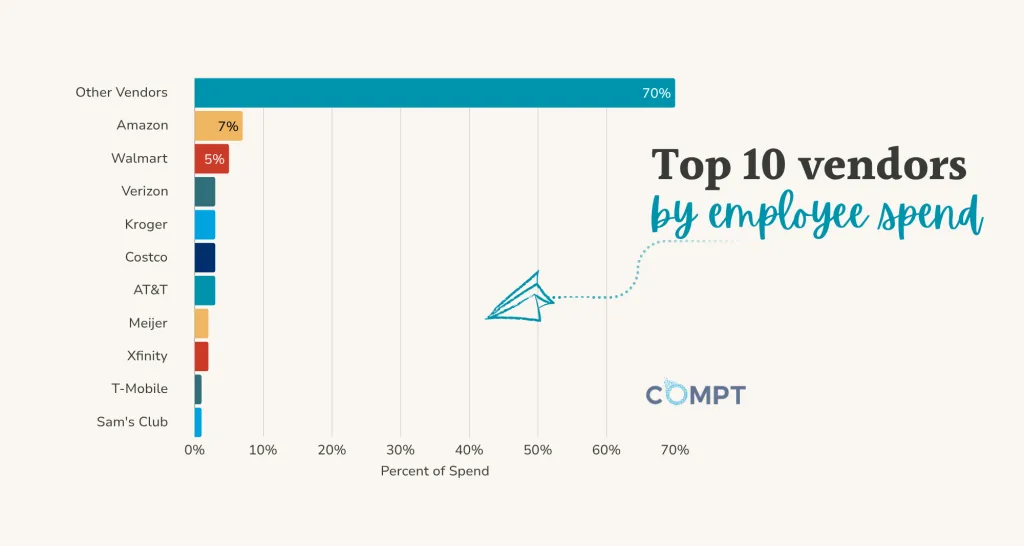
And our data shows just how much variety that freedom creates. In our 2026 Annual Lifestyle Benefits Benchmark Report, we found that employees of Compt customers spent their benefits across more than 64,000 unique vendors in 2025, with 70% of spending going to local, regional, niche, and independent businesses.
Compt combines that freedom with policy controls and automation to make the process easier for everyone. Here’s how it addresses the problems with card-first benefits programs:
- Your policy determines what’s eligible. Employees use their preferred payment methods without running into benefits-card merchant restrictions. Compt checks claims against your policy before reimbursement, so HR isn’t stuck trying to recover money after an ineligible card purchase. And you can tailor eligibility and funding by location, department, tenure, or employee type without managing separate programs manually.
- Tax treatment is built into the reimbursement process. Employees submit claims under benefit categories designated as taxable or nontaxable. That information is reviewed before approved expenses ever reach payroll, where applicable taxes are handled alongside reimbursement rather than potentially being reconciled months later.
- Your cash stays in your business until it’s needed. Compt doesn’t require prefunding. You pay approved reimbursements through payroll, and unused benefits dollars stay with your company instead of sitting in a vendor-managed wallet or account.
- Rejected claims are super rare. In the first half of 2026, 99.04% of expenses submitted through Compt were accepted on the first try, sparing lifestyle benefits administrators the extra work of handling an initial rejection or resubmission request.
- Employees actually use their benefits. In full-year 2025 data, Compt’s all-inclusive LSAs achieved 93% employee participation and 89% utilization of available funding. Employers aren’t just allocating benefits dollars — their people are using them.
- You can offer more Total Rewards programs with fewer vendors. Compt’s Lifestyle Benefits offering includes unlimited stipend and LSA programs, rewards and recognition, employee discounts, and company swag. That means you can bring recurring stipends, birthdays, anniversaries, spot bonuses, and recognition together without managing a separate vendor for every program.
“I love the ease of use and the freedom to use my comp money for things that matter most to me, whether that’s signing up for a race or donating to my favorite charity.”
— Compt G2 reviewer in enterprise computer software, 5/5 stars
Employees do have to pay upfront and wait for reimbursement, a tradeoff hundreds of Compt customers have decided is worth making for the flexibility, control, and reduced administrative burden.
And while card-based programs leave HR resolving declined transactions and auditing purchases that shouldn’t have gone through, reimbursement has historically required its own administrative work. We know that well.
That’s why we launched Compt AI.
Compt AI takes on more of that work to make administering reimbursements even more effortless.
Our AI-assisted features now handle several steps:
- Claim Autofill reads a receipt and populates the submission details, which reduces how long it takes for your employees to submit their reimbursement requests.
- Policy Checker alerts employees to potential eligibility issues before they submit.
- Claim Reviewer examines expenses against your written stipend policy then recommends approval, rejection, or further review, along with an explanation.
You still define the rules. HR can review the AI’s recommendations, adjust the policy when it isn’t working as intended, and decide whether to enable automatic approval for high-confidence claims. Rejections always go to a human.
That part is important. I don’t want AI making up benefits policies out of nothing or independently deciding how an employer should spend its money.
I want AI doing the repetitive work that consumes real people’s time and energy.
That’s how I’d judge any stipend platform today, regardless of how it’s administered: by how much work it actually takes off HR’s plate.
Is it time to reconsider what makes a benefits platform better?
I don’t expect benefits cards to disappear, and I wouldn’t argue they’re the wrong solution for every employer. Immediate access to funds can be valuable, especially for employees who can’t afford to wait for reimbursement.
That said, I do think employers should reconsider the tradeoffs they’ve been willing to accept.
How much purchasing flexibility are your people giving up? How much control does Finance have over funds sitting in a vendor-managed account? And how much work is HR actually saving once you account for declined transactions, rejected claims, receipt verification, replacement cards, post-purchase audits, and employee questions?
For years, the conventional wisdom was that cards offered convenience while reimbursement offered flexibility and financial control. Employers had to decide which advantages mattered most to them.
Compt AI is already changing that calculation. We’ve built policy controls, expense verification, and tax classification into the reimbursement process, reducing the work that previously came with offering employees more flexibility.
But I think there’s an even bigger opportunity when you consider what payroll technology could become.
Imagine combining that kind of expense intelligence with the infrastructure companies already use to pay their employees. People could receive funds almost instantly, with the appropriate tax treatment handled at the same time. HR wouldn’t need to chase down documentation that technology could verify, and employees wouldn’t have to worry about unexpected payroll deductions months after making a purchase.
The individual pieces of that system are already taking shape. The opportunity is to bring them together. Ultimately, the goal here is to make the entire process easier, for both employers and employees, from the purchase to the paycheck.
I’ve spent enough of my career in Finance to know that when the economics of a decision change, it’s worth reconsidering the decision itself. And I think the next big improvement in lifestyle benefits is making the systems behind them work better together, not just giving employees another card to carry.

 No receipt chasing