
A Lifestyle Spending Account (LSA) is an employer-funded benefit that reimburses employees for approved lifestyle expenses. The employer decides which expenses qualify, how much funding employees receive, who is eligible, and how the program is administered.
Most LSA reimbursements are taxable unless the expense qualifies for a specific tax exclusion. The IRS generally treats employer-provided fringe benefits as taxable income unless federal law specifically excludes them.
In the first half of 2026, according to our Midyear Lifestyle Benefits Benchmark Report, 65% of Compt customers offered an all-inclusive LSA, making it the most common lifestyle benefits structure in our dataset.
Below, we define what an LSA is, how reimbursement-based programs work, and what 2026 benchmark data shows about how employers are designing lifestyle benefits.
What is a Lifestyle Spending Account?
A Lifestyle Spending Account (LSA) is a flexible benefit that an employer designs around its workforce. Unlike an HSA or FSA (which Compt does not offer), an LSA does not have a federally defined set of eligible expenses. The employer determines what their program covers, and it can include categories such as wellness, food, family support, professional development (including AI upskilling), technology, and other lifestyle expenses.
That flexibility does not make every reimbursement tax-free. As mentioned above, per the IRS, employer-provided fringe benefits are taxable unless the law specifically excludes them. Depending on the expense and how the program is structured, some reimbursements may qualify for an exclusion while others are treated as taxable income.
A wellness stipend is a type of employee stipend, and it can also be one category within an all-inclusive LSA. “Stipend” describes the employer-provided funding, while an LSA generally describes a benefits structure that can combine multiple categories under one program.
Comparison table: What’s the difference between an LSA, an employee stipend, and a wellness stipend?
| Lifestyle Spending Account (LSA) | Employee stipend | Wellness stipend | |
|---|---|---|---|
| What it is | A benefits structure that can combine multiple lifestyle expense categories | Employer-provided funding for a defined purpose or set of expenses | A stipend specifically for employee health and wellness expenses |
| Typical scope | Broad; may include wellness, food, family, professional development, technology, and more | Narrow or broad depending on employer policy | Wellness-focused |
| Who sets eligible expenses? | Employer | Employer | Employer |
| Tax treatment | Generally taxable unless the expense qualifies for a specific tax exclusion | Generally taxable unless the expense qualifies for a specific tax exclusion | Generally taxable unless the expense qualifies for a specific tax exclusion |
| Can it contain multiple categories? | Yes | Yes, although many stipends are designed for a specific purpose | Usually focused on wellness; a Compt wellness stipend may include weight management expenses |
| Example | $1,200* annual account covering wellness, family, food, and professional development | $100/month cell phone stipend | $600/year fitness and wellness stipend |
*Based on the H1 2026 median annual funding for all-inclusive LSAs in the 2026 Midyear Lifestyle Benefits Benchmark Report.
What does a Lifestyle Spending Account look like in practice?
An LSA can combine several employer-defined benefits under one program. For example, an employer might give employees one annual budget to spend across wellness, food, family support, professional development, technology, or other approved categories. Employees choose how to use their available funds within the company’s policy rather than receiving the same predefined perk or vendor benefit as everyone else.
That flexibility can cover needs an employer might never create a standalone benefit for. In our 2026 midyear report, Treat Yourself, Compt’s most flexible LSA category, became the No. 1 LSA category in our dataset. Employees used it for expenses including car repairs, clothing, home improvements, travel, entertainment, gifts, hobbies, celebrations, and family-related purchases.
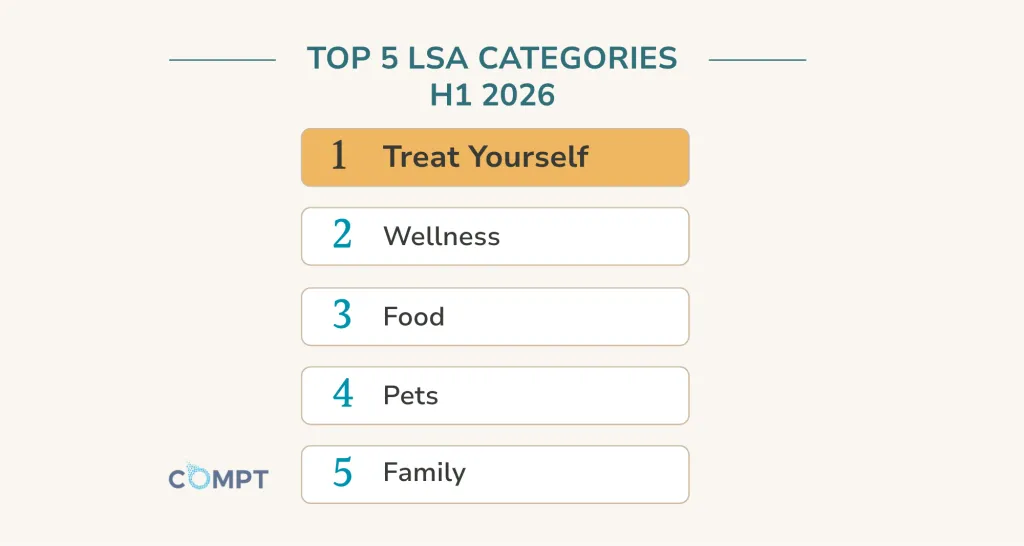
The most common all-inclusive LSA categories on Compt in H1 2026 were:
- Treat Yourself
- Wellness
- Food
- Pets
- Family
- Personal development
- Financial wellness
- Technology
- Charitable giving
- Productivity
Those categories are not a fixed menu. When you launch your LSA with Compt, you can define your own eligible expenses and combine categories with either broad or targeted support based on your workforce’s overall needs and preferences.
How many categories can an LSA include?
There is no standard number of categories an LSA has to include. At Compt, we generally consider a program with five or more categories an LSA rather than a single-purpose stipend, but that’s a guideline, not a rule.
In Compt’s 2026 midyear data, monthly programs tended to include about 11 eligible categories, while annual and semiannual programs commonly included 15 to 20+. Quarterly programs showed the widest mix of benefit designs. With Compt, employers can add or change categories as workforce priorities evolve without introducing a separate benefit program or vendor for each.
How does an LSA work?
A Lifestyle Spending Account typically starts with an employer defining the program: who is eligible, how much funding employees receive, which expenses qualify, and when funds become available. Employees then use their own money for eligible purchases and submit expenses for reimbursement according to your policy.
To help with that initial step before launch, Compt’s Stipend Policy Builder can help employers create the written policy that defines eligible expenses, limits, and edge cases. It is a standalone tool rather than an in-platform feature.
Once your Compt program launches, the reimbursement process works like this:
- Employees make eligible purchases. Because Compt uses a reimbursement model, your employees can buy from the stores and vendors that work for them rather than being stuck within a predefined marketplace.
- Employees submit a receipt. Compt’s AI-assisted Claim Autofill reads the receipt and drafts the claim. It can pull details such as the vendor, amount, date, description, and eligible benefit category from the receipt, and the employee can review and edit the information before submitting their claim.
- Compt flags potential issues before submission. Compt’s built-in Policy Checker compares the claim with your established stipend or LSA policy and gives the employee guidance if their claim may not qualify under your policy. However, it does not prevent the employee from submitting the claim.
- AI checks the receipt and your policy. Compt’s AI-assisted Claim Reviewer verifies that the receipt supports the submitted claim, applies your defined policy, and provides a recommendation (accept, reject, or uncertain) with written reasoning and any discrepancies it finds.
- A human reviewer makes the call when judgment is required. Compt never automatically rejects an employee’s claim. Anything uncertain, inconsistent, or recommended for rejection goes to a person for review. However, customers can choose to automate high-confidence approvals.
- Approved reimbursements move to the payroll report for processing and payment. The claim history within Compt retains what the system found, what it recommended, why, and what ultimately happened.
How often should you fund a Lifestyle Spending Account?
There is no single funding cadence that works for every LSA. Employers can choose to make funds available annually, semiannually, quarterly, monthly, or on another schedule based on the types of expenses they cover and how they want employees to use the benefit.
In Compt’s H1 2026 data, annual funding was the most common cadence among employers: 58% of Compt customers used annual funding, compared with 39% using quarterly funding and 36% using monthly funding. (Companies may use more than one cadence across different programs, so these percentages do not add up to 100%.)
But the most common cadence is not necessarily the one associated with the highest utilization. According to Compt’s 2026 Annual Lifestyle Benefits Benchmark Report, which covers full-year 2025 data, quarterly funding produced the strongest utilization rate.
LSA utilization by funding cadence (2025)
- Quarterly: 85% utilization
- Semiannual: 70% utilization
- Annual: 65% utilization
- Monthly: 52% utilization
- Overall average: 67% utilization
The H1 2026 data adds another useful view: although only 39% of Compt customers used quarterly funding, approximately 85% of employees overall and 86% of employees with access to an all-inclusive LSA experienced quarterly funding. Two large quarterly programs heavily influence those employee-reach figures, so they should not be interpreted as the cadence most employers choose.
Together, the two datasets suggest that LSA funding cadence is a program-design decision, not simply a matter of administrative preference. Annual funding remains the most common employer choice, while quarterly funding has produced stronger utilization in Compt’s full-year data.
Participation vs. utilization: how Compt measures benefit performance
Participation measures the percentage of employees who submit at least one eligible expense during a funding period. Utilization measures the percentage of issued stipend dollars that are actually spent within that same period.
High participation shows that a benefit is relevant and accessible. High utilization shows that funding levels, cadence, and categories are well aligned with real employee needs.
In full-year 2025 data, Compt LSAs achieved 93% participation and 89% utilization. That means 93% of eligible employees used the benefit at least once, while employees collectively used 89% of the LSA funding made available to them.
What are typical stipend funding ranges by category?
Stipend funding varies widely by category, company size, and program goals. To give a realistic picture of how employers are budgeting, it’s more useful to look at medians alongside minimums and maximums rather than extremes alone. These figures are observed benchmarks, not recommended funding targets.
Below are the minimum, median, and maximum annual funding levels per employee observed across Compt programs in H1 2026, based on data from our 2026 Midyear Lifestyle Benefits Benchmark Report.
Why medians matter:
Medians provide the most useful planning benchmark because they reflect typical program design without giving disproportionate weight to unusually large or specialized benefits. Minimums and maximums show the wider range of approaches in the dataset.
Stipend funding ranges by category (annual, per employee, H1 2026)
| Stipend category | Minimum | Median | Maximum | Median vs. 2025 |
|---|---|---|---|---|
| All-inclusive LSA | $10 | $1,200 | $45,000 | Unchanged |
| Cell and Internet | $240 | $870 | $1,800 | Down from $1,080 |
| Charitable Giving | $100 | $300 | $2,500 | Unchanged |
| Commuter | $600 | $1,860 | $4,080 | Down from $2,400 |
| Company Swag | $100 | $600 | $900 | No prior benchmark |
| Coworking | $1,200 | $1,800 | $3,360 | Unchanged |
| Culture | $200 | $450 | $7,000 | Up from $28 |
| Experiences and Entertainment | $180 | $190 | $200 | Up from $180 |
| Family and Caregiving | $1,200 | $2,000 | $12,000 | Down from $2,500 |
| Family Planning | $2,500 | $10,000 | $75,000 | No prior benchmark |
| Food | $300 | $390 | $480 | Down from $480 |
| Office Equipment | $100 | $800 | $3,600 | Up from $250 |
| Out-of-State Care | $1,000 | $4,000 | $5,000 | Up from $3,500 |
| Pets | $600 | $600 | $600 | Up from $150 |
| Professional Development | $250 | $1,600 | $10,000 | Up from $800 |
| Sabbatical | $1,000 | $1,000 | $1,000 | Down from $4,750 |
| Safety Equipment and Uniforms | $100 | $200 | $250 | Up from $150 |
| Team Recognition | $100 | $200 | $240 | Down from $220 |
| Wellness | $50 | $600 | $36,000 | Down from $735 |
| Work Support | $600 | $1,920 | $2,520 | No prior benchmark |
There is no single “right” stipend amount. Funding ranges reflect differences in workforce needs, program design, industry, and employer priorities. Medians are useful planning benchmarks, but individual programs may sit well above or below them depending on what the benefit is designed to cover. For example, in the table above, Culture and Family Planning have unusual maximums that relate to specific programs and shouldn’t be interpreted as market norms.
The largest change among major categories was professional development: median funding doubled from $800 in 2025 to $1,600 in H1 2026, while the share of Compt customers offering a professional development stipend increased from 20% to 25%.
What categories do employers include in LSAs?
Lifestyle Spending Accounts are intentionally flexible, which means no two programs look exactly alike. Some employers focus on a few targeted stipends, while others consolidate multiple categories into a single all-inclusive LSA.
Looking at what employers actually offer provides a more useful benchmark than a list of everything an LSA could theoretically cover.
Most common stipend and LSA offerings in H1 2026
According to Compt’s 2026 Midyear Lifestyle Benefits Benchmark Report, these were the five most common offerings among Compt customers in the first half of 2026:
| Category | Percent of Compt customers offering | Change from 2025 |
|---|---|---|
| All-inclusive LSA | 65% | +1 pp |
| Wellness | 42% | +5 pp |
| Office equipment | 27% | +2 pp |
| Professional development | 25% | +5 pp |
| Cell and internet | 18% | +3 pp |
The chart below shows how employer adoption changed across 20 comparable stipend categories from 2025 to H1 2026.

What changed in 2026?
Category adoption increased across 13 of the 20 comparable stipend categories in H1 2026. Professional development had one of the largest increases, rising from 20% to 25% of Compt customers. Wellness also increased five percentage points, while cell and internet, food, commuter, and several other categories were offered by more employers than in 2025.
All-inclusive LSA adoption remained comparatively stable at 65%, up slightly from 64% in 2025. Employers are increasingly using that existing infrastructure to add or change categories as priorities evolve instead of introducing a separate program or vendor for each one.
Are employers adding newer categories to LSAs?
Yes; in particular, weight-management support is beginning to appear within flexible benefits programs. In Compt’s H1 2026 data, employers covering GLP-1 medications and related expenses were largely including them within LSAs or wellness programs rather than creating standalone weight-management stipends. Commonly covered expenses included gym memberships, fitness coaching, nutritionist consultations, wellness apps, and GLP-1 prescriptions where permitted by the employer’s policy.
Because LSA categories are employer-defined, companies can adjust eligible expenses as workforce priorities change without rebuilding the entire program.
Need help crafting the right LSA for your team? Chat with an expert at Compt.
Benefits of a Lifestyle Spending Account (LSA) from Compt
Lifestyle Spending Accounts balance employee choice with clear structure. Instead of scattering budget across one-off perks that are hard to manage and easy to underuse, employers consolidate support into a single program that’s predictable, explainable, and widely used.
LSAs help employers consolidate benefits without sacrificing flexibility.
Traditional perks often grow by addition: a wellness vendor here, a learning stipend there, a marketplace on top. Over time, this creates complexity without improving outcomes.
LSAs reverse that pattern. As shown earlier, all-inclusive LSAs are now the most common lifestyle benefits structure in Compt’s H1 2026 dataset. Employees still choose what matters to them, but HR and Finance manage fewer programs with clearer rules.
LSAs address real gaps left by traditional benefits.
Health insurance remains essential, but it doesn’t cover many of the costs that shape employees’ day-to-day well-being. LSAs are increasingly used to support areas health plans don’t adequately address, such as family and caregiving needs, food and everyday wellness expenses, or emerging categories like GLP-1 medication support.
Because categories are employer-defined, companies can offer intentional support without turning lifestyle benefits into an open-ended expense.
LSAs drive high participation and utilization.
Traditional benefits don’t always translate into actual use. In NFP’s employee benefits trend report, only 28% of employees reported making maximum use of their perks and benefits, with respondents citing a mismatch between benefits offered and what they value.
By comparison, Compt’s 2025 data shows 93% participation and 89% utilization for all-inclusive LSAs. Participation measures whether employees use the benefit at least once, while utilization measures how much of the available funding employees spend.
LSAs reduce administrative overhead for HR.
Managing perks through multiple vendors requires ongoing maintenance: eligibility checks, annual renewals, employee questions, and manual tracking. That work compounds as teams grow or become more distributed.
LSAs simplify this by centralizing lifestyle benefits under one set of policies and workflows. HR teams can manage budgets, rules, reimbursements, and reporting through one program instead of maintaining separate workflows across multiple vendors.
Learn how Jellyvision reduced lifestyle benefits admin time to one day of work per quarter.
Read the case study or this blog from their former CPO.
LSAs reinforce company values in a scalable way.
Because categories are configurable, LSAs give employers a practical way to reflect their priorities. A company that values learning can emphasize professional development. A company focused on well-being can prioritize wellness and caregiving support.
Compt customer ButterflyMX took this approach by surveying employees and launching a global “Self-Care Stipend” across 10 countries. The program reached 96% employee participation.
LSAs align with DEI and inclusion strategies.
LSAs support DEI strategies by shifting from one-size-fits-all perks to structured flexibility. Instead of offering benefits that only resonate with a narrow employee segment, LSAs allow individuals across different life stages, cultures, family structures, and geographic locations to use funds in ways that are personally relevant.
For example, caregiving support may matter most to employees supporting children or aging relatives, while professional development or AI tool stipends may be more relevant to employees focused on skill-building or technical work. By offering equitable access to flexible support rather than rigid, vendor-specific perks, LSAs help employers design benefits programs that are inclusive by structure.
LSAs are a benefit that works for employees and employers.
For employees, LSAs provide choice, relevance, and fairness — benefits that fit real lives instead of forcing behavior through rigid vendors. For employers, they offer controlled spend, high engagement, and a structure that’s easy to explain internally.
That combination is why LSAs have become a core part of modern benefits strategy infrastructure, rather than another perk layered on top.
Disadvantages of Lifestyle Spending Accounts (LSAs)
Lifestyle Spending Accounts aren’t a fit for every organization in every scenario. Understanding the tradeoffs — particularly around tax treatment and administration — helps teams decide whether LSAs make sense and how to design them responsibly.
LSAs often include taxable benefits.
Most LSA reimbursements are taxable unless the expense and program meet the requirements for a specific tax exclusion. General wellness, food, travel and experiences, pet care, and similar lifestyle expenses are typically taxable. Other reimbursements may qualify for an exclusion depending on how the benefit is structured and the applicable IRS requirements.
For example, under a qualifying Section 127 educational assistance program, employers can provide up to $5,250 in combined educational assistance and qualified student loan payments per employee in 2026 without including that amount in the employee’s gross income. Certain employer-provided cell phone benefits may also be excluded when they are provided primarily for noncompensatory business reasons.
According to Compt’s 2026 Annual Lifestyle Benefits Benchmark Report, 78% of total stipend and LSA spend is taxable, a ratio that has remained stable year over year. This reflects how employees actually use LSAs: they prioritize what they need, even when some expenses carry tax implications.
Accurate tax treatment is critical.
Tax handling is where LSAs can create risk if they’re poorly administered. Applying tax treatment incorrectly — or too late — can result in unexpected withholdings for employees, which undermines trust in the benefit. On the employer side, covering taxes through gross-ups without clear visibility can introduce unplanned costs that Finance teams aren’t expecting.
The key is expense-level accuracy. Tax treatment should be determined for each reimbursement based on the specific expense, documentation, program structure, and applicable tax rules, then carried through accurately to payroll reporting.
How Compt mitigates these risks.
Taxability is a real design consideration for LSAs. The administrative risk comes from classifying and reporting reimbursements inconsistently.
Compt is built to handle tax treatment at the individual expense level and carry those classifications through to payroll reporting. Its reimbursement-based model gives HR and Finance a record of the expense, applicable program rules, tax treatment, and reimbursement rather than requiring teams to reconcile that information across separate systems.
Real quotes on how Compt LSAs improve lives
Employees often share with our customers how life-changing their LSA programs have been, helping them feel more supported, balanced, and seen in their everyday lives.
Below are real stories and quotes from Compt users highlighting the powerful impact Lifestyle Spending Accounts can have when people are given the freedom to choose what matters most to them:
- “I exercise regularly, but this gives you extra motivation to go a little more!!”
- “I have never worked for a company that I’ve felt so appreciated.”
- “The benefits take a bit of the edge off of life’s large purchases — like tires to get safely to work!”
- “They are helpful with heating and cooling bills for my family.”
- “I have used it to cover expenses for my puppy.”
- “I like that my employer does this program. With the inflated prices this is a godsend!”
- “We have had so many fun family outings with this benefit :)”
- “The Compt benefits make me feel more free to book a hotel that’s just a little nicer than usual once in a while :)”
- “Able to obtain protein shakes and supplements that contribute to my overall health, wellness, and weight loss/maintenance.”
- “I am able to afford a membership to the YMCA for my family.”
- “We are already living paycheck to paycheck and this helps to buy essentials for our children. Thank you!”
- “With the high cost of getting groceries, it has helped to almost cover one weekly trip.”
- “It’s easy to upload a screen shot of a receipt to access my benefits through Compt.”
- “I love it — It feels like cash that I can spend on something special for me instead of adding to the family budget.”
- “Its been a great perk! This just feels like a gift every 3 months.”
- “They help offset costs for unexpected needs and offer me the opportunity to enjoy life without the financial worry.”
- “YES! I am able to buy a yoga punch pass. Yoga is my anti-depressant :)”
- “It helped me get a standing desk! About to follow up with a walking pad. Hopefully these will help me get healthier!”
- “They help with little extras here and there that I otherwise would not be able to provide my family.”
- “The benefits inspire you to not only take care of yourself and grow, but that you are appreciated.”
5 companies offering LSAs with Compt today
We’re constantly inspired by the incredible HR and People teams using Compt to offer flexible lifestyle benefits and personalized perks to their employees. Honestly, getting to witness the care and creativity these teams pour into supporting their people? That’s one of our favorite perks.
At Compt, we believe people do their best work when they feel supported and can thrive in inclusive environments — and we see that belief come to life every day through our customers.
One thing that stands out: when a company introduces a Lifestyle Spending Account (LSA), they typically see very high utilization across their team. (By “utilization,” we mean the percentage of stipend dollars actually used. So if a program has 80% utilization, that means employees are using $0.80 of every dollar offered.)
Below are some of the creative and impactful LSA and stipend programs companies are running with Compt, all with utilization rates of 85% or higher:
1. PDI Technologies
Industry: Software technologies
Stipends offered:
- Work anniversary
- Birthday stipend
- LSA program
2. TCL Marketing
Industry: Advertising services
Stipends offered:
- $720 annual internet stipend for executives
- $3,120 annual all-inclusive stipend for directors
- $1,920 annual all-inclusive stipend for managers/supervisors
- $1,920 annual all-inclusive stipend for seniors/coordinators
- $1,320 annual all-inclusive stipend for technicians
- $125 per quarter health & wellness stipend
- Special callout: All-inclusive stipend amounts vary depending on the role
3. Polyvinyl
Industry: Music
Stipends offered:
- Full-time and part-time all-inclusive stipend
- $300 per quarter for full-time employees
- $150 per quarter for part-time employees
- Special Callout: Both full-time and part-time employees get the stipend!
4. StackRabbit
Industry: Advertising services
Stipends offered:
- $500 per quarter for all-inclusive LSA stipend
5. Bovitz
Industry: Market research
Stipends offered:
- Spot bonus – charitable giving
- $860 per quarter all-inclusive stipend
- Special callout: Charitable giving stipend to go along with their Community retreat
How to get started with LSAs
Setting up a Lifestyle Spending Account (LSA) comes down to five core decisions: who is eligible, how much to fund, when funds become available, what expenses employees can reimburse, and how the program will be administered.
1. Set your employee eligibility and total LSA budget.
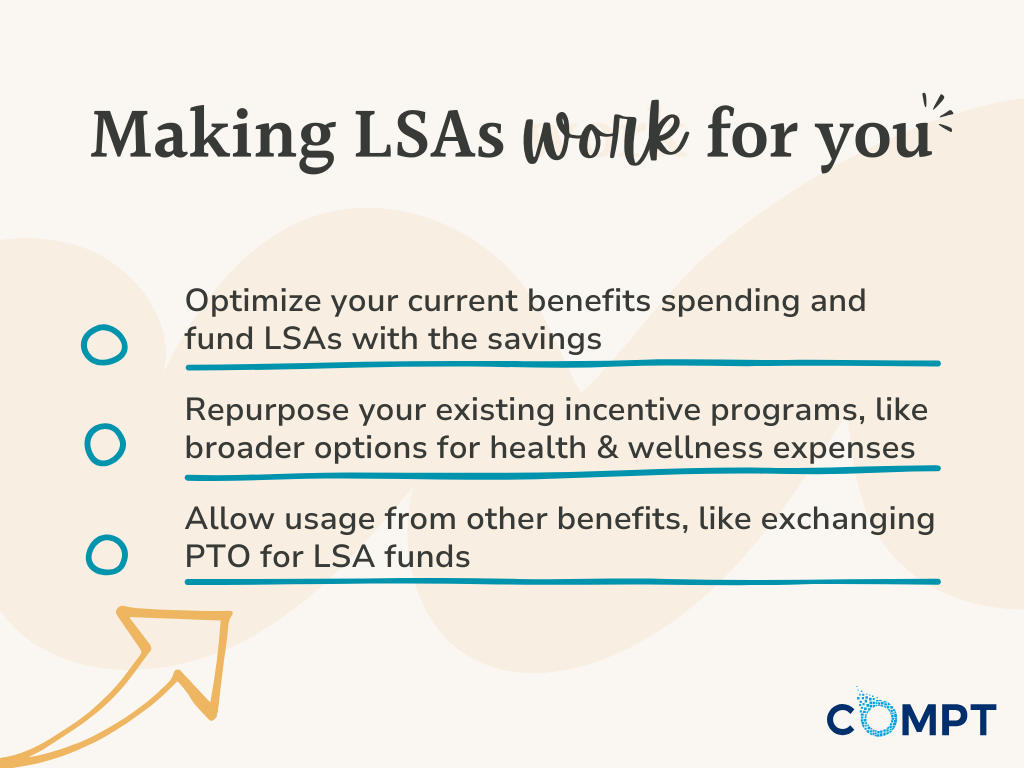
Start by deciding which employees will participate and how much you can spend on the program overall. Then use current benchmarks to put your per-employee budget in context.
Across the stipend and LSA programs measured in Compt’s 2026 Midyear Lifestyle Benefits Benchmark Report, average annual funding was $891 per employee in H1 2026. Average funding varied significantly by company size:
- $1,642 at companies with fewer than 100 employees
- $1,167 at companies with 100–1,000 employees
- $695 at companies with 1,000+ employees
The median annual funding for an all-inclusive LSA was $1,200 per employee. These are observed benchmarks, not recommended targets; your budget should reflect the expenses you want to cover, your workforce, and your overall benefits strategy.
2. Decide how much employees receive and how often.
Next, choose the funding amount for each employee and the cadence on which funds become available.
As covered earlier, there isn’t one cadence every employer should use. In H1 2026, annual funding was the most common choice among Compt customers, while full-year 2025 data showed the highest utilization among quarterly programs. Consider the size and frequency of eligible expenses, how employees are likely to use the benefit, and how you want to manage the budget throughout the year.
3. Select the categories employees can spend in.
Choose categories based on what you want the benefit to support and what employees are likely to value. Options can include wellness, food, family support, professional development and AI tools, technology, company swag, and flexible categories such as Treat Yourself.
In H1 2026, 65% of Compt customers offered an all-inclusive LSA, and Treat Yourself became the No. 1 category within those programs.
4. Choose how you’ll administer your LSA.
Your LSA platform affects how much work the program creates for employees, HR, Finance, and Payroll. When comparing LSA vendors, look at how each platform handles:
- Employee eligibility and program rules
- Receipt submission and claim review
- Tax classification and payroll reporting
- HRIS and payroll integrations
- Audit trails and reporting
- Employee vendor choice
- Global employees and currencies
- Automation and AI-assisted administration
- LSA pricing structure and what’s included
For reimbursement-based programs in particular, look at what happens from the moment an employee makes a purchase through final reimbursement. Employees should understand what qualifies, reviewers should have the documentation and context they need, and Finance should be able to trace what was reimbursed and how it was treated.
Psst: Compare the pros and cons of LSA vendors before you choose.
5. Communicate the LSA to employees.
Before launch, make sure employees know:
- How much funding they receive
- When funds become available and whether unused funds expire or roll over
- Which categories and expenses are eligible
- How to submit expenses for reimbursement
- Which reimbursements may be taxable and how they appear in payroll
- Where to go with questions
Clear communication helps employees understand what the benefit is for and how to use it from the start.
Build your Lifestyle Spending Account with Compt.
Compt gives employees the freedom to spend with the vendors that work for them while HR and Finance define the budgets, eligibility rules, categories, and tax treatment behind the program.
Because Compt is reimbursement-based, there’s no prefunding: employers pay for approved employee spending rather than loading unused funds onto cards or into accounts. Compt AI also reduces manual work throughout the reimbursement process with AI-assisted features such as Claim Autofill, Policy Checker, and Claim Reviewer, while keeping people involved when judgment is required.
Ready to explore Lifestyle Spending Accounts? Request a Compt demo today.
FAQs: Lifestyle Spending Accounts (2026)
A Lifestyle Spending Account (LSA) is an employer-funded benefit that reimburses employees for approved lifestyle expenses under rules set by the employer. With Compt, employers define who is eligible, how much funding employees receive, which categories and expenses qualify, and when funds become available; employees choose how to spend within those rules.
Unlike an HSA or FSA, an LSA does not have a federally defined list of eligible expenses. Most LSA reimbursements are also taxable unless the expense qualifies for a specific tax exclusion.
In H1 2026, 65% of Compt customers offered an all-inclusive LSA, making it the most common lifestyle benefits structure in our dataset.
How are Lifestyle Spending Accounts taxed for employees?
Most LSA reimbursements are taxable to employees unless the expense and program meet the requirements for a specific federal tax exclusion. Compt supports expense-level tax classification and carries that treatment through payroll reporting so taxable and nontaxable reimbursements can be handled consistently.
The employer decides whether an expense is eligible under its LSA policy; tax law determines whether the reimbursement can be excluded from the employee’s taxable wages. The IRS generally treats fringe benefits as taxable unless federal law specifically provides an exclusion.
General lifestyle expenses such as food, pet care, travel and experiences, and most wellness spending are typically taxable. Certain reimbursements may qualify for exclusions when specific requirements are met. For example, qualifying educational assistance under Section 127 can be excluded from income up to $5,250 per employee in 2026, and employer-provided cell phones can qualify when provided primarily for a noncompensatory business reason. And that taxable treatment is common in flexible benefits: 78% of total stipend spend in Compt’s 2025 benchmark data was taxable.
Which expenses are eligible vs. ineligible under an LSA?
LSA eligibility is determined by the employer’s policy. With Compt, employers define which categories and expenses qualify, and employees are reimbursed only for purchases that fit those rules and include acceptable documentation.
Eligibility is separate from tax treatment. An expense can be eligible under an employer’s LSA policy and still be taxable; whether the reimbursement qualifies for a tax exclusion depends on the applicable tax rules and documentation.
Expenses are generally ineligible when they fall outside the employer’s approved categories, violate a program rule or policy, or don’t include enough documentation to support the claim.
What happens if an LSA expense is ineligible or rejected?
If an LSA expense appears ineligible, Compt can flag the issue before the employee submits the claim and route decisions that require judgment to a human reviewer. These Compt features are AI-assisted, but please note the platform will never automatically reject an employee’s claim.
Before submission, Compt’s AI-assisted Policy Checker compares the claim with the employer’s policy and alerts the employee if something may not qualify, but it does not prevent them from submitting. After submission, Claim Reviewer checks the receipt against the claim and policy and provides a recommendation with written reasoning. Rejection recommendations, uncertain claims, and discrepancies always go to a person for review; Compt customers can choose whether to automate qualifying high-confidence approvals.
If a reviewer ultimately rejects the claim, the employee receives the rejection reason and a prompt to resubmit. Employers can also choose how rejected funds are handled, including returning them immediately, returning them in a later funding cycle, or not returning them when the program rules require it.
How do LSAs align with DEI and inclusion strategies?
LSAs support DEI and inclusion strategies by giving employees equal access to a flexible benefit while allowing them to use it in ways that fit their own lives. With Compt, employers set consistent eligibility rules and budgets, while employees can choose approved expenses and vendors based on their location, life stage, family structure, and priorities.
That flexibility can make the same benefit relevant across a more diverse workforce. For example, one employee may use their LSA for caregiving, another for wellness or professional development, and another for commuting, food, or technology.
A reimbursement-based model also preserves geographic choice. In H1 2026, about 70% of stipend spending on Compt occurred outside the top 10 vendors, including local, independent, regional, and niche businesses. We’ve observed this general trend in our data since 2022.
Can an LSA cover pet insurance and other pet-related expenses?
Yes, an LSA can reimburse pet insurance premiums and other pet-related expenses if the employer includes them in its eligible-expense policy. With Compt, employers define which pet expenses qualify, and employees submit approved purchases for reimbursement just like they would in other LSA categories.
Pet benefits delivered through an LSA are different from an employer purchasing a group pet insurance policy. An LSA can instead give employees a defined budget they may use for approved expenses such as pet insurance, veterinary care, medications, grooming, boarding, or other pet-related costs, depending on the employer’s rules.
Pet support is already showing up prominently in flexible benefits: Pets ranked No. 4 among all-inclusive LSA categories on Compt at midyear 2026.
What categories can be covered in a lifestyle stipend or LSA?
Lifestyle stipends and LSAs can cover any employer-approved expense category, from wellness and food to professional development, family support, technology, pets, charitable giving, and more. With Compt, employers can offer a few targeted stipends or combine many categories within one all-inclusive LSA.
In H1 2026, the most common categories within all-inclusive LSAs on Compt were Treat Yourself, wellness, food, pets, family, personal development, financial wellness, technology, charitable giving, and productivity. That said, there is no required category mix. Employers should choose categories based on what they want the benefit to support, which expenses are relevant across their workforce, how each category will be taxed, and how much funding they can sustain.
How are companies structuring modern employee benefits programs in 2026?
In 2026, many employers are structuring lifestyle benefits around a consolidated LSA rather than maintaining separate programs for every category. With Compt, 65% of customers offered an all-inclusive LSA in H1 2026, making it the most common lifestyle benefits structure in our dataset.
A typical all-inclusive LSA can combine categories such as wellness, food, family support, professional development, technology, pets, and financial wellness under one employer-defined policy. The median annual funding for an all-inclusive LSA was $1,200 per employee in H1 2026.
Funding cadence varies by program design. Annual funding was the most common employer choice in H1 2026, used by 58% of Compt customers, followed by quarterly at 39% and monthly at 36%.
What employee benefits trends should a remote-first company watch if we want to add Lifestyle Spending Accounts next year?
Remote-first companies should watch the move toward practical support, stronger professional development funding (especially for AI upskilling), and benefits structures that work across locations without requiring a separate vendor for each need. With Compt, employers can use one LSA structure while varying categories, budgets, cadences, and eligibility rules for different employee groups.
As of midyear 2026, Compt saw increased employer adoption of cell and internet, food, commuter, professional development, wellness, family and caregiving, and other practical-support categories. Professional development increased from 20% to 25% of customers, while cell and internet rose from 15% to 18%.
For distributed companies, global portability matters too. Among Compt customers supporting international employees, all-inclusive LSA adoption rose from 57% to 61%, while professional development increased from 14% to 22%. Employers are increasingly using one LSA as the foundation, then adjusting support for local workforce needs.
How can we measure the success or ROI of an LSA program?
The best way to measure LSA success is to track whether employees use the benefit, how much of the available funding they use, and how efficiently the program is administered. With Compt, those measures include participation, utilization, spend by category, budget usage, and administrative workload.
In Compt’s full-year 2025 benchmark data, all-inclusive LSAs reached 93% participation and 89% utilization, giving employers a useful benchmark for whether employees are engaging with the benefit and using the funding provided.
Stipend and LSA ROI should also include operational efficiency. If an LSA replaces multiple point solutions, reduces manual reimbursement work, or gives HR and Finance clearer reporting on spend and tax treatment, those savings are part of the program’s return too.
How do companies consolidate multiple benefits vendors into one program?
Companies can consolidate benefits by moving categories that share similar eligibility, funding, and reimbursement workflows into one flexible LSA. With Compt, employers can manage benefits such as wellness, food, professional development, family support, technology, and other lifestyle categories through one platform while still setting different rules, budgets, and funding cadences for each.
This approach lets employers add or adjust categories without introducing a new point solution every time workforce priorities change. In H1 2026, 65% of Compt customers offered an all-inclusive LSA, making it the most common lifestyle benefits structure in our dataset. Compt’s midyear data also showed employer adoption increasing vs. 2025 across 13 of 20 comparable stipend categories, while employers continued using established stipend infrastructure to support those additional needs.
What participation and utilization rates do Lifestyle Spending Accounts achieve?
Compt’s all-inclusive LSAs reached 93% employee participation and 89% utilization in full-year 2025 data. Participation measures the percentage of employees who submitted at least one expense, while utilization measures the percentage of available LSA funding employees actually spent.
Those metrics answer different questions about program performance. High participation means employees are using the benefit; high utilization means they’re using a large share of the funding available to them. Employers should track both when evaluating whether their LSA’s categories, funding amount, and cadence are working.
How do reimbursement-based benefits differ from prepaid cards?
Reimbursement-based benefits let employees make an eligible purchase with their own payment method and submit it for reimbursement, while prepaid or corporate-card programs provide a card employees use at the point of purchase. Compt uses a reimbursement model, so employers pay only for approved expenses employees actually incur rather than prefunding benefit balances.
Reimbursement also gives employees broad vendor choice because they can purchase from any merchant that fits the employer’s policy. Each Compt claim can be matched to documentation, checked against program rules, classified for tax treatment at the expense level, and carried through payroll reporting.
The tradeoff is that employees usually pay upfront and wait for reimbursement, while card-based programs can remove that initial out-of-pocket cost. Compt reduces the manual work involved in reimbursement with AI-assisted features such as Claim Autofill, Policy Checker, and Claim Reviewer, which help draft claims, flag likely policy issues, and support review when judgment is needed.
What are some examples of Lifestyle Spending Accounts?
Lifestyle Spending Accounts can be designed very differently depending on the workforce. With Compt, employers can combine broad lifestyle coverage with targeted benefits, different funding amounts, and different eligibility rules within the same program.
For example, one global Compt customer supports about 400 employees in more than 20 countries through 60+ employee-group configurations. The same program provides commuter, internet, and cell phone support for some employees, remote-office equipment for new hires, a global wellness stipend, and sabbatical reimbursements for employees who reach 10 years of tenure.
Other employers take different approaches. In Compt’s H1 2026 data, one employer added $100 to employees’ quarterly wellness stipend after they completed an annual physical, while another offered anniversary bonuses, a New Year benefit, and a summer-specific stipend. Among AI-focused companies, examples included a dedicated professional development budget, a $12,000 annual childcare stipend, and bonuses triggered by specific employee occasions.
There isn’t one standard LSA design: employers can use the same basic infrastructure for all-inclusive employee choice, targeted workforce support, recognition, or a combination of all three. Check out our case studies for more Compt customer stories.
Can employees carry over unused Lifestyle Spending Account funds? Can they combine multiple years for a bigger purchase?
Compt supports LSA rollover, but it’s configurable rather than automatic. Most Compt programs are set up as use-it-or-lose-it within each funding cycle; when rollover is enabled, unused funding typically carries into the next cycle rather than accumulating across multiple years.
Because Compt is reimbursement-based, the LSA allocation is a spending limit rather than money loaded into an employee-owned account. At the end of a cycle, employers can let unused funding expire or roll it into the next cycle. The employer retains the money until an employee submits an eligible expense for reimbursement.
Combining several years of unused LSA funding for one large purchase is not a standard setup. Employers that want to give employees more time to save toward larger purchases can instead use a longer funding cycle or an accrual structure that lets funding build within the cycle.
What features should I prioritize when comparing employee benefits management platforms that include Lifestyle Spending Accounts?
When comparing LSA platforms, prioritize HRIS and payroll integrations, eligibility and funding controls, tax handling, employee spending flexibility, reporting, implementation and support, and the total cost of running the program. With Compt, those functions are built around a reimbursement model that lets employers define program rules while employees choose where to spend within them.
Look beyond whether each feature technically exists. Ask whether employee eligibility updates from your HRIS, taxable and nontaxable reimbursements flow into payroll, Finance gets usable audit and reporting records, employees can spend with the vendors they choose, and the platform can support the program as your workforce or benefit strategy changes.
Pricing belongs in that comparison too. Ask whether the quoted software fee includes integrations, SSO, additional benefit programs (e.g., recognition, swag), reimbursement transactions, implementation, and support; whether pricing changes as headcount fluctuates; and whether you have to prefund employee balances. Compt uses fixed annual pricing tiers rather than PEPM pricing, does not require prefunding, and includes unlimited stipend and LSA programs and categories in its base pricing. Some products and international support are priced separately, so buyers should compare the total cost of the setup they actually need rather than the headline software fee.
AI is another useful comparison point, especially what the system is allowed to decide. Compt’s AI-assisted features help employees submit claims and help reviewers assess them, while maintaining human review for decisions that require judgment.
Editor’s note: Compt software supports the categorization and proper reporting of benefits according to IRS guidelines, helping businesses maintain compliance. However, Compt cannot provide tax advice, and users should consult their own tax, legal and accounting advisors when necessary.

 No receipt chasing