
Employee needs change every few years, and companies always scramble to catch up.
I’ve watched this pattern play out from two vantage points: first as a CFO and COO, where I saw countless benefits decisions made reactively, and now as the founder of Compt, where I talk to hundreds of HR and Finance leaders every year. The pattern is almost always the same: A need emerges. It spreads. Then suddenly it’s everywhere, and companies are trying to figure out what to do about it with open enrollment six weeks away.
GLP-1s and weight-management support are the most recent iteration. For a while, insurance covered them broadly. Demand exploded — because of course it did; these medications work for a lot of people. Then insurers started pulling back, and employers were left asking, ‘Do we cover this? How much? What does it mean if we don’t?’
That chapter isn’t even fully written and I can already see the next draft in the queue.
It’s perimenopause and menopause. And it’s going to be even bigger.
Why menopause is the next major workforce benefits challenge
Every year, approximately 1.3 million U.S. women enter menopause. That number alone doesn’t capture the scale of what’s happening right now, though.
Millennials are the largest generation in the U.S. workforce today, and they are already in or approaching perimenopause. This life stage goes beyond a niche population concern — it affects the very core of your workforce.
The workplace cost of untreated menopause symptoms is already $26.6 billion annually in the U.S., accounting for lost productivity, absenteeism, and medical expenses. And women, on average, hit peak career earnings at age 44 — a full decade before men. That gap has a name: the Menopause Penalty. It maps almost exactly onto the perimenopause window, and it’s happening now, across your organization, for your Generation X and Millennial women.
Why menopause benefits are different from GLP-1 coverage
Menopause is inherently different from GLP-1s: it’s not a new or contested medical question, but rather a universal life phase.
Nobody debates whether employers should support employees through pregnancy, new parenthood, or elder care. Those are recognized as life stages that affect people’s ability to show up fully at work, and employers have built programs around them. Perimenopause and menopause belong in that same category. Half the population goes through it. It affects cognition, sleep, mood, energy, and physical health — often for years. Companies are not going to be able to look away from this.
But unlike family benefits, menopause support is still in its earliest stages. The conversations I’m having on sales calls right now feel like the conversations I was having about mental health benefits in 2018, or about GLP-1s two years ago. There’s a rumble. People know something needs to happen. Nobody’s sure what it looks like yet.
What I do know is that the companies that wait for this to become a crisis before acting are going to have a much harder time than the ones that start building flexibility into their benefits infrastructure now.
Why 80% of women with menopause symptoms never seek care
I want to be honest here: I’m one of these affected women. I’ve been dealing with perimenopause symptoms for longer than I knew — and for years, my doctors ignored them. Fatigue. Brain fog. Joint pain. Migraines. ITCHY EARS! These complaints are sitting in my medical chart going back years. They were waved off, one by one.
It wasn’t until I saw someone on LinkedIn talking about hormone replacement therapy (HRT) that I started connecting the dots. I ended up rage-posting on LinkedIn that I wanted a solution — and someone kindly sent me to Midi Health. I went and finally started getting real answers. I’m still adjusting my dosage, six weeks at a time, because that’s how this works.
I share this not for sympathy, but because my experience is not unusual. A Mayo Clinic study published in October 2025 found that more than 80% of women with menopause symptoms didn’t seek medical care for them, making that the norm. One in five said they felt judged by their healthcare provider. More than one in six were embarrassed to even bring it up.
Our medical system has consistently failed women. The NIH didn’t even require women to be included in clinical research trials until 1993. Think about what that means for medical training. Doctors — many of whom are still practicing and/or training more junior medical professionals — learned from research that largely didn’t include us. That’s a real and serious knowledge gap.
In the meantime, there is a national shortage of estrogen patches that could last up to three years. Demand tripled after the FDA removed decades-old black box warnings on HRT in late 2025. Manufacturers are running at full capacity and still can’t keep up. Women who finally got a diagnosis, finally got a prescription, are calling pharmacy after pharmacy and coming up empty.
I know, because it’s happening to me. My script has been sitting at CVS for eight months. I ended up getting my HRT through Amazon. That’s where we are.
What untreated menopause symptoms are actually costing employers
I’m not predicting that every company will add a perimenopause benefit line item this year. I know how these conversations go. Benefits teams are already under pressure, and “menopausal employee support” isn’t exactly a line item that sails through budget approval.
But the employees who are dealing with this right now aren’t coming to HR and asking for a menopause stipend. They’re just struggling. They’re showing up to meetings with brain fog they’re calling stress. They’re missing workdays they’re attributing to symptoms rather than the cause. They’re passing on promotions they don’t feel ready for — when the real issue is that they haven’t slept well in six months and nobody in their healthcare system has made the connection yet.
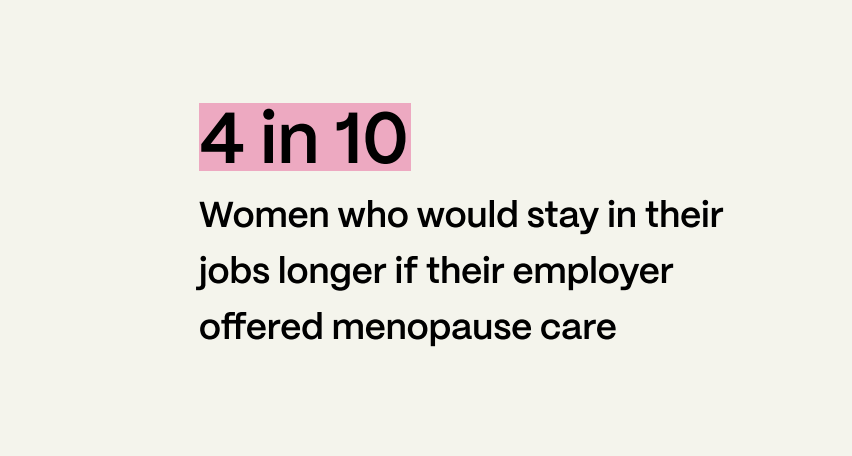
The Midi Health workplace survey found that 93% of women dealing with menopause symptoms could technically meet their job requirements. But more than 70% did so with lots of extra effort. And 74% said they often or always felt unwell at work.
Your highest-performing, most experienced employees are quietly burning through reserves to keep showing up for you. That is not a sustainable talent strategy.
The case for flexible benefits as a menopause strategy
I think the instinct to ask, ‘What benefit do I add for this?’ is actually the wrong question.
The right question is: How do I build a benefits infrastructure that can move with my employees wherever they are in their lives, without requiring HR to become fortune-tellers?
I use an example in my sales demos constantly. On day one at Compt, one of our employees was using her wellness stipend for race entry fees and running shoes. Then she got pregnant and shifted to prenatal vitamins and massage. Then the baby came and she moved to yoga and meditation. I didn’t have to change her benefits through all that; I just said, ‘Here’s a stipend, use it for what you need.’ And it worked, because life changes.
That’s what flexible benefits infrastructure is supposed to do. It doesn’t require HR and Finance to read tea leaves and tarot cards (though that can be fun, too) to predict which health trend survives. Instead, it simply gives people the ability to use their benefits for whatever is actually relevant to their lives right now.
GLP-1s, perimenopause, whatever comes next — a flexible reimbursement model handles all of it, without requiring a new vendor, policy, or budget line.
HR and Finance leaders can get ahead of this with Compt
If you’re trying to figure out what to do with all of this, I see you — and I don’t think the answer is to launch a menopause benefits program tomorrow.
Instead, look honestly at whether your current benefits infrastructure is flexible enough to serve employees at every life stage, and start closing the gap if it isn’t.
The companies getting ahead of this aren’t the ones who predicted the GLP-1 moment or the mental health moment or this one. They’re the ones who built a program that adapts, regardless of moment.
That’s a much better strategy than scrambling every two years.