
Employee stipends give employees a set budget for approved expenses, such as wellness, professional development, internet and phone costs, food, caregiving, small treats that bring them joy, or other defined needs. Employers can offer a targeted stipend for one purpose or combine multiple eligible categories within a Lifestyle Spending Account (LSA).
For HR and People Ops teams, the challenge is often less about whether to offer flexible stipends and more about how to best run them. Programs that start in spreadsheets or expense tools often require manual receipt reviews, repeated eligibility questions, and coordination with payroll around tax treatment.
This guide explains what employee stipends are, how they work, current 2026 funding and program-design benchmarks, common stipend types, tax treatment, and what to consider when building a program that stays broad for employees without creating more day-to-day administration for HR.
What is an employee stipend?
First, a definition:
Employee stipend (2026 definition):
An employee stipend is an employer-funded benefit that gives employees a defined budget to spend on approved expenses, such as wellness, professional development, food, caregiving, or work-related costs. The strongest stipend programs use rules-based reimbursement, where employees make eligible purchases and are reimbursed through payroll with the appropriate tax treatment.
With a reimbursement-based stipend, the employer defines what’s covered, how much funding employees receive, and how often the benefit is funded. Employees make eligible purchases, submit their expenses, and receive reimbursement through payroll. Because the program rules are set upfront, eligibility and tax treatment can be applied consistently without asking HR to make one-off or ad hoc decisions for every claim.
Reimbursement also preserves employee choice. Employees can spend with the vendors they prefer rather than being limited by a prepaid card or a closed marketplace, while the employer only pays when an eligible expense is actually submitted.
According to our 2026 Midyear Lifestyle Benefits Benchmark Report, roughly 70% of stipend spending happened outside the top 10 vendors in H1 2026. When Compt first tracked this benchmark in 2022, it was about 75%, showing that employees consistently spread their spending across a wide range of businesses rather than concentrating it with a handful of major brands.
Related stipend terms
Depending on how the program is structured, an employee stipend may also be described as:
- Lifestyle stipend: a broad stipend that can cover several employee needs
- Lifestyle Spending Account (LSA): a reimbursement-based stipend structure that can combine multiple eligible spending categories
- Wellness stipend or wellness wallet: a targeted stipend for health and wellness expenses
- Professional development stipend or professional development account: a targeted stipend for learning, courses, tools, conferences, and related expenses
- Employee allowance: a term sometimes used for employer-funded spending programs
These terms aren’t always interchangeable. A targeted stipend usually funds one specific purpose, while an all-inclusive LSA can combine multiple eligible spending areas within one reimbursement-based program.
Table: How employee stipends work with reimbursement
| Step | What happens |
|---|---|
| Employer designs the stipend | Sets the funding amount, funding cadence (e.g., monthly, quarterly, annual, semiannual), eligible expenses, and program rules |
| Employee makes an eligible purchase | Spends with the vendor of their choice within the above rules |
| Employee submits the expense | Provides the required receipt or documentation within the Compt platform |
| Program rules are applied | Compt consistently applies eligibility and tax classification |
| Employee is reimbursed | Reimbursement is delivered through payroll with the appropriate tax treatment |
Now let’s ground that in real-world data. The benchmarks below combine Compt’s 2026 Midyear Lifestyle Benefits Benchmark Report for the latest employer-funding and program-design data with our 2026 Annual Lifestyle Benefits Benchmark Report for full-year 2025 participation, utilization, and employee spending trends.
2026 employee stipend and lifestyle benefits benchmarks (by company size, category, and cadence)
Compt’s latest benchmark data shows an established program structure with some changes in where specifically employers are putting their dollars: All-inclusive LSAs remain the most common program type, annual funding is now the most common cadence among employers, and professional development saw the strongest increase in both adoption and typical funding in the first half of 2026.
If you’re evaluating an employee stipend program in 2026, these benchmarks can help answer a few practical questions: How much are companies funding? Which categories are most common? And how often are employers making funds available?
How common are all-inclusive LSAs?
Nearly two-thirds (65%) of Compt customers offered an all-inclusive Lifestyle Spending Account (LSA) in H1 2026, making it the most common program structure by a wide margin. That’s only a slight increase from 64% in the full-year 2025 data, which suggests the LSA has become an established way to structure flexible stipend programs rather than a rapidly emerging model.
The five most common stipend and LSA categories offered by Compt customers in H1 2026 were:
| Category | Percent of Customers Offering |
|---|---|
| All-inclusive LSA | 65% |
| Wellness | 42% |
| Office equipment | 27% |
| Professional development | 25% |
| Cell and internet | 18% |
Professional development and wellness each increased 5 percentage points from 2025, while cell and internet increased 3 points and office equipment increased 2. Across the full comparable set, employer adoption increased in 13 of 20 categories.
Average stipend funding by company size
Small companies still fund stipends the most per employee, but the gap between small and large employers narrowed in H1 2026.
| Company Size | Average Annual Stipend Budget |
|---|---|
| Small: Fewer than 100 employees | $1,642 |
| Midsize: 100–1,000 employees | $1,167 |
| Large: 1,000+ employees | $695 |
| Overall average | $891 |
Compared with the full-year 2025 benchmark, funding was essentially flat among companies with fewer than 100 employees, increased 11% among midsize companies, and increased 7% among companies with more than 1,000 employees. The small-to-large funding gap narrowed from 2.6x to 2.36x.
These are averages across the stipend and LSA programs represented in Compt’s dataset, not recommended budgets or targets. Company size is one useful point of comparison, but program categories, workforce needs, and benefit design also affect how much an employer funds.
Median annual funding by common stipend category
Funding varies substantially depending on what a stipend is designed to cover. For planning purposes, the median is generally more useful than the minimum or maximum because unusually large or specialized programs can pull the outer ranges higher.
| Stipend Category | H1 2026 Median Funding |
|---|---|
| All-inclusive LSA | $1,200 |
| Wellness | $600 |
| Professional development | $1,600 |
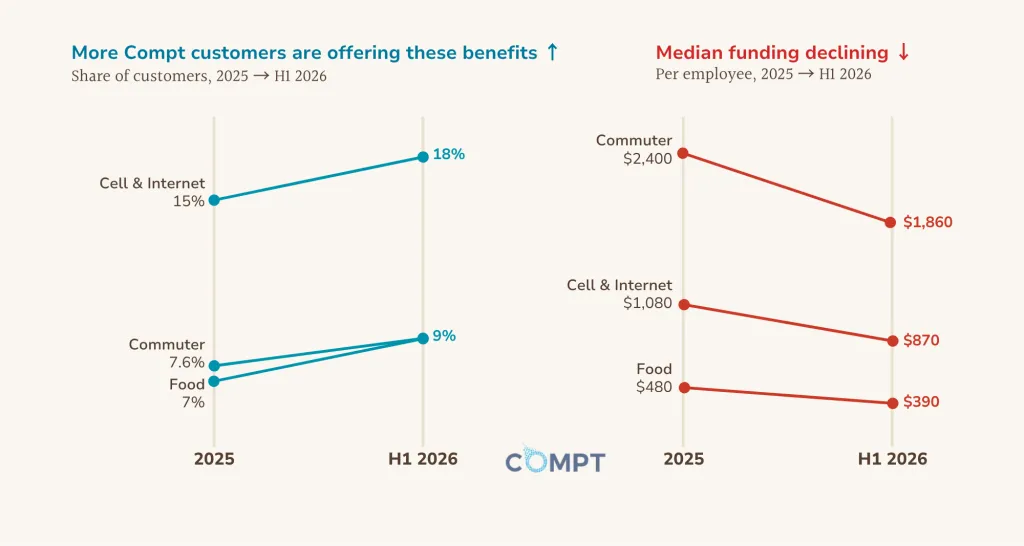
| Cell and internet | $870 |
| Commuter | $1,860 |
| Food | $390 |
| Family and caregiving | $2,000 |
Professional development is the clearest change in the latest data: median funding doubled from $800 in 2025 to $1,600 in H1 2026, while the share of customers offering the category rose from 20% to 25%.
Other stipend categories show a different pattern. Commuter, cell and internet, and food stipends all became more common even as their median funding decreased. That suggests some employers are expanding access to practical expense categories without necessarily increasing the amount allocated to each employee.
How often do employers fund employee stipends?
There isn’t one funding cadence that fits every stipend. In H1 2026, annual funding was the most common choice among Compt customers, followed by quarterly and monthly funding.
| Funding Cadence | Percent of Compt Customers |
|---|---|
| Annual | 58% |
| Quarterly | 39% |
| Monthly | 36% |
| New hire | 15% |
| Semiannual | 6% |
Companies may use more than one cadence across different programs, so these percentages do not sum to 100%.
Quarterly funding reaches the largest share of employees in the H1 dataset: about 85% of employees overall and 86% of employees with access to an all-inclusive LSA experience quarterly funding. But two very large quarterly programs heavily influence those figures, so employee reach should not be read as evidence that quarterly is the cadence most employers choose.
Full-year 2025 data adds another useful lens: employee utilization was highest among quarterly-funded programs at 85%, compared with 70% for semiannual, 65% for annual, and 52% for monthly programs. That doesn’t make quarterly automatically “best”; cadence should match the kinds of expenses employees are expected to make and how much funding they may need access to at once.
What does strong participation look like?
For employee behavior, the full-year 2025 dataset gives us the more complete benchmark. Across Compt customers:
- 95% of eligible employees activated their benefit
- 93% of active users participated
- All-inclusive LSAs reached 93% participation and 89% utilization
Participation tells you whether employees are actually using the benefit. Utilization tells you how much of the available funding they spend. Looking at both gives employers a clearer picture than relying on either metric alone.
What the latest benchmarks say about employee stipend design
Taken together, these benchmarks show why there isn’t one standard stipend budget or funding structure to copy. Employers are making different choices based on what they want to cover, their workforce’s needs, competitive benefits in their specific industry, and how employees are likely to use the benefit. The data is most useful as planning context for those decisions, not as a prescribed program design.

Example of an employee stipend
In the example above, Sam’s company has allocated $100 per month to her and other employees to spend on the following stipend categories: continuous learning, health and wellness, and food.
This month, Sam:
- Bought two books
- Renewed her gym membership
- Grabbed lunch with her team
She still has $20 left to use on anything that fits the categories before the month ends.
How would you spend $100 this month?
Examples of leading organizations using stipends today
Employee stipend programs can look very different depending on what a company wants to fund, how often employees receive their budget, and whether benefits are organized into targeted categories or an LSA.
The examples below show the variety in how organizations structure stipends, including monthly and annual funding, targeted stipends, and programs that combine several spending categories within one reimbursement-based structure.
Here are examples of companies using employee stipends today:
- Webflow: A monthly stipend employees can use toward work and wellness expenses, including cell phone service, internet, gym memberships, meditation apps, and more.
- Qualtrics: A $1,800 annual “Experience Bonus” employees can use for concerts, trips, sports, events, or charity; a $1,200 annual wellness stipend; and up to $10,000 reimbursed for adoption or surrogacy expenses.
- Evernote: A $1,000 annual vacation stipend to encourage employees to take meaningful time off.
- Buffer: A comprehensive stipend program that includes a $1,000 home-office setup stipend, an annual family support stipend ($3,000 per year per child, for up to four dependents), a $250 AI tools stipend, a coworking/working-smarter stipend, and annual learning and development funds.
- GitLab: A monthly remote-work stipend employees can use for home-office supplies, ergonomic equipment, and workspace needs.
- Fictiv: A 13-category stipend program powered by Compt (including cell phone, internet, continuous learning, remote work, and team events) with 95% employee participation.
- ButterflyMX: A $300/quarter “Self-Care Stipend” administered in Compt that covers wellness, groceries, fitness, pet care, and more across 10 countries.
- Carrot Fertility: Multiple stipends delivered through Compt, including a new-hire tech stipend, a productivity stipend, wellness spending, and meal-related spot bonuses.
- Quickbase: A flexible lifestyle stipend program set up in Compt that consolidates multiple vendors and supports spending across more than 1,300 vendors.
- TEN7: A comprehensive stipend program managed in Compt that includes a $900 annual tech stipend, a $250 annual professional development stipend, a $3,600 annual professional coaching stipend for leadership, and a $100 annual mental wellness stipend, along with a new-hire stipend for workspace setup and spot bonuses throughout the year.
Note: These examples reflect employee stipend programs publicly shared by each company. Benefit structures may evolve over time as organizations update their total rewards strategies.
Across these examples, there’s no single stipend design companies have to follow. What they have in common is a defined budget, clear eligible expenses, and a structure employees can understand and use.
Want to see more examples? Check out “53 Examples of Employee Stipends at Leading Organizations.”
What does typical spending look like?
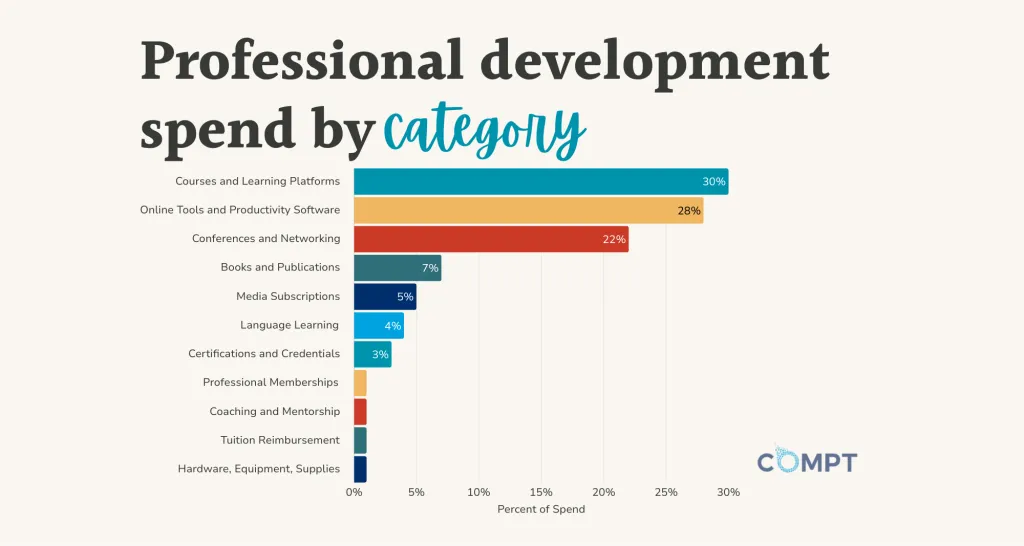
Check out how Compt customers use their professional development stipends
After analyzing our customers, we can see the data is clear: Delivering choice to your people matters.
Types of employee stipends offered by companies
Employee stipends can cover a wide range of employee expenses. Compt offers 30+ different stipend categories, including the following:
- All-inclusive employee stipends, also known as Lifestyle Spending Accounts (LSAs)
- Wellness stipends and weight management stipends
- Professional development stipends and AI upskilling stipends
- Remote work stipends
- Food and grocery stipends
- Travel or experience stipends
- Family and caregiving stipends
- Cell phone stipends
- Equipment stipends
- Company swag stipends
An employer can offer one targeted stipend or combine multiple eligible categories within an all-inclusive LSA. At midyear 2026, 65% of Compt customers offered an all-inclusive LSA, making it the most common stipend structure in our dataset.
The advantage of an all-inclusive LSA is that employers can set one reimbursement-based program with defined categories and eligibility rules, then adjust what it covers as employee and business needs change.
What are the benefits of employee stipends?
Benefits still play a major role in how employees evaluate their jobs. In Morgan Stanley at Work’s 2026 research, 91% of employees said they would consider switching jobs for benefits that better help them reach their goals.
The challenge for employers is that adding more benefits doesn’t automatically make a program more useful. Employees have different priorities, while every additional point solution can add another vendor, eligibility policy, and administrative process for HR to manage.
Employee stipends offer a different approach: Employers define the budget and eligible expenses, while employees have more flexibility in how they use the benefit within those rules. With a reimbursement-based model, employers can support a broader range of needs without prepaying for access that employees may never use.
So, what are the benefits for companies and employees? Let’s dig in.
Why are stipends more flexible than point-solution benefits?
Point-solution benefits typically give employees access to one vendor, service, or narrow type of support. Employee stipends take a different approach: The employer defines what expenses are eligible, while employees choose how to use their budget within those rules.
That makes it possible to support a broader range of needs without adding a separate vendor every time employees ask for something new. A wellness stipend, for example, can cover eligible fitness, mental health, nutrition, or other wellness expenses instead of requiring the company to select one gym, app, or wellness provider for everyone.
With a reimbursement-based model, employers also avoid paying upfront for access employees may never use. Employees submit eligible expenses as they incur them, and the employer reimburses the actual amount spent within the program rules.
That’s a budget win!
Table: Reimbursement-based stipends vs. point-solution benefits
| Feature | Reimbursement-based employee stipends | Point-solution benefits |
|---|---|---|
| Vendor access | Employees can use any vendor that meets the program’s eligibility rules | Typically limited to the selected vendor or network |
| Employee options | Multiple eligible purchases within defined categories | Determined by the vendor’s offering |
| Employer spending | Employer reimburses eligible, documented expenses employees submit | Often involves contracted or prepaid access |
| Program changes | Categories and eligibility rules can be adjusted as needs change | Adding new types of vendor support may require a new vendor or contract |
| Administration | Multiple stipend categories can run through one reimbursement process | Separate vendors may require separate contracts, reporting, and more manual workflows |
| Tax treatment | Tax classification is automatically applied based on the expense and configured program rules | Varies by benefit, vendor, and program structure |
Why do employees prefer stipends?
Stipends provide more value than extra money in a paycheck. They give employees a defined benefit they can actually see and use for approved expenses, while still giving them flexibility within the program’s rules.
Employees don’t all want to use the same benefit in the same way. One person might use a wellness stipend for a gym membership, while another uses it for fitness equipment, a meditation app, or nutrition support. With an LSA, those options can extend across several eligible categories.
That flexibility shows up in how employees use these programs. In Compt’s full-year 2025 data, 95% of eligible employees activated their benefit, and 93% of active users participated. All-inclusive LSAs also reached 93% participation and 89% utilization.
How do stipends simplify HR workflows compared to forms and spreadsheets?
HR no longer has to pick the “perfect perk” or manage a long list of disconnected vendors. With stipends, you save time and money on implementation and ongoing administration. You can even set one up in an hour or less.
“I’m probably in Compt twice a month for a few minutes. It’s self-sufficient.”
— Dani Adelman, Director of Operations, TEN7
When you choose stipends, you manage one program instead of many point solutions.
With Compt, you also tap into our employee reimbursement system that supports customizable spending categories without limiting employees to a predefined vendor network. This level of flexibility is only possible with a stipend reimbursement model.
Employees can buy what they need and get reimbursed through the platform. They can shop anywhere from major retailers like Target or Amazon to their favorite local bookstore or ice cream shop. In full-year 2025, Compt customers made purchases across 64,000+ unique vendors, from major retailers to local businesses, without requiring HR to manage individual vendor contracts
Want to see how much your perk vendors are costing you today? Visit our Vendor Calculator.

Learn more about the benefits of all-inclusive Lifestyle Spending Accounts.
Unlock the power of Lifestyle Spending accounts with our comprehensive guide on benefits and setup, plus examples from companies of all sizes.
How do stipends support accuracy, compliance, and security?
If you’re managing stipends manually, maintaining consistent eligibility decisions, tax treatment, documentation, and employee data can require significant coordination across HR and payroll.
With a platform like Compt, HR defines the categories and eligibility rules upfront. Compt enforces those rules, applies the correct tax treatment, and delivers reimbursement through payroll. Receipts and reimbursement records also stay within the platform instead of being scattered across forms, spreadsheets, and inboxes.
How employee stipends are taxed (taxable vs. nontaxable)
Employee stipends are generally taxable unless the reimbursement qualifies for a specific tax exclusion. The tax treatment depends on what the expense is, why it was incurred, how the program is structured, and whether applicable documentation and other requirements are met. The IRS treats fringe benefits as taxable unless a specific exclusion applies.
For example:
- Lifestyle expenses such as general wellness and food are typically taxable when they don’t qualify for a specific exclusion.
- Some work-related expenses may be nontaxable when applicable requirements are met. Employer-provided cell phone benefits can qualify for exclusion when provided primarily for noncompensatory business purposes, and qualified transportation benefits have specific tax-free limits and requirements.
- Professional development can receive different tax treatment depending on the program and expense. The IRS provides exclusions for qualifying educational assistance and certain working-condition benefits, including job-related skill development that meets the requirements.
- Reimbursement alone does not make an expense nontaxable. For business-expense reimbursements to qualify under accountable-plan rules, requirements include a business connection and adequate substantiation.
With Compt, the configured eligibility and tax-classification rules are applied to submitted expenses, and taxable and nontaxable reimbursements are separated for payroll.
Which expenses are eligible vs. ineligible under an LSA or employee stipends?
In most employee stipend programs, eligible expenses are defined by category and verified by receipts, while ineligible expenses lack documentation or fall outside the policy. Taxability depends on the category and how the policy is structured.
The framework below breaks expenses into three buckets: commonly taxable eligible expenses, conditionally nontaxable expenses (when structured properly), and commonly ineligible expenses.
Commonly eligible expenses (taxable categories)
| Category | Examples |
|---|---|
| Wellness | Gym memberships, yoga classes, therapy apps, fitness equipment, supplements |
| Food and Groceries | Grocery purchases, meal kits, food delivery |
| Professional Development | Books, courses, certifications, conferences, AI tools |
| Remote Work | Desk, monitor, keyboard, coworking memberships |
| Family and Caregiving | Childcare, elder care, fertility-related support |
| AI Tools | ChatGPT, Claude, research tools, productivity software |
These categories are typically treated as taxable income and processed through payroll.
Conditionally nontaxable expenses (when structured properly)
| Category | Notes |
|---|---|
| Cell Phone and Internet | Often nontaxable if tied to business use and documented |
| Commuter Benefits | Must follow IRS transportation guidelines |
| Work Equipment | May qualify as business expense reimbursement |
| Safety Equipment | Generally nontaxable when required for role |
| Home Office Expenses | May be nontaxable when treated as business reimbursements and documented |
These require clearer policy documentation and payroll coordination.
Commonly ineligible expenses
| Not Allowed | Why |
|---|---|
| Cash withdrawals | No receipt verification |
| Alcohol | Not aligned with wellness or business categories |
| Luxury personal goods unrelated to category | Outside policy scope |
| Expenses without documentation | No audit trail |
Gray areas to clarify in your policy
Some purchases fall into mixed-use territory, such as:
- Personal laptops used partly for work
- Hybrid wellness + cosmetic services
- Subscription bundles
- Shared household internet
In these cases, reimbursement-based administration creates a clearer audit trail and reduces classification errors.
Why clear eligibility rules matter
Clearly defining eligible and ineligible expenses:
- Reduces employee confusion
- Prevents payroll errors
- Protects against audit risk
- Supports Finance alignment
- Increases participation by eliminating guesswork
Most modern employee stipend programs define broad categories upfront and rely on reimbursement-based verification rather than restricting vendor choice.
How do stipends help companies reduce waste and improve utilization?
With Lifestyle Spending Accounts, companies no longer waste money on unused perks. There are no expired snacks, unused event tickets, or under-attended in-office fitness sessions.
Choosing Compt also means you don’t have to pre-fund debit cards or accounts that employees may never use. A reimbursement model ensures that the only money you pay is the money employees actually spend.
Which metrics help finance prove ROI of stipends?
The most useful metrics for measuring stipend ROI are participation, utilization, cost per participating employee, administrative time, and unused budget avoided. With a reimbursement-based program, employers can measure how much employees actually use alongside what the program costs to fund and administer.
Employee stipend ROI can be measured through participation, administrative efficiency, and actual employee spending. Reimbursement data gives HR and Finance direct visibility into how employees use the benefit and how much of the available budget they spend.
Core ROI metrics for employee stipends
| Metric | What It Measures | Why It Matters |
|---|---|---|
| Participation rate | % of eligible employees who use the stipend | Indicates real adoption, not passive enrollment |
| Utilization rate | % of allocated budget actually spent | Shows benefit relevance and design effectiveness |
| Cost per engaged employee | Total stipend budget ÷ active users | Compares value against vendor-based perks |
| Administrative time saved | HR hours spent managing benefits | Converts operational efficiency into labor savings |
| Unused budget avoided | Funds not pre-paid to unused vendors | Protects against sunk costs |
| Reimbursement cycle time | Time from submission to payout | Impacts employee satisfaction and trust |
In modern stipend programs, participation rate has become the primary performance indicator, because unused benefits generate zero ROI.
Simple stipend ROI example
Consider a company with 100 employees eligible for a stipend.
If 93 employees participate, the program has a 93% participation rate. If employees use 89% of the funding available to them, the program has an 89% utilization rate.
Those two numbers answer different questions:
- Participation: How many eligible employees actually used the benefit?
- Utilization: How much of the available funding did employees spend?
Employers can then layer in actual reimbursement costs and administrative time to understand cost per participating employee and the overall efficiency of the program.
(For context, Compt’s full-year 2025 customer data found that all-inclusive LSAs reached 93% participation and 89% utilization, hence using these numbers to illustrate.)
Additional cost efficiencies
Employee stipends also improve ROI by:
- Eliminating overlapping vendor contracts
- Reducing HR administrative hours
- Avoiding prepaid debit cards with unused balances
- Simplifying payroll classification through automated tax handling
In many organizations, the time saved alone offsets a significant portion of the stipend program cost. And while there’s no single ROI target that applies to every stipend program, your goal should be to understand how many employees use the benefit, how much available funding they use, what the program costs to administer, and whether that performance aligns with the program’s overall purpose at your organization.
How LSAs align with DEI and inclusion strategies
Employee stipends can support a more inclusive benefits experience by giving employees flexibility to choose eligible expenses and vendors that fit their location, life stage, and individual needs.
Employee stipends give employers a way to support a wider range of employee needs without choosing one vendor or benefit experience for everyone, because a single vendor rarely meets the needs of an entire organization. For example, a LinkedIn Learning subscription only works for certain roles and interests.
The consequences of this type of cookie-cutter point solution mean you’re investing time and resources into programs that not everybody wants or likes.
| Traditional Perk Limitation | How Stipends Improve Inclusion |
|---|---|
| Single-vendor access | Employees choose vendors that reflect their culture or preferences |
| Office-based benefits | Remote and hybrid employees receive equal access |
| Fixed program design | Employees allocate funds based on life stage or caregiving needs |
| Geography-restricted perks | Global teams can use stipends locally |
| Role-specific benefits | Broad categories serve multiple job functions |
For example, stipends allow:
- Parents to allocate funds toward childcare or elder care
- Global employees to use benefits in their local currency
- Employees with disabilities to choose tools that meet accessibility needs
Stipends help companies move away from point solutions and toward flexible spending categories. For example, a “Continuous Learning Stipend” allows people to choose from LinkedIn Learning, Udemy, Coursera, extension universities, books, conferences, coaching, learning AI tools, and more.
This flexibility allows companies to design benefits programs that scale equitably across diverse workforces.
Get in touch today to learn more about professional development stipends.
How do stipends align with company mission, values, and goals?
A strategic stipend program helps companies gain a competitive edge by aligning perks with mission, values, and culture. It creates a benefits experience that reflects what matters most to the business and the people who work there.
Learn more about how real Compt customers use employee stipends.
The benefits of employee stipend management software
Why do companies use stipend management software?
If you already offer your team a stipend, awesome! You’re ahead of the curve, and you’re likely experiencing a tremendous number of benefits. High-five!
However, you’re also likely dealing with one major challenge: the admin work.
Unless you’re using software to streamline the management of your employee stipend program, you’re likely spending countless hours managing tasks such as:
- Fielding questions around which perks qualify
- Documenting which categories and vendors apply
- The approval workflow after an employee makes a purchase
- The reimbursement process once a receipt is submitted
- The IRS tax compliance of the taxable and nontaxable perks
- Communicating with employees around their remaining balances
The time spend on these tasks adds up quickly. Some companies we’ve spoken to at Compt told us they spent 20+ hours a week managing these details for a company with fewer than 200 people. That is half of one full-time employee’s week, or more realistically, a portion of several people’s time.
By contrast, Compt customers have realized real savings in time and energy:
- Quickbase reduced benefits processing time from days to 90 minutes.
- TEN7 now spends 5-10 minutes per month administering their Compt program.
- ButterflyMX achieved 100% IRS compliance, reducing the manual burden on HR and Finance.
If these administrative tasks are becoming too much, consider implementing a stipend management software like Compt.

Manage your stipends in as little as 10 minutes a month with Compt.
What do employees buy with their stipends?
Are you curious about how people spend their stipends?
Across stipend categories, employees tend to spend on everyday needs, wellness, and productivity tools rather than novelty perks, while leaving space for spending on things that bring them joy.
Here are some examples of real purchases from Compt users:
Health and wellness
- Gym memberships
- Yoga classes
- ClassPass
- Peloton subscriptions
- Fitbit and other wearable devices
- Oura ring
- Aaptiv app
- Calm app
- Massages
- Acupuncture
- Groceries
- GLP-1 support
Learn more about health and wellness stipends.
Remote work
- High-speed Wi-Fi
- Desks, monitors, keyboards (and other items also purchasable through a one-time equipment stipend)
- Groceries, delivery, and healthy food kits
- Coffee, teas, specialty sodas, and other beverages
Learn more about remote work stipends.
Continuous learning
- Books (audio, Kindle, and hard copy)
- Classes and courses (e.g., Udemy and LinkedIn Learning)
- Udacity Nanodegree
- Sales or marketing courses or coaching
Learn more about educational stipends.
Family
- House-cleaning services
- Dog-walking services
- Babysitting and daycare services (e.g., Care.com)
- Elder care services and support
- Museum passes
- Meal delivery kits (e.g., Blue Apron or Purple Carrot)
- Fertility benefits
Learn more about family stipends.
AI tools
- ChatGPT Plus/Pro, Claude
- Prompt libraries and research tools
- Online courses and certifications (e.g., on Udemy, LinkedIn, Coursera)
- AI note-taking, writing, and design subscriptions (e.g., Fathom, Notion AI, Otter.ai, Granola)
- Paid AI newsletters or research reports
- Any AI solution aligned with team workflow productivity
Learn more about AI tools stipends.
Looking for an even more comprehensive list? Check out our ideas for stipend spending, including suggestions from the various other categories.
How do you know if stipends are right for your organization?
Whether you’re creating a perks program or a lifestyle benefits program from scratch or planning updates to an existing one, adding personalization to your employee benefits can help you achieve the same goals as traditional perks with more impact and less complexity.
Companies usually begin looking to employee stipends when they want to:
- Offer perks, but lack the time to manage various point solutions
- Increase utilization rates or employee satisfaction with fringe benefits
- Update perks to be inclusive of everyone, not just a few
- Support a remote or hybrid workforce
- Decrease the administrative burden to manage perks
- Offer the same benefits as competitors and/or improve employer brand
- Raise employee engagement or eNPS scores
- Apply tax classification consistently and keep employee data in a secure platform

How to create an employee stipend program at your company
Setting up a traditional perk program from scratch takes constant tweaking to get it right. Employee stipends or Lifestyle Spending Accounts make it easy to offer flexible, personalized perks without managing a long list of vendors.
The steps below reflect how companies typically design an employee stipend policy that balances flexibility, compliance, and predictable budgeting.
Follow these steps to set up your program.
- Identify your employee count and total budget.
Determine how many employees will be eligible and how much money you can allocate overall. This helps you calculate a meaningful amount for each person.
- Decide how much to offer per employee and how often.
Choose your cadence. Stipends can be monthly, quarterly, semiannual, annual, or offered as a one-time benefit (aka a “spot bonus”).
- Select the categories employees can spend in.
Choose categories that align with your mission and values or keep them fully flexible. Popular options include health and wellness, continuous learning, family, food, travel, student loans, productivity, company swag, and AI tools.
- Set up your stipend program.
With Compt, your Customer Success team handles most of the platform-side setup, while your team confirms program design, payroll, HRIS, and other key details. Most customers are live within two to four weeks of contract signature.
If you manage stipends manually, create a spreadsheet or form to track spending, collect receipts, calculate taxes, and monitor balances. - Communicate the new benefit to your team.
Share the what, why, when, and how, and follow these best practices. Use an email announcement and an internal wiki page, and consider using a feedback form or hosting office hours to answer questions.
When designing your policy, you’ll also need to decide how specific categories should be structured. One of the most common design questions in 2026 involves phone and internet stipends, especially whether they should be offered as flat allowances or reimbursement-based benefits.
Example: What policy should we set for phone/internet stipends (flat vs. reimbursement)?
Flat allowances are simplest but are usually taxable. Reimbursement-based phone/internet policies provide stronger documentation and may be nontaxable when tied to business use and supported by clear policy rules.
The right structure for a phone or internet stipend depends on your company’s risk tolerance, payroll complexity, and documentation standards. In general, reimbursement-based stipends offer stronger compliance controls, while flat allowances offer simplicity.
Here’s how to evaluate the tradeoff.
Flat allowance vs. reimbursement model
| Policy Structure | How It Works | Pros | Considerations |
|---|---|---|---|
| Flat allowance | Employees receive a fixed amount each pay cycle (e.g., $75/month) without submitting receipts | Simple to administer Predictable payroll processing No receipt review required | Often treated as taxable income Less documentation for business-use justification Harder to differentiate personal vs. work usage |
| Reimbursement-based | Employees submit receipts for eligible phone or internet expenses and are reimbursed | Strong documentation trail May qualify as nontaxable when tied to business use Greater compliance control | Requires receipt submission Slightly more administrative oversight |
When a flat phone or internet stipend may make sense
- Small teams with limited administrative bandwidth
- Fully taxable stipend design
- Low audit-risk tolerance requirements
- Situations where tracking business vs. personal use is impractical
Flat allowances prioritize simplicity over classification nuance.
When reimbursement is typically the stronger approach
- Multi-state or global teams
- Companies aiming to treat phone/internet as business expense reimbursements
- Organizations with stricter compliance or audit standards
- Finance teams that want clear documentation for tax treatment
Reimbursement-based administration provides a clearer audit trail and allows companies to define eligible expenses precisely.
How phone and internet support can fit within an LSA
Organizations can also structure phone and internet support as part of a broader Lifestyle Spending Account (LSA), where:
- The category is clearly defined
- Expenses are documented
- Tax treatment is automatically classified
- Employees retain vendor choice
This approach balances flexibility with compliance, especially for distributed workforces.
Ultimately, the best structure aligns with your payroll processes, documentation standards, and overall benefits strategy.
Ready to set up stipends with Compt?
Traditional perk vendors charge more and deliver less.
With Compt, 99% of expenses are accepted on first submission, so employees can spend less time dealing with claims and more time using their benefits.
Request a Compt demo today and see what better benefits look like.
FAQ: Employee stipends and Lifestyle Spending Accounts
Employee stipends give employees a defined budget they can use with any vendor that meets the program’s eligibility rules, while traditional perks are often tied to a specific provider or service. With Compt, employers can manage multiple stipend categories through one reimbursement-based program while employees retain flexibility in how they use their benefit.
How do companies decide how much to offer in a stipend?
Companies typically set stipend amounts based on their total benefits budget, workforce needs, program goals, and current market benchmarks. Compt’s H1 2026 customer benchmarking data shows median annual funding of $1,200 for all-inclusive LSAs, $600 for wellness stipends, and $1,600 for professional development stipends, although actual funding varies widely by program design.
Company size can provide another benchmark: Average annual stipend funding in H1 2026 was $1,642 per employee for companies with fewer than 100 employees, $1,167 for midsize companies, and $695 for companies with 1,000+ employees.
Which categories are most commonly included in lifestyle stipends?
All-inclusive LSAs, wellness, office equipment, professional development, and cell and internet were the five most common stipend and LSA offerings among Compt customers at midyear 2026. Compt also supports categories such as food, caregiving, commuting, AI tools, travel, remote work, weight management, company swag, and other employee needs.
Many employers combine several categories within an all-inclusive LSA so employees have more flexibility within one defined budget.
How do stipends support remote and hybrid employees?
Stipends give remote and hybrid employees access to benefits regardless of whether they work in an office. With Compt, employers can offer eligible support for expenses such as internet, home-office equipment, meals, wellness, caregiving, and other needs while configuring programs for different employee populations and locations.
Can managers tailor stipend categories to their department’s needs?
Companies can tailor Compt stipend programs based on factors such as department, location, employee group, or level. For example, Compt customer TEN7 offers a professional coaching stipend specifically to leadership, while other employers use one all-inclusive LSA across a broader employee population.
The right approach depends on whether the company needs distinct budget controls for specific groups or wants to maximize flexibility through a shared program structure. Either option, or a mix of both options, is possible with Compt.
What’s the best way to manage stipends without adding admin work?
The most scalable approach is to define eligibility and program rules upfront and use stipend software to apply them consistently. With Compt, HR can manage eligibility, balances, expense submissions, tax classification, and payroll reimbursement within one platform instead of tracking the program across spreadsheets, forms, and separate vendors.
Compt customers can manage their programs in as little as 10 minutes per month, per our midyear 2026 reporting.
How do companies ensure stipends are handled correctly for tax purposes?
Companies should clearly define eligible expenses and determine the appropriate tax treatment for each category based on applicable tax rules. Compt applies configured, automated tax-classification rules to submitted expenses and separates taxable and nontaxable reimbursements for payroll.
Tax treatment depends on the expense and program structure, so employers should consult their own tax, legal, and accounting advisors when needed.
What types of purchases usually fall under professional development stipends?
Professional development stipends commonly cover books, courses, certifications, conferences, coaching, professional memberships, and skill-building tools. With Compt, employers define which professional development expenses are eligible while employees choose the learning options that best fit their roles and goals.
AI tools and AI-related learning can also fall within professional development programs, or under a dedicated AI upskilling stipend. In H1 2026, 18% of spending through flexible professional development stipends went toward AI-related tools and learning.
How do stipends compare to corporate discounts or gift cards?
Stipends provide employees with employer-funded purchasing power for eligible expenses, while corporate discounts reduce the price of purchases from participating vendors and gift cards generally limit spending to a particular merchant or network. Compt uses reimbursement instead, so employees can choose eligible purchases and vendors without being restricted to a closed marketplace or handed a gift card they may or may not use.
That said, Compt also offers a free Employee Discounts marketplace with stipends and LSAs so your employees can stack discounts with their stipends if they prefer.
What should companies look for when choosing stipend management software?
Companies should look for stipend software that supports flexible eligibility rules, tax classification, payroll integration, reimbursement tracking, reporting, employee usability, and the geographic reach their workforce requires. Compt combines those capabilities in one reimbursement-based platform while allowing employers to manage multiple stipend and LSA programs without restricting employees to a vendor marketplace or debit card model.
Are employee stipends taxable income?
Employee stipends may be taxable or nontaxable depending on the expense, the purpose of the benefit, and how the program is structured. Compt automatically applies your configured tax treatment to each submitted expense and separates taxable and nontaxable reimbursements for payroll.
Lifestyle expenses such as general wellness and food are typically taxable, while some cell phone, commuter, education, and work-related reimbursements may qualify for nontaxable treatment when applicable requirements are met.
What’s the difference between an employee stipend and an LSA?
An employee stipend is the broad term for an employer-funded budget employees can use for approved expenses, while a Lifestyle Spending Account (LSA) typically combines multiple eligible spending categories within one program. Compt supports both targeted stipends and all-inclusive LSAs.
At midyear 2026, 65% of Compt customers offered an all-inclusive LSA, making it the most common program structure in our dataset.
What is a wellness wallet?
A wellness wallet is another name commonly used for an employer-funded wellness spending benefit. With Compt, companies can offer wellness as a standalone stipend or as an eligible category within a broader Lifestyle Spending Account.
Employees can then submit approved expenses such as gym memberships, fitness equipment, wellness apps, and other covered purchases according to the employer’s program rules.
What are modern perks this year?
In 2026, flexible benefits are increasingly centered on LSAs and stipends that support a broad range of employee needs. Compt’s H1 2026 customer data shows all-inclusive LSAs remain the most common program structure, while professional development saw the strongest increase among major stipend categories and commuter, cell and internet, and food benefits also became more common.
Employers are using these programs to support areas including wellness, AI upskilling, professional development, hybrid work, caregiving, food, commuting, and everyday employee needs.
How can I design a wellness program for employees?
Start by defining what you want your wellness program to accomplish, how much you can fund, which expenses will qualify, and how employees will access the benefit. With Compt, employers can build a reimbursement-based wellness stipend with defined eligibility rules while allowing employees to choose the eligible wellness purchases that work for them.
Compt’s H1 2026 customer data shows a $600 median annual wellness stipend, with observed programs ranging from $50 to $36,000 per employee annually.
How do I ask employees what perks they want without over-promising?
Tell employees upfront that you’re gathering input to inform future benefit decisions rather than promising that every request will become a new program. Compt recommends asking survey questions about broader needs or benefit categories, such as wellness, caregiving, learning, food, or remote-work support, rather than asking employees to select specific vendors.
That gives HR useful information while preserving flexibility in how the eventual program is designed.
Which benefits categories see the highest ROI?
There isn’t one benefits category that delivers the highest ROI for every workforce. Compt recommends evaluating stipend performance using metrics such as participation, utilization, cost per participating employee, administrative time, and unused budget avoided rather than assuming one category will perform best everywhere.
Broad programs can give more employees opportunities to participate, but the strongest design depends on what the workforce needs and what the employer is trying to accomplish.
What categories can be covered in lifestyle stipends?
Lifestyle stipends can cover categories including wellness, food and groceries, family and caregiving, professional development, commuting, remote work, AI tools, travel, productivity, and more. Compt supports 30+ stipend categories, and employers decide which categories and expenses their employees can use.
Companies can offer these as individual stipends or combine multiple categories within an all-inclusive LSA.
How do stipends align with talent strategy and retention goals?
Stipends can strengthen a total rewards strategy by giving employees benefits they can adapt to their individual needs. Compt helps employers offer that flexibility through defined budgets and eligible categories while keeping the program visible and manageable for HR.
Because employees can choose how to use their benefit within the employer’s rules, stipends can support a wider range of life stages, work arrangements, and employee priorities than a narrowly defined benefit.
How do LSAs prepare companies for an AI-driven future of work?
LSAs let employers add support for emerging needs such as AI tools and training without launching a separate vendor program every time technology changes. With Compt, companies can add eligible AI tools or learning expenses to an existing stipend or LSA, or create a specific AI upskilling stipend, and define the rules around what employees can use.
That flexibility is already showing up in employee spending: In H1 2026, 18% of flexible professional development stipend spending went toward AI-related tools and learning.
What are some examples of remote work stipends?
Remote-work stipends commonly cover expenses such as internet service, desks, monitors, ergonomic equipment, coworking, and other home-office needs. With Compt, companies can offer those expenses through a dedicated remote-work stipend or include them within an all-inclusive LSA.
The exact categories, funding amounts, and tax treatment depend on how the employer designs the program.
What’s the ROI of Lifestyle Spending Accounts (LSAs) compared to one-size-fits-all perks?
LSA ROI is best evaluated through actual employee use, program cost, and administrative efficiency rather than a blanket comparison with another type of benefit. With Compt, employers can directly measure participation and utilization through reimbursement data while only paying for eligible expenses employees actually submit.
In Compt’s full-year 2025 customer benchmarking data, all-inclusive LSAs reached 93% participation and 89% utilization, providing useful benchmarks for evaluating an existing program.
What are the benchmarks for my size company for Lifestyle Spending Accounts?
Based on Compt’s midyear 2026 customer data, companies with fewer than 100 employees provide an average of $1,642 per employee annually through stipend and LSA programs. Midsize companies with 100–1,000 employees average $1,167, while companies with 1,000+ employees average $695. Overall average funding is $891 per employee.
At midyear 2026, 65% of Compt customers offer an all-inclusive LSA, up slightly from 64% in 2025.
What are the benchmarks for wellness stipends?
Based on Compt’s midyear 2026 customer data, the median wellness stipend is $600 per employee annually, down from $735 in 2025. Observed annual wellness funding ranged from $50 to $36,000 per employee, reflecting the wide variety of wellness program designs employers use.
Editor’s note: Originally published in 2022, this post has been recently updated for clarity and relevance for our readers.
Editor’s note: Compt software supports the categorization and proper reporting of benefits according to IRS guidelines, helping businesses maintain compliance. However, Compt cannot provide tax advice, and users should consult their own tax, legal, and accounting advisors when necessary.

 No receipt chasing