

The pressure of rising grocery bills is hitting workers across all industries, even in households with two or more full-time incomes. Prices for basic items have climbed year over year, and roughly one in eight Americans now relies on food stamps to fill the gap. But that safety net is fraying.
In November 2025, Reuters reported that the U.S. federal government, amid the shutdown, planned only partial funding for SNAP benefits — and states warned some households could face extended delays. Earlier in the year, The Guardian noted new eligibility rules that reduced SNAP access for an estimated 2.4 million Americans. Together with inflation and broader economic strain, these changes have left many working families uncertain about their next grocery trip.
HR leaders — you have an opportunity here to provide practical, immediate help where traditional benefits fall short. Launching an employee grocery stipend (on its own, bundled with wellness, or within a Lifestyle Spending Account) is one of the best ways to support employees’ everyday needs.
And with Compt, you can have it live in less than two weeks.
What a food or grocery stipend actually is
A food stipend gives employees a set allowance they can use on groceries, meal delivery, travel meals, or dining. Instead of selecting from prepaid gift cards or vendor catalogs, employees make their own purchases, upload their receipts, and receive reimbursement through payroll.
This model is inclusive for remote, hybrid, and on-site employees because it works anywhere and adapts to real life. It’s also easy to manage — many Compt customers spend only a few minutes per week administering their programs.
Food doesn’t always exist as its own standalone benefit, but it shows up everywhere employees already spend. While only 6% of Compt customers offer a dedicated “food” stipend, food is the top category paired with wellness stipends and appears in 93% of all-inclusive LSAs. This means most employees on our platform already have access to grocery or meal reimbursements through a broader lifestyle benefit.
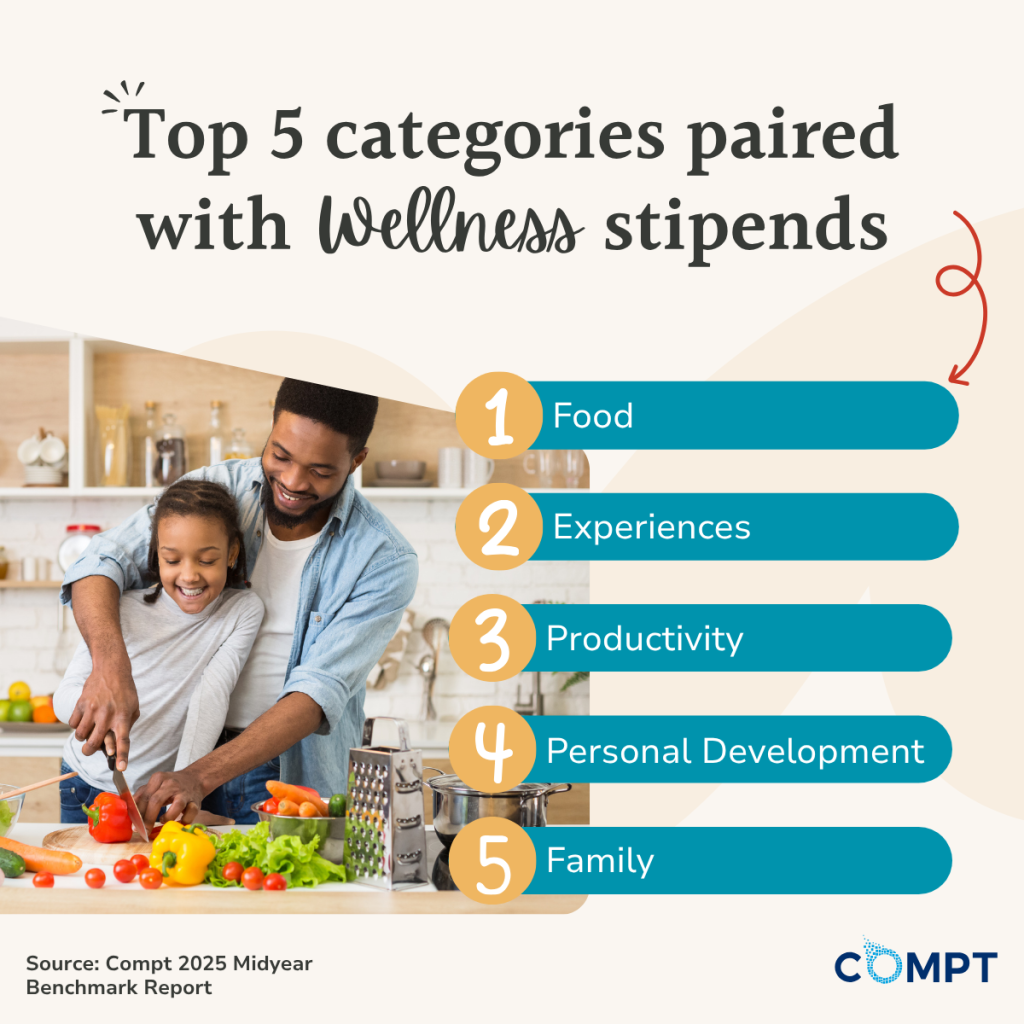
The data tells us that when employees have flexibility in how they use their benefits, they spend on essentials that make everyday life easier. In Compt’s 2024 data, the average food claim totaled $161, covering everything from coffee beans and sparkling water to meal kits and snacks for the workday.
As of midyear 2025, companies typically funded between $50 and $480 per employee per year for food-related stipends. That range reflects a wide variety of program types, from small quarterly grocery reimbursements to larger, all-inclusive wellness stipends and LSAs with food as one category.
You can make your employee grocery stipend program as broad or as focused as your workforce needs.
“Food-related stipends go far beyond the basics, with employees creating meaningful experiences with every bite. Whether it’s health and wellness, connecting with colleagues, or celebrating loved ones, food continues to play a significant role in employee well-being and satisfaction.”
— Tim Faherty, Senior Customer Success Manager, Compt
This approach meets employees where they are, turning a small benefit into a meaningful way to relieve pressure at home and strengthen connection at work.
How to structure an employee grocery stipend
Every company structures food support a little differently. The most successful programs share three traits: flexibility, simplicity, and clear intent. Here’s a quick guide to how we’ll work together to structure your employee grocery stipend.
1. Define how employees can use it.
Food stipends can cover a wide range of use cases, and you determine your company’s policy. Employees at Compt customers have used their food stipends in all the following ways.
- Everyday meals and groceries: stocking up on household staples and healthy ingredients like salmon, produce, and protein shakes.
- Team lunches and celebrations: picking up the tab for a “marketing team lunch” or a “holiday lunch for the tax team.”
- Health and wellness food: investing in nutrition-related purchases like bone broth, supplements, or meal kits that support specific diets.
- Small joys: snacks that make the workday easier — think almonds or popcorn.
- Travel meals: local dining during business or personal travel, made easy through reimbursement in multiple currencies.
“Employees seem to appreciate the ability to enjoy quality meals, stock up on groceries, share team lunches, and treat themselves to snacks.”
— Tim Faherty, Senior Customer Success Manager, Compt
2. Choose a cadence that fits your budget.
Quarterly stipends are the most common, representing 53% of all stipend programs in the 2025 Midyear Benchmark Report. Quarterly distribution gives employees predictable access while keeping budgets simple for HR and Finance.
3. Keep reimbursement vendor-free.
For this benefit to be most useful, employees should be able to buy what works for them — whether that’s a Costco grocery run, a DoorDash delivery, a meal kit from HelloFresh, or a team lunch at a local favorite. Compt’s vendor-free approach ensures inclusion for all employees, especially remote and hourly workers who may not have the same access to specific establishments based on their locations and hours.
4. Automate the admin.
Food stipends are taxable, which doesn’t sound like fun to manage and calculate on your own. Compt is a modern lifestyle benefits platform built to handle tax classification automatically. You can launch and maintain stipend programs without additional software or manual reconciliation, and approving reimbursements takes many customers less than 10 minutes a week. (Say goodbye to spreadsheets!)
“Through the Compt platform, employees can add details (up to 255 characters) about how they use their stipends. The extra detail (maybe we’ll refer to it as extra spice or flavor?) helps fast-track reimbursement by giving employers a more thorough insight to reject or approve the claim.”
— Tim Faherty, Senior Customer Success Manager, Compt
Real employee impact
The proof of a benefit’s effect on people always shows in how they use it. When employees talk about their food stipends, they aren’t describing luxury — they’re describing relief. A little flexibility goes a long way toward reducing stress and helping people focus on work and life at home — not worrying about what’s in the fridge.
Here’s what Compt users have said about the difference it makes:
- “The $250 from Compt is very helpful for me. I put it toward my grocery bill. A big thank you.”
- “With the high cost of groceries, it’s helped to almost cover one weekly trip.”
- “Eating healthy isn’t cheap. This extra money has helped out a lot.”
- “I struggle to make ends meet as a single mother. This quarterly stipend has helped so much.”
- “It’s been nice being able to turn in receipts for groceries or flights. I hope to do something frivolous sometime!”
- “I really appreciate this benefit. It helps out a lot with groceries.”
Every reimbursement tells a small story: someone choosing healthy food options or stretching a paycheck a little further to take care of themselves and their family.
Launch a grocery stipend that works with Compt
Food stipends have always mattered, but moments like this make their impact even clearer as families navigate higher costs and reduced public assistance.
A grocery stipend is one of the fastest, most visible ways to make a difference for your team — and it doesn’t take much budget to get results. You can add a grocery category to your existing benefits in less than two weeks with Compt’s lifestyle benefits platform.
Request a demo to see for yourself.

FAQs: Employee grocery stipends
The most effective approach is reimbursement-based, not vendor-based. Rather than leaning on restrictive gift cards, a reimbursement model lets employees buy groceries, meals, or snacks from their preferred stores or delivery services, wherever they live. It’s also inclusive for global and hourly teams who may not have access to the same vendors. With Compt, reimbursements are submitted and approved through one platform, then processed automatically through our integrations with payroll providers like ADP, Workday, and Gusto.
I’m setting up a Lifestyle Spending Account — how much flexibility can I give employees to choose between food, pet, and family stipends without creating compliance headaches?
You can offer broad flexibility while staying compliant by separating taxable and nontaxable categories within the same program. For example, groceries, pet care, and family support are taxable, while internet or commuter benefits are not. Compt was built with IRS compliance as a priority, so it classifies each claim automatically.
I’m sketching out a benefits policy for our distributed tech team — are there examples of flexible stipends that cover home office, fitness, and food allowances all in one?
Yes. Many employers are moving toward all-inclusive Lifestyle Spending Accounts (LSAs) that combine multiple categories into a single program. Compt’s 2025 Midyear Benchmark Report found that 65% of our customers offer all-inclusive LSAs, and food is included in 93% of them — often alongside wellness, home office, and family support. This setup reduces administrative lift while giving employees more freedom to use their stipends in ways that fit their lives.
Any benchmarks on how fast-growing tech companies structure food benefits inside a lifestyle stipend — daily meal credits vs. monthly reimbursements?
Food benefits have evolved quickly. Only 6% of Compt customers offer food as a standalone stipend, but it still shows up consistently as the top category paired with wellness stipends. It’s also included in 93% of LSAs. In other words, companies are adding “food” to the flexible stipend, not running a separate meal program. Nearly all employers have shifted away from daily meal credits toward monthly or quarterly reimbursements, with quarterly stipends representing 53% of all programs. This cadence is easier to manage and ensures equitable access for hybrid and remote teams.
Compt data shows companies typically fund between $50 and $480 per employee per year for food-related stipends. That range reflects a wide variety of program types, from small quarterly grocery reimbursements to larger, all-inclusive wellness stipends and LSAs with food as one category.
What’s the best stipend management solution for a global company that has to reimburse meals, car costs, and wellness expenses in multiple currencies?
Your best option is a vendor-free platform that can manage reimbursements across currencies and regions without adding local complexity. Compt supports stipends in 70+ countries, automatically converts reimbursements into local currency, and processes payments through payroll. That means you deliver lifestyle benefits with one consistent global experience for every employee.
Additional reading: Tim’s quotes are from the Compt article, “The 6 Top Food Stipend Categories Employees Love Most (With Real-Life Examples).” Check it out for his experiences with Compt customers and how they use food and grocery stipends.

 No receipt chasing