

Fitness classes, meditation apps, healthy meal plans, you name it — every team member has their own individual wellness needs. To support everyone at once, you need something that’s (a) easy to standardize, (b) straightforward to administer, and (c) inclusive.
This is why wellness stipends have become a common feature in modern benefits packages. There are quite literally dozens of ways to use them. According to our 2025 Midyear Lifestyle Benefits Benchmarking Report, it’s the most-offered benefits category among Compt customers (for both stipends and all-inclusive LSAs).
But for HR and payroll teams, they come with an important question: Are these stipends considered taxable income?
Misunderstanding the IRS’s rules leads to expensive compliance issues and unexpected tax liabilities down the road.
This article answers that question. And, it breaks down what HR and finance leaders need to consider before rolling out or expanding their wellness stipend program.
Wellness stipend tax 101
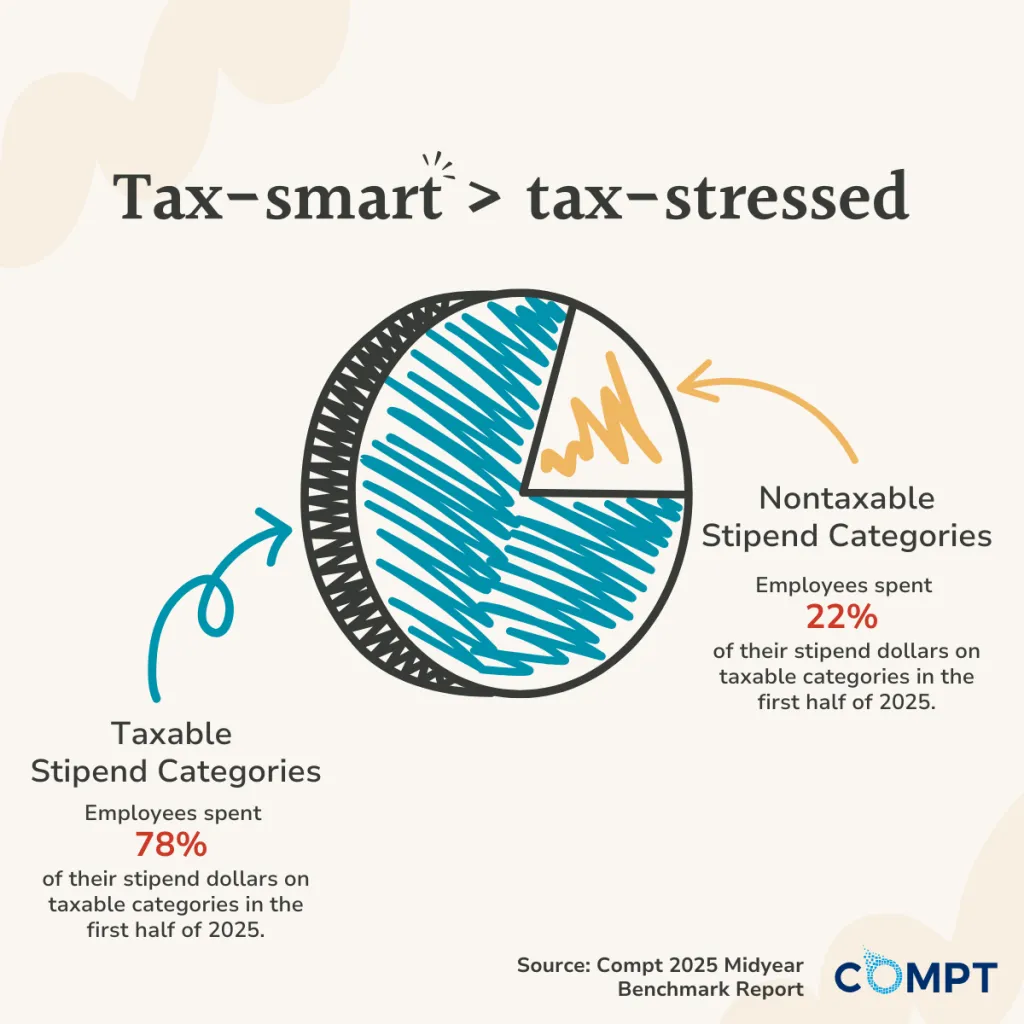
Wellness stipends are generally considered taxable income in the United States. Whether you’re giving employees $100 a month for fitness apps, reimbursing them for a gym membership, or offering a full wellness benefit package, your employees will have to pay taxes on the money.
That means these benefits are subject to:
- Federal income tax withholding
- Social Security (FICA) and Medicare taxes
- Employer-side payroll taxes
Why?
Because the IRS treats most wellness stipends as fringe benefits — that is, nonwage compensation provided in addition to regular salary. Unless a specific exemption applies, fringe benefits are included in the employee’s gross income and must be reported on Form W-2.
What is a fringe benefit, exactly?
A fringe benefit is any form of compensation other than straight wages. This includes things like company cars, tuition reimbursement, employee discounts, and yes, wellness stipends. While the IRS does allow some fringe benefits to be tax-free, they have to meet strict criteria to qualify.
Are there any exceptions?
There are three limited cases where wellness-related benefits might be excluded from income, and they have to be structured that way on purpose:
- Medical expense reimbursements through a group health plan or HRA (Health Reimbursement Arrangement).
- De minimis benefits, like occasional fruit baskets or fitness swag, which are low in value and infrequent.
- Certain employer-operated athletic facilities/EAP-type benefits, depending on how they’re structured.
But here’s the key takeaway: Recurring wellness stipends don’t fall under these exceptions. A few narrow wellness benefits can be excludable when they’re part of an employer health plan or meet another specific IRS exclusion, but in general, monthly and quarterly wellness allowances that employees can spend broadly are taxable and should be treated as wages.
Important note: If you start reimbursing medical or §213(d) expenses through what is supposed to be a taxable, nonmedical wellness stipend, you can inadvertently create a separate group health plan and trigger ERISA, COBRA, ACA, HIPAA, and HSA-eligibility rules. So, keep medical reimbursements inside the health plan or HRA.
What happens if stipends aren’t properly taxed?
If you fail to properly tax your employee’s wellness stipend payments or reimbursements, you’ll owe penalties, back taxes, and interest.
- Failure to withhold and report employment taxes can result in penalties ranging from 2% to 15% of the unpaid tax, depending on the duration of the delay. (Penalties are time-based and tied to the kind of failure; check IRS Publication 15 for the current chart.)
- Failure to withhold the necessary taxes from employee compensation makes you liable for both the employer and employee portions of Social Security and Medicare taxes, and potentially the income tax that should’ve been withheld.
This means the IRS can hold you responsible for paying the amount that should have been withheld.
On top of that, when you cover an employee’s share of taxes without withholding them from the employee’s wages, the amount you paid is also considered additional income to the employee. This further increases the total wages subject to taxation and, by extension, increases your tax liability.
Note: You can find all this information and more in IRS Publication 15 (Circular E).
How this fits into your benefits program implementation
Once you’ve decided to offer a wellness stipend, the next step isn’t picking which fitness apps to reimburse. It’s making sure your payroll system can handle it correctly.
It’s important to build your wellness program like you’d build any other compensation component: with payroll, finance, and compliance in mind from day one.
Payroll configuration matters. A lot.
Because wellness stipends are typically taxable benefits, they need to be tracked, reported, and taxed just like regular wages. That means adding them to your payroll system as a specific line item categorized as taxable income.
If you’re using Compt, this is handled for you automatically. The system knows to treat wellness stipends as taxable fringe benefits and ensures they’re included in gross pay, taxed appropriately, and appear correctly on employee pay stubs.
If you’re not? You’ll need to manually:
- Add the stipend as a taxable benefit in your payroll system.
- Set up the correct tax treatment (federal, state, FICA, Medicare).
- Report it consistently across payroll cycles.
- Do this for all your employees.
W-2 reporting and compliance
Taxable wellness stipends need to be reflected on each employee’s Form W-2 under Box 1 (“Wages, tips, and other compensation”). While there’s no separate code required for this type of benefit, accurate tracking is essential in case of a payroll audit or IRS inquiry.
If you’re doing things by hand or with spreadsheets, this makes things more complicated. There’s no separate line for you to enter the wellness stipend, so you need clear internal records that show:
- Who received a stipend
- When it was issued
- How much was disbursed
- That it was taxed accordingly
With Compt, we customize payroll reports to make sure these expenses are processed correctly. That way, employees are taxed appropriately and everything flows smoothly through their payroll provider.
And, there’s an audit trail of everything, so you can easily provide documentation whenever you need it.
How to help employees understand your wellness stipend
If you offer $100/month for wellness expenses, employees may assume they’re getting the full $100. When they receive a bit less because of tax withholdings, confusion (and frustration) can follow if you aren’t proactive with your communication.
Talk taxes early, and in plain language.
Don’t wait for questions. As part of your program launch or annual benefits review, explain:
- The stipend is considered taxable income.
- It will show up on pay stubs and W-2s.
- The net amount employees actually receive may vary depending on their tax bracket and deductions.
Avoid jargon. Keep it straightforward:
“You’ll see the wellness stipend taxed the same way your regular income is. The full amount is included in your paycheck, and then standard payroll taxes apply.”
Put it in writing, too. Ideally, in your benefits guide or a one-pager dedicated to the stipend program. Include a real example using sample numbers so they can visualize the impact.
Offset the tax impact (if your budget allows).
If your goal is for employees to net a specific amount (e.g., $100/month to spend on wellness), consider grossing up the stipend.
Grossing up means increasing the stipend amount to account for taxes. So instead of offering $100, you offer ~$130 (depending on your payroll tax rates) so the employee still pockets around $100 after taxes.
This small adjustment can:
- Prevent confusion
- Improve the perceived value of the benefit
- Show you’ve thought through the details and care about your employees’ experience
Preempt the payroll surprises.
Most employees won’t check their pay stub closely until tax season. To help them avoid surprises when they see a higher W-2 wage total than expected, let them know upfront that the stipend counts toward total compensation.
Framing this as part of their overall earnings will help you shift the perception from “this got taxed” to “this is an extra part of what my company invests in me.”
Budgeting for a taxable benefit
Because it’s taxable, offering a wellness stipend is more than just setting a dollar amount. You need to understand the full cost to the company.
Because the stipend is considered taxable income, you’ll owe employer-side FICA taxes, including:
- 6.2% for Social Security
- 1.45% for Medicare
- Plus any applicable state-level payroll taxes
So for a $100 stipend, you’re really paying about $107.65 per employee per month (based on 2025 rates; use the current year’s IRS Publication 15 for the exact Social Security wage base and FICA rates). Multiply that across your team, and the true cost adds up quite a bit.
And if you’re not using a platform like Compt to automate compliance, you’ll also need to account for:
- W-2 reporting oversight
- Manual tracking and reconciliation time
- Additional payroll and finance labor hours
Even if those costs are indirect, they impact your HR ops team, so they have to be factored into how you structure and scale the program.
Pro tip: Include your finance team early when building or adjusting the stipend. You’ll be better positioned to scale the program without surprises.
Simplify your wellness stipends with Compt’s compliance-first software.
Designing a wellness stipend that employees love and stays compliant requires coordination between HR, payroll, and finance, with clear rules and airtight execution.
While every company absolutely must work with a qualified tax advisor when building out fringe benefit programs, Compt’s health and wellness stipend software makes the process easier, faster, and far less error-prone.
With Compt, you can:
- Automate tax-compliant payroll reporting
- Track stipend usage and disbursement in real time
- Give employees freedom to choose wellness options that fit their lifestyle
- Ensure proper documentation for W-2 reporting and audits
Ready to create a benefits program that supports employee well-being while protecting your business from compliance headaches?
Request a demo to see how it works.

FAQs: Nontaxable and taxable benefits for employees (2026)
Wellness stipends have become one of the most popular ways to support employee health and well-being, but they also raise important compliance questions. Before launching or expanding a wellness stipend, it’s crucial to understand how the IRS classifies these benefits, when they’re considered taxable income, and how to manage reimbursement and payroll reporting properly.
The FAQ below answers the most common questions HR and Finance teams ask about taxable benefits, taxable vs. nontaxable stipends, and how lifestyle benefits compare to traditional perks in engagement and ROI.
Which stipends are nontaxable vs. taxable?
In 2026, most stipends are taxable, but a few categories qualify as nontaxable fringe benefits when they meet IRS exclusions. Work-related expenses such as professional development courses, books, or conferences can be untaxed if they primarily benefit the employer. Cell phone and internet reimbursements may also be excluded when used for business purposes, and commuter benefits for parking or transit remain tax-free up to the monthly IRS limit.
Everything else — wellness stipends, meal or food perks, family or pet stipends, productivity or travel allowances, charitable-giving funds, bonuses, and gift cards — counts as taxable benefits and should be reported on the employee’s W-2. Lifestyle stipends also differ from traditional fringe benefits like gym memberships, which only qualify for tax exclusion when provided on-site or for business necessity.
How do meal allowances get taxed?
A flat meal or food allowance, such as $100 per month for healthy meals, is generally taxable income to the employee and should be included in wages. Only meals provided on the employer’s premises for business reasons or during business travel may qualify for exclusion. For 2026, confirm the employer deduction and employee tax treatment in the latest IRS guidance, as rules can change year to year.
Can wellness stipends ever be pre-tax?
Not usually. To be pre-tax, the benefit must be part of a compliant medical arrangement, such as an integrated HRA, and reimburse only eligible §213(d) medical expenses. Standalone wellness or lifestyle stipends are flexible benefits by design, so they are almost always post-tax.
Do we have to report wellness or other stipends on the W-2?
Yes. If the stipend is taxable — and most are — it must be included in the employee’s Form W-2 wages (Box 1, and typically Boxes 3 and 5). Using a platform built for tax compliance like Compt ensures proper payroll integration and tracking so everything is recorded and reported correctly.
How should we handle receipts for sensitive reimbursements (fertility, therapy, family planning)?
Compt includes secure receipt review for all reimbursable stipends to maintain compliance while protecting employee privacy. Employees can redact or blur sensitive details before uploading receipts. Larger teams may opt for Compt’s third-party receipt review service so HR doesn’t have to view sensitive documents directly. Employers can also use preapproved vendor lists or auto-approval rules to minimize manual review.
What happens if we don’t tax the stipend?
If a stipend that should be taxable isn’t, the IRS can hold the employer responsible for both the employee and employer portions of unpaid Social Security, Medicare, and income taxes, along with penalties and interest. That’s why stipends should always be reviewed for proper classification and processed through payroll.
Can we gross up stipends so employees still get the full amount?
Yes. Employers can choose to increase the stipend amount to cover estimated taxes so employees receive a consistent net benefit. This “gross-up” approach should be applied consistently across all eligible employees to ensure fairness and compliance.
Is it smarter to roll taxable perks like meals or gym reimbursements into a lifestyle stipend?
Yes. While individual perks like meal allowances or gym memberships are almost always taxable, grouping or consolidating them under a lifestyle stipend simplifies administration and gives employees more flexibility to choose what’s meaningful to them, without adding extra categories or reimbursement rules to track.
Which metrics help finance prove ROI when we replace point-solution perks with a lifestyle benefits wallet?
Finance teams typically track participation rate, average spend per employee, and total budget utilization. When point-solution perks such as gym memberships or meal cards are replaced with a Lifestyle Spending Account with Compt, utilization often increases from less than 30% to more than 90%. The result is higher employee satisfaction, improved equity, and a clearer link between benefit dollars spent and engagement outcomes.
Because you’re reimbursing actual employee spend and tracking it in one system, Finance gets a cleaner view of benefit dollars used and can adjust funding levels over time as business needs shift. The more programs you consolidate with Compt, the greater the benefit.
How do lifestyle stipends stack up against traditional fringe benefits in terms of engagement?
Traditional perks like on-site gyms or commuter programs tend to benefit only a small segment of the workforce. Lifestyle stipends from Compt, by contrast, are inclusive and self-directed; employees choose what matters most to them. This flexibility leads to utilization rates up to three times higher than fixed perks and drives stronger engagement across diverse, hybrid, and remote teams.
What’s the most tax-efficient way to offer work-from-home or remote stipends alongside wellness benefits?
When remote employees receive multiple stipends — like home-office and wellness allowances — each should be tracked and taxed based on how it’s used. Internet and equipment reimbursements that support business operations may qualify for tax exclusion, but wellness expenses remain taxable. Using a single platform like Compt helps automate correct tax treatment across categories and locations, keeping payroll consistent across states or countries.
How do we make sure wellness or lifestyle stipends stay compliant across multiple states?
Each state may have slightly different wage and reporting rules for taxable fringe benefits. The IRS governs federal tax treatment, but states determine how benefits flow into wage bases for unemployment insurance and local taxes. Using software that integrates with payroll (like ADP or Gusto) ensures stipend reimbursements are automatically coded and taxed correctly across state lines.
Looking for more guidance on designing compliant, inclusive benefit programs? Explore our Lifestyle Spending Account Guide for a deeper look at how LSAs handle taxation and flexibility, or see how leading employers are structuring their stipend programs and Lifestyle Spending Accounts in our 2025 Midyear Benchmark Report.

 No receipt chasing