
Nowadays, attracting talented workers requires more than just a competitive salary.
While base salary is often the most visible component, total compensation reflects the complete financial and nonfinancial investment an organization makes in its workforce. Companies invest heavily in compensation and benefits strategies to attract, retain, and support employees.
But what is total compensation, and how can companies maximize their investment in total compensation and rewards strategies?
What is total compensation?
Total compensation is the complete value of all payments and benefits given to an employee by an employer in exchange for their work. It includes direct pay, such as base salary, bonuses, commissions, and tips, as well as indirect compensation, such as employee benefits, lifestyle benefits and perks (e.g., flexible Lifestyle Spending Accounts, or LSAs), and equity.

Base salary
Base salary is the amount of money an employer pays an employee for performing their job-related responsibilities.
An employee’s base salary excludes any additional compensation such as benefits, bonuses, or commissions.
Salary is calculated annually and typically increases as an employee advances and takes on new roles and additional responsibilities within a company.
Bonus pay
Bonus pay is money given to employees in addition to their base salary. Companies often provide bonuses to employees as rewards for performance or for time spent working for the company. Bonuses are not mandatory, and many companies give them out as a token of appreciation for their employees.
Employee benefits
Employee benefits are noncash forms of compensation provided in addition to base salary. These may include health insurance, retirement contributions, tuition reimbursement, paid time off, and equity.
Some benefits are legally required. Employers must pay certain statutory payroll taxes, including Social Security and Medicare (FICA), and provide unemployment insurance coverage. Others are discretionary and vary from one organization to the next.
Lifestyle benefits and employee perks
Employee perks are additional offerings that supplement traditional benefits. These can include gym reimbursements, meal plans, an internet stipend, family care stipends, student loan stipends, and Lifestyle Spending Accounts.
Unlike fixed benefits, LSAs allow employees to allocate employer-provided funds toward eligible expenses that fit their personal needs.
(Psst: Here’s a more in-depth look at employee perks.)

Stock options
Employee stock options (ESOs) are a form of equity compensation that a company gives its employees. ESOs allow owners to buy or sell shares at a prearranged price and date. Employers issue ESOs in the hope that the stock will rise. A corporation giving out ESOs must issue its employees new shares when they are exercised.
Commission
Commissions are a percentage-based compensation given to staff contingent on their sales performance.
For example, if an employee brings in $20,000 in sales and has a 5% commission, they earn $1,000. Employees in roles that pay both salary and commission will be more likely to receive smaller salaries to incentivize work performance.
Tips
The hospitality industry is where tips rule. Service workers, such as bartenders, baristas, and servers, earn substantial tips (in addition to their base wage). Workers receive tips in cash or by debit or credit card. Tips are considered taxable and must be reported when filing a tax return. The IRS has a form for tracking tips to be reported to an employer.
The difference between salary and total compensation
Salary represents guaranteed earnings. Total compensation includes salary plus all additional employer-funded benefits.
Employees are usually aware of their base salary but are often unaware of how much they earn in additional benefits.
This is because additional benefits typically include perks or services such as insurance, ClassPass subscriptions, fertility and family-building support, transportation stipends, or work-from-home stipends.
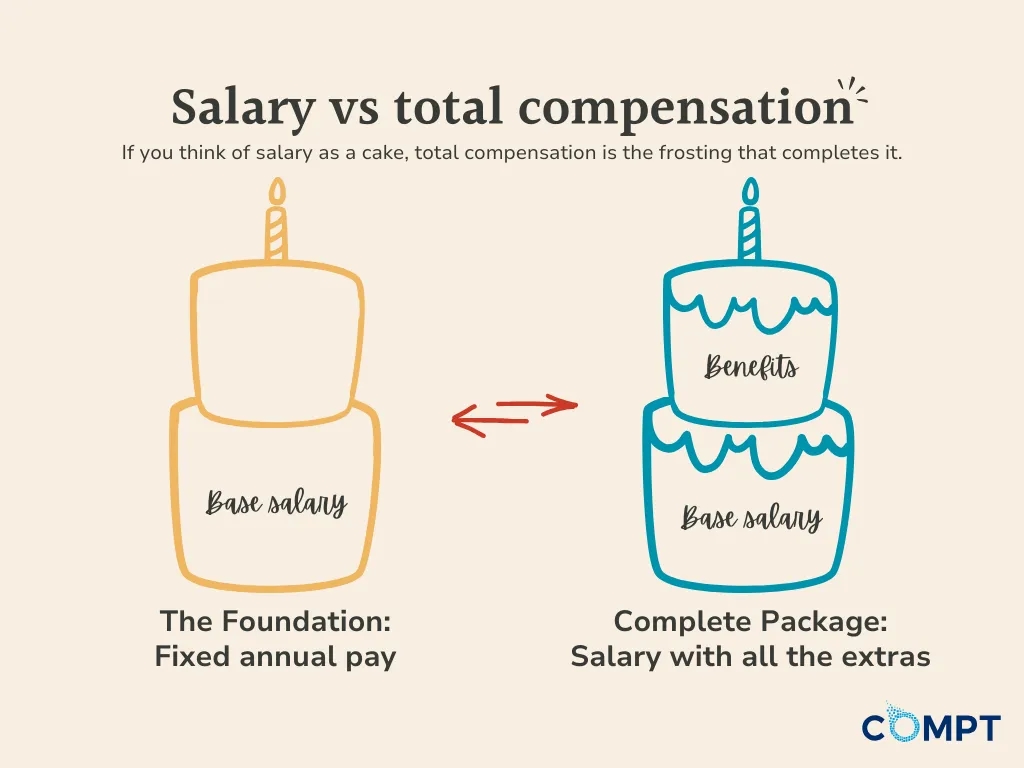
Ultimately, these perks and services are an additional cost to an employer and are factored in when calculating the total cost of an individual employee.
How to calculate total compensation
To calculate total compensation for an employee, take the sum of their base salary and the dollar value of all additional benefits. Additional benefits include insurance, commissions and bonuses, time-off, and perks. Employees rarely receive the exact same amount of pay, so the total dollar value of compensation packages will vary.
Let’s look at an example:
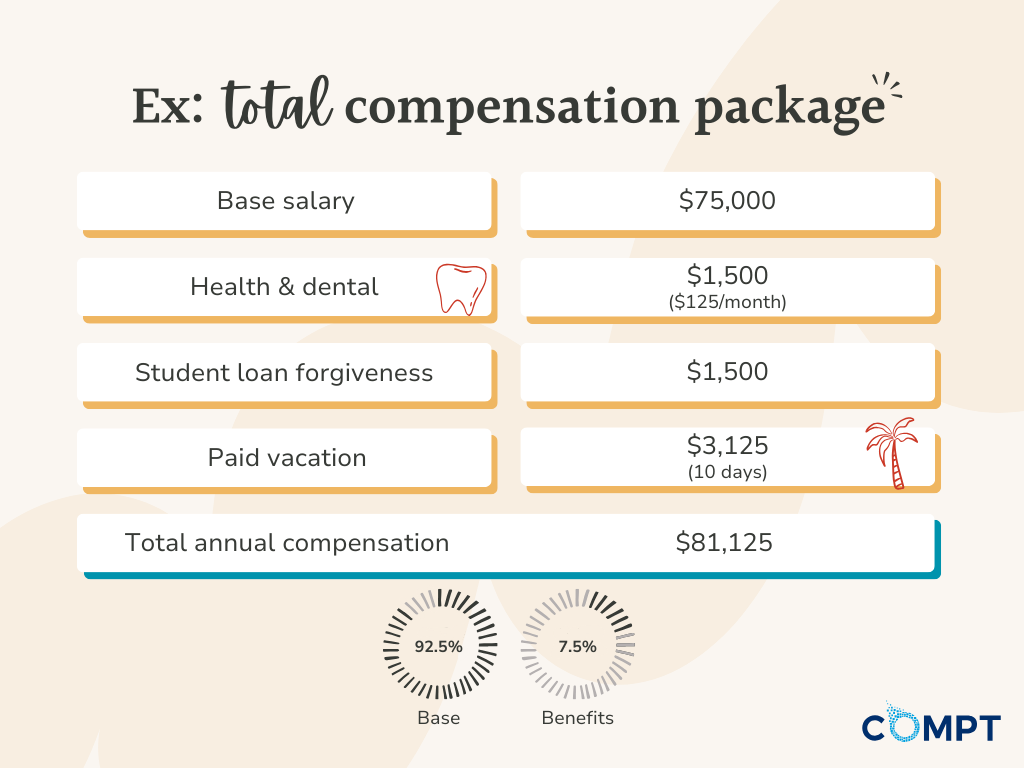
Suppose a financial analyst was just hired by a large financial institution. For simplicity, assume their base salary is $75,000 a year, and their additional benefits package comes with health and dental insurance, $1,500 a year toward student loan forgiveness, and 10 days of paid vacation every year. The combined health and dental insurance is $125 a month, for a total of $1,500 yearly. Their 10 paid vacation days are worth $3,125 a year.
In summary, the total annual compensation for this financial analyst is $81,125.
Why is total compensation important?
Total compensation is important because it plays a central role in recruitment, retention, and workforce stability. When evaluating job opportunities, candidates often consider more than just salary; they analyze the full compensation package.
When base salaries are similar, differences in benefits can influence decision-making. Participation data reinforces this: according to our 2026 Annual Lifestyle Benefits Benchmark Report, all-inclusive Lifestyle Spending Account benefit programs achieved 89% utilization and 93% participation among active users, demonstrating that well-designed compensation components can drive consistent engagement. In competitive hiring markets, candidates compare total compensation packages, not salary figures alone.
For employers, the implication is clear: compensation design affects realized value. A benefit that is rarely used contributes little to retention. A benefit that aligns with employees’ real-world needs becomes part of how they evaluate the overall fairness and competitiveness of their compensation.
Example: The real cost of getting compensation wrong
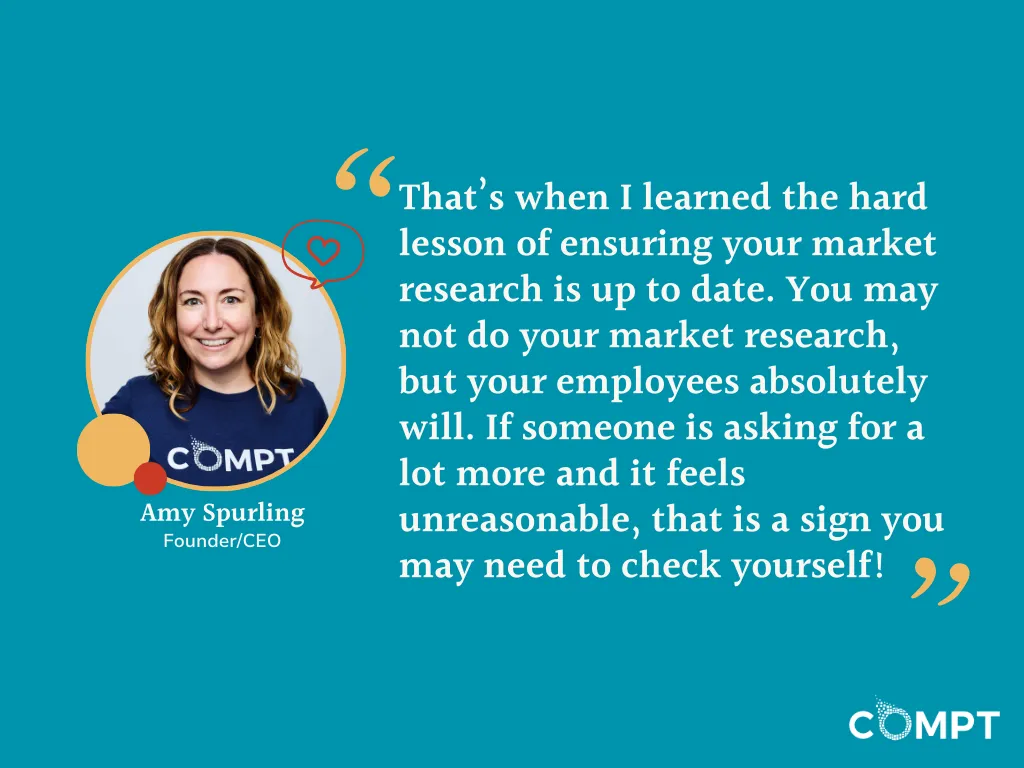
While employers look at compensation as a line item, remember that it matters to employees and can make the difference between staying and leaving. Our CEO, Amy Spurling, told me that, as a former CFO, she once let a key employee walk away from a $15k compensation dispute because it would have broken the compensation bands the company had in place.
The cost to replace them? More than $40k in their base salary alone, plus:
- 6 months of recruitment
- 4 months of training
- Lost instituitional knowledge
- Team disruption
Here’s a nugget of advice from Amy:
How employee benefits affect total compensation
Employee benefits shape how total compensation is experienced and evaluated. While salary determines baseline earnings, benefits influence how supported, flexible, and competitive a compensation package feels and how much value employees realize.
Compt’s 2026 Annual Lifestyle Benefits Benchmark Report shows that benefit funding cadence significantly impacts utilization: Quarterly-funded lifestyle benefit programs reached 85% utilization, compared to 52% for monthly funding and 65% for annual funding.
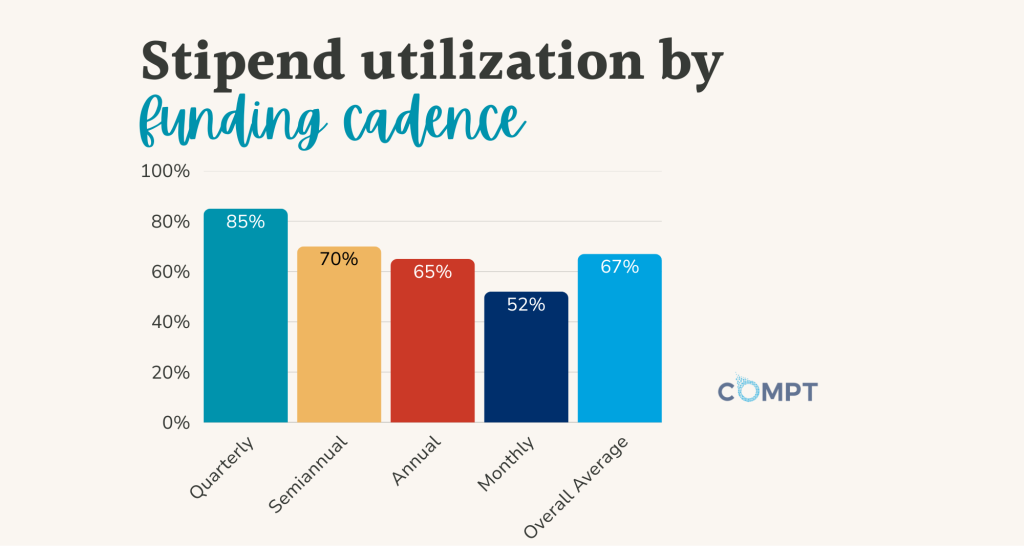
In other words, when benefits are funded can matter as much as which benefits you offer. For HR and Finance leaders, evaluating total compensation requires understanding both what you offer and how design decisions affect participation and realized ROI.
Modern compensation strategies increasingly bundle benefits into flexible structures rather than offering isolated point solutions. Using wellness stipends as an example from the 2026 Annual Lifestyle Benefits Benchmark Report:
- Bundled programs vs. standalone stipends: 71% of Compt customers bundle wellness into broader lifestyle benefit programs rather than offering standalone wellness stipends.
- Utilization: Wellness benefits embedded within a flexible program reached 86% utilization, compared to 62% when offered separately.
For compensation planning, this underscores a critical point: architecture directly affects employee engagement with the benefit. The value of a benefit is not just its cost, but whether employees use it.Spending data from the 2026 Annual Lifestyle Benefits Benchmark Report illustrates why flexibility matters. In 2025:
- Employees most frequently allocated stipend funds toward wellness, food, family support, and professional development.
- 20% of professional development expenses were AI-related, reflecting growing demand for skills-based and productivity-focused tools.
- 20% of organizations supported employees in 62 countries outside the U.S., underscoring the need for equitable access to the same benefit structures regardless of location.
- Employees spent funds across more than 64,000 vendors.
- 70% of spending went to local or independent businesses.
- 1 in 10 stipend dollars were spent at grocery retailers.
The data shows that employees use benefits that integrate into everyday life more consistently than narrowly curated marketplaces. Flexible stipends are increasingly incorporated into total compensation packages because they allow benefits to function as real, usable compensation — not just theoretical value — while avoiding the challenges of adding stipends to payroll.
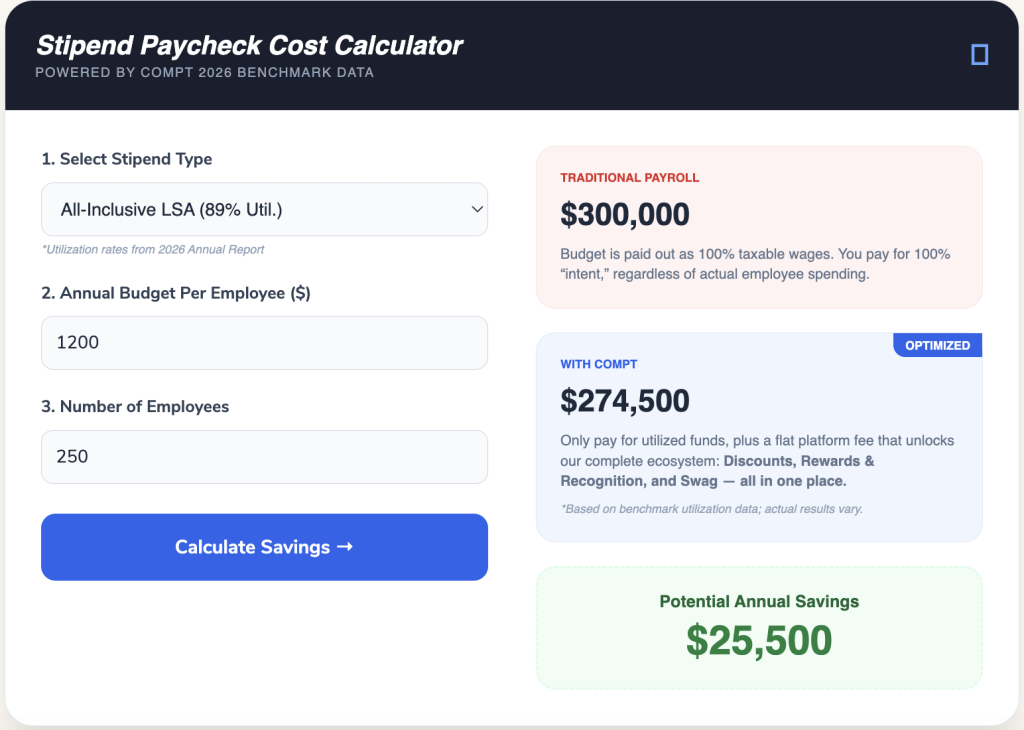
Stop overpaying for underused benefits.
Traditional payroll stipends are paid out 100% regardless of actual use.
With Compt, you only pay for the funds employees spend, saving you thousands while increasing benefits engagement.
Budget allocation also varies by company size:
- Small organizations averaged $1,675 per employee in annual stipend budgets.
- Midsize organizations averaged $1,055.
- Large organizations averaged $649.
These differences reflect varying total compensation strategies, driven by workforce scale and financial models.
For HR and Finance leaders, total compensation planning requires evaluating how salary, benefits, flexibility, and participation work together, as well as employee reception.
“An LSA was actually the only benefits enhancement that we recommended to our executive team for 2026.”
— Head of Total Rewards, midmarket HR software provider
Pay equity and employee compensation
Pay equity is the practice of giving employees with similar job responsibilities equal pay regardless of race, gender, ethnicity, or background. While simple in theory, pay equity can be hard for employers to properly implement. In many instances, enforcement of pay equity is a legal obligation. An effective way to tackle this issue is to implement a comprehensive compensation strategy.
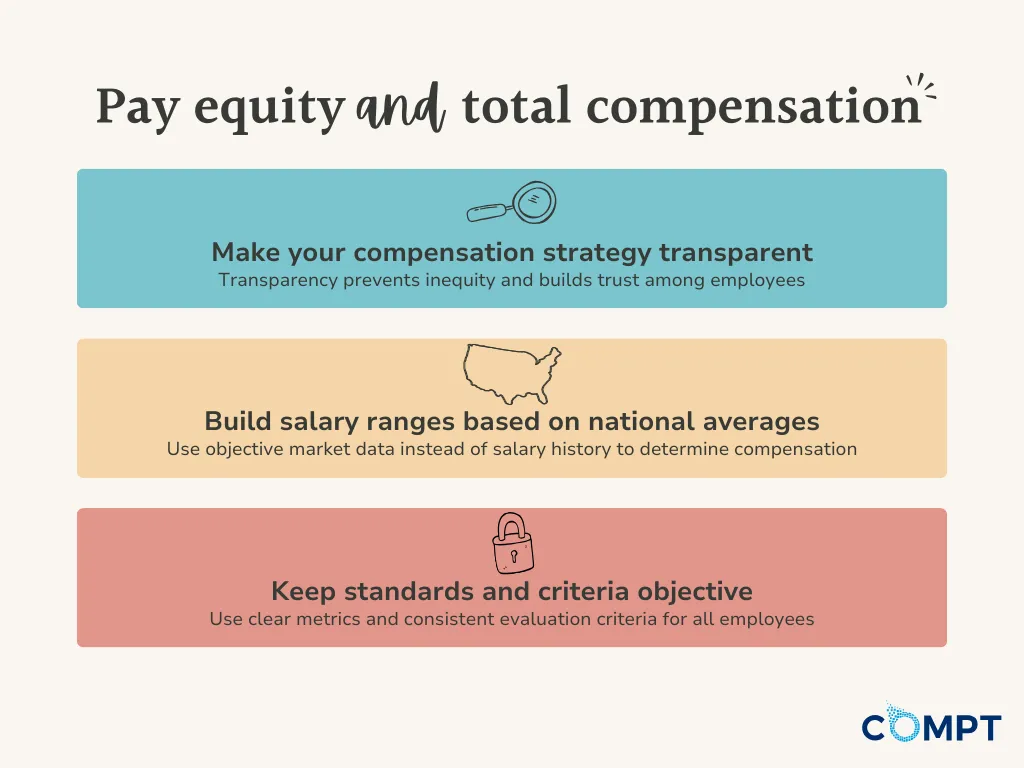
A compensation strategy is the detailed approach a company takes to how employees are paid. These strategies carefully consider all forms of compensation an employee receives to make sure everything is aligned with business and organizational goals. Compensation strategies fortify pay equity by keeping standards and criteria as objective as possible.
For example, asking about a candidate’s salary history may bias decisions on how they should be compensated. The candidate may have been severely underpaid for their actual role and responsibilities. A solution is to set a salary range based on national averages for the position.
Transparency is another key aspect of maintaining pay equity. Employees want to know whether they’re being paid fairly, but often feel uncomfortable addressing the issue directly with management. This leads to awkward conversations between coworkers comparing their earnings with one another. A compensation strategy that emphasizes transparency helps eliminate this problem.
To show its dedication to the battle against bias, Buffer, a social media planner company, publicly lists the salaries of all its employees on its website.
Add to your employees’ total compensation with lifestyle benefits and stipends from Compt.
Total compensation encompasses more than just salary. It’s the full value employees receive from pay, benefits, and flexibility in exchange for their work.
Compt helps HR and Finance teams design flexible lifestyle benefits that increase participation, simplify administration, and strengthen overall compensation strategy.
Get in touch with our team to learn more.
FAQs: Total compensation for employees
Total compensation is the complete value of salary, bonuses, equity, and employer-funded benefits provided to an employee. It includes base salary, variable pay (such as bonuses or commissions), and indirect compensation, such as benefits, equity, stipends, and Lifestyle Spending Accounts (LSAs).
Rather than looking at salary alone, total compensation reflects the full financial investment an organization makes in an employee, including both guaranteed earnings and employer-funded benefits.
What does total compensation include beyond salary?
Beyond base salary, total compensation may include performance bonuses, commissions, equity awards (such as stock options or RSUs), employer-paid health insurance, retirement contributions, paid time off, tuition assistance, and flexible stipends or lifestyle benefits.
For HR and Finance leaders, evaluating total compensation means assigning a clear dollar value to each component and ensuring those components align with market positioning, workforce needs, and budget constraints.
What is the difference between base pay and total compensation?
Base pay refers only to the fixed salary an employee earns for performing their job responsibilities. It does not include bonuses, equity, benefits, or employer-funded stipends or other support.
Total compensation includes base pay plus all additional compensation components. While base pay determines guaranteed earnings, total compensation reflects the broader employment value proposition and is often what candidates compare when evaluating job offers.
How should employers calculate total compensation?
To calculate total compensation, employers combine base salary with the dollar value of all additional compensation components. This includes:
-Bonuses and commissions
-Equity awards
-Employer-paid insurance premiums
-Retirement contributions
-Paid leave
-Allocated stipend or lifestyle benefit funding
Finance teams should evaluate both budgeted cost and realized utilization. A benefit’s allocated value may differ from its perceived value if participation is low. Accurate benchmarking requires understanding total spend and actual employee engagement.
How do employee benefits factor into total compensation?
Employee benefits represent a significant portion of total compensation costs, but their impact depends on how they are structured and whether employees use them.
Benefit design directly influences participation and utilization. For example, flexible lifestyle benefit programs funded on a quarterly cadence reached 85% utilization, compared to 52% for monthly funding and 65% for annual funding. This demonstrates that timing and structure materially affect how employees experience total compensation.
A benefit that is rarely used adds cost but limited perceived value. A benefit that is actively used becomes part of how employees evaluate the competitiveness and fairness of their overall compensation.
How do stipends and lifestyle benefits fit into total compensation packages?
Stipends and lifestyle benefits function as flexible extensions of total compensation. Instead of tying value to a single vendor or narrow category, these programs allow employees to allocate employer-provided funds toward eligible personal expenses within defined guidelines.
Spending patterns show that employees frequently direct flexible stipend dollars toward everyday categories such as wellness, food, family support, and professional development. When structured effectively, these programs achieve high participation and utilization, making them a practical and visible part of total compensation rather than an unused perk.
What’s the easiest way to show candidates that a Lifestyle Spending Account is part of their total compensation, not just a perk?
The simplest way is to present it as a line item in the total compensation summary.
Employers should:
-Assign a clear annual dollar value (e.g., “$1,200 annually, funded quarterly”)
-Include it in offer letters and compensation breakdowns
-Explain eligible categories in practical terms
-Show how often funds are available (monthly, quarterly, annually)
Avoid describing the program as a “perk.” Instead, frame it as an employer-funded lifestyle benefit that is part of the employee’s overall compensation package. When candidates see a defined dollar amount and structured funding cadence, the benefit is perceived as compensation, not an extra.
Why is total compensation important for employee retention?
Programs that align with real-world needs tend to see higher participation and engagement. High utilization rates in flexible benefit programs indicate that employees actively use and value these components. For employers, this reinforces the idea that a total compensation strategy directly affects competitiveness, employee satisfaction, and long-term retention.