
Offering exceptional employee perks requires time, resources, and a significant investment from organizations.
Since no two companies’ perks look exactly alike, it’s not an exact science, nor is it something you can set and forget. Work is constantly evolving, so naturally, your perks should evolve too. Still, there are proven strategies that can help HR implement perks that meaningfully impact employees’ lives.
Whether you’re new to employee perks strategies or looking to improve your offerings this year, Compt’s official guide is here to help. Keep reading to learn more about how to offer better employee perks at work, including how to evaluate perks categories, structure programs that scale, and make informed tradeoffs between cost, participation, and employee value.
What are employee perks?
Employee perks are non-wage offerings beyond salaries and core benefits that enhance employee well-being. Typically, employee perks align with the company’s brand and core values.
You may also hear employee perks referred to as fringe benefits.
Be careful not to confuse employee perks with healthcare, dental, or vision coverage — those are benefits. Perks are not foundational workplace expectations like fair pay, clear leadership, or a functional team structure, either. When implemented effectively, perks can enhance your workplace culture, but they are not a replacement for culture.
While they are a piece of the total compensation pie, perks support employees beyond their standard compensation and are not a replacement for competitive pay strategies. Rather, employee perks are an additional layer that signals to employees that the organization sees them as whole people, with needs that extend beyond their jobs.
There are a few ways to categorize perks:
- Purchasable perks are items or services the company buys or reimburses, such as fitness stipends, meal allowances, or professional development funding.
- Programmatic perks are policy-driven advantages, such as remote work flexibility, Summer Fridays, or generous parental leave.
- Hybrid or remote-work perks reflect how a physical or digital workplace is set up, including dedicated wellness spaces, home office support, coworking access, and cell phone and internet stipends.
- Sustainable or “green” perks are emerging alongside Corporate Social Responsibility (CSR) initiatives to attract and retain eco-conscious talent. These include volunteer days, subsidies for green energy suppliers, or sustainability sabbaticals, where employees can take time off to participate in or lead environmentally conscious projects.
A well-designed perks program is a solid differentiator when candidates weigh similar offers, and it supports day-to-day engagement once someone is hired. Still, perks are not a replacement for but rather a complement to equitable compensation and core benefits.
Read full definitions of compensation, salary, benefits, perks, perk stipends, and more here.
Why stellar employee perks matter
Perks that are flexible, well-funded, and easy to use drive real results: higher employee activation, stronger participation rates, and lower turnover costs.
Among Compt customers in 2025, activation hit 95% and participation among active users reached 93%.
The business case goes beyond attraction and retention. As core benefit costs climb — total health benefit cost per employee rose 6% in 2025 and is projected to rise another 6.7% in 2026 (or nearly 9% without employer intervention), according to Mercer’s National Survey of Employer-Sponsored Health Plans, the highest projected increase in 15 years — HR and Finance leaders need to justify perks spending with programs that drive real utilization.
Programs that consolidate costs, expand employee choice, and deliver measurable participation are far easier to defend than scattered vendor relationships with low adoption.
Perks support attraction and retention.
When candidates evaluate competing offers, perks are visible evidence of how an employer invests in its people. Gallup reports that 54% of employees say better pay and benefits are very important when deciding whether to accept a new job offer.
Retention is more cost-efficient than recruiting.
Replacing an employee is expensive, and with 50% of midsize U.S. companies anticipating turnover in 2026, that’s a price tag that significantly exceeds the cost of an intentionally funded perks program.
According to Express Employment Professionals, the average cost of turnover rose by $10k last year, to $45,236. In comparison, Compt’s 2026 Annual Lifestyle Benefits Benchmark Report shows the median annual budget for an all-inclusive Lifestyle Spending Account (LSA) is $1,200 per employee per year — a manageable investment relative to the cost of losing someone.
Perks reinforce culture without substituting for it.
Well-designed perks reflect what a company values. A professional development stipend signals investment in employee growth. A wellness benefit signals care for well-being beyond standard healthcare coverage. Some real-world examples of this include:
- REI offers employees “Yay Days” — two days off per year to get outside — cultivating a sense of adventure that maps directly to their brand.
- Airbnb offers quarterly travel expenses and emergency travel support
- PerfectKeto, a health food company, offers $150/month for healthy food, $250/month for fitness, and mindfulness subscriptions.
Remember, while these are meaningful supports, employee perks are only successful when the broader workplace is functional and compensation is fair. They work best as reinforcement within a broader employee experience strategy.
Flexible employee perks outperform fixed.
Flexible perks — those that adapt to individual circumstances rather than assuming uniform needs — consistently outperform fixed perks in both participation and perceived value.
Compt’s 2026 Annual Lifestyle Benefits Benchmark Report found that 64% of employers now offer an all-inclusive Lifestyle Spending Account (LSA) as their primary perks vehicle, up from 55% in 2024. Employee participation is highest for benefits tied to recurring needs: all-inclusive LSAs (93%), cell and internet (88%), wellness (85%), and office equipment (84%).
Employee preferences here reflect a deliberate shift toward benefits that offset everyday living costs, and employers are paying attention and consolidating scattered perks into a single, flexible structure that’s easier to manage and that employees actually use.
List of modern employee perks for every business
Employee perks fall into two categories based on tax treatment: taxable lifestyle benefit stipends, which cover the broadest range of everyday employee needs, and nontaxable workstyle benefits, which qualify for favorable IRS treatment. The distinction matters for program design, payroll reporting, and how employees experience the value of what you offer.
Many of these categories can be delivered within a single flexible stipend or Lifestyle Spending Account (LSA), which reduces vendor sprawl and administrative overhead.
Taxable lifestyle benefit stipends
These categories are taxable as income and cover the broadest range of employee needs: everyday well-being, family and caregiving, financial education and support, and travel. Because they are employee-directed, they consistently drive higher participation than fixed, employer-selected perks.
- Caregiving
- Charitable giving
- Entertainment
- Experiences
- Family
- Family building
- Financial wellness
- Food
- Health and wellness
- Home
- Personal development
- Personal travel
- Pets
- Productivity
- Tech
- Treat yourself
- Weight management
Nontaxable workstyle benefits
These categories qualify for favorable tax treatment under IRS guidelines, meaning employees receive the full value of the benefit with no additional tax burden. Compt automates the categorization and reporting of nontaxable benefits within our platform, reducing compliance risk for HR and payroll teams.
- Business travel
- Cell phone
- Commuter parking and transit
- Company swag
- Coworking
- Internet
- Professional certifications
- Professional development
- Remote work equipment
- Safety equipment
- Student loan repayment
- Team events
The right mix depends on your organization’s culture, workforce size, and employee needs. But participation data reveals which categories employees actually value most. According to Compt’s 2026 Annual Lifestyle Benefits Benchmark Report, all-inclusive LSAs led utilization at 89%, outperforming standalone wellness (70%), professional development (40%), and caregiving (46%) stipends. Wellness category engagement also increases when it’s part of a broader program, reaching 86% when delivered within an LSA, compared to 62% as a standalone stipend.
Flexibility is the common thread. Whether delivered as a standalone stipend or as part of a broader LSA, the perks with the highest utilization are those that employees can direct toward their everyday lives rather than a fixed list of employer-selected options.
Table: Average participation and utilization by stipend (2025)
| Stipend category | Participation rate | Utilization rate |
|---|---|---|
| All-inclusive LSA | 93% | 89% |
| Caregiving and family | 78% | 46% |
| Cell and internet | 88% | 74% |
| Charitable giving | 49% | 51% |
| Commuter | 60% | 25% |
| Coworking | 27% | 7% |
| Food | 79% | 77% |
| Office equipment | 84% | 77% |
| Out-of-state care | 14% | 18% |
| Professional development | 47% | 40% |
| Safety equipment | 66% | 62% |
| Team recognition | 82% | 80% |
| Wellness | 85% | 70% |
Explore Compt’s 30+ employee stipend categories and see how they map to your workforce.
Moving from fixed perks to flexible stipends or Lifestyle Spending Accounts (LSAs)
The defining shift in how modern employers structure employee perks is the move away from fixed, vendor-specific offerings toward flexible stipends and LSAs. In 2025, the share of Compt customers offering an all-inclusive LSA jumped from 55% in 2024 to 64% in 2025 — a 9-point increase in a single year that reflects how quickly employers are moving away from fixed vendor programs.
Rather than selecting a sprawling list of approved vendors, employers define eligible spending categories and a per-employee budget, then decide the right cadence to fund perks — annually, semiannually, quarterly, or monthly. Employees submit receipts for qualifying purchases within those categories and are reimbursed through payroll.
When benefits are funded matters as much as how many categories are offered. According to Compt’s 2026 Annual Lifestyle Benefits Benchmark Report, quarterly-funded programs reached 85% utilization, compared to 52% for monthly and 65% for annual funding.
“We began by mapping our current perks ecosystem end-to-end to better understand what we offered, who actually used it, what it cost, and how easy (or not) it was to administer. We discovered that many of our current perks were underutilized, misaligned, or simply too complicated to be worth the effort.”
— Turiya Gray, Fractional Chief People Officer, FXG Partners
Why consolidation is the right starting point
For most organizations, the path to a better perks program starts with consolidation. Merging multiple standalone stipends into a single LSA typically reduces administrative complexity and vendor management costs, which can partially offset reductions in employee-facing budget. It also gives employees more flexibility within the same or lower total spend.
Low-utilization vendor programs are the clearest candidates for consolidation. If fewer than half of eligible employees engage with a given perk, it’s a natural target for rollback or absorption into a broader flexible structure. Wellness utilization reached 86% when delivered within an all-inclusive LSA, compared to 62% as a standalone stipend; embedding perks within a broader flexible structure drives meaningfully higher participation, a key metric for Finance and HR leaders evaluating program ROI.
How the transition works in practice
- Audit what you currently offer. Catalog every perk, vendor contract, and stipend in the current program. Map each against actual participation data, not just headcount eligibility.
- Identify consolidation opportunities. Categories like wellness, professional development, commuter benefits, cell phone, and home office can often be folded into a single LSA with defined eligible categories. This reduces vendor management overhead and gives employees more flexibility within the same budget wallet.
- Set a funding model. Per-employee budget, funding cadence, and eligible categories are the primary design levers. Quarterly-funded programs reached 85% utilization in the 2026 Annual Lifestyle Benefits Benchmark Report, compared to 52% for monthly-funded programs — for Finance leaders building a business case for perks, funding structure is as important a design variable as total budget.
- Connect to payroll. LSAs and stipends that integrate directly with payroll reduce administrative burden for HR and ensure accurate tax treatment for applicable benefits.
- Measure participation, not just spend. Utilization rate (the percentage of allocated funds employees spend) is one signal, but participation rate (the percentage of eligible employees who actively engage with the program) is the better indicator of whether a program is working.
Table: Stipend funding ranges by category (2025)
How much should you budget? The table below shows funding ranges across common lifestyle benefit categories, per employee per year, based on Compt customer data from 2025. Medians are the most reliable planning benchmark. Minimums and maximums reflect the full range of observed program designs.
| Stipend category | Minimum | Median | Maximum |
|---|---|---|---|
| All-inclusive LSA | $50 | $1,200 | $33,000 |
| Cell and internet | $240 | $1,080 | $1,800 |
| Charitable giving | $100 | $300 | $1,000 |
| Commuter | $600 | $2,400 | $4,080 |
| Coworking | $1,200 | $1,800 | $3,600 |
| Culture | $25 | $28 | $200 |
| Experiences and entertainment | $70 | $180 | $200 |
| Family and caregiving | $1,000 | $2,500 | $12,000 |
| Food | $160 | $480 | $5,020 |
| Office equipment | $100 | $250 | $2,400 |
| Out-of-state care | $1,000 | $3,500 | $4,000 |
| Pets | $150 | $150 | $150 |
| Professional development | $50 | $800 | $10,000 |
| Sabbatical | $1,000 | $4,750 | $6,000 |
| Safety equipment and uniforms | $100 | $150 | $250 |
| Team recognition | $200 | $220 | $240 |
| Wellness | $12 | $735 | $36,000 |
Best practices for employee perks
Not all perks programs are built with the same level of intention. The strategies below reflect what leading HR and Finance teams do differently — including a framework for evaluating which perks to offer and how to structure programs that employees actually use.
How to select the best company perks: the 4Cs and 1P framework
Before evaluating cost, participation, or logistics, it helps to understand why a perk exists in the first place. That’s where the 4Cs and 1P framework comes in.
Through conversations with HR professionals across industries, Compt identified four distinct methods for thinking about perks selection. We organized them into five purpose categories: Convenience, career/continuing education, community, contribution, and personal/home life. Together, these form the 4Cs and 1P.
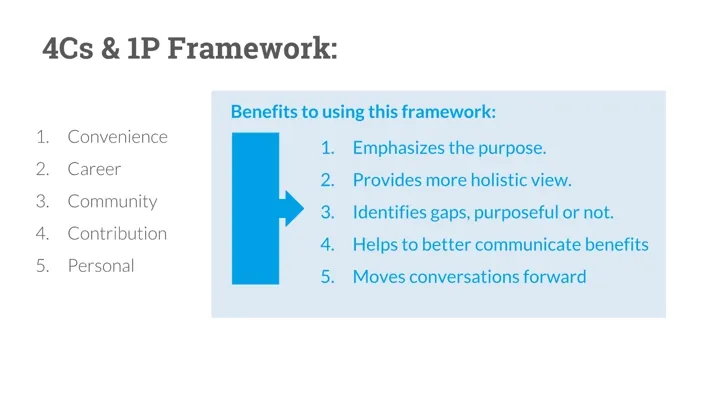
Understanding which purpose a perk serves helps HR leaders make intentional tradeoffs, avoiding programs that look generous on paper but deliver uneven value in practice.
Convenience
Convenience perks reduce friction in an employee’s day. They don’t necessarily change someone’s life, but they signal that the organization respects employees’ time and attention.
In-office or location-specific convenience perks — such as dry cleaning pickup, car washes, or on-site services — help reduce the need to run errands outside of work. Company-funded convenience perks like catered meals, snack programs, or coffee bars are a direct investment in the in-office experience.
For hybrid and remote teams, convenience perks have evolved. Home office stipends, meal delivery allowances, and coworking access serve the same purpose: reducing the daily friction that pulls focus away from work.
Note that convenience perks tend to be location- or situation-dependent. Before investing here, evaluate how many employees will realistically benefit.
Career/continuing education
Professional development perks support employees in growing their skills and advancing their careers. When employees are learning, they tend to be more engaged, more productive, and more likely to stay.
This category includes conference attendance, book allowances, paid online courses, professional certifications, and memberships in industry organizations. Increasingly, it also includes access to AI tools and productivity software— a category that accounted for 20% of professional development spend in 2025, according to the 2026 Annual Lifestyle Benefits Benchmark Report.
A common design mistake here is defining this category too narrowly. A professional development benefit that only covers formal degree programs or pre-approved vendors will exclude a large share of employees who invest in their growth differently. Structuring this category around outcomes (e.g., skill development, career advancement, professional knowledge) rather than a fixed vendor list drives broader participation.
Community
Perks in this category build connection and a sense of belonging among employees.
Community perks can include team events, group fitness or wellness activities, sports leagues, volunteer programs, and shared experiences that bring employees together around something beyond their daily work.
For hybrid and remote teams, community-building requires more intentional design. Virtual team events, in-person offsites, and shared experiences funded through flexible stipends can all serve this purpose. The key is building connection across the full workforce, not just employees who happen to be in the same office.
Contribution
Contribution perks support employees in giving back to causes they care about. This reflects a growing expectation among employees, particularly younger workers, that their employer shares a sense of social responsibility.
This category includes paid volunteer days, charitable giving matching programs, payroll donation options, and sustainability-focused perks like green commuter benefits or environmental sabbaticals. The rise of CSR as a talent differentiator has elevated this category from a “nice to have” to a distinctive part of a values-aligned perks program.
Personal/home life
Personal and home-life perks support employees outside of work — and the evidence is clear that what happens outside of work directly affects performance and retention inside of it.
This is one of the broadest and fastest-growing categories. It includes health and wellness stipends, gym access or fitness reimbursements, mental health support, pet insurance, childcare subsidies, fertility benefits, student loan repayment, and home office support. For remote and hybrid employees, home-life perks often carry the highest perceived value because they directly offset the costs of working outside a traditional office.
This category also offers the most flexibility for personalization. A single well-structured LSA that covers health, family, pets, home, and wellness gives every employee a path to participation — regardless of their life stage or personal priorities.
Pro tip: Many of the highest-utilization perks live in this category. All-inclusive LSAs that incorporate personal and home-life categories consistently outperform narrowly scoped standalone stipends in both participation and employee-reported satisfaction.
Design for real employee needs, not optics.
The most common reason perks programs underperform is a mismatch between what employers offer and what employees actually need.
A wellness stipend that only covers gym memberships excludes employees who prioritize mental health, physical therapy, or outdoor fitness. A professional development benefit that only covers formal courses misses the growing share of employees investing in AI tools and productivity software.
Designing with a “broad definition” approach — structuring categories around outcomes rather than approved vendor lists — gives every eligible employee a path to participation, and consistently drives better program performance.
“When you strip away assumptions and actually listen, employees will tell you exactly what they need. When you pair that insight with flexible, well-designed, well-administered programs, the results are undeniable.”
— Turiya Gray, Fractional Chief People Officer, FXG Partners
Fund programs at a cadence that drives utilization.
How frequently perks are funded affects how much value employees extract from them. Quarterly-funded programs significantly outperform monthly-funded programs on utilization — 85% vs. 52%, according to Compt’s 2026 Annual Lifestyle Benefits Benchmark Report. In some cases, shifting funding cadence improves program performance without increasing total budget.
Keep the program simple to administer.
A perks program that requires significant HR overhead to manage is difficult to sustain, particularly with leaner teams. Prioritize platforms that integrate with payroll, automate reimbursement, and provide clear reporting on participation and utilization. The administrative cost of running an employee perks program can reduce significantly with intentional consolidation.
Communicate the value clearly.
Employees cannot participate in programs they find overwhelming or don’t understand.
Clear, consistent communication about what’s covered, how to submit claims, and what the per-employee budget is drives participation more reliably than adding new categories. When transitioning from fixed perks to a flexible stipend or LSA, framing the change as increased employee choice preserves perceived value, even when total spend is flat.
Evaluate programs by participation, not just budget.
Finance teams understandably focus on spend. But spend alone does not tell you whether a perks program is working. Participation rate tells you what percentage of eligible employees are actively using the program. Low participation is almost always a design or communication problem, and it is worth addressing before budget reduction becomes the default response.
Evaluate and consolidate perks with Compt.
Whether you’re building a perks program from scratch, consolidating a fragmented set of vendor relationships, or looking to improve participation without increasing budget, Compt’s lifestyle benefits platform gives HR and Finance teams a simpler, more flexible way to deliver benefits employees actually use.
Request a Compt demo to see for yourself.
FAQs: Employee perks programs in 2026
Employee benefits and employee perks are related but distinct parts of a total compensation package. Benefits are foundational — healthcare, dental, vision, retirement plans, and paid time off. They’re often legally required or baseline expectations in competitive hiring markets. Compt’s guide to compensation, salary, benefits, and perks breaks down the full taxonomy if you want the longer version.
Employee perks are the additional layer beyond those basics. They’re non-wage offerings that enhance well-being, reflect company culture, and give employees support that extends beyond their core job. Think wellness stipends, professional development accounts, home office support, or pet insurance. Perks are optional but increasingly expected — and when designed well, they drive measurable engagement and retention.
The simplest way to think about it: benefits cover needs, perks reflect values.
What employee perks have the highest ROI?
Flexible, employee-directed perks consistently deliver the highest return, and Compt’s data makes the case clearly. According to the 2026 Annual Lifestyle Benefits Benchmark Report, all-inclusive LSAs lead participation at 93% and utilization at 89%, outperforming every standalone stipend category. Cell and internet (88% participation), wellness (85%), and office equipment (84%) also rank consistently high.
The pattern is that benefits that offset everyday costs outperform fixed, employer-selected perks on every engagement metric. A standalone gym membership program will always underperform a wellness stipend that employees can direct toward whatever supports their health — gym, therapy, fitness gear, or nutrition.
For Finance leaders making the ROI case, the comparison that matters most is cost-per-engaged-employee, not total program spend. A $1,200 median LSA budget with 93% participation is a stronger investment than a $600 point solution with 40% adoption.
How does Compt’s “broad definition” approach help HR offer perks that everyone uses?
Compt’s “broad definition” approach structures LSA categories around outcomes rather than a fixed list of approved vendors or products — so a wellness category covers gym memberships, mental health apps, physical therapy, fitness equipment, and outdoor recreation, rather than defaulting to a single vendor or format.
This design means employees across life stages, roles, and geographies can find something that fits their actual needs, increasing both participation and utilization. Broad-definition LSAs consistently outperform narrowly defined stipend programs: wellness utilization reached 86% when delivered within an LSA, compared to 62% as a standalone stipend, according to Compt’s 2026 Annual Lifestyle Benefits Benchmark Report.
As Mary Migiano, Compt’s Head of Customer Success, explains: “An LSA lets employers bring budgets together under one roof, giving them a more accurate picture of spending and a clearer expectation of what will be used. And even though an LSA sounds very flexible, it can actually be a cost savings for companies. If you’re getting 90% utilization, there’s still that 10% that might never get spent — that adds up.”
What solutions does Compt propose for companies with great perks but low adoption rates?
Low adoption is almost always a structural problem, not a communication problem, and Compt’s approach to solving it starts with consolidation. Replacing multiple low-utilization vendor programs with a single, all-inclusive Lifestyle Spending Account (LSA) gives employees more flexibility with the same or lower total budget, directly improving participation.
Funding cadence is another lever. Compt’s 2026 Annual Lifestyle Benefits Benchmark Report shows quarterly-funded programs reach 85% utilization, compared to 52% for monthly programs. When employees can allocate stipend funds toward their highest-priority needs at a cadence that matches how they spend, adoption naturally follows.
How do you transition from fixed perks to flexible stipends?
Compt recommends starting with an audit of your existing perks. Catalog every vendor contract, stipend, and one-off benefit currently in place, then map each against actual participation data. Categories with low or uneven adoption are strong candidates for consolidation into an LSA.
From there, the design decisions center on eligible spending categories, per-employee budget, and funding cadence. Connecting the LSA to payroll integration ensures accurate tax treatment and reduces HR administrative burden. Finally, roll out your new program with a strategic internal communication plan that frames the transition as increased flexibility and choice. Employees will love it.
How do companies structure employee perks programs for remote or hybrid workforces?
Remote and hybrid workforces need perks that travel with the employee, and Compt’s flexible stipend model is built exactly for that. The most effective structure is an LSA with categories that map to how distributed employees actually work: home office equipment, cell phone and internet reimbursement, coworking access, wellness, and professional development.
The advantage of this model is equity. Rather than investing in in-office perks that only benefit employees who come in regularly, a flexible stipend gives every employee — regardless of location — access to the same budget and the same categories. According to Compt’s 2026 Annual Lifestyle Benefits Benchmark Report, hourly and international employees use lifestyle benefits at rates comparable to salaried U.S. employees, confirming that benefits designed around real-life needs scale across workforces without requiring separate programs.
What are the best perks programs for seasonal or temporary employees?
For seasonal or temporary employees, Compt recommends an LSA as the most practical and equitable solution — it doesn’t require separate program design for different worker types. A single all-inclusive LSA with defined eligible categories — commuting, wellness, and professional development, for example — gives seasonal hires the same flexibility as full-time employees within a defined budget and timeframe.
Compt’s platform supports time-bound or prorated funding, so employers can offer a meaningful benefit for a summer engagement without overcommitting budget. The 2026 Annual Lifestyle Benefits Benchmark Report found that hourly workers show some of the highest benefit utilization, with nearly 90% of all-inclusive LSA funds used — suggesting that benefits designed for real life scale well regardless of employment type.
Editor’s note: Originally published in 2019, this post has been recently updated for clarity and relevance for our readers.