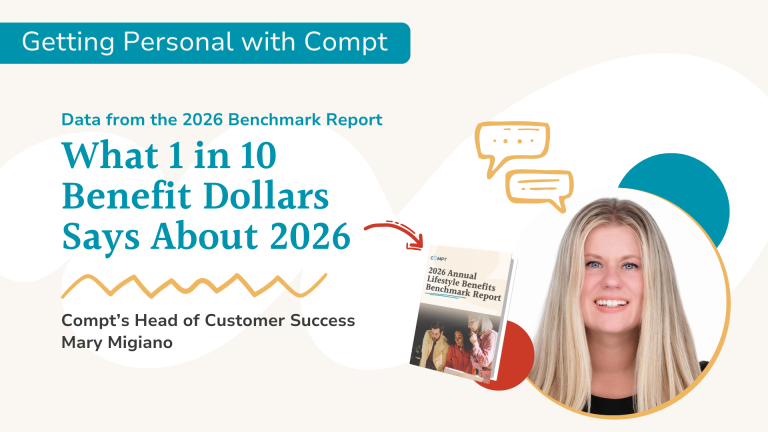

In this episode of Getting Personal with Compt, Head of Brand and Communications Lauren Schneider sits down with Mary Migiano, Compt’s Head of Customer Success, to unpack what the 2026 Annual Lifestyle Benefits Benchmark Report reveals — and more importantly, what it looks like in practice.
Mary shares what she’s seen firsthand in customer conversations throughout 2025: how companies are navigating tighter budgets, what benefit structures actually drive engagement, and why flexibility is no longer optional.
Key takeaways from this episode
Doing more with less defined 2025.
Market uncertainty put every benefits dollar under the microscope last year. Companies consolidated vendor relationships, pulled back budgets, and in some cases removed benefits entirely — while still needing to retain and attract strong talent. The theme Mary heard most often: thoughtful program design matters more than budget size.
Success looks different for every company.
Some employers prioritize awareness (employees simply knowing a benefit exists). Others aim for maximum participation or utilization. Still others want tight control over how funds are spent. Mary’s team works to understand each company’s goals before implementation, because the right success metric for one program may be completely wrong for another.
0% utilization can be a win.
Stipends designed for rare, specific, or sensitive needs — like out-of-state care or fertility support — shouldn’t be judged by how often they’re used. These benefits function more like a safety net than a recurring perk. The right benchmark for a benefit depends entirely on its purpose.
All-inclusive LSAs provide flexibility that traditional benefits can’t.
A fertility benefit might be worth $20,000 — but it only helps a small slice of your workforce. A Lifestyle Spending Account (LSA) with broad, flexible categories meets employees where they are in their lives, making the benefit relevant to everyone. This structure also improves equity across the workforce because employees can spend the benefit in ways that reflect their individual needs.
LSAs can actually save you money.
Even at 90% utilization, the 10% of unspent funds represents real cost savings compared to adding the same amount directly to a paycheck (which also carries payroll tax implications). Consolidating multiple perks into a single LSA program also gives employers clearer visibility into their total benefits budget.
Groceries became a headline spending category in 2025.
One in ten stipend dollars went to grocery retailers — a direct reflection of inflation’s impact on employees’ everyday budgets. Feedback Mary collected throughout the year included messages from employees saying that grocery reimbursements made a real difference for their families. Benefits are no longer just workplace perks; for many employees, they function as real financial support.
Quarterly funding often produces the best participation.
Monthly funding can feel like another task employees have to manage. Annual funding means everyone scrambles in December and low engagement the rest of the year. Quarterly keeps employees engaged without creating stress, and it aligns naturally with quarterly manager check-ins on growth and development. Compt also offers flexibility around expiration dates, so funds can accumulate across quarters when needed.
Professional development is shifting toward AI tools.
Traditional classroom courses are giving way to hands-on AI tools, productivity software, and platform-based learning like Udemy and Coursera. A dedicated professional development stipend — even $500 a year — gives employees the flexibility to pursue what’s actually relevant to their role right now, rather than being locked into a narrow list of approved vendors or topics.
Smaller companies often invest more per employee.
Counter to what you might expect, small companies tend to offer larger stipend amounts than large ones. For many smaller organizations, flexible stipends or LSAs from Compt function as a core benefits solution rather than a supplemental perk.
Budget alone doesn’t determine program impact.
Mary’s closing advice: leadership buy-in and budget approval are only the starting point. The programs that actually drive employee loyalty and retention are the ones built intentionally: tied to company values, shaped by employee feedback, and communicated clearly. When employees feel that connection, they stay.
Read the full podcast transcript below.
See how leading companies are using Compt to stay ahead on benefits — before your competitors do.
Unfilled roles, declined offers, preventable attrition — benefits that don’t meet market expectations show up on the bottom line fast. Our 2026 Annual Lifestyle Benefits Benchmark Report shows what companies are actually offering, what employees are spending on, and where the bar is moving. Compt helps you close the gap without adding vendor complexity or blowing your budget.
Download the full 2026 report or request a Compt demo.
Full episode transcript
Lauren Schneider
Joining me today is Mary Migiano, our Head of Customer Success at Compt. Mary spends her days talking with customers once benefits programs are actually live, which means she sees what works, what doesn’t, and how things feel in practice, not just in theory. Welcome, Mary.
Mary Migiano
Hi, Lauren. I’m so excited to be here. I usually see you outside of the podcasting world, so it’s so much fun to be doing this with you today.
Lauren
I love the energy. We are just coming off of wrapping up and launching our Annual Lifestyle Benefits Benchmark Report. We’ve been doing this for six years, and it gets more exciting each year, which is why I’m excited to talk to you about it. It’s full of really interesting signals, and I know that data only tells part of the story. So what I wanted to do today is talk through what those numbers actually look like once programs are live, budgets are real, we’re spending real money, and employees are making choices. Mary, you are in the best seat in the house to see that.
Mary
I’m excited. Real talk with Mary and Lauren today.
Lauren
Real talk. With that in mind — you talk to Compt customers at implementation, once programs are actually live, not just on paper. When you think back on all of 2025, which is where the data’s pulled from, what feels different about those benefits conversations?
Mary
Last year really changed a lot from previous years. I’ve been here with Compt for a while, and the biggest change I saw is market uncertainty coming to light. We always see budgets being scrutinized closely, but last year, every dollar was under the microscope. There were higher expectations for where budgets are going and how they’re being spent on benefits. But also, the expectation is really high because benefits aren’t just a nice-to-have anymore — it’s a necessity to retain good employees and attract well-qualified new ones. The overarching theme I saw in conversations last year was doing more with less.
Lauren
Yeah. Beyond consolidation — when we think about taking a varied tool stack and consolidating it — what does that look like in practice?
Mary
It’s really everything. On one side, it’s consolidating tools — companies want to use fewer vendors and maximize the value from the ones they keep. But then you’re also seeing companies asking: how can we pull back our budget? Or in some cases, depending on the financial state of a company, do we need to remove a specific benefit entirely? That’s a very challenging place to be. Last year we were able to help guide a lot of employers through that, because you can still do a lot of great things even without a large budget — it just takes more thoughtful planning. We stayed close with a lot of customers, whether they were new to Compt or had been with us for years. Budget pressure — through consolidation or otherwise — was a big pain point for everyone.
Lauren
You said something there that started to get into benefits program structure. One thing that kept coming up in our data was really strong participation, even when utilization looked uneven across different categories and demographics. When customers see that, how do you help them interpret what success actually looks like — and how they’d define it?
Mary
Great question. Success means different things to different companies. Just as we at Compt say there’s no one-size-fits-all approach, the same goes for our customers. It really depends on what the company is trying to solve for.
Sometimes a company just wants to create awareness — to give employees a benefit that’s there when they need it, and just knowing it’s available is enough. Participation isn’t a top priority; they simply want employees to know it exists.
Other companies prioritize maximum utilization. They want to see employees using the benefit 100% of the time. That’s where flexible programs like a Lifestyle Spending Account (LSA) come in — how can you open it up enough that employees actually use it completely?
And then there’s a third group that really wants to control the spend side — making sure funds aren’t wasted and are being used intentionally. That’s where a program might look a little different, because instead of one flexible Lifestyle Spending Account, they’ll break it into separate buckets: a cell phone stipend, an internet stipend, a fitness subscription stipend, and so on. That gives them more control over amounts.
Ultimately, it really depends on the company and what’s important to them. That’s why in our implementation process, we work hard to understand what drove a company to come to us and what they’re looking to achieve. High participation and utilization are great — as long as those metrics are what the company actually cares about. And that can change over the years too. Maybe right now high utilization isn’t a big priority, but in a few years as budgets increase, it might be. We try to stay flexible and stay tuned in with our customers throughout their journey with us.
Lauren
I imagine it even gets as nuanced as: we have a couple of different stipends, and certain ones we want to see used all the time, while others we’re fine seeing used occasionally. Internally, we have our Find Your Balance stipend, and we’re thrilled when everyone uses it every quarter to its fullest — because it covers wellness, treating yourself, your family, food, whatever. But then we have other specific ones, like an out-of-state care stipend, that’s there for when you need it. You’re not necessarily going to need it every quarter, and maybe only one person needs it over the course of their entire tenure here. So you wouldn’t see much utilization there, and that’s OK.
Mary
And with some of those, you wouldn’t want utilization. Hopefully no one is ever in a position where they need it. So 0% utilization — like you said — might actually be a positive thing on certain stipends. It just depends on how the stipend is designed.
On a related note: cell phone and internet stipends are a good example where you won’t always see 100% utilization. The cost of those can vary significantly across the country and internationally, so depending on the amount offered, you might see something like 60% utilization. That’s expected — and it’s normal across a large employee base.
Lauren
Right. So there are a couple of ways to structure this. We talked about individual stipends, and you mentioned Lifestyle Spending Accounts, which makes a lot of sense — a lot of teams are moving toward LSAs because they’re all-inclusive. Maybe we could start there: what does “all-inclusive” mean when we’re talking about a Lifestyle Spending Account, as opposed to running a bunch of separate programs?
Mary
Sure. When we talk about an LSA — a Lifestyle Spending Account — or an all-inclusive stipend, it really just means a very flexible stipend, as opposed to what we were just discussing, where benefits are purpose-built for only cell phone or only internet connectivity.
An all-inclusive stipend allows for broad categories — usually five or more — so employees can truly make the benefit work for them. The best way I explain it is that it’s very different from a traditional benefit, because most traditional benefits only serve a small portion of the employee population.
A fertility benefit is a great example. Some companies offer $20,000 to employees for fertility support — which is an amazing benefit. But it only helps a very small percentage of the workforce. An all-inclusive LSA, by contrast, gives you the ability to meet employees where they are in their lives and give them the flexibility they need based on what’s relevant to them specifically. It becomes a much more meaningful benefit.
Lauren
It also adds equitability to your benefits package.
Mary
Absolutely.
Lauren
With that in mind, from your side of the house — what problem do you see customers trying to solve when they shift from, say, manual reimbursements, individual stipends, a marketplace, or prepaid cards, toward an all-inclusive LSA?
Mary
A few different reasons. First, tax compliance. Tax compliance can be incredibly difficult to manage and can honestly be a nightmare. When you can move everything into a single stipend — whether expenses are taxable or nontaxable — and not have to manage IRS guidelines yourself, that’s a huge driver.
The second reason ties back to what we discussed about budgets. An LSA lets employers bring budgets together under one roof, giving them a more accurate picture of spending and a clearer expectation of what will be used. And even though an LSA sounds very flexible, it can actually be a cost savings for companies. If you’re getting 90% utilization, there’s still that 10% that might never get spent — that adds up. Compare that to just adding money to a paycheck, and the difference becomes clear.
Lauren
I guess that’s also where the argument between putting money directly in a paycheck vs. prefunding vs. reimbursing comes into play.
Mary
Definitely. And beyond utilization, when you put money directly in a paycheck, companies also pay payroll tax on it. That all adds up and can meaningfully affect cost savings.
Lauren
The taxability piece is interesting. Our data revealed — and this happens year over year — that significantly more people use their stipends on taxable items than nontaxable ones. I’m trying to think of examples on the fly here…
Mary
The biggest thing I saw this year — and inflation has everything to do with it — is groceries.
Lauren
Yes.
Mary
There are so many taxable expense categories, and it really comes down to the company identifying what their employees actually need. Basically anything you’re hearing in employee feedback can probably be tied back to a stipend category. I once worked with a company that had a more structured stipend, and I was trying to convince them to switch to an LSA for more flexibility. My contact was a little hesitant — in HR, we don’t always love risk. But when we worked together and found a way to have structure while still building in flexibility, they made the switch and were genuinely happy with it afterward.
That’s where those unconventional routes can make life easier. And another reason customers come to us is that market trends are always changing. Think about what’s evolved just in the last year — health insurance rates and GLP-1 coverage, for example. That’s the conversation of the moment right now, but next year there’ll be something else. Instead of finding a very specific GLP-1 benefit vendor, a stipend or LSA lets you evolve as market trends shift without having to rebuild your entire program.
Lauren
That’s a really good point. From a marketing perspective, for a long time the conversation was all about gym memberships — I want to reimburse people for going to Planet Fitness, but this employee doesn’t have a Planet Fitness within three hours of their house. Now the conversation has shifted completely to wellness as a whole, and there’s been a huge spike specifically around GLP-1s. I’m glad you brought that up.
Mary
The gym membership thing feels so old-school now. There’s so much technology out there. The Oura Ring was huge last year, and I literally just ordered myself a glucose monitor — they’re over the counter now, so you can track your glucose trends for your health. There’s so much technology and products that can help you beyond a gym membership. And these things are going to keep changing. It’s less about a specific vendor and more about how you stay current without creating extra work for yourself. Who wants to manage a Planet Fitness corporate agreement? That sounds exhausting.
Lauren
I always find it interesting that really large corporations go that route, given how many vendor contracts they’d have to manage. You’d need an entire procurement team just for benefits.
Mary
Yeah.
Lauren
When wouldn’t it make more sense to just give your people a wellness stipend or a Lifestyle Spending Account and manage one vendor? Maybe I’m just too close to Compt, but it seems obvious.
Mary
No, it really does make a lot of sense. And here’s something I think about: I’m a big saver. If I can catch a deal somewhere, I’m always on it. Sometimes companies sign vendor contracts because they’re getting, say, 10% off a membership. But there are so many great resources already available. Here at Compt, we have a discounts page with over 20 categories. I could go right now and get a discount on a nationwide gym membership — without Compt needing to manage a corporate relationship. When that functionality and those discounts are built in automatically, you don’t need another vendor to manage.
Lauren
I’m so glad you brought that up. We have over 3,000 brands, and I spend an embarrassing amount of time scrolling through before I buy anything.
Mary
That $5 savings? I need it. I’m getting it every time.
Lauren
Exactly. For example, I’ll pay with my Discover card to get cash back, and then reimburse through Compt. So my stipend covers it and I’m making money on money.
Mary
Yes! Today on my lunch break I was looking into a new oven, and through our discount marketplace I found it cheaper than anywhere else — cheaper than major retailers, cheaper than anyone. I was genuinely surprised by the discount.
Lauren
It’s interesting that you mentioned that, because there’s actually an overlap between our top 10 vendor lists — both from our discount program through PerkSpot and from stipend and reimbursement spend through Compt. Wholesale clubs like Sam’s Club and Walmart are on both lists, so it’s clear a lot of people are doing exactly what we’re doing. And for entertainment — I always look for a coupon code before I go to the movies.
Mary
Why are movies so expensive these days? It’s wild. But yes, there are so many discounts people don’t even realize are there.
Lauren
And we use it for groceries too. Which brings me to what might be the headline statistic of our report this year: one in ten benefit dollars now goes to groceries.
Mary
It’s heartwarming in a way when I read specific user feedback throughout the year. You don’t always realize how much inflation is impacting people — hourly or salaried, regardless of their role. I cannot tell you how many pieces of feedback I saw that said something like: “Thank you so much, [company name], for covering my groceries for the next two weeks, it really made a difference for my family.” People are saying that. Living paycheck to paycheck is more common than we sometimes remember, and seeing these benefits actually making a difference in people’s day-to-day lives — that’s really powerful.
Lauren
I went through the spreadsheet of those comments you gathered, and I was scanning for exactly that. I don’t want to say I was surprised, but I had to sit with it for a moment when I saw how many people were impacted specifically by their grocery and utilities stipend. The prior year I noticed a lot around caregiving. So there’s this theme — whether it’s wellness, family, or food — where LSAs and stipends are supporting life beyond work. Sure, we use them for professional development and home internet, but so much of the impact is on employees’ families and loved ones, not just the employees themselves.
Mary
Exactly. And some of the standout comments I’ve seen — this isn’t a one-off thing, I see these regularly — include things like: “I was able to get my father, who’s going through cancer treatments, an Uber to and from his appointments.”
What I saw clearly in the last year is two things: the grocery piece, where stipends are genuinely helping people get by, but also the flip side — stipends enabling employees to do something for themselves that they otherwise wouldn’t have done. I hear that constantly. We say, “Oh, just throw extra money in a paycheck,” but that money doesn’t get used in the way it’s intended. A stipend, by contrast, ends up being used for something extra in a lot of cases — self-care, something personal, something that contributes to their life. And think about how that makes a person show up at work. Their productivity, their sense of connection to their company. It makes a big difference.
Lauren
That’s exactly how I think about it too. Anything on my paycheck goes to the mortgage, my daughter’s dance class, whatever else. But our quarterly stipend is basically my “mom’s fun fund.” I spend it on things for me — or honestly sometimes Christmas presents — and it just feels like bonus money in the best possible way.
Mary
It is — and it’s needed. Because let’s be honest: moms feel guilty spending money on themselves. That Find Your Balance stipend is literally for finding your balance, not worrying about everyone else. It’s so important.
Lauren
For us, that stipend is quarterly, and I know funding cadence is a huge deal. It might sound like a small detail when you’re having a conversation with a customer about program setup, but it can completely change how a program feels. Quarterly seems to be a really successful option. When customers are deciding between monthly, quarterly, and annual funding, what do you usually see work best and why?
Mary
Quarterly. Hands down, not even a question.
A lot of customers come in wanting to do monthly stipends, which makes intuitive sense. But the problem with monthly frequency is that it becomes too much — another thing to remember every month. Quarterly ends up being the sweet spot. It keeps employees engaged with the benefit without making it feel like work. Four times a year vs. twelve times a year — you can feel that difference. It’s manageable. It keeps the benefit top of mind so employees remember their company is supporting them, without becoming an annoyance.
Lauren
That actually matches my own experience. When it’s quarterly, I find myself putting it off a bit, but I always end up using it. If it were monthly, I think I’d feel rushed — like it’s another item on my to-do list — and I’d probably end up forgetting entirely. The quarterly window gives me breathing room.
Mary
You literally sound stressed just talking about it being monthly. And that’s the point — we’re not trying to induce stress. But human nature proves time and again that people wait until the last minute. So let’s consider the other extreme: annual funding. You end up with everyone submitting expenses in December. A few Type A personalities do it sooner, but most wait until year-end — and in the meantime, they forget the benefit even exists because they’re only interacting with it once a year.
That’s where quarterly wins. And what’s great about Compt is that we have a lot of flexibility in how funds are distributed. It’s not just, “Here’s your quarterly stipend at the start of every quarter.” There’s real customization available around when funds are distributed, when they expire, and things like that — so you can build a program that keeps employees engaged while still working for your team.
Lauren
So without a doubt — quarterly, for every type of stipend? That seems clear for wellness and lifestyle stipends, but what about professional development? Those conversations have shifted a lot lately. People are trying to figure out AI, and a lot of that software runs on monthly subscriptions. How does that all interact?
Mary
Great point. I’d actually say quarterly is even more important for professional development. As a leader, you don’t want your team racing to the finish line in December just to check professional development off a list and burn through the budget. You want it used intentionally throughout the year.
And like the other stipend types, you don’t want it monthly either — what if there’s genuinely nothing worth spending on that month? You don’t want people stressed about losing funds. Quarterly keeps them engaged. It also aligns well with quarterly growth conversations that many managers have with their teams anyway.
Plus, with Compt’s stipend funding, you don’t have to choose strictly between quarterly distribution and annual access. You can issue funds quarterly but set them not to expire until end of year — so if someone wants to save up a few quarters for a more expensive course or certification, they have that flexibility. The regular cadence is still important, even semi-annually, so people aren’t waiting until December to act.
Lauren
Are HR leaders, benefits managers, and finance teams doing anything differently with professional development budgets this year compared to years past?
Mary
We actually launched a professional development module in Compt that supports multi-level approvals, and we’ve seen strong traction with that. Companies like it because they want managers involved in the decision — managers are best positioned to know what’s directly relevant to a given role — but they still want HR or finance to have visibility. That covers one piece.
The other big trend is just how fast AI is moving, and how hard it is for any HR team to stay on top of what professional development is actually relevant for each role. Think about how many positions we have here at Compt — how do you know what’s good professional development for each one, at the individual level? That’s where we’re seeing a lot of interest in recommendations driven by what real people are using and what they’re saying about it.
Lauren
That makes a lot of sense. There’s so much to cover in this report. I’m pulling it up separately because as you’re talking, I keep remembering other data points I want to get into. Like stipend amounts — that’s probably one of the first questions people have, whether they’re familiar with stipends or not. They want to benchmark against what others are doing. So: I’m going to offer a professional development stipend, quarterly — how much should I actually give people?
Mary
It really depends on your program design. We see two main approaches. Some companies run a program that’s essentially tuition reimbursement — in those cases, stipend amounts can be quite large. You might see $5,000 a year per employee, intended specifically for college courses or university programs.
Then there’s the broader professional development stipend — think of it as the LSA of professional development. Much more flexible, and you don’t need a large budget to start. Even $500 a year is a meaningful amount that gets people using their funds in a real way.
What we’ve seen a lot this past year is AI leading the charge. We’re past the era of traditional online or classroom courses. People want hands-on learning, and we’re seeing a lot of productivity and AI tools being claimed as professional development expenses. It’s been a really interesting shift to watch. And even for more traditional learning, platforms like Udemy and Coursera are popular — those flexible platforms are more commonly used than very topic-specific resources.
Lauren
As you were talking about AI subscriptions, I pulled up the report. For professional development stipend funding ranges specifically: the minimum is $50 — which makes sense, since something like a Claude subscription runs maybe $20 a month — the median is $800, and the maximum is $10,000. That higher end sounds like in-person conferences or tuition reimbursement folded into professional development.
Mary
Exactly. And honestly, back to professional development basics — some people still just want a good old-fashioned book. Amazon is one of our top vendors for a reason.
Lauren
I completely forgot to mention — $50 could cover a couple of books!
Mary
Our minds jump straight to AI now, which they should — that’s where the world is headed. But the simplicity of being able to buy a book on Amazon about coding or whatever’s relevant to your role, without needing a specific approved vendor, makes a big difference.
And speaking of AI — I read that AI is trending to surpass human intelligence. When do you think that happens?
Lauren
Oh no … has it already happened? I’m scared. Everything I’ve seen puts it around 2030, but honestly it could be sooner.
Mary
2030. Four years from now, no human will be smarter than AI. When you think about professional development, this is exactly why right now is the time to skill up your employees with AI and prepare them for what’s coming. It’s not about being the smartest person in the room anymore — it’s about connecting the dots with AI. The tools, the online courses, the certifications — all of that is going to be really important.
Lauren
As we’re talking about that, I started wondering: is stipend size dependent on company size? I said $10,000 for professional development out loud and thought — is that affordable for a smaller company? Looking at the data, for midsize companies, the professional development range is anywhere between $300 and $10,000. And what blew my mind: that $33,000 maximum for an all-inclusive LSA? That’s attributed to a small company.
Mary
And that actually makes sense when you think about it. Small companies usually lead the pack on stipend size. Large companies tend to have a big toolkit of benefits — a stipend isn’t the only thing they’re offering. Smaller companies, on the other hand, often invest more heavily in a benefit like Compt to solve for a lot at once, vs. larger companies that have access to a broader portfolio of resources and health benefits. For smaller companies, Compt is doing the heavy lifting across the board.
Lauren
That’s a great point. And I guess for those smaller companies, a well-designed Compt program is actually more affordable than trying to manage a large health insurance carrier plus multiple vendors to build out a benefits package.
Mary
Definitely. We work closely with a lot of health insurance brokers, and for companies in that middle range especially, stipends are a great way to round out their benefits offering — and sometimes to offset medical costs too.
Lauren
One thing I want to go back to is something you mentioned earlier about hourly vs. salaried employees and how they might approach flexible benefits differently. Was there anything that stood out — either in the data or anecdotally — from last year?
Mary
It’s funny because we actually touched on this earlier. The hourly-vs.-salaried split is really what I was referencing when I talked about using benefits for essentials. Hourly employees — some of whom are living paycheck to paycheck — tend to use stipends for day-to-day essentials: groceries, household items, even things like paying their electric bill through our home category. Just getting by.
Salaried employees, by contrast, tend to use stipends to treat themselves or do something they wouldn’t have otherwise done. But honestly, that pattern can show up in either group depending on the individual.
The really cool thing is that the LSA gives everyone the autonomy to use it however it’s most meaningful to them — whether that’s everyday essentials or something extra. That flexibility is what makes it work across such different situations.
Lauren
It’s a huge impact on personal budgets. And speaking of budgets — my final question, although I could ask many more because this report is genuinely rich and I don’t want to give it all away. A lot of teams already have their 2026 budgets in motion. Maybe they’re locked in, maybe they’re not. Either way, they’re still making trade-offs somewhere. Based on what you’ve seen this year, what is one assumption you’d encourage people to pause and rethink?
Mary
I’d say this: the budget is not the most important piece.
Getting leadership buy-in and launching a program is great — but it’s just one piece of the puzzle. The most important thing is making the program impactful for your employees. That means spending real time developing the program, tying it back to your company’s goals and mission, and actually listening to what’s in your employee feedback. I can nearly guarantee that anything employees are asking for in surveys can be embedded in a stipend — it’s about how you design, market, and communicate it.
When you do those things well, it’s not just about getting money into employees’ hands. It’s about building trust. Employees feel connected to the company, and that connection drives loyalty. They’re more likely to stay.
Lauren
Well said. Thanks so much for your time, Mary.
Mary
Thanks for having me. Always great to chat with you.
Lauren
Likewise. And for anyone listening — you can find our 2026 Annual Lifestyle Benefits Benchmark Report on our website and across our social channels. You can also search for it pretty much anywhere: Google, ChatGPT — or as we lovingly call it, Chatty — and you’ll find it. We also have something we created called a Benchmark Advisor, which uses AI to let you explore the report interactively. Mary, do you want to tell them about it?
Mary
I love this thing. If you’re someone who wants insights fast — without reading through a full report — this tool lets you ask your specific questions and get answers drawn directly from the report’s data. It’s incredibly useful.
Lauren
Exactly. It’s interactive, which is great if sitting down with a static report isn’t how you best absorb information. You can type in questions in real time — and if you’re reading the report and hit a point where you wonder, “what would this actually look like for my company?” you can just ask. It’s pretty amazing.
Mary
Love it.
Lauren
All right — that’s a wrap!