
Employee stipends are one of the most effective ways to support teams: They consolidate what used to be a patchwork of vendors, debit cards, marketplaces, and low-usage perks into a single, streamlined benefit. Instead of separate line items for wellness, professional development, and recognition, stipends allow HR and Finance leaders to simplify operations while still giving employees real choice in what best supports their lives.
With salaries remaining relatively flat for another year and healthcare costs rising, stipends are one of the few benefits that can expand without adding complexity.
But how much should you budget, and how should stipend programs be structured in 2026? Compt’s 2026 Midyear Lifestyle Benefits Benchmark Report examines how employers are funding and structuring stipends and Lifestyle Spending Accounts (LSAs) based on customer data from January through June 2026. It includes category-level funding ranges, company-size and regional benchmarks, and the program-design trends we’re seeing at midyear.
Below, we break down the latest H1 2026 benchmarks to help HR, People, and Finance leaders set realistic budgets and evaluate their own program design. Where full-year data gives us a better view of employee behavior, we’ll use Compt’s 2026 Annual Lifestyle Benefits Benchmark Report, covering customer data from January through December 2025, for that context.
What are typical stipend funding ranges by category?
Stipend funding varies widely by category, which is why the median is usually the most useful number for planning. It shows the typical funding level in Compt’s dataset without giving disproportionate weight to unusually large or specialized programs.
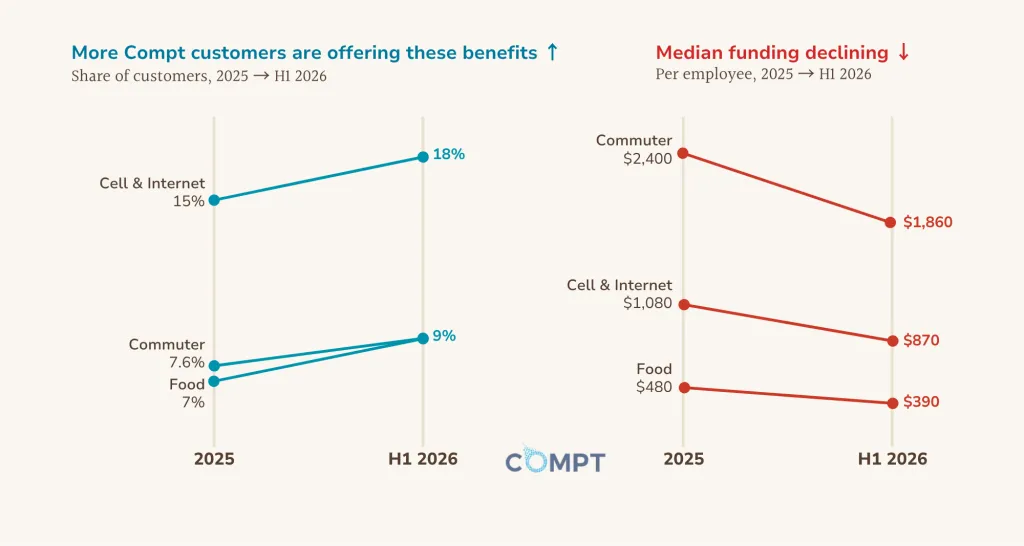
Professional development say the biggest funding increase at midyear 2026: median annual funding doubles from $800 to $1,600 per employee. Other categories moves in the opposite direction: median commuter funding fell from $2,400 to $1,860, cell and internet from $1,080 to $870, and food from $480 to $390, even as more compt customers began offering each benefit.
All-inclusive LSAs remain the most common benefit structure, offered by 65% of Compt customers at midyear 2026. Their median annual funding held steady ay $1,200 per employee, giving employers one budget that can flex across multiple eligible categories (including Treat Yourself, our most flexible benefits category and the No. 1 LSA category in our dataset as of midyear 2026).
The table below shows the observed minimum, median, and maximum annual funding per employee across Compt stipend and LSA programs in H1 2026.
Stipend and LSA funding benchmarks by category, H1 2026
| Stipend category | Minimum | Median | Maximum | Median vs. 2025 |
|---|---|---|---|---|
| All-inclusive LSA | $10 | $1,200 | $45,000 | Unchanged |
| Cell and Internet | $240 | $870 | $1,800 | ↓ from $1,080 |
| Charitable Giving | $100 | $300 | $2,500 | Unchanged |
| Commuter | $600 | $1,860 | $4,080 | ↓ from $2,400 |
| Company Swag | $100 | $600 | $900 | No prior benchmark |
| Coworking | $1,200 | $1,800 | $3,360 | Unchanged |
| Culture* | $200 | $450 | $7,000 | ↑ from $28 |
| Experiences and Entertainment | $180 | $190 | $200 | ↑ from $180 |
| Family and Caregiving | $1,200 | $2,000 | $12,000 | ↓ from $2,500 |
| Family Planning** | $2,500 | $10,000 | $75,000 | No prior benchmark |
| Food | $300 | $390 | $480 | ↓ from $480 |
| Office Equipment | $100 | $800 | $3,600 | ↑ from $250 |
| Out-of-State Care | $1,000 | $4,000 | $5,000 | ↑ from $3,500 |
| Pets | $600 | $600 | $600 | ↑ from $150 |
| Professional Development | $250 | $1,600 | $10,000 | ↑ from $800 |
| Sabbatical | $1,000 | $1,000 | $1,000 | ↓ from $4,750 |
| Safety Equipment and Uniforms | $100 | $200 | $250 | ↑ from $150 |
| Team Recognition | $100 | $200 | $240 | ↓ from $220 |
| Wellness | $50 | $600 | $36,000 | ↓ from $735 |
| Work Support | $600 | $1,920 | $2,520 | No prior benchmark |
Notes:
*Culture: The $7,000 maximum reflects one employer’s specialized stipend for pharmacists working on-call days. Excluding that program, the observed range is $200–$500, with a $400 median.
**Family Planning: The $75,000 maximum reflects a legacy lifetime benefit retained after a company spinoff and should not be interpreted as a new marketwide funding level.
Want help applying these benchmarks to your own program? Try the interactive Compt Lifestyle Benefits Benchmark Advisor in ChatGPT. Ask about funding for a company your size, how to structure an LSA, which cadence to use, or how to design a program around a specific per-employee budget.
How do stipend distribution trends affect employee engagement?
How often employees receive stipend funds can affect how they use the benefit. In H1 2026, annual funding was the most common funding cadence among Compt customers at 58%, followed by quarterly at 39% and monthly at 36%. (Some companies use more than one cadence across different programs, so those percentages don’t add up to 100%.)
Quarterly funding reached a large share of employees in the H1 2026 dataset: about 85% of employees overall and 86% of employees with access to an all-inclusive LSA experience quarterly funding. Two large quarterly programs heavily influence those figures, so they reflect employee reach rather than the cadence most employees select.
In our full-year 2025 data, employee engagement shows up across two related measures:
- Participation measures the percentage of employees who submit at least one eligible expense during a funding period.
- Utilization measures the percentage of issued stipend dollars that employees actually spend within that same period.
Quarterly funding led to the highest utilization rate at 85%, compared with 70% for semiannual funding, 65% for annual funding, and 52% for monthly funding.
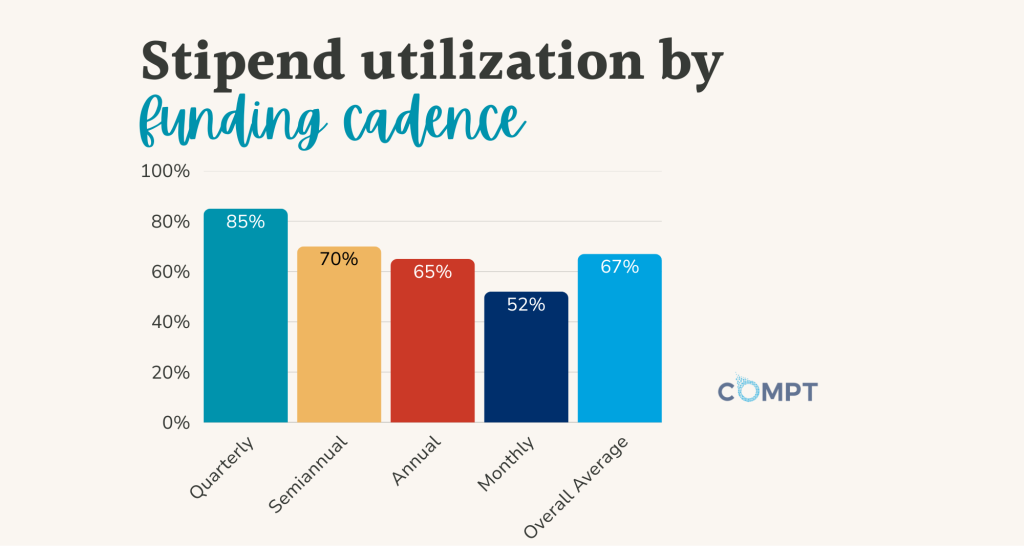
The takeaway there is that cadence should match the types of expenses the benefit is designed to cover. Recurring, predictable expenses may work well with more frequent funding because employees can use the benefit as those costs arise. Larger or less frequent purchases often benefit from longer funding windows that let employees plan ahead and use more of their available balance at once. And some categories, such as caregiving, charitable giving, or coworking, may naturally have lower utilization because they function more like occasional or safety-net support than an everyday benefit.
Annual funding remains the most common employer choice, while quarterly funding has produced the highest utilization in Compt’s full-year data. The right stipend funding cadence depends on the category, the size of the benefit, and how employees are likely to use it.
What is the average stipend per employee by company size?
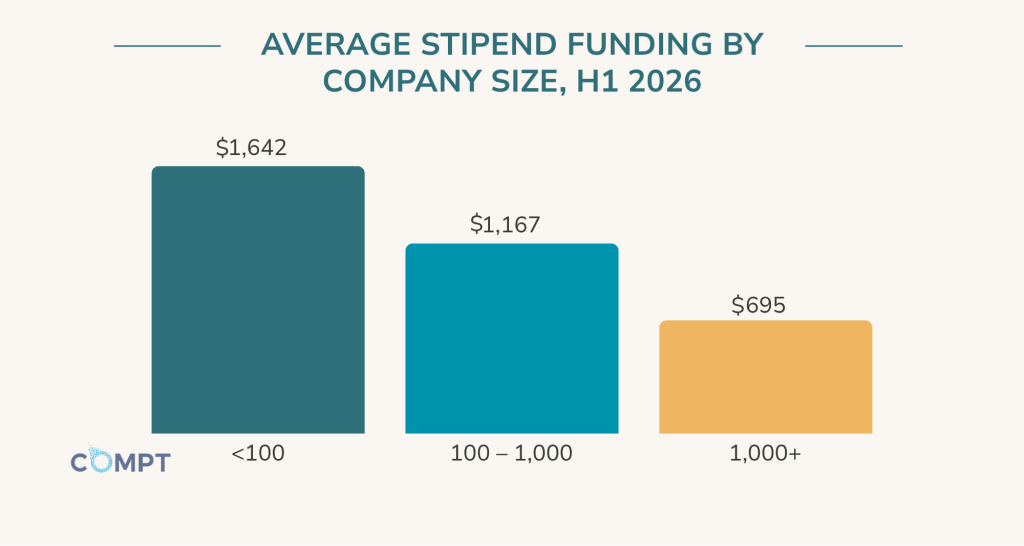
In H1 2026, average stipend funding across all employer in Compt’s dataset reached $891 per employee, up 5% from $850 in 2025. Small companies still fund the most per employee, but midsize and large employers are beginning to narrow the gap.
By company size:
- Small companies (fewer than 100 employees): $1,642 per employee, essentially flat from $1,675 in 2025.
- Midsize companies (100–1,000 employees): $1,167 per employee, up 11% from $1,055.
- Large companies (1,000+ employees): $695 per employee, up 7% from $649.
Small companies still allocate about 2.36x more per employee through the stipend and LSA programs measured here than large companies, down from 2.6x in 2025. That gap doesn’t necessarily reflect total benefits investment, however; larger employers may fund additional point solutions alongside their LSAs, while others may be increasing LSA funding as they consolidate separate programs.
How do stipend budgets vary by region?
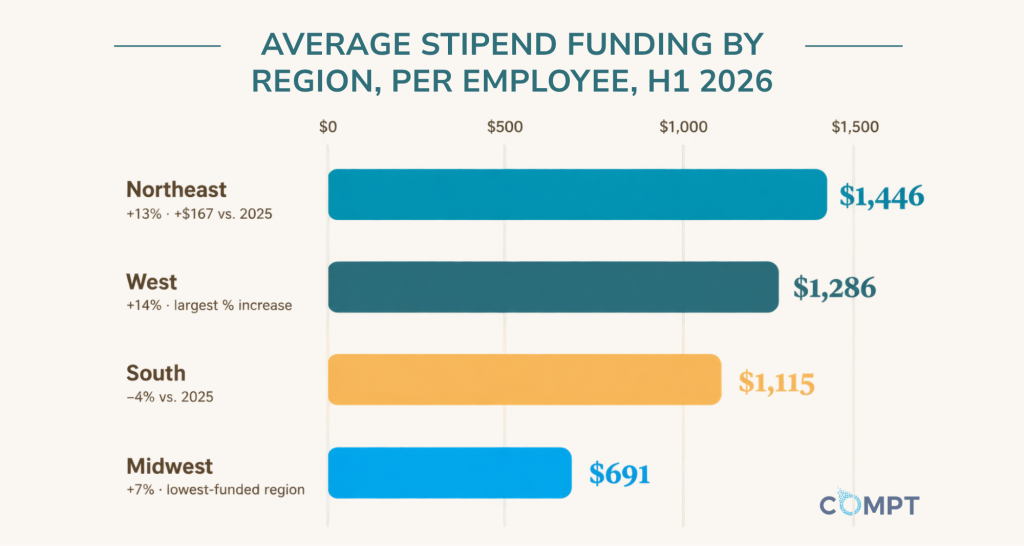
In H1 2026, average stipend funding was highest in the Northeast at $1,446 per employee, followed by the West at $1,286, the South at $1,115, and the Midwest at $691. Average funding increased in three of the four U.S. regions compared with 2025.
By region:
- Northeast: $1,446 per employee, up 13% from 2025.
- West: $1,286 per employee, up 14%, the largest percentage increase.
- South: $1,115 per employee, down 4%.
- Midwest: $691 per employee, up 7%, but still the lowest-funded region.
Regional averages are best used as planning context rather than funding targets. They reflect the mix of employers, industries, and program structures represented in each region, so your own budget should still be based on your workforce and program goals.
You can ask
Curious how employers are designing stipends and LSAs for global teams? Download the 2026 Midyear Lifestyle Benefits Benchmark Report — global program design benchmarks are on page 17.
What should employers keep in mind for 2027 benefits planning?
For 2027 benefits planning, employers should look first at where existing stipends, reimbursements, and point solutions can be consolidated into fewer, more flexible programs that can accommodate new priorities without adding more administrative complexity. At midyear 2026, 65% of Compt customers offered an all-inclusive LSA, while employers were also expanding support across categories such as professional development, commuter benefits, cell and internet, and food.
The H1 2026 data points to a few practical considerations:
- Use flexible programs to accommodate changing priorities. Professional development had one of the clearest increases in both adoption and funding, while newer needs such as AI upskilling are emerging quickly. A broader stipend or LSA gives employers room to respond without introducing a new vendor or program every time employee needs change.
- Benchmark access and funding separately. More employers are offering commuter, cell and internet, and food benefits even though median funding for all three declined. A smaller budget can still expand the types of support available to employees.
- Choose funding cadence based on the expenses employees need to cover. Annual funding may work better for larger planned purchases, while more frequent funding can keep recurring expenses accessible throughout the year. The right cadence depends on what the benefit covers, not simply what is easiest to administer.
- Pressure-test whether the program can scale. Clear eligibility rules, visibility into utilization, and fewer manual decisions matter more as headcount and claim volume grow. If routine questions still depend on spreadsheets, inboxes, or one-off judgment, that’s a sign the program structure needs attention.
Turn 2026 benefits benchmarks into your 2027 plan with Compt.
The 2026 Midyear Lifestyle Benefits Benchmark Report gives you the latest data on stipend and LSA funding, program design, company size, regional differences, and the benefits priorities gaining ground in 2026. If you’re pressure-testing your 2027 budget or deciding how to structure your program, download the report to compare your plans with real employer data.
When you’re ready to act, Compt can help you consolidate stipends and LSAs into one flexible program with clear eligibility rules, consistent tax treatment, and less administrative work as your workforce grows.
Request a demo of Compt today.
FAQs: Employee stipend benchmarks
In H1 2026, employers in Compt’s dataset funded an average of $891 per employee annually across the stipend and Lifestyle Spending Account programs we measured for our midyear report. That overall figure varies substantially by company size and benefit category, so it is best used as a starting point for comparison rather than a recommended budget.
How much should a company budget for employee stipends?
There is no single standard stipend budget. Compt found that in H1 2026, average annual funding ranged from $695 per employee at companies with 1,000+ employees to $1,642 at companies with fewer than 100 employees. Employers should compare themselves with similar-size companies and then look at the categories their program is intended to cover.
How do employee stipend benchmarks vary by company size?
Companies in Compt’s dataset with fewer than 100 employees averaged $1,642 per employee in H1 2026, compared with $1,167 for companies with 100–1,000 employees and $695 for companies with 1,000+ employees. Small companies still fund more per employee, although the gap between small and large employers narrowed compared with 2025.
What are typical stipend amounts by benefit category?
Median annual funding varies widely by category. At midyear 2026, Compt customers averaged $1,600 for professional development, $1,200 for an all-inclusive LSA, $870 for cell and internet, $600 for wellness, and $390 for food. The category-level median is generally more useful for budgeting than the overall stipend average.
How much do stipend budgets vary by region?
At midyear 2026, Compt found average annual stipend funding was $1,446 per employee in the Northeast, $1,286 in the West, $1,115 in the South, and $691 in the Midwest. Regional averages provide useful context, but company size, industry, and program design can all affect the amount an individual employer funds.
If you want help applying these benchmarks to your own program, try the interactive Compt Lifestyle Benefits Benchmark Advisor in ChatGPT.