

When you try to name example ways to use a wellness stipend, how far do you get? If you’re stuck after “gym membership,” you’re not alone.
Despite how much the world of well-being has expanded, many employee wellness programs still default to a narrow set of perks that don’t reflect how people actually take care of themselves. And it’s showing up in the data. Gallup estimates burnout costs companies $322 billion globally in turnover and lost productivity, while only 1 in 4 U.S. employees strongly agree their employer cares about their overall well-being.
At the same time, utilization tells a different story. While many traditional benefits go underused, Compt customers see 93% participation in their stipend programs, driven by flexibility and employee choice.
If you’re an HR or People Ops leader designing or rethinking a wellness benefit, the challenge is less whether to offer support and more how to structure that support so employees actually use it.
That’s where wellness stipends stand out. Instead of offering a one-size-fits-all perk, they give employees the flexibility to choose what wellness looks like for them, across their physical, mental, emotional, and even financial health.
Today’s workforce is more varied than ever. You likely support a mix of:
- In-office employees
- Field employees
- Hybrid workers
- Remote workers
- Working parents and caregivers
- Multigenerational teams
- Employees across different financial situations
When your workforce isn’t one-size-fits-all, your benefits can’t be either.
What is a wellness stipend?
A wellness stipend is an employer-funded, post-tax benefit that reimburses employees for eligible health and well-being expenses.
Unlike a traditional gym reimbursement or single-vendor perk, a wellness stipend gives employees the flexibility to spend on what wellness means to them, whether that’s therapy, fitness classes, nutrition support, or wearable devices.
Wellness stipends are not the same as HSAs or FSAs. Those are pre-tax accounts tied to qualified medical expenses, while wellness stipends are broader, taxable benefits designed to support everyday well-being.
For the full details, see our “Ultimate Guide to Health and Wellness Stipends.”
“Compt helps me to make sure I always have time and money put aside for my health and well-being, regardless of pay.”
— Compt user, January 2025
What you need to know about wellness stipends
A few key things to understand before designing a wellness stipend:
- They are taxable benefits. Employers can either pass the tax burden to employees or gross up the stipend so employees receive the full value.
- They are typically reimbursement-based. Employees make a purchase, submit a receipt, and are reimbursed through payroll based on your program rules.
- You define what’s eligible. Approved expenses in a wellness stipend program can range from fitness and mental health to nutrition, caregiving, financial wellness, or even broader lifestyle support.
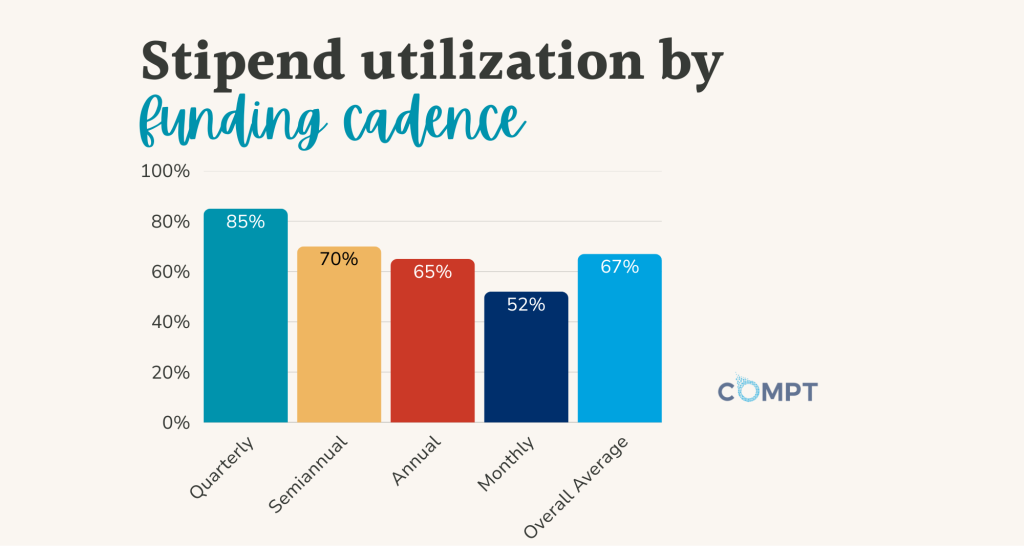
- Funding can be flexible. Most companies offer stipends monthly, quarterly, or annually depending on how they want to drive engagement.
Many companies start with a wellness-specific stipend, then expand into a broader Lifestyle Spending Account (LSA) that includes wellness alongside other categories like learning, family support, and remote work.
20+ ways employees use a wellness stipend
One of the biggest advantages of a wellness stipend is flexibility. Instead of trying to predict what employees need, you give them the ability to choose — within specific guardrails, which you define — what actually supports their well-being.
Below are 20+ real examples of how employees use wellness stipends today, along with typical cost ranges to help you plan your program.
Counseling
Therapy is one of the most common ways employees use a wellness stipend, especially when sessions cost $100–$250 out of pocket and many providers don’t accept insurance. This stipend may be the difference between employees delaying care and actually getting support when they need it.
Ergonomic office furniture
Employees can use a wellness stipend to improve their physical comfort at work by purchasing items like standing desks or ergonomic chairs, which typically cost $150–$800+ one-time. This helps prevent long-term strain and repetitive stress injuries, especially for remote and hybrid workers.
Gym memberships or home fitness equipment
Employees can use a wellness stipend to pay for gym memberships ($30–$100/month) or build a home setup with equipment like weights or exercise bikes ($100–$2,000+ one-time). This supports both in-person and at-home fitness routines.
“I exercise regularly, but this gives you extra motivation to go a little more!!”
— Compt user, January 2025
Health insurance support
Some companies allow wellness stipends to offset health-related costs like premiums or out-of-pocket expenses, particularly for employees on high-deductible plans. This can range widely but often falls between $100–$1,000/month, depending on program design. For example, to ensure Compt employees get the same dollar-value benefit regardless of whether they’re on the company health plan, we offer monthly stipends of up to $1,000 for those who elect to get their health insurance elsewhere.
Weight management programs
Employees can use a wellness stipend for structured weight management programs, including coaching, nutrition plans, or clinically supported options. Programs typically range from $20–$200/month, while newer options like GLP-1 medications can cost $500–$1,000/month, depending on coverage and employer policy. With Compt, you can also elect to offer a more specific weight management stipend that focuses entirely on metabolic health vs. general wellness; it does require clear policy guardrails to stay compliant as a post-tax benefit.
Massage or recovery services
Employees can use a wellness stipend for services like massage therapy or recovery treatments, which typically cost $60–$130 per session. These are often used to manage stress, muscle tension, or chronic pain.
Health supplements
Employees can use a wellness stipend to purchase vitamins and supplements, which typically cost $20–$100/month depending on needs. This can support nutritional gaps that aren’t always covered by traditional benefits.
“With the rise in costs, this has really helped our budgeting of some everyday items.”
— Compt user, September 2024
Smoking cessation programs
Quitting smoking is one of the hardest — and most expensive — health changes employees try to make, which is why wellness stipends are often used for cessation programs costing $50–$300+. The broader impact is significant: cigarette smoking costs the U.S. more than $600 billion annually, including over $240 billion in healthcare spending and nearly $365 billion in lost productivity from illness and premature death. Supporting employees who want to quit isn’t just a health initiative — it’s one of the clearest ways to reduce long-term costs while improving day-to-day productivity.
Mental health apps
Tools like Calm or Headspace are an easy entry point into wellness stipends, typically costing $70–$100 per year. They’re low-cost, but high-frequency — employees tend to use them daily for sleep, stress, or focus, which makes them one of the most consistently engaged-with categories.
Nutrition coaching or classes
Nutrition is one of those areas where employees often want to improve but don’t know where to start. Wellness stipends can cover one-on-one coaching ($50–$150/session) or structured programs and courses ($50–$300 total), helping employees build habits that actually stick rather than relying on guesswork.
Yoga or specialized fitness classes
Not everyone wants a traditional gym membership, and that’s exactly why stipends get used for things like yoga, Pilates, or boutique fitness classes. These typically range from $15–$40 per class or $100–$250/month for memberships, giving employees options that better match how they actually like to move.
“It has allowed me to do something for myself and not feel guilty about it.”
— Compt user, September 2024
Diabetes education and prevention programs
Many employees don’t realize they’re at risk for conditions like prediabetes until it becomes a bigger issue. Wellness stipends can be used for education programs, screenings, or coaching ($50–$300+ depending on the program), helping employees take a more proactive approach to long-term health.
Personal training or fitness coaching
Accountability is often the missing piece in fitness routines, which is why employees use stipends for personal training or coaching. Sessions typically cost $60–$150 each, and employees who invest here tend to stay more consistent compared to going it alone.
“It has helped me do my light strength training and do exercises to benefit my circulation.”
— Compt user, January 2025
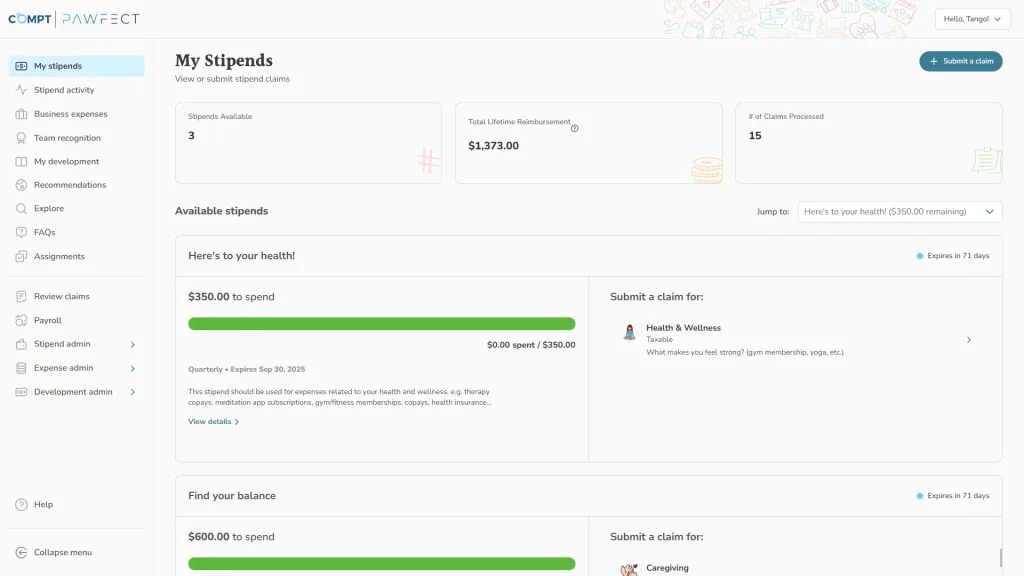
Designing a wellness stipend is one thing. Running it without adding work for HR and Finance is another.
Compt helps teams manage wellness stipends and LSAs with a reimbursement-first model that keeps programs flexible for employees and predictable for the business.
Vacation and recovery time
Burnout doesn’t get solved with a meditation app alone — sometimes employees just need time away. Wellness stipends can be used toward vacation-related expenses, as long as your policy allows it. Because wellness stipends are post-tax benefits, there are no IRS restrictions; it all comes down to how you define your program.
“It has allowed my family to do extra things together.”
— Compt user, September 2024
Wearable health devices
Devices like Fitbit, Apple Watch, or Oura Ring are a popular one-time purchase, typically costing $100–$400+. These tools give employees real-time visibility into activity, sleep, and overall health, which often leads to more consistent behavior changes over time.
“I am able to do things for myself that I would not normally do.”
— Compt user, February 2025
Meditation and mindfulness programs
Beyond apps, some employees prefer guided programs, classes, or retreats focused on mindfulness and stress reduction. These can range from $50–$300+, depending on the format, and are often used to manage stress in a more structured way.
Meal delivery services
Healthy eating is easier when it’s convenient. Employees often use stipends for meal delivery services, which typically cost $8–$15 per meal or $80–$300/month depending on frequency. This is especially valuable for employees managing specific dietary needs or busy schedules.
Groceries
Groceries are one of the most practical ways employees use a wellness stipend, particularly when nutrition is included as an eligible category. This can cover everyday food purchases, meal ingredients, and specialized dietary needs, making it one of the easiest ways for employees to consistently use the benefit. Including groceries expands access without adding complexity and reflects how wellness shows up in real life through daily habits.
“I have enjoyed getting a little help with groceries. When you have a big family, every penny counts.”
— Compt user, September 2024
Vision care
Even with insurance, vision costs add up. Employees can use stipends for glasses, contacts, or services (LASIK, anyone?) not fully covered by their plan, with typical costs ranging from $100–$500+. It’s a practical category that often gets overlooked but has a direct impact on daily comfort and productivity.
Chiropractic and alternative care
Some employees get more relief from chiropractic care, acupuncture, or other alternative treatments than traditional care alone. These services typically cost $30–$100 per session, and stipends make them more accessible when insurance coverage is limited.

What to budget for a wellness stipend: Compt customer benchmarks
Once you’ve defined what a wellness stipend can cover, the next decision is how much to offer. Understanding how other companies fund these programs can be helpful here.
Wellness stipend funding data (Compt 2026)
Compt’s 2026 benchmark data shows how wellness stipends are funded across employers:
| Metric | Annual amount per employee |
|---|---|
| Minimum | $12 |
| Median | $735 |
| Maximum | $36,000 |
The median is the most useful reference point. It reflects how most employers are funding wellness stipends once programs are established and in active use.
The minimums and maximums show the full range of program design. These figures include outliers driven by company size, workforce mix, or specialized use cases, such as highly targeted programs or broader, multipurpose benefits.
How to interpret this for your program
Most companies design wellness stipends to support consistent, repeatable use rather than to fully cover the cost of wellness-related expenses.
Funding decisions typically center on:
- Making the benefit usable across common, recurring expenses.
- Keeping total program spend predictable over time.
- Aligning wellness with other benefit categories when relevant.
The exact dollar amount matters less than whether employees can easily understand and regularly use the benefit.
Wellness stipends vs. Lifestyle Spending Accounts (LSAs)
Once the budget is set, the next decision is how that budget is structured.
A wellness stipend applies the full allocation to a defined set of health-related categories, such as fitness, mental health, nutrition, and recovery.
A Lifestyle Spending Account (LSA) uses the same reimbursement model but allows that allocation to be used across a broader set of categories. In addition to wellness, employees may also use the benefit for areas like family support, professional development, commuting costs, or even company swag, depending on how the program is designed.
This structural difference affects how the benefit is used over time.
From Compt’s 2026 data:
- Standalone wellness stipends see approximately 70% utilization.
- Wellness included within an LSA reaches 86% utilization.
Wellness remains one of the most-used categories in both models. In a broader program, it sits alongside other categories that reflect day-to-day needs, which increases the number of ways employees can engage with the benefit.
How teams approach this decision
Teams typically choose their structure based on how narrowly or broadly they want to define the benefit at launch.
A wellness stipend is commonly used when:
- The program is focused on a specific set of health-related outcomes.
- Categories are intentionally limited to maintain a clear scope.
- The goal is to introduce a straightforward, easy-to-explain benefit.
An LSA is more common when:
- The workforce has a wider range of needs across different roles or life stages.
- Multiple stipends would otherwise be introduced or managed separately.
- Consistent participation across the employee population is a priority.
Many organizations start with a wellness stipend and expand the structure over time as usage patterns become clearer.
How this connects back to budget
The overall budget typically stays within the same range. The difference is how employees can access that budget:
- With a wellness stipend, the allocation is tied to a defined set of categories.
- With an LSA, that same allocation can be used across a broader set of use cases.
This often leads to more consistent use of allocated funds and reduces the need to introduce additional programs as employee needs evolve. Win-win.
Why companies use Compt to manage wellness stipends and LSAs
Designing the program is only part of the equation. Running it day to day is where most teams feel the complexity.
Compt helps you manage wellness stipends and LSAs through a reimbursement-first model that keeps programs flexible for employees and predictable for Finance.
With Compt, you can:
- Launch and adjust stipend programs without adding administrative overhead.
- Automate reimbursements, approvals, and tax treatment.
- Give employees the flexibility to spend with vendors that fit their lives.
- Consolidate multiple stipends into a single, easy-to-manage program.
Whether you’re starting with a wellness stipend or expanding into a broader LSA, Compt gives you a structure that scales with your team.
Request a Compt demo to see how it works.

FAQs: Examples of wellness stipends
A wellness stipend is an employer-funded, typically post-tax benefit that reimburses employees for eligible health and well-being expenses. Unlike pre-tax accounts such as HSAs or FSAs, which are limited to qualified medical expenses, wellness stipends are defined by the employer and can cover a broader set of categories like fitness, mental health, nutrition, and recovery.
How does Compt define a wellness stipend?
Compt defines a wellness stipend as a reimbursement-based benefit that employers configure and manage through a single platform. Employers set the eligible categories, funding cadence, and rules, and employees submit expenses for reimbursement within those guidelines.
In practice, that means the stipend is tied to real workflows: employees submit receipts, expenses are reviewed or auto-approved based on policy, and approved reimbursements are included in payroll with the correct tax treatment. Admins can adjust funding, segment eligibility by employee groups, and track participation and utilization in real time.
This structure keeps the benefit flexible for employees while giving HR and Finance a consistent system for managing approvals, compliance, and reporting.
How much is a typical wellness stipend?
Wellness stipend funding varies based on company size and program design. Compt’s 2026 benchmark data shows a median annual wellness stipend of $735 per employee, with funding levels influenced by how broadly the program is structured and how many categories are included.
Is a wellness stipend taxable?
Yes. Wellness stipends are considered taxable income and are reported on an employee’s W-2. Employers can either withhold taxes from reimbursements or gross up the stipend so employees receive the full intended value. Compt is a leading stipend and LSA platform that automates tax treatment and reporting as part of the reimbursement process to reduce manual HR admin work and enable easier IRS compliance.
What can a wellness stipend be used for?
Wellness stipends are typically used for health-related purchases, including fitness, mental health, nutrition, recovery, and preventive care. These expenses account for the majority of real-world usage and reflect how employees apply the benefit to recurring, everyday expenses.
What are the benefits of wellness stipends?
Wellness stipends are effective because they balance flexibility with consistent usage. Compt’s 2026 data shows standalone wellness stipends reach about 70% utilization, meaning most allocated funds are actually used.
They also support a broad range of employee needs, which increases participation and makes the benefit more relevant than one-size-fits-all perks. Employers typically evaluate impact through participation, utilization, and employee feedback, along with longer-term trends like retention and engagement.
How do I set up a wellness stipend?
Setting up a wellness stipend starts with defining the program structure: the budget, eligibility rules, and which categories are allowed. From there, you should establish how reimbursements will be submitted and approved, how the benefit will be communicated to employees, and how usage will be tracked over time.
Most teams follow a clear set of steps: define the policy, set funding and cadence, configure reimbursement workflows, and align the program with payroll for tax reporting. Programs that are easy to understand and broadly applicable tend to see higher participation. Platforms like Compt manage reimbursements, approvals, and compliance as part of this process.
Learn more in our dedicated guide, “How to Design a Successful Health and Wellness Stipend Program.”
How much are other companies our size giving for wellness stipends?
For overall stipends by company size, Compt’s 2026 benchmark data shows average annual funding of $1,675 per employee for companies under 100 employees, $1,055 for companies with 100–1,000 employees, and $649 for companies with more than 1,000 employees.
For wellness stipends specifically, Compt’s benchmark data shows a median of $735 per employee per year, with a minimum of $12 and a maximum of $36,000. The median reflects how most employers fund these programs, while the minimums and maximums capture outliers and specialized designs.
Can a wellness stipend cover GLP-1 medications?
Yes, if the stipend is structured as a taxable reimbursement benefit and the employer includes GLP-1 medications as an eligible wellness expense. Many employers use wellness stipends or LSAs to provide partial reimbursement for these medications while keeping overall costs capped and predictable. A specific weight management stipend from Compt is another option, too.
Because these programs are not medical plans, they avoid the regulatory complexity of expanding pharmacy benefits, but employers still define the eligibility rules and reimbursement limits.
What exactly counts as a wellness stipend vs. gym reimbursement under IRS rules?
A wellness stipend is a post-tax reimbursement program that can cover multiple employer-defined categories. A gym reimbursement is usually a single-category benefit and is also typically taxable unless it qualifies under limited fringe benefit exceptions. In practice, both are treated as taxable income in most cases, but a wellness stipend provides broader flexibility in how funds can be used.
What are examples of wellness stipends at real companies?
Companies use wellness stipends in different ways depending on how broadly they define wellness. At Quickbase, employees use a global wellness stipend across a wide range of expenses, with usage reaching 96% of employees.
At ButterflyMX, a quarterly self-care stipend supports categories like food, travel, tech, and fitness across a global workforce, also reaching 96% participation.
At Fictiv, wellness is one of several categories within a broader stipend program, contributing to 95% participation and over 80% utilization overall.
How does a wellness stipend compare to an LSA?
A wellness stipend limits spending to health-related categories, while an LSA allows the same reimbursement model to cover a broader set of categories such as wellness, food, family support, and professional development.
This difference affects how the benefit performs across a workforce. Standalone wellness stipends in Compt’s data see about 70% utilization, while LSAs reach closer to 89% utilization and higher participation, reflecting how broader category access increases engagement across different employee needs and life stages.
Do remote employees qualify for wellness stipends?
Yes. Wellness stipends work across remote, hybrid, and in-office teams all over the world because they are vendor-agnostic and reimbursement-based. Employees can submit expenses for services that are available in their location, which makes the benefit adaptable to different work environments.
Editor’s note: Originally published in 2021, this post has been recently updated for clarity and relevance for our readers.

 No receipt chasing