

As an employer, your employees’ health and wellness have to be the top priorities. According to Gallup’s State of the Global Workplace 2025 report, 40% of employees say they experienced stress “a lot of the previous day,” and just one in three report thriving in life.
Prioritizing your employees’ health and wellness isn’t just a moral priority, and it doesn’t only benefit them — it also benefits you. WTW’s 2025 Benefits Trends Survey found that two-thirds of employers are recalibrating benefits to deliver more value in a cost-constrained environment, while SHRM’s 2025 Employee Benefits Survey shows flexible programs like wellness stipends continue to rise in adoption.
Companies with programs supporting employee well-being have higher retention rates, productivity levels, and overall job satisfaction. That’s why it’s critical to understand how to design a successful health and wellness stipend program that aligns with employees’ needs and organizational goals.
Our own data supports this shift. In Compt’s 2026 Annual Lifestyle Benefits Benchmark Report, health and wellness remains one of the top three stipend categories, with 37% of our customers offering it. Wellness is included as a category in 99% of broader Lifestyle Spending Accounts (LSAs), showing that no matter how the program is designed, well-being remains a priority and core component of modern benefits programs.
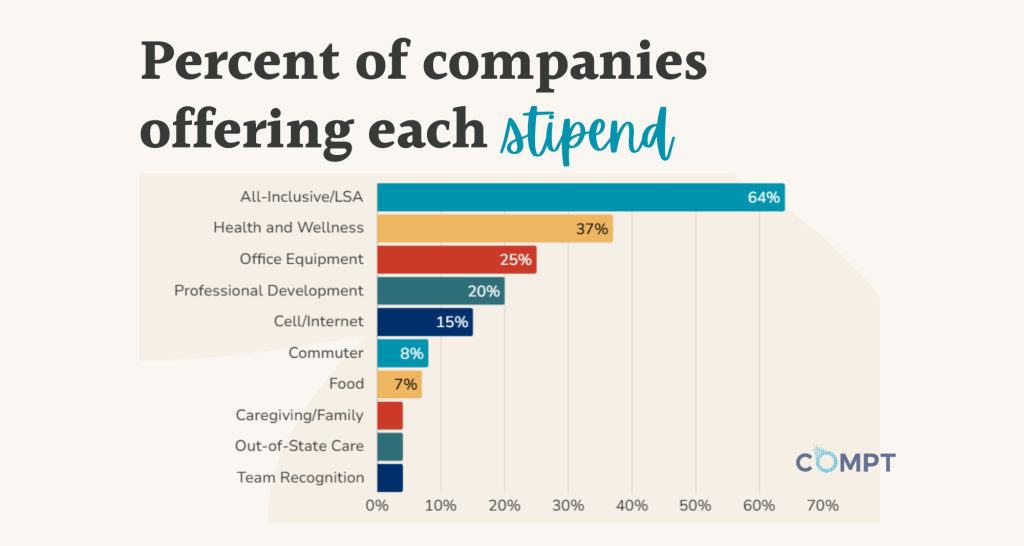
And employees actually use these benefits. According to Compt’s 2026 Annual Lifestyle Benefits Benchmark Report, standalone wellness stipends reach 70% utilization, meaning employees spend $70 for every $100 allocated. When wellness is embedded inside an all-inclusive Lifestyle Spending Account (LSA), utilization climbs to 89%. Participation also increases — from 85% for standalone wellness stipends to 93% for LSAs. Consolidation doesn’t just simplify administration; it drives measurable increases in engagement and spend efficiency.
Not sure how to get started? We’re here to help. This article will go in-depth to support you in building your own health and wellness stipend to offer your employees ultimate choice and control over their well-being benefits.
Psst: Ready to start building? Our team can help you design and launch a wellness stipend in just a few clicks. See how:
What is a health and wellness stipend?
Let’s start off with a quick definition. If you want to dig deeper, check out our comprehensive guide to health and wellness stipends.
A health and wellness stipend is a recurring allowance employees can use to support their physical, emotional, or financial well-being.
Unlike one-size-fits-all perks, wellness stipends give your employees real choice, whether they opt to use the benefit on therapy, gym memberships, vitamins, or healthier groceries.
How can I design a wellness program for employees?
A strong employee wellness program is less about adding “more perks” and more about designing a system employees will actually use. Start with a simple structure, then choose the delivery method (stipend, vendors, or both) that best matches your workforce.
A practical wellness program framework looks like this:
- Set the goal (and the metric).
Decide what you’re trying to improve: stress reduction, retention, engagement, absenteeism, or benefits utilization. Pick 1–2 metrics you’ll track quarterly.
- Cover the basics first.
Confirm you have foundational benefits in place (health plan, paid leave, EAP/mental health access). Wellness programs work best as a supplement, not a substitute.
- Design for broad relevance.
Offer options that work across life stages and job types. If only a narrow employee segment can use the benefit, participation will stall.
- Choose the delivery model.
Most programs use one of these approaches:
Flexible stipend/wellness wallet: employees choose eligible wellness expenses within employer-defined guardrails.
Curated vendor stack: a small set of vetted programs (fitness, mental health, nutrition).
Hybrid: stipend for flexibility + a few “anchor” vendors for structure.
Compt now offers a hybrid model with our addition of Employee Discounts. - Make it easy to use.
Keep categories clear, documentation simple, and reminders consistent. Complexity is the silent killer of wellness benefits ROI.
- Review and iterate quarterly.
Use participation + utilization + feedback to adjust categories, funding cadence, and comms. The best wellness programs evolve with employee needs.
This post walks through how to apply that framework specifically to a Compt wellness stipend (one of the most flexible, highest-participation delivery models).
What expenses can a health and wellness stipend cover?
How you design a successful health and wellness stipend program depends on your culture, goals, and budget. What’s great about stipends is they’re flexible — employees get the stipend through Compt and can use it for anything that falls under the wellness umbrella, broadly defined by you.
During my years building out different health and wellness benefit plans for customers, I’ve seen three common program tiers:
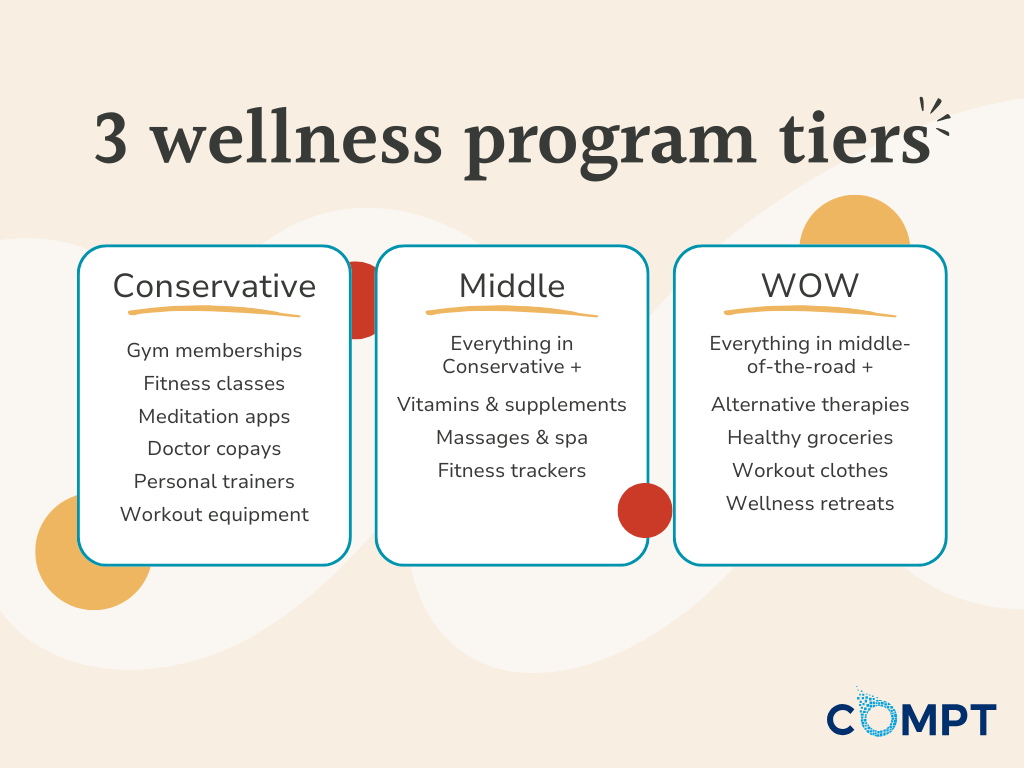
Conservative
- Gym memberships
- Fitness classes
- Meditation apps
- Doctor copays
- Personal trainers
- Workout equipment
Middle-of-the-road
All of the above, plus:
- Vitamins and supplements
- Massages and spa treatments
- Fitness trackers
“WOW” level — where Compt customers realize the most value
All of the above, plus:
- Alternative therapies
- Healthy groceries
- Workout clothes
- Wellness retreats
Essentially, how you want to structure your wellness stipend program depends on how you want to define wellness for your employees. The key is doing so broadly enough for everyone to find value. It’s good to understand what needs your employees have in this area so you can offer them choice.
Want more ideas? Here are 20+ ways to use a wellness stipend.
Why offer health and wellness stipends?
Among Compt users, health and wellness is consistently one of the top stipend categories by total spend.
But let’s remind you, wellness shouldn’t be just a checkbox goal for the company. The true impact of health and wellness stipends is to support your team in living their best lives outside the office while reinforcing company values around work-life balance, fitness, and self-care.
And to measure the impact of your stipend program over time, you’ll want to look at metrics like:
- Enrollment and engagement percentages
- Changes in productivity, job satisfaction, and retention rates
- Feedback from employees via benefits surveys and one-on-one conversations
How to design a wellness stipend program for employees with Compt: 6 easy steps
Before you begin planning, gather the following information so you have everything you need to properly manage your health and wellness stipend program. This typically covers:
- Budget and dollar amount per employee
- Eligibility criteria
- Application and reimbursement process
- Allowed expenses and any exclusions
- Communication plan to employees (and managers)
- Tracking system for expenses and ROI metrics
If you’re not sure about any of the above, request a demo with Compt to consult with our benefits experts and simplify the whole process.
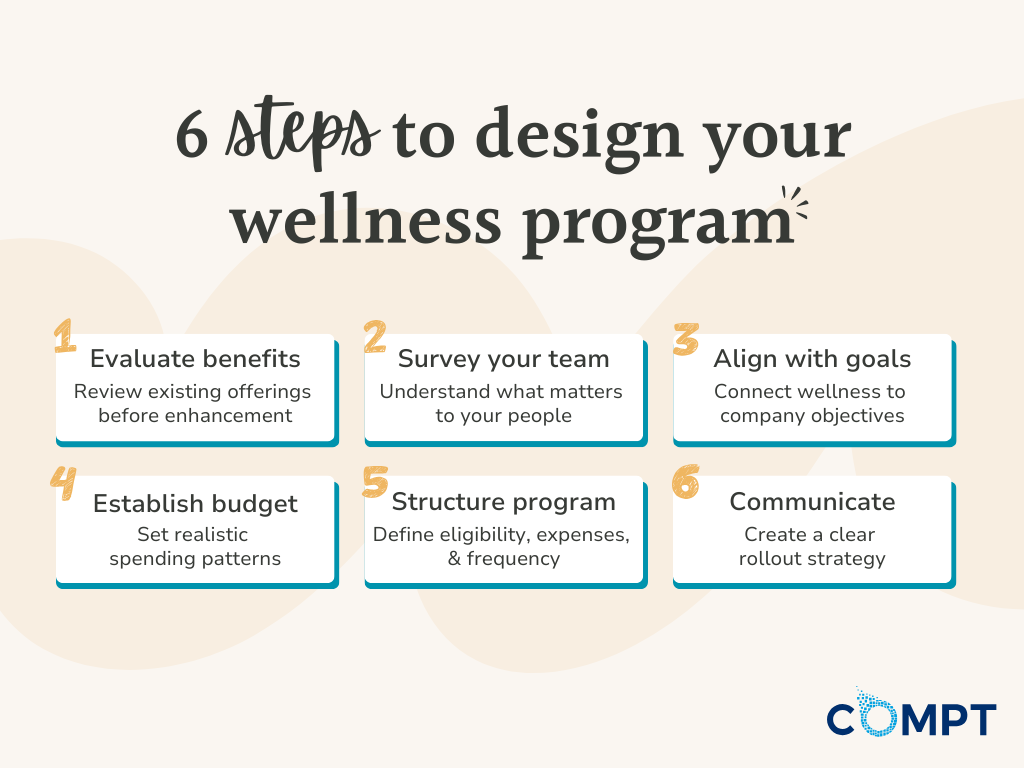
Although setting up a health and wellness stipend takes just an hour, your company’s budget, values, and goals will all play a role in determining the details of your program. Here’s how to design a successful health and wellness stipend program step by step.
1. Evaluate your current benefits offerings.
A wellness stipend complements, not replaces, medical coverage and core benefits.
Confirm that baseline health insurance, paid leave, and family benefits are in place to address employees’ basic health and well-being needs before planning and making room in your budget for stipends.
2. Find out what matters to your team.
Will a health and wellness stipend actually be meaningful to your team members? Mercer’s Health on Demand 2025 report found 54% of employees want more personalized benefits tailored to their lives.
But you need to survey your own team members directly to see if they would value it and how much is reasonable. Uncovering their needs is a must-do step to design a successful health and wellness stipend program.
Run an employee benefits survey and ask them about:
- Health concerns and priorities
- Current lifestyle habits
- Preferred wellness activities
That way, you’ll know which areas to focus your stipend program — for instance, stress management, physical activity, or nutrition. From there, you can tailor the program to address gaps in your team’s current needs.
Some of my favorite examples from Compt’s real-life customers include:
- I am acquiring a First Aid certificate.
- Just began using this for my yoga membership.
- My quarterly massage is very rewarding.
- I am struggling with sciatica pain and the benefit helps me pay for a chiropractor.
As you can see, the needs vary, so offering a benefit that can be used in different ways (like an all-inclusive Lifestyle Spending Account with wellness categories) could be key to supporting your people where they need it most. This flexibility is, ultimately, what drives inclusion and engagement.
Psst: Request a Compt demo to learn more about how a Lifestyle Spending Account can support your employees’ needs outside of health and wellness.
3. Align your team’s needs with your company’s goals.
Because they fund activities that promote healthy lifestyles, stipends are a way to reinforce your company’s values and reach your business goals. For the impact of your program to be measurable, you need to know what those values/goals are, and how to measure them.
That means:
- Quantitative measures like changes in productivity, absenteeism rates, and healthcare costs over time
- Qualitative measures like employee satisfaction, engagement levels, team dynamics, and the general attitude toward specific wellness activities (e.g., physical vs. mental wellness)
When it comes to your team’s demographic makeup, culture, and company dynamics (e.g., in-office vs. hybrid vs. remote, young vs. multigenerational), these factors aren’t the main drivers of health and wellness stipend program design. It’s a lot simpler than that.
In my opinion, a flexible, workplace-agnostic approach is the recipe for success with any stipend program.
Overall, it doesn’t matter the industry. The key is not adding too many guardrails — say what’s allowed, but nothing too granular. You want to keep it broad enough to where all employees can use it.
Where those differences matter is in how you market the program to your employees (more on this later). It’s important to tailor your communication to fit your cultural priorities and your team’s health and wellness goals, which you learned in Step 2.
4. Establish your budget.
If you’re serious about offering health and wellness benefits, it’s important you have a realistic idea of what you’ll spend. Something isn’t always better than nothing — for the stipend to be effective, there’s a general baseline you want to aim for.
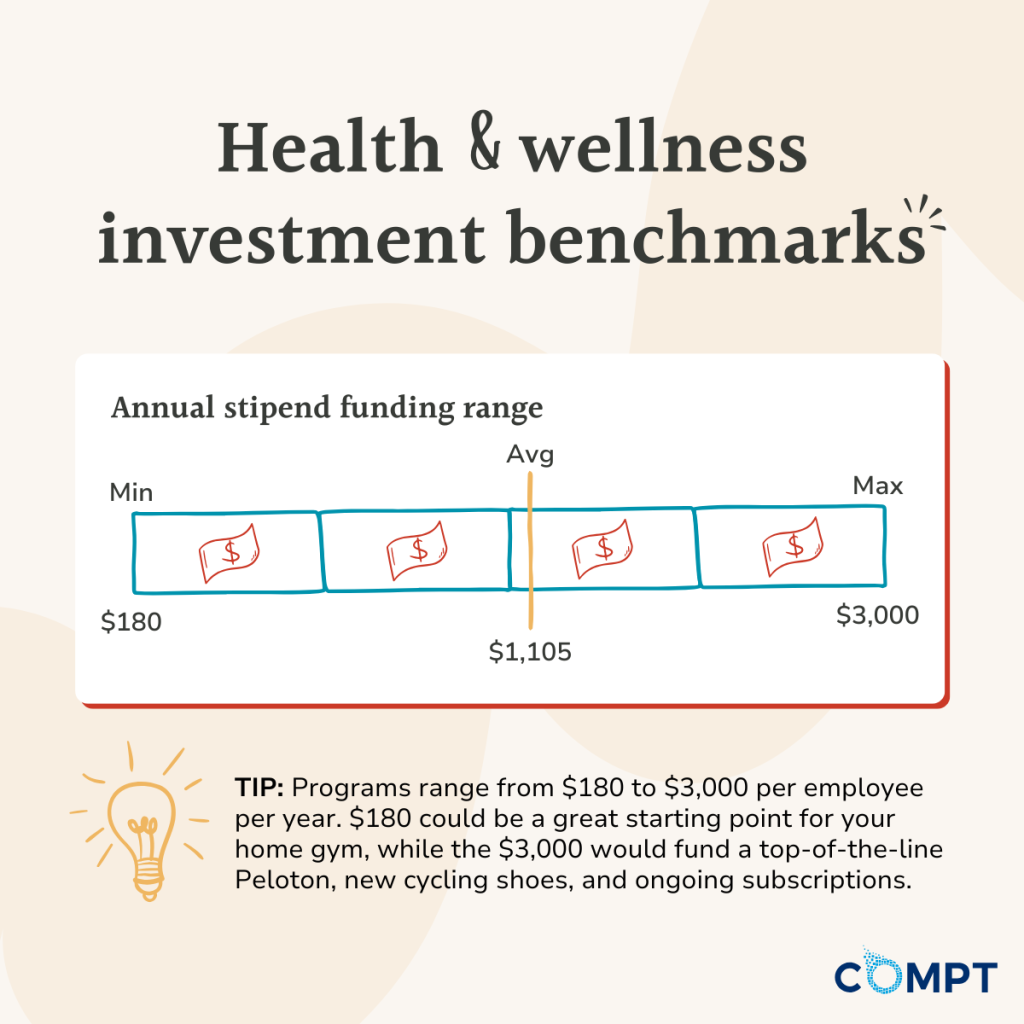
From what we see with our own users, many employers start with $15 to $100 per month per employee.
According to Compt’s 2026 Annual Lifestyle Benefits Benchmark Report, the average wellness stipend is $735 per employee per year, though funding varies significantly based on company size and total rewards philosophy. Per-employee funding ranges from $12 at the low end to $36,000 at the high end, reflecting everything from small pilot programs to highly customized executive or global offerings.
Think of it this way: An average stipend of $735 per year can cover a full year of gym memberships, multiple therapy copays, fitness equipment, wearable trackers, or a combination of groceries, supplements, and mindfulness apps. Even a modest monthly stipend can meaningfully offset rising wellness costs and make healthy choices more accessible to employees.
That said, even an extra $20 or so could make a big difference to your people! According to KFF’s 2024 Employer Health Benefits Survey, the average premium for employer-sponsored family health coverage rose 7% year-over-year to $25,572, reinforcing why supplemental wellness funds matter.
Pro tip: Don’t forget about taxes! A health and wellness stipend is a taxable benefit, which means the amount will be included within the employee’s gross income. It’s considered a fringe benefit, and we cover this in much more detail in our comprehensive guide to taxable vs. nontaxable fringe benefits.
5. Structure your health and wellness stipend program.
There are three factors to consider here:
- Eligibility. Stipend programs are normally available to all full-time employees, but you can define more specific eligibility criteria. You could, for instance, limit it to those who don’t do shift work, or create a separate, smaller amount for part-time workers.
- Allowed expenses. The more flexible, the better. Let employees use the stipend for gym memberships, fitness classes, mental health services, preventive care, health products, and a variety of other health- and wellness-related expenses.
- Funding cadence. Some companies offer a monthly stipend to make things like gym memberships more manageable. Others opt for a quarterly stipend, or even a larger annual one, which is advantageous if employees want to use it for something more expensive like a retreat.
As far as payment frequency goes, I recommend extending the timeframe.
Quarterly stipends tend to have the highest utilization because a month can be too short — employees either forget to use it in that time, or it’s too late to submit a receipt by the time they get around to it.
Keep in mind, though, that a year is too long a timeframe for a health and wellness stipend. At that length, employees tend to procrastinate or forget about the stipend entirely.
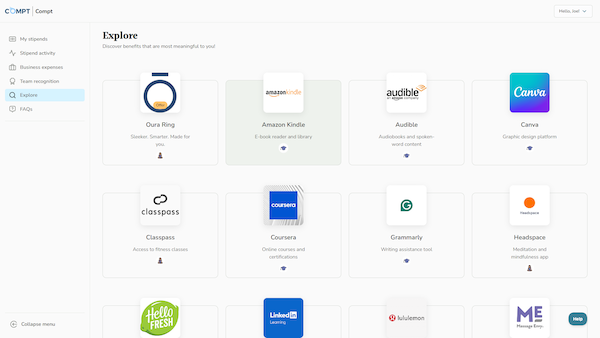
To get better deals for your employees, we recommend partnering with local vendors. Plenty of local gyms, wellness centers, and healthcare providers offer employers discounted rates or special packages for teams.
We built a specific section in our platform, called “Explore,” to highlight different vendors that employees can use their stipends on, with special discounts exclusive to our Compt customers for some of the vendors listed. I’m seeing this go a long way when employees are trying to figure out where best to spend their stipend dollars!
6. Develop a communication plan.
For your team to actually use their benefits, you need to clearly communicate the details, eligibility criteria, and how to access the program.
Ideally, you’ll do this a few weeks before rolling the program out by sending a company-wide email or intranet posting explaining everything and holding a meeting where your HR team can answer questions.
Pay close attention to who’s enrolling and who hasn’t yet, so you can follow up personally with those who haven’t. And, to get everyone more excited about the stipend, hold team competitions, wellness challenges, and incorporate rewards and recognition for reaching milestones (you can set this up automatically with the Compt-Slack integration).
When you write your program descriptions, it’s best to keep things broad and flexible, just like your program.
With health and wellness stipends, we always encourage employers to be as flexible as possible. Listing too many items that are explicitly “covered” can deter employees from using the benefit if they don’t see anything that they personally need.
Instead, it’s best to mention the few things that wouldn’t be covered, then provide a few diverse recommendations for how the benefit can be used to demonstrate its inclusivity. You can tailor those examples to what’s culturally important to you, what’s top priority for your employees, and the demographic makeup of your team.
For instance, if a significant number of your team members are women in their late 20s and early 30s and family planning is important to them, you could point to its potential use for things like postpartum exercise classes or mental health support.
Regardless, remember to make it clear that employees have the freedom to use the stipend toward just about anything health- and wellness-related.
3 unique health and wellness stipend program ideas
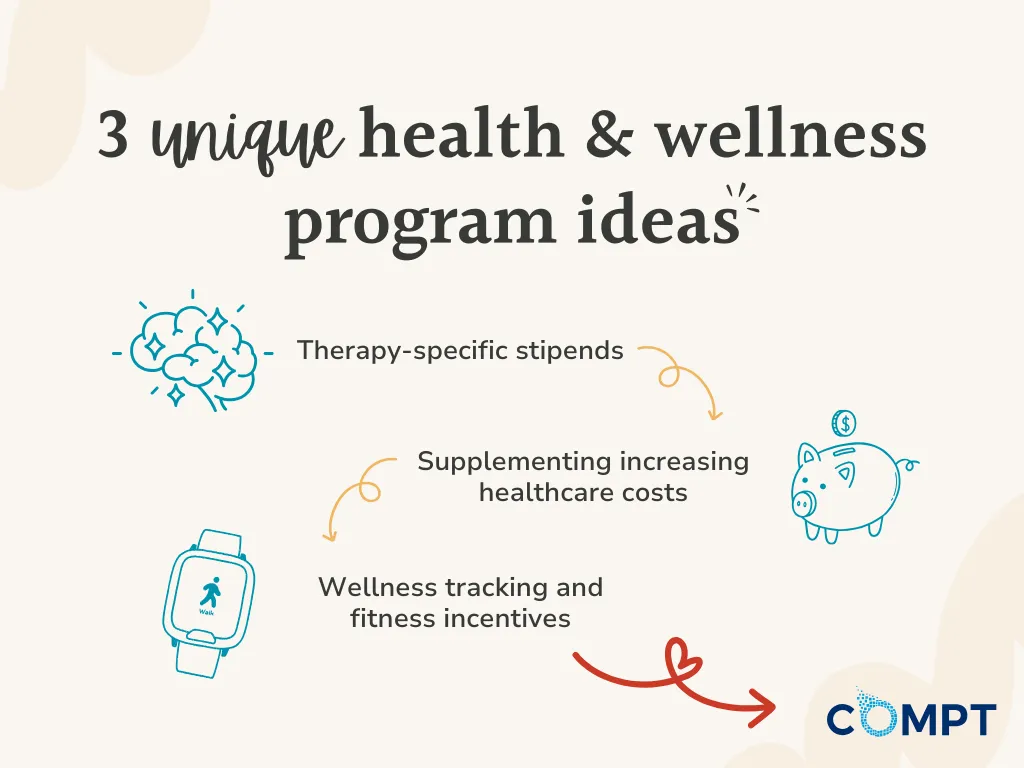
1. Wellness tracking and fitness incentives
To solidify health and wellness as a cultural pillar of their organization, some companies tie their program to an incentive.
For example:
- Offering a $100 stipend for each employee who gets their yearly physical and submits their results
- Providing a bonus or reward for reaching individual fitness goals, such as completing a 5k race or participating in a group fitness class for a set number of weeks
By tying the program to incentives and rewards, employees are more likely to participate. And you can make a meaningful impact in their lives once they make it a habit.
2. Supplementing increasing healthcare costs
According to Mercer, the total health benefit cost per employee is projected to rise by 6.5% on average in 2026 — the highest increase since 2010 — even after planned cost-reduction measures. Without action, estimates suggest costs could increase by nearly 9%. And the United States already has the most expensive healthcare in the world (by a huge margin).
Here’s a real-life example: What did one of our clients do when their employees’ health plans increased in cost? They used Compt to offer a health and wellness stipend covering the difference.
A health and wellness stipend or LSA is also a great accompaniment to an ICHRA, or to support GLP-1 drug costs.
3. Therapy-specific stipends
If prioritizing your employees’ mental health is something that’s taking center stage, then perhaps the most meaningful use of health and wellness stipends could be for therapy or counseling.
The average cost of these services in the U.S. varies (reaching up to $250/hour for in-person sessions in the country’s largest metro areas). But some Compt clients offer a health and wellness stipend of $50 to $100 per month, which can be enough to cover copays or even the full cost for some employees.
Compt makes it easy to structure, communicate, and manage your stipend program.
With Compt, it’s easy to set up a stipend (less than an hour!), manage employee spending, track usage, and provide easy access to eligible vendors. And we integrate with payroll platforms to make the process as seamless as possible for your back office.
It’s also 100% tax-compliant, so you won’t have the mess of tracking receipts, calculating taxable benefits yourself, or being unprepared for an audit.
Request a demo to see how it works.
FAQs: How to design a successful health and wellness stipend program
Start with outcomes, then build a program employees will actually use. Define the goal (e.g., retention, stress reduction), confirm foundational benefits are covered, and choose a delivery model that fits your workforce: a flexible stipend/wellness wallet, a small set of vendors, or a hybrid approach. Keep eligibility broad, categories clear, and participation easy (simple rules + regular reminders). Then review participation, utilization, and employee feedback quarterly and adjust the program over time.
How much should I budget for a health and wellness stipend?
According to Compt’s 2026 Annual Lifestyle Benefits Benchmark Report, the average wellness stipend is $735 per employee per year, though funding varies widely based on company size and philosophy. Many employers start between $15 and $100 per month and adjust over time based on participation and utilization data.
When you’re just getting started, even $15-$100 per month is enough to drive meaningful engagement without overspending. As your program matures, you can expand funding or bundle wellness into a broader Lifestyle Spending Account (LSA).
What expenses qualify for a wellness stipend?
Wellness stipends cover a wide range of expenses that promote physical, emotional, and even financial well-being. Common examples include gym memberships, therapy or counseling sessions, meditation apps, ergonomic equipment, and nutrition or fitness programs. Some companies go further by covering holistic options like acupuncture or wellness retreats. With Compt, you define eligible categories so employees can choose what matters most to them.
Are wellness stipends taxable?
Yes. In most cases, health and wellness stipends are considered taxable fringe benefits under IRS rules because they reimburse employees for personal expenses. Compt automatically categorizes and reports taxable reimbursements through payroll, saving HR teams the burden of manual tracking. For a deeper dive into the details, see our guide to taxable vs. nontaxable fringe benefits.
How often should wellness stipends be distributed?
It’s up to you. Quarterly stipends consistently deliver the strongest utilization rates. According to Compt’s 2026 Annual Lifestyle Benefits Benchmark Report, quarterly-funded stipends reach 85% utilization, compared to 70% for semiannual, 65% for annual, and 52% for monthly funding. A quarterly schedule gives employees enough time to plan meaningful purchases while helping employers maintain budget control and higher engagement.
Monthly stipends can work well for smaller or newer programs, but they tend to see lower utilization than quarterly models. Annual stipends perform better than monthly, but for health and wellness in particular, shorter funding cycles often encourage more consistent engagement. Many organizations reserve annual stipends for categories like professional development, where employees may plan larger, less frequent purchases.
What’s the average participation rate for wellness stipends?
Participation rates are a strong indicator of program success. All-inclusive LSAs reach 93% participation among Compt customers, showing that flexible, consolidated design drives engagement.. Programs with too many restrictions — like marketplaces and debit card solutions that limit employee choice to specific vendors — tend to see lower adoption and engagement. The takeaway: choice and flexibility drive participation.
How can HR teams measure ROI on wellness stipends?
Measuring ROI starts with tracking participation, utilization, and feedback. In Compt, you can view real-time dashboards that show how often employees engage and what categories are most popular. Pair that with periodic surveys to see whether employees feel better supported. Over time, you can link stipend usage to outcomes like retention, productivity, and reduced burnout—turning qualitative feedback into quantitative proof.
Category utilization reporting example from Compt: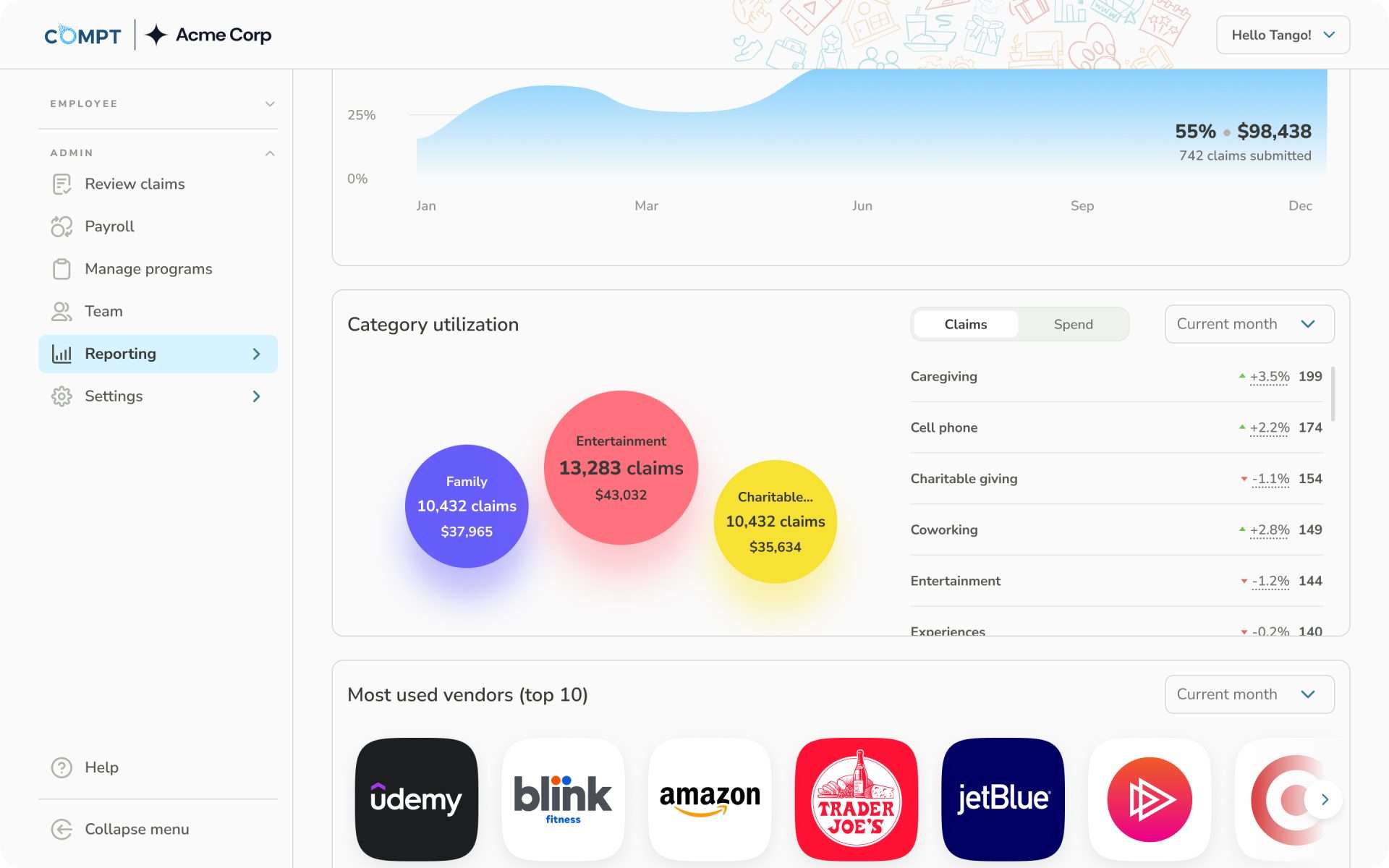
Can wellness stipends include mental-health support?
Absolutely. Mental health is a popular category Compt’s platform and one of the most valued by employees. Companies often allow health and wellness stipends to be used for therapy, coaching, meditation apps, or even subscription services like Calm or Headspace. This flexibility normalizes mental health care as part of total well-being rather than a separate, siloed benefit.
How do wellness stipends differ from Lifestyle Spending Accounts (LSAs)?
A wellness stipend covers expenses related to physical or mental health, while a Lifestyle Spending Account can include multiple categories (including health and wellness, but also family, recognition, professional development, swag, and more — Compt offers 28 categories) in a single taxable benefit.
Many employers start with a wellness stipend and later expand into an LSA as part of a holistic benefits strategy. Compt supports both approaches, so you can start small and scale when ready.
How should we communicate the wellness stipend to employees?
Communication is the make-or-break factor in program adoption. Start by announcing the benefit early, sharing examples of eligible expenses, and explaining how reimbursements work. Then, remind employees regularly — especially before the stipend renews.
Your Compt Customer Success Manager can help with communication templates and reminders.
How does Compt simplify compliance and administration of the wellness stipend program?
Compt automates the messy parts of running stipends, such as approvals, reimbursements, and payroll syncing. Every expense is coded correctly for IRS compliance, and audit logs are built in. HR teams save time, reduce risk, and eliminate the need for manual spreadsheets — all while giving employees more autonomy.
Do wellness stipends affect HSA or FSA eligibility?
Not if they’re designed correctly. Because wellness stipends are taxable, they operate separately from pre-tax health accounts like HSAs or FSAs. Employers should avoid reimbursing medical expenses already covered under an HSA-eligible plan to stay compliant. Compt’s categories make this easy; you can simply exclude items that would create overlap.
Discuss any concerns with your Compt Customer Success Manager during program onboarding and they’ll make sure you’re all set.
Can wellness stipends be used internationally?
Yes, as long as your payroll system supports taxable reimbursements in each country. Many global companies use Compt to manage stipends across currencies and tax jurisdictions. You can localize eligible categories and spending limits to ensure fairness and compliance no matter where your employees live. It’s one of the simplest ways to offer equitable global benefits without separate vendors in each region.
How do wellness stipends align with a comprehensive total rewards strategy?
Wellness stipends are increasingly part of modern total rewards packages, helping companies attract and retain talent without adding rigid benefit tiers. They support flexibility, inclusion, and personalization, which are three priorities highlighted in WTW’s 2025 Global Benefits Trends Survey. For organizations shifting toward outcomes-driven benefits, wellness stipends are a cost-effective, high-impact way to show employees they’re valued as whole people.
Editor’s note: Compt software supports the categorization and proper reporting of benefits according to IRS guidelines, helping businesses maintain compliance. However, Compt cannot provide tax advice, and users should consult their own tax, legal, and accounting advisors when necessary.
Originally published in February 2025, this post has been recently updated for clarity and relevance for our readers.

 No receipt chasing