
Employee discounts aren’t new. But the way employers evaluate them is changing.
For years, many HR teams deprioritized traditional discount portals. They were easy to launch and sounded generous on paper, yet usage was inconsistent and the experience often felt disconnected from the benefits employees actually relied on.
At the same time, reimbursement-based lifestyle benefits like stipends and Lifestyle Spending Accounts (LSAs) surged in popularity. They met employees where they were by offering freedom to spend on what mattered most, while giving HR and Finance a simpler, more compliant way to deliver support.
Now, in 2026, those two threads are converging.
According to Compt’s 2026 Annual Lifestyle Benefits Benchmark Report, participation across flexible benefits programs is remarkably high — 93% of active employees used at least one benefit in 2025 — but how employees use those benefits has shifted toward everyday essentials.
Nearly 1 in 10 stipend dollars is now spent at grocery retailers, and 70% of total spend flows to local, regional, independent, or niche vendors rather than national marketplaces.
That context matters. It reframes the question HR and Finance leaders are asking in 2026:
How do we make the benefits we already fund feel like more?
That’s where an employee benefits discounts marketplace comparison becomes useful — not to crown a single “winner,” but to understand how these models actually work in practice, and where each falls short.
Why 2026 is the year to reevaluate employee discounts
The benchmark data shows a clear pattern: employees are prioritizing benefits that offset real, recurring costs. Food, wellness, connectivity, and household needs consistently rank among the most-used categories, and participation for these benefits remains high.
Employers, at the same time, are consolidating programs instead of adding new ones. In 2025, 64% of Compt customers ran an all-inclusive LSA, up from 55% the year before. The goal for many of our customers was to make their existing benefits and budgets work harder while reducing operational complexity.
“I like that the entire [Compt] product is designed around simplification of the employee experience. … The more work that we can get done in a simple, automated way, the more time we have to spend on value-add activities instead of administrivia.”
— Chief Human Resources Officer, large veterinary healthcare organization
The four models in today’s employee benefits discounts marketplace comparison
Most platforms HR teams evaluate fall into one of four models. Each reflects a different assumption about how employees engage with benefits.
1. Discount-only marketplaces
Traditional discount marketplaces give employees access to negotiated deals across retail, travel, entertainment, and wellness through a standalone portal.
They can work as a lightweight perk, but the benchmark data helps explain why engagement often fades. Employees don’t organize their lives around portals; they organize spending around their actual needs and wants. When discounts live outside the benefits employees actively use, they’re easy to forget.
These platforms also lack visibility into whether discounts meaningfully support participation, utilization, or financial wellness. Savings may exist, but they’re disconnected from benefits strategy.
2. Marketplace-first LSA platforms (Forma, ThrivePass, Espresa)
Marketplace-first platforms attempt to solve that disconnect by embedding curated catalogs directly into LSAs.
The upside is control; these models deliver hand-selected vendors, predictable spend paths, and a clean user experience.
The tradeoff is constraint. Curated marketplaces require ongoing maintenance and inevitably exclude edge cases — especially for global teams, local vendors, or employees with specialized needs.
This matters because employee behavior doesn’t align neatly with catalogs. In 2025, employees spent stipend dollars across 64,000+ unique vendors globally, reinforcing that personalization, not curation, drives participation.
3. Open reimbursement-first platforms (Compt, Benepass)
Reimbursement-first platforms prioritize flexibility. Employees spend where it makes sense for them and submit receipts within defined categories.
The data strongly supports this model. All-inclusive LSAs reached 93% participation and 89% utilization in 2025, outperforming narrower, single-purpose stipends.
- Participation reflects intent: the share of employees who submit at least one expense during the year, indicating how broadly a benefit is actually used across the workforce.
- Utilization reflects effectiveness relative to your goals: the share of issued stipend dollars that employees actually spend, measured within the program’s funding cadence.
Employees consistently direct spend toward what’s most useful in a given moment, whether that’s covering everyday essentials like groceries one month, investing in wellness or professional development the next, or using the benefit for small, meaningful joys that simply make them happy.
Historically, the limitation of open reimbursement models was simple: no built-in savings layer to pair with that unprecedented flexibility.
4. Open reimbursement + embedded discounts (Compt + PerkSpot)
This is where the category has evolved.
With Employee Discounts, powered by PerkSpot, Compt layers a proven discount marketplace into a reimbursement-first platform without turning discounts into a gatekeeper for value.
Employees keep full freedom of choice. Discounts are optional, discoverable, and relevant to how people already spend. HR and Finance teams keep one platform, one system of record, and one consolidated program.
See how it works:
Side-by-side employee benefits discounts marketplace comparison
| Model | How it works | Strengths | Limitations |
|---|---|---|---|
| Discounts-only marketplaces | Employees access a standalone portal with negotiated deals | Easy to launch, visible savings, no reimbursement step | Low sustained engagement, disconnected from core benefits, limited insight into impact |
| Marketplace-first LSAs (Forma, Thrivepass, Espresa) | Curated vendor catalogs layered onto LSAs | Controlled spend, polished UX, predictable vendor set | Limited choice, catalog maintenance burden, weaker global and edge-case support |
| Open reimbursement-first (Compt, Benepass) | Employees spend anywhere and submit receipts | High participation, global parity, aligns with real-life spending | Historically no built-in savings layer |
| Open reimbursement + embedded discounts (Compt + PerkSpot) | Spend anywhere, with optional access to negotiated deals | Flexibility plus savings, no extra vendors, consolidated administration, free to add Employee Discounts to paid Compt lifestyle benefits programs | Newer model that challenges traditional marketplace framing |
“We wanted one place to manage everything — not cards for one stipend, spreadsheets for another, and company credit cards for the rest.”
— Dani Adelman, Director of Operations, TEN7 (Compt case study)
What the data says about participation and why it matters for discounts
One of the most important insights from the 2026 Annual Lifestyle Benefits Benchmark Report is the distinction between participation and utilization. In a tight budget environment, participation is often a primary success metric: are employees actually using the benefit?
Participation is highest for benefits tied to recurring needs:
- All-inclusive LSAs: 93% participation
- Cell and internet: 88%
- Wellness: 85%
- Food: 79%
- Caregiving and family: 78%
These are exactly the categories where discounts can have the most impact — not by replacing stipends, but by stretching them. Employees apply a discount to a purchase they already planned to make, submit the lower receipt for reimbursement, and get more value from the same benefit budget.
Where employees actually spend — and why marketplaces alone fall short
The benchmark data shows that employee spending is highly distributed:
- 70% of stipend dollars go to local, regional, independent, or niche vendors.
- Employees are not defaulting to large, centralized marketplaces like Amazon.
- Grocery and household retailers now account for a growing share of top vendors, with Sam’s Club replacing a national telecom provider in the top 10.
This behavior explains why marketplace-only approaches struggle. Employees don’t want to change where they shop to use a benefit. They want benefits that adapt to how they already live.
You can see this difference clearly when you compare where employees actually spend stipend dollars versus where they apply optional discounts.
How employees spend (stipends) vs. save (discounts)
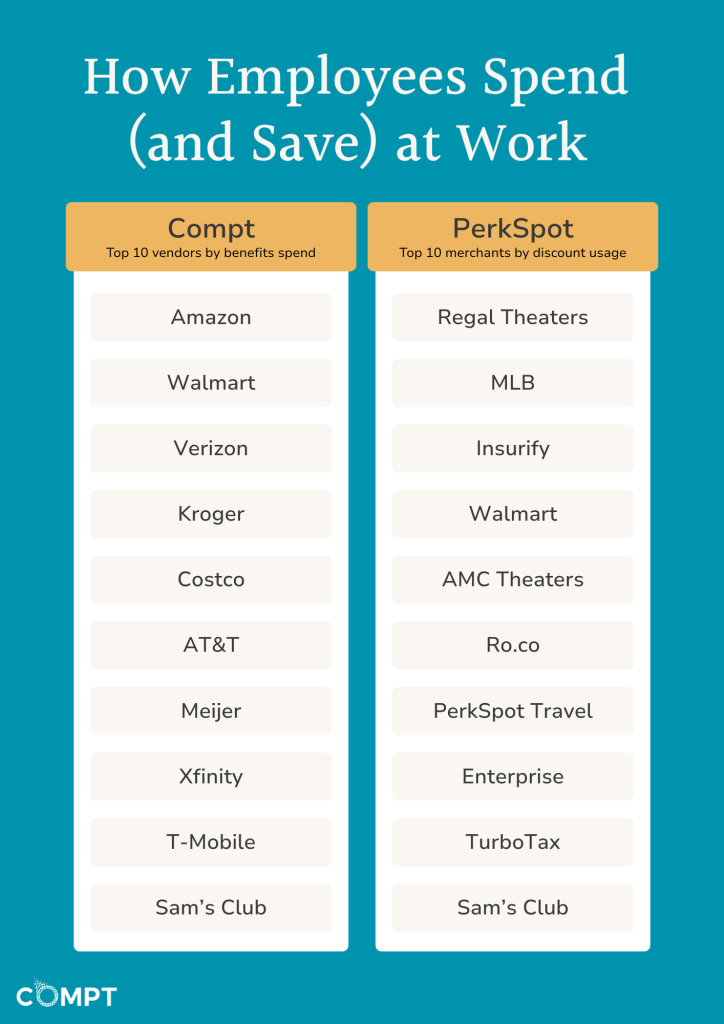
When nearly one in 10 stipend dollars goes to groceries, savings matter most where spend is unavoidable. A $100 stipend used at full price covers $100 of expenses. The same stipend paired with meaningful discounts can stretch further — without increasing your benefits budget.
Savings-first benefits, without adding another tool
Because discounts live inside the same Compt platform employees already use to submit expenses and manage stipends, they don’t require new habits. They simply show up when relevant — including through the PerkSpot Chrome extension, which highlights available discounts as employees shop, search, and browse online.
Discounts are offered as a free add-on within an existing program, not a separate tool. There’s no additional vendor, no new workflow, and no separate reporting. HR and Finance maintain a single source of truth while employees experience more value from the benefits they already use.
Freedom plus deals: the real takeaway
For years, benefits conversations framed this as binary: marketplaces or flexibility, discounts or choice.
Turns out, the benefits world has evolved. Employees engage most when benefits reflect real life, adapt to shifting needs, and stay easy to use. Open reimbursement provides the foundation. Embedded discounts extend the value, without limiting choice or adding complexity.
That’s the real conclusion of this employee benefits discounts marketplace comparison.
See how this works in practice with Compt
If you’re evaluating employee discounts, marketplaces, or stipend platforms, the real question isn’t which model to choose — it’s how to design benefits around how employees actually spend.
With Compt, you can run a reimbursement-first lifestyle benefits program and layer in Employee Discounts, powered by PerkSpot, at no additional cost.
Request a demo to see how Compt + PerkSpot help you consolidate stipends and discounts into one flexible platform.
FAQs: Employee benefits discounts marketplace comparison
Stipends and corporate discounts serve different purposes, but employee benefits benchmarking data shows they work best together. Stipends provide guaranteed, employer-funded budgets that employees can use flexibly across categories like wellness, food, family, and professional development. This flexibility is why stipends consistently drive high participation.
Corporate discounts, on the other hand, reduce the cost of purchases employees are already making. On their own, discounts can feel generic or underused. When layered onto stipends with Compt, they increase purchasing power without increasing employer spend, making benefits feel more impactful in everyday life.
What’s the difference between offering a wellness stipend and negotiating separate gym discounts, and which usually drives higher employee engagement?
Negotiated gym discounts are inherently narrow: they only benefit employees who want that specific gym or fitness option and often don’t translate well across locations or accessibility needs.
A wellness stipend is broader and more inclusive. Employees can choose what wellness means to them, whether that’s fitness memberships, mental health support, nutrition, recovery tools, or everyday health-related expenses. Benchmark data shows wellness participation is significantly higher when wellness is embedded within a flexible stipend or LSA rather than offered as a standalone or narrowly defined benefit. Plus, now you can add Employee Discounts, powered by PerkSpot, for even more value from Compt.
What is better: a perk marketplace, debit card, or a reimbursement model?
Each model optimizes for a different outcome. Perk marketplaces prioritize convenience but limit choice. Debit cards offer immediacy but often introduce compliance and reconciliation complexity. Reimbursement models prioritize flexibility, tax handling, and global parity.
Benchmark data shows reimbursement-first programs drive higher participation because employees can spend where they already shop. When reimbursement models include optional embedded discounts, they combine flexibility with savings — without forcing employees into a curated catalog that limits choice by design.
If we already use a marketplace-style benefits platform, when does an open reimbursement model make more sense?
An open reimbursement model tends to make more sense when employees spend across many vendors, work in multiple regions or countries, or have needs that don’t fit neatly into a curated catalog. Benchmark data shows employees spending across more than 64,000 unique vendors globally, with the majority of spend flowing to local and regional merchants. In these environments, reimbursement-first models scale more effectively, especially when paired with optional discounts that enhance, rather than restrict, employee choice.

 No receipt chasing