
By now, you’re fully aware that AI is one of (if not the) most significant levers for growth and productivity. Problem is, most orgs — and their people — aren’t fully prepared to harness it.
According to PwC’s 2025 Global AI Jobs Barometer report, workers whose roles are “AI-exposed” saw a 300% productivity increase, as well as a 56% wage premium. On a macro level, industries most exposed to AI had ~3x higher revenue per employee growth.
But while practically all companies are thinking about and investing in AI, McKinsey finds that only 1% believe they’ve reached maturity in AI adoption. Roughly half of those companies’ leaders pinpoint “skills gaps” as the number-one barrier.
Traditional roles are quickly becoming AI-augmented versions of themselves. And because the tech is evolving faster than the talent base, the gap between what people know and what modern roles require is only going to widen.
Addressing it requires a professional development program that focuses specifically on AI tools and training. The easiest-to-implement and lowest-cost place to start is with an AI stipend.
“We’ve leaned into AI upskilling heavily by making learning and experimentation both accessible and expected across the organization. We rolled out a $500/year AI exploration stipend for every employee, along with enterprise-level licenses for key AI tools, so teams can practice hands-on. … We pair this with ongoing internal training, a weeklong hackathon, demos from internal experts, and open-source knowledge sharing to help employees build real proficiency and bring AI directly into their day-to-day work. Overall, our approach is to remove barriers, give people the tools, and create a culture where experimenting with AI is part of how we grow.”
— Head of HR Technology, large consumer technology company
What are AI stipends and how do they work?
AI stipends are fixed, employer-funded budgets that let employees explore AI tools, courses, and workflows within clear financial and compliance guidelines.
They work much like any other stipend:
- The company sets the allowance.
- Then defines what qualifies (e.g., subscriptions, training, certifications).
- Employees submit permitted expenses through a structured process.
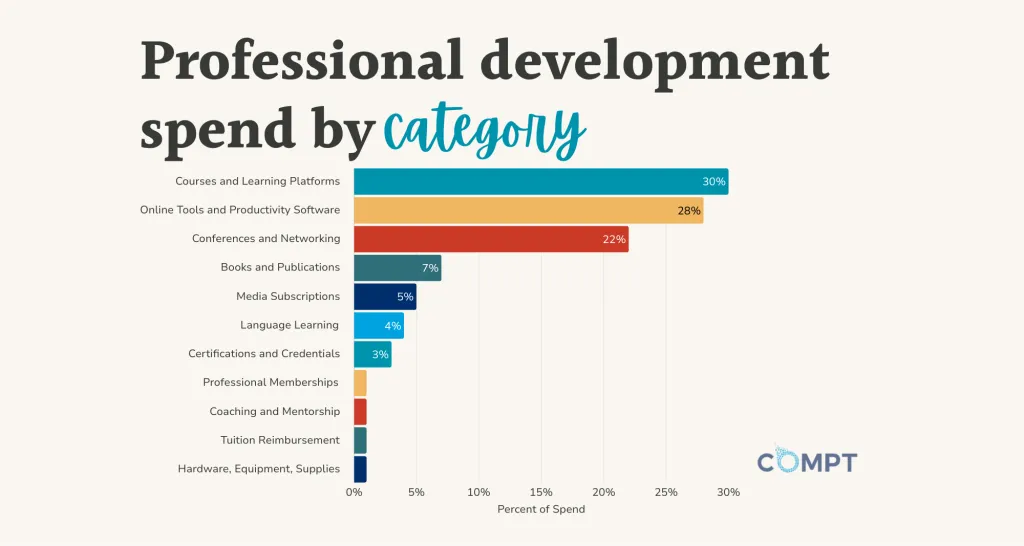
But there’s a growing demand for AI, specifically. Our 2026 Annual Lifestyle Benefits Benchmark Report found that 20% of all professional development expenses were AI-related in 2025, including 62% of spend in the Online Tools and Productivity Software category — the second most popular bucket.
That’s why this is so important.
Ready to kick things off? Check out our guide to getting started with AI stipends.
What an AI stipend covers
An AI stipend covers anything that helps employees learn, test, or apply AI in their day-to-day work.
That includes:
- Tool subscriptions like ChatGPT, GitHub Copilot, and Perplexity
- Courses, certifications, and microlearning
- Prompt libraries
- Role-specific software (e.g., an AI note-taker, writing, or design tool)
The premise is simple: give people room to explore the technology while keeping spending aligned with company priorities.
How employees use stipends to build AI literacy
While ChatGPT already writes most of your devs’ code, less than half of front-line and nontechnical staff use AI tools regularly. Competency and adoption levels naturally vary by department, which is why an ‘across the board’ solution like companywide training doesn’t work.
AI stipends give your people a practical way to build the specific skills their roles demand without forcing everyone into the same training track. Some examples:
- A sales rep uses theirs on a note-taking assistant for prospect calls. (My favorite is Granola, for those wondering.)
- A marketer tests out AI research tools and buys access to a prompt library.
- An ops manager invests in automation training.
And because each person is learning in a way that’s totally relevant to their day-to-day work, adoption feels natural rather than forced.
Professional development accounts and LSAs make it easier to offer AI stipends.
A professional development account is the smoothest way to roll out AI stipends because it’s already built for L&D-oriented spending. It’s a recurring budget employees can use for broader learning, tools, and skill-building.
When you fold AI into that structure, it removes a ton of administrative friction. Instead of creating a brand-new program, Finance and HR can define AI as an approved category and let the same reimbursement process handle the rest.
Lifestyle Spending Accounts (LSAs) work similarly. Their broader focus on lifestyle benefits, however, can make them less effective at specifically driving AI adoption compared to a dedicated professional development account or AI stipend.
But if you’re working with a lean benefits budget or prefer a single wide-net program, an LSA does the job while also addressing your team’s other benefits priorities.
(Based on our 2026 benchmarks, some of our customers offer as much as $10,000 per employee per year on professional development through stipends and LSAs!)
3 companies using AI stipends from Compt to drive productivity and companywide adoption
Now without further ado, let’s dive into three real-life examples of how AI stipends work in practice. While we’ve redacted the company names, these are all actual use cases from Compt customers.
1. How a midsize B2B gifting platform rewards employee AI ideas
One midsize B2B gifting platform uses AI stipends as a way to spark internal innovation. Instead of limiting the budget to tools or training, they created two spot bonus stipends that reward employees who submit ideas or projects to the company’s AI Challenge.
It’s a light-touch incentive, but it does two jobs at once:
- Employees feel recognized for experimenting.
- Leadership gets a steady stream of practical, employee-driven AI use cases.
It’s a perfect case study in how SaaS companies can use these stipends strategically. It reduces the pressure to “get AI perfect” while encouraging hands-on exploration and surfacing ideas that would’ve never seen the light of day in a traditional top-down rollout.
2. How a small AI automation firm enables daily AI usage
One small AI automation firm takes a straightforward, high-impact approach: giving employees ongoing monthly budgets specifically for the AI tools they rely on daily. They get a $24 stipend for ChatGPT, plus a separate $50 stipend for an AI-powered code editor like GitHub Copilot.
This is exactly what to do if your main goal is to normalize AI use across the company. Engineers get the tools they need to be more productive. Nontechnical employees get their foot in the door and familiarize themselves with conversational AI. Everybody wins.
3. How a small VR gaming studio uses stipends to fuel AI hackathons
A small VR gaming studio uses Compt stipends to power one of its most energizing culture initiatives: a companywide AI hackathon. Employees prototype new AI tools and game ideas, then the company rewards that effort with $250 spot bonus awards.
Just like with our B2B gifting client, the benefit here goes beyond the prize itself. While other companies force idea development and AI adoption, stipends create a safe space for experimentation. That leads to a culture where AI is something people are excited to explore.
What these three companies have in common
What ties these three very different approaches together is that each company started with a clear business goal, then shaped its stipend strategy around the outcome it wanted.
One used stipends to encourage bottom-up participation in AI initiatives; another to normalize daily AI usage; another to fuel hands-on experimentation. Different paths, same underlying mechanism.
Four other shared takeaways:
- Flexible for employees, predictable for Finance. Everyone uses the budget differently, but Finance always knows the maximum exposure.
- Clear guardrails facilitate safe exploration. Employees know what qualifies, so they can experiment without compliance risks.
- Adaptable across teams and skill levels. Stipends support nontechnical staff taking their first steps just as effectively as experts refining advanced workflows.
- The same software powers every model. Whether it’s monthly, on the spot, or challenge-based, the stipend system gives you control and visibility.
No matter the use case, stipends are the reason these programs work. Had these companies tried to roll out a single corporate license or a one-size-fits-all training program, they’d have lost the individualized approach needed to get people to participate in the first place.
How to launch an AI stipend at your company
Now we know what an AI stipend program looks like when someone else does it, but what about you?
- Define the business outcome you want.
This is the most important step and the one most companies skip. Everyone knows they need to “do something” about AI, but until you’re clear on what that “something” is, the ROI of offering this kind of benefit just isn’t there.
Do you want to …
-Improve AI literacy across the entire company?
-Drive wider adoption of specific tools?
-Spark innovation through challenges? - Decide where the stipend lives.
You have three main options, and each comes with different implications.
Option A: Fold AI into a broader benefits account.
Professional development accounts and LSAs naturally support skill-building and give employees autonomy. You only need to update the eligibility rules (“AI tools + training qualify”).
This one’s best for companies who want limited admin overhead. It’s also great if your main goal is to test employees’ interest in the program before creating a dedicated category.
Option B: Create a dedicated AI stipend.
With a dedicated stipend, employees can explore tools and training within the boundaries you’ve defined.
Compt’s reporting capabilities will segment your data by spend category anyway, but a dedicated AI stipend makes it even cleaner. When your team can only submit AI-related expenses for reimbursement, every dollar maps directly to your adoption, literacy, or productivity goals.
That’s what makes this the best stipend model if you care about targeted control and are aiming for a specific outcome.
Option C: Use spot bonus AI stipends.
If you have an internal project you’re working on and want to gamify it, a spot bonus will create that short-term momentum without you having to commit to an ongoing monthly budget.
Tying financial recognition directly to participation makes the work fun and taps into natural competitiveness. Your team will be more enthusiastic about their goals and you’ll get more and better-quality participation because of it. - Set your budget.
Most companies under-budget because they think of AI as one line item. Really, AI spending breaks into two layers:
Universal baseline ($15 to $30 per employee per month): A small, predictable monthly amount that gives everyone access to foundational tools like ChatGPT.
Role-specific AI needs ($30 to $100 per month for those teams only): Additional budget for teams that rely on deeper or specialized tools.
This works because (a) it’s predictable and (b) not everyone needs the high-cost tools. It’s also scalable, so you can easily adjust as adoption grows. - Define simple, confidence-building eligibility rules.
Benefits participation is always highest when the rules are easy to understand. Make sure to include what qualifies, what doesn’t, the frequency, and team-specific rules you might have (based on the goals you determined earlier).
We also recommend writing an AI use policy that outlines acceptable usage, limitations, and security rules. For example, perhaps teams are required to only use ChatGPT within a company workspace or with temporary chat turned on, or are barred from uploading specific types of customer data. These are your decisions to make, and they’re every bit as important as the stipend eligibility itself. - Use the reimbursement model to your advantage.
Compt’s stipend-reimbursement model solves three major problems:
1. You don’t have to prefund anything. Employees buy first, then the company reimburses.
2. It’s “use it or lose it.” If someone only spends $20 of their $40 stipend, you’re not paying the other $20.
3. You maintain control without killing autonomy. You define categories and maximums, but unlike with traditional reimbursements, employees choose what’s relevant to their role.
Again, this is precisely what makes structured stipends work better than corporate licenses and one-size-fits-all training programs. - Launch with clear purpose and practical examples.
Employees need a simple explanation of why this exists, a list of examples that qualify, and one easy CTA (e.g., “Start with ChatGPT and try Prompt XYZ for Task ABC”). Our most successful clients are the ones who communicate their benefits effectively.
(Psst: Compt averages 90%+ employee benefits participation!) - Track usage and evolve the program every quarter.
Within your Compt stipend software, you’ll be able to see how many people are participating and what they’re spending that money on. Compare your adoption rates and overall spend with the tangible improvement you’re seeing from the team as a whole.
Let’s say your sales team uses the stipend for an AI note-taking or call-analysis tool and you start to see shorter ramp times and a measurable conversion lift. Well, there’s your answer: you’re getting a return on that investment.
Compt makes AI stipends simple.
Inside the Compt platform, all you have to do is set up a category for AI tools and learning. Then, define the specifics of your program and let employees take it from there.
The platform supports global currencies, so international teams can expense anything and you can pay them out in their home currency. And because Compt runs on reimbursement rather than preloaded funds, you’re never going to lose out on money that’s not spent.
IRS compliance is totally automated, which your back office will love, and employees get the flexibility to choose the tools and training that make sense for their role.
It also fits every approach you’ve seen in this guide: recurring monthly stipends, role-specific allowances, and spot-bonus rewards for challenges or hackathons.
Want to see what professional development and AI stipends could look like at your company? Request a demo today.
FAQs: AI stipends for professional development
AI stipends are employer-funded budgets that let employees explore AI tools, training, and workflows within clear financial and compliance guardrails.
Companies define the allowance amount, set eligibility rules (such as approved tools or learning categories), and reimburse employees for qualifying expenses. This gives teams flexibility to learn and experiment with AI while keeping spending predictable for Finance and aligned to IRS rules.
What does an AI stipend typically cover?
An AI stipend covers expenses that help employees learn, test, or apply AI in their day-to-day work. Common examples include:
-AI tool subscriptions like ChatGPT, GitHub Copilot, and Perplexity
-Courses, certifications, and microlearning related to AI or automation
-Prompt libraries and workflow templates
-Role-specific AI software, such as note-taking, design, research, or writing tools
The goal is to support practical, hands-on AI adoption through genuine professional development, not just theoretical training.
How are companies using AI stipends to encourage innovation?
Many companies use AI stipends to drive bottom-up experimentation instead of mandating top-down AI initiatives.
Some tie employee stipends to internal AI challenges or hackathons by rewarding employees who submit ideas or prototypes. Others fund ongoing experimentation so teams can test tools and workflows that leadership may not have considered yet. This approach reduces pressure to “get AI right” immediately and creates a culture where innovation feels safe and encouraged.
How can employees use stipends to close the AI skills gap and boost AI literacy?
AI stipends let employees build skills that are directly relevant to their roles instead of forcing everyone into the same training program.
For example:
-A sales rep might use AI tools for call summaries or note-taking
-A marketer might test AI research tools or prompt libraries
-An operations manager might invest in automation training
Because learning is self-directed and job-specific, adoption tends to feel natural rather than forced, which is key to closing real skills gaps.
How do AI stipends support tools like ChatGPT, GitHub Copilot, and other AI software?
AI stipends make it easy for employees to access the tools they actually use and want to learn. Instead of purchasing one-size-fits-all corporate licenses, companies reimburse employees for approved AI subscriptions based on role needs.
This approach supports both technical and nontechnical teams, normalizes everyday AI usage, and avoids paying for unused licenses — a common issue with centralized procurement.
What’s the smoothest way to roll out an AI learning stipend inside a Lifestyle Spending Account (LSA)?
The smoothest approach is to add AI tools and learning as an approved category within an existing professional development account or LSA.
This avoids launching a brand-new program and lets HR and Finance reuse existing reimbursement workflows, eligibility rules, and reporting. Employees get flexibility, while admins maintain visibility and control.
Should we fold AI stipends into an existing LSA or create a dedicated AI stipend?
Both approaches work. The right choice depends on your goal.
Folding AI into an LSA is ideal for lean teams or companies testing interest in AI upskilling. A dedicated AI stipend, however, offers cleaner reporting and tighter alignment when you’re aiming for a specific outcome, such as driving adoption of certain tools or improving AI literacy across targeted teams.
How much should we budget for an AI stipend per employee?
Many companies think about AI stipend budgets in two layers:
1. A universal baseline (often $15-$30 per employee per month) for foundational tools like ChatGPT
2. Additional role-specific funding (roughly $30-$100 per month) for teams that rely on more advanced or specialized AI software
This structure keeps your budget predictable while ensuring the people who need deeper tools can access them.
What guardrails should we set so employees can experiment safely with AI tools?
Clear, simple rules are essential. Most companies define:
-What qualifies and what doesn’t
-Spend limits and reimbursement frequency
-Any role-based restrictions
Many also publish an AI use policy covering acceptable data usage, security considerations, and approved environments. Clear guardrails give employees confidence to explore without creating compliance risk.
What metrics should HR and Finance track to evaluate AI stipend participation and impact?
Rather than chasing abstract ROI, most teams start with practical indicators, such as:
-Participation rates (who’s actually using the stipend)
–Spend by category or tool
-Adoption patterns by team or role
Over time, companies often layer in business signals, like faster ramp times, productivity improvements, employee engagement or satisfaction levels, or increased experimentation, to guide iteration.
Is it better to reimburse employees for AI tool subscriptions or buy company licenses?
For fast-evolving AI tools, reimbursement-based stipends often work better than companywide licenses.
Stipends prevent overpaying for unused seats, adapt easily as tools change, and let employees choose what fits their workflow. Corporate licenses can still make sense for select platforms, but while employees are still learning, stipends offer far more flexibility for exploration.
How often should an AI stipend be funded — monthly, quarterly, or annually?
Funding cadence depends on how the stipend is used.
Monthly funding works well for recurring subscriptions, while annual or quarterly funding is better for courses, certifications, or larger learning investments. Many companies combine approaches, offering a small monthly baseline alongside flexible annual professional development budgets.

 No receipt chasing