
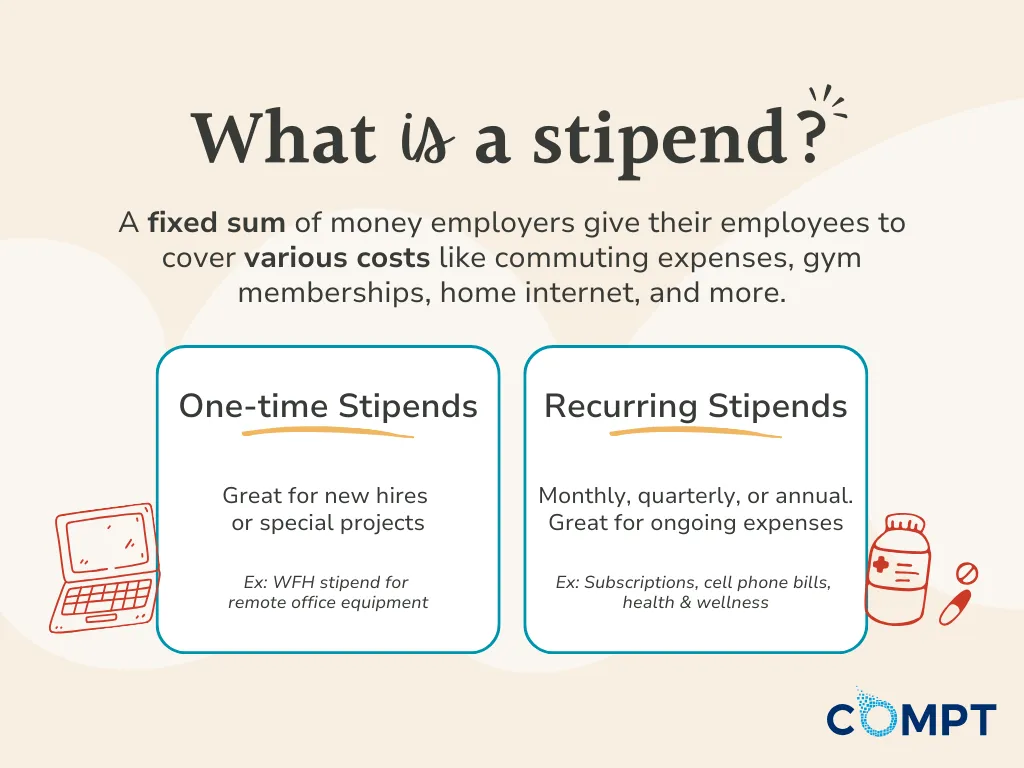
A stipend is a fixed amount of money employers give their employees to cover the costs of various business-related expenses or lifestyle perks such as gym memberships, meals, or commuting expenses.
The concept of stipends has been around for a while. However, how organizations design and deploy them to their people has transformed quite a bit over the last 10 years.
Companies are launching new stipend programs to solve operational challenges — consolidating vendors, optimizing their benefits budget, reducing administrative work — while supporting employee needs like wellness, professional development (hello, AI upskilling), family benefits, and more.
The result is stronger total compensation packages that attract, engage, and retain top talent.
In this guide we’ll cover how the concept of stipends has evolved over the last 10 years, and focus on the modern approach to stipends companies are now taking.
What is a stipend?
Traditionally, the concept of stipends was solely to cover employees’ business-related expenses, such as a “relocation stipend” or “meal stipend for travel.” These were centered around the needs and requirements that make work possible.
As more companies recognize that employee stipends enable them to offer a wider range of perks within the same budget, they are adopting stipends as a flexible solution that allows employees to choose their own benefits.
This approach not only addresses employees’ needs during work hours (9-5), but also extends support beyond the workplace, focusing on the ‘5-9’ — the time employees spend outside the office.
So, in short:
- Traditional stipends = relocation stipend, meal stipend for travel, and housing stipends.
- Modern employee stipends = wellness stipend, family stipend, professional development stipend, tuition reimbursement stipend, work-from-home stipend, and a lot more — see all 30+ stipends you can offer with Compt!
For the purpose of this post, we’ll be focusing on the modern approach.
Key attributes of stipends
There are several key elements to stipends that make up a modern stipend program, which we’ve outlined below.
Stipends can be designed to be one-time or recurring.
- One-time stipends are great for new hires or special projects, as they provide a one-time boost in compensation (think: a work-from-home stipend for remote equipment).
- Recurring stipends are paid out to employees on a monthly, quarterly, or annual basis. They’re best for ongoing expenses, like gym reimbursements, subscriptions, cell phone bills, and wellness benefits.
Stippend funding cadence also affects how much employees actually use their stipend. According to the 2026 Annual Lifestyle Benefits Benchmark Report, quarterly funding drives the highest utilization at 85%, compared to 70% for semiannual, 65% for annual, and 52% for monthly. For Finance teams evaluating program design, quarterly funding also balances budget predictability with employee planning flexibility better than any other cadence.
Many companies, including Deloitte, Slate, LinkedIn, Microsoft, and more, offer stipends of some kind. Learn about them in our post, “53 Real-World Examples of Employee Stipends at Leading Organizations.”
The stipends you choose to offer depend on your company’s goals, budget, and what matters to your team. It’s best to survey your employees to see which benefits matter most to them.
What are the key differences between a stipend and a salary?
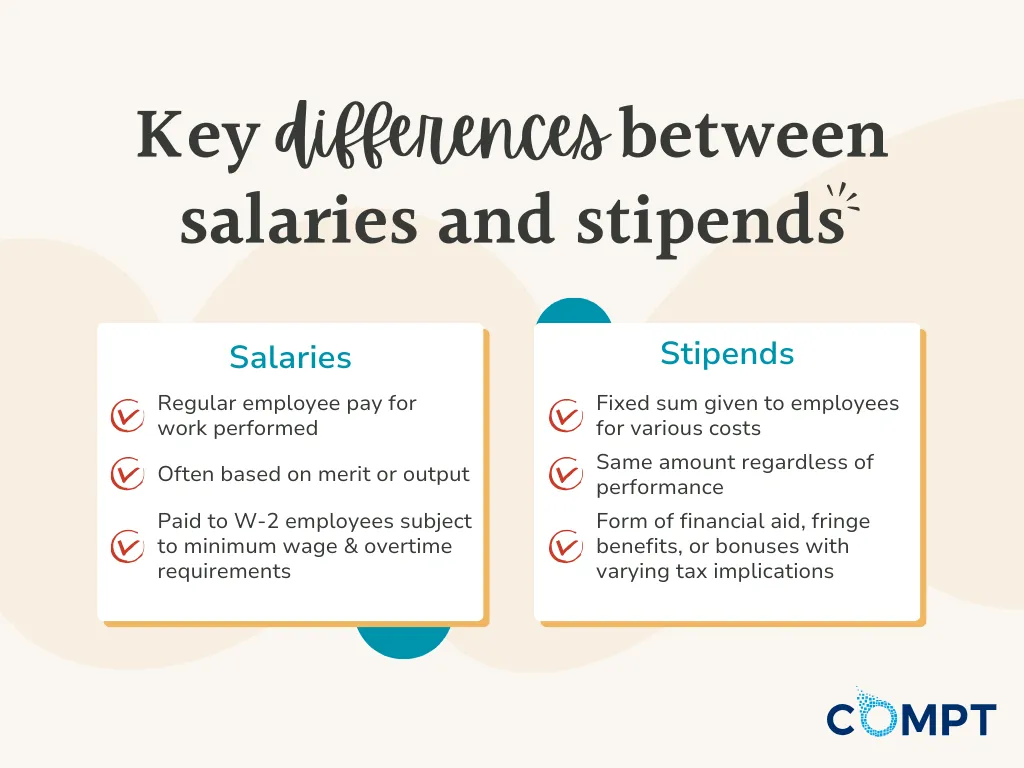
The main difference between a stipend and a salary is that the latter is regular employee pay for work performed.
Conversely, the modern approach to employee stipends are a form of financial support used to cover lifestyle or workstyle benefits.
Although a stipend and a salary are considered fixed sums, salaries are often modified based on merit and output. In contrast, a stipend remains a fixed amount regardless of performance.
Another difference is a salary is paid to W-2 employees, who are subject to minimum wage requirements and overtime pay. The federal minimum wage is currently $7.25 per hour for covered nonexempt employees and $2.13 per hour for employees who receive tips.
The employer must make up the difference if the minimum wage and tips received don’t equal at least $7.25 per hour. Overtime pay is 1.5x your regular pay rate for any hours worked over 40 in a workweek.
In contrast to paying hourly or regular salaries, a stipend is given only at the employer’s discretion. Under the Fair Labor Standards Act (FLSA), stipends may be lower than the minimum wage as long as they’re reserved for trainees.
Although you can’t pay a W-2 employee with a stipend rather than hourly wages or a regular salary, you can bestow a recurring stipend upon said employee as additional compensation to their base pay. In this manner, stipends serve as fringe benefits or bonuses in a comprehensive total compensation package.
Psst: Learn why offering stipends is better than adding extra cash to a paycheck in our breakdown.
Are stipends taxable?
The Internal Revenue Service (IRS) considers most stipends taxable income, which means employers are responsible for payroll taxes, and recipients still have to pay federal and state taxes on the amount.
However, while regular pay for W-2 employees is subject to tax withholding by employers, stipends aren’t classified as wages. Therefore, employers will not withhold income, Social Security, or Medicare taxes.
HR leaders considering stipends as fringe benefits for their workforce should check with the IRS regarding tax implications.
For example, the IRS considers taxable income stipends related to health and wellness initiatives. Conversely, stipends for parking and public transit expenses can be funded by employees’ pre-tax dollars up to a designated limit.

As of 2026, the IRS allows employers to withhold up to $340 per month for pre-tax commuter benefits, such as qualified parking, commuter highway vehicle transportation, and transit passes.
When filing their tax returns, recipients must record their stipends. Students who receive stipends (also called ‘taxable scholarships’ or ‘taxable grant scholarships’) should report the amounts used for incidental expenses, such as room and board, travel, and equipment, as well as amounts received as payments for teaching, research, or other services.
The IRS considers stipends for tuition and fees required for enrollment or attendance at an educational institution or for fees, books, supplies, and equipment required for courses tax-free and do not need to be reported.
Psst: Did you know that we offer a special module for professional development for easy approvals and streamlined workflows?
Examples of some types of stipends
Several common types of stipends cover the cost of work, travel, and living expenses.
Housing stipends (traditional stipend)
A housing stipend or housing allowance is a specific amount of money provided to assist with covering housing-related expenses. Typically offered by employers or educational institutions, housing stipends are often part of employee compensation packages or student benefits.
Unlike traditional salaries or wages intended for general living expenses, a housing stipend is designated explicitly for rent, mortgage payments, utilities, and other related costs.
Wellness stipends (modern stipend)
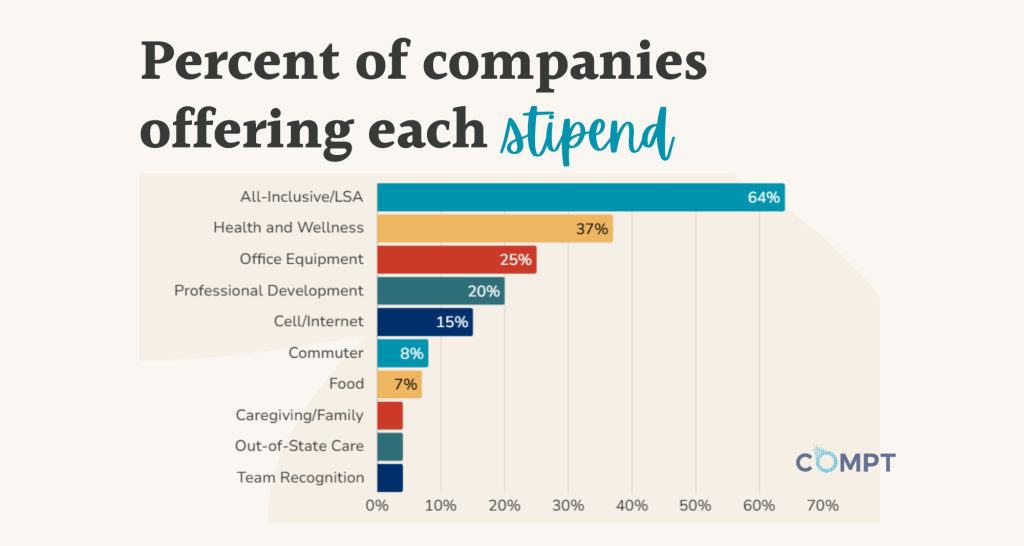
According to the 2026 Annual Lifestyle Benefits Benchmark Report, wellness stipends perform significantly better when embedded in a broader Lifestyle Spending Account (LSA) — reaching 86% utilization compared to 62% for standalone wellness-only stipends. That’s one reason 64% of Compt customers now offer an all-inclusive LSA, compared to 37% who offer a standalone wellness stipend.
Whether delivered within an LSA or not, wellness stipends are designed to offer people the financial support to make well-being a priority.
Below are real quotes and stories from Compt users highlighting the powerful impact their company’s wellness stipend has had on their lives:
- “I am able to buy a yoga punch pass. Yoga is my anti-depressant :)”
- “It has allowed me to participate in regular exercise programs that I normally would not have attended due to the cost.”
- “It is a huge relief to have help purchasing a necessary medical device that is not covered by insurance.”
- “Compt helps me to make sure I always have time and money put aside for my health and well-being, regardless of pay.”
- “It has helped me do my light strength training and do exercises to benefit my circulation.”
- “I exercise regularly, but this gives you extra motivation to go a little more!!”
- “Trying to get caught up on my medical expenses is very difficult. I pay almost $200 a month. The stipends do help out.”
- “I’m able to obtain protein shakes and supplements that contribute to my overall health, wellness, and weight loss/maintenance.”
Learn more about wellness stipends here.
Professional development stipends (modern stipend)
A 2025 study by the United Nation Trade and Development found that up to 40% of jobs worldwide will be impacted because of AI. As a result, more companies are ramping up learning and development, providing stipends to cover training costs and offering additional job training opportunities.
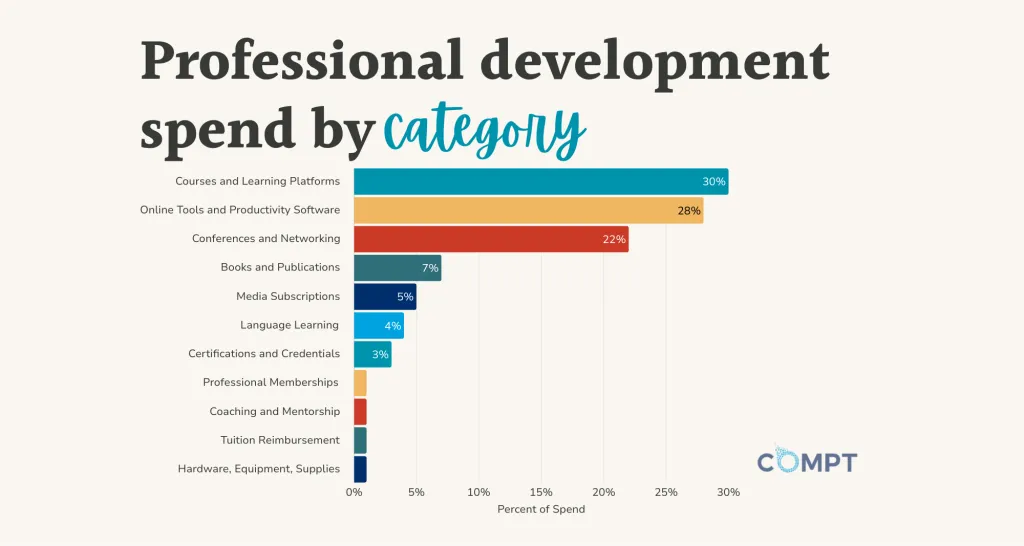
For example, professional development stipends typically cover online tools and productivity software, courses and learning platforms, books, and conferences — though the 2026 Annual Lifestyle Benefits Benchmark Report shows spend is shifting toward tools and self-directed learning over one-time training events.
With more workers interested in continuing their education, tuition credits have emerged as one of the most highly valued benefits in recent years. Employers are able to make contributions of up to $5,250 per employee annually toward eligible education expenses without raising the employee’s gross taxable income under Section 127 of the Internal Revenue Code.
AI tools stipends (modern stipend)
As AI becomes a standard part of how people work, more companies are adding AI tools as a reimbursable stipend category. According to the 2026 Annual Lifestyle Benefits Benchmark Report, 20% of professional development expenses among Compt customers are now AI-related.
Common purchases include ChatGPT, Claude, AI note-taking tools, prompt libraries, and AI-focused courses and certifications. Because AI tools categories can sit within a broader LSA or professional development stipend, companies don’t need a separate program to offer this benefit.
Family stipends (modern stipend)
Family stipends cover caregiving expenses employees often can’t absorb on their own — childcare, elder care, fertility services, adoption, and pet care. According to the 2026 Annual Lifestyle Benefits Benchmark Report, the median annual family and caregiving stipend is $2,500 per employee, making it one of the highest-funded categories.
Many companies deliver family support within a broader LSA rather than as a standalone stipend, which allows employees to use the benefit when the need arises rather than drawing from a dedicated budget they may not use every cycle.
Get in touch with someone on our team to learn how quickly you can put employee stipends in place with Compt.
Health insurance stipends (traditional stipend)
Employers may offer a health insurance stipend instead of enrolling trainees in their health insurance plan to mitigate the cost of coverage from another provider. LSAs and ICHRAs also complement each other well to create a comprehensive and modern benefits package.
Academic research stipends (traditional stipend)
Institutions typically offer academic research stipends to cover expenses for graduate students and researchers. This allows them to focus solely on their projects rather than working a full-time or part-time job to make ends meet. A graduate student may also receive a stipend from a third-party organization interested in the research.
Why you should offer lifestyle stipends
Nearly 40% of employees still don’t report satisfaction with their benefits package, according to McLean & Company’s HR Trends Survey 2026. And dissatisfaction is trending in the wrong direction — a December 2025 report from BenefitsPro found only 6 in 10 employees feel satisfied with their benefit offerings, down from two-thirds the year prior.
What’s more, 91% of employees say they would consider switching jobs for benefits that better help them reach their goals, according to Morgan Stanley at Work’s 2026 State of the Workplace Financial Benefits Study.
That’s why offering additional benefits like lifestyle benefits and employee stipends or LSAs can increase morale, employee engagement, and ultimately, retention. Paying stipends can also enhance your recruiting efforts, as top talent expects more from employers than ever before. With total health benefit costs per employee projected to rise 6.7% in 2026, according to Mercer, LSAs also give Finance a cost-efficient alternative — companies only pay for what employees actually spend, with no prefunded vendor contracts.
Companies that offer stipends demonstrate that they’re invested in their employees and candidates holistically, providing financial support for nonwork expenses like wellness purchases and pet care.
That raises their profile in a competitive labor market. Also, Nearly 1 in 10 stipend dollars is now spent at grocery retailers, according to the 2026 Annual Lifestyle Benefits Benchmark Report, reflecting how employees increasingly use flexible benefits to offset everyday cost-of-living pressure.
While there are countless options for lifestyle benefit stipends, the most popular among Compt customers span wellness, professional development, family support, food, and remote work. With our 30+ stipend categories, you can mix and match to build a program that fits your team — and because Compt is reimbursement-based, you only pay for what employees actually spend. Unused funds at the end of a cycle stay with the company, not a vendor.
Compt makes it easy to launch employee stipends
Our reimbursement-based platform turns days of admin work into a 30-minute monthly review. There’s no prefunding requirement or vendor restrictions, and the system handles tax classification at the transaction level, so you can focus on your people, not the paperwork.
Request a Compt demo to see how it works.

FAQ: What is a stipend?
Compt gives CFOs real-time budget visibility, automated tax classification, and one-click payroll sync — the core requirements for any stipend platform evaluation. Beyond those, look for a reimbursement-based model that eliminates prepaid card waste, role-based approval workflows that keep spending on policy, and audit trail documentation that holds up at year-end. A platform that only charges for what employees actually spend protects budget predictability in a way prepaid tools can’t.
If we already use spot bonus software, when would a lifestyle stipend platform make more sense for ongoing perks?
Compt handles both recurring lifestyle benefits and one-time recognition, but the two serve different purposes. Spot bonus software is built for one-time moments, whereas stipend platforms are built for the ongoing tax handling, receipt verification, and payroll sync that comes with giving employees a predictable monthly or quarterly budget for wellness, professional development, or remote work. Your administrative overhead grows quickly when you try to run recurring stipends through a bonus tool.
What should I look for in global stipend management software if my team spans the US, UK, and India and I don’t want tax surprises?
Compt’s global stipend management software supports multicurrency reimbursements and applies tax treatment by country. Beyond that, look for clear documentation standards for receipts and expenses that hold up under local payroll audits, and a reimbursement-based model — rather than prepaid cards — that gives you stronger compliance controls across jurisdictions.
How does an all-in-one stipend management platform simplify perk budgeting compared with juggling separate wellness or learning vendors?
Compt replaces separate vendor contracts, invoices, utilization reports, and renewal cycles with a single, consolidated budget line, a single approval workflow, and a single report. Managing those separately adds significant HR and Finance overhead that compounds as your team grows. Because Compt is reimbursement-based, you also stop paying for low-utilization vendor contracts — you only pay for what employees actually spend.
How does a reimbursement-based stipend compare to a card-based stipend platform?
Compt uses a reimbursement-based model, which means employees submit receipts after purchase, creating a documentation trail that supports tax compliance and reduces misuse. Card-based platforms are faster for employees but harder to control: expenses can slip through that don’t match policy, and tax classification often has to happen manually after the fact. For companies that want clean payroll reporting and audit-ready records, reimbursement-based administration is the stronger approach.
What factors should I consider most when choosing an employee stipend or lifestyle spending account software platform?
Compt was built around the four factors that matter most: automated tax handling, HRIS and payroll integration, category flexibility, and employee experience. A platform that automatically classifies taxable versus nontaxable expenses reduces payroll errors and audit risk. Strong integrations mean reimbursements flow through to payroll without manual reconciliation, and broad category flexibility means the program fits your workforce rather than forcing employees into a predefined menu.
Which stipend software handles HRIS and payroll sync across multiple payroll systems?
Compt integrates with major HRIS and payroll systems — including Workday, BambooHR, ADP, and Rippling — and outputs structured, payroll-ready reports formatted for your system, with taxable and nontaxable amounts already classified before anything touches payroll. The key workflow you’re solving for is getting reimbursements into payroll on time and in the right format, without manual reconciliation or last-minute tax judgment calls. What used to take some HR teams days now takes about 30 minutes a month.
What’s the best way to offer a food or snack stipend for remote employees?
Compt makes it easy to include food as a category within a broader Lifestyle Spending Account, letting employees use it at any grocery store, meal delivery service, or restaurant without HR managing vendor relationships. Food stipends are generally treated as taxable income, so the program should run reimbursements through payroll with amounts flagged correctly. Based on 2026 Annual Benchmark Report data from Compt customers, a quarterly cadence tends to drive higher utilization than monthly funding.
Is it cheaper to pay an HR admin to handle stipend receipts or pay for a platform to do it?
For most companies, Compt pays for itself once you account for the full cost of manual administration — receipt review, tax classification, payroll coordination, employee questions, and compliance documentation. Some companies told us they were spending 20+ hours per week managing stipends manually for teams under 200 people before switching. Compt customers like TEN7 now spend 5–10 minutes per month on administration.
What are best practices for rolling out a lifestyle stipend?
Compt customers who see the strongest participation typically follow the same playbook: survey employees first, design categories around what they actually want, and set a quarterly funding cadence — which drives higher utilization than monthly, based on 2026 Compt customer data. Communicate the benefit before launch with a plain-language explainer on how reimbursements work, and track participation as your primary success metric in the first 90 days, not just utilization. A simple, flexible program consistently outperforms a highly restrictive one.
Could you break down the difference between an LSA software and a regular employee benefits enrollment system?
Compt is an LSA platform, which is fundamentally different from a benefits enrollment system — the two solve different problems. A benefits enrollment system manages elections for fixed benefits like health insurance, dental, and 401(k), where employees choose from a defined set of employer-sponsored plans once a year. An LSA platform like Compt manages ongoing, flexible reimbursements across spending categories employees use throughout the year, with automatic tax classification, receipt verification, and payroll reporting built into every transaction. The overlap is that both connect to your HRIS — but where enrollment systems manage plan elections, Compt manages what employees actually spend and ensures it flows through payroll correctly.
Help me build a business case for switching from point-solution perks to a single perk stipend platform?
Compt replaces scattered perk vendors with one reimbursement-based platform that reduces admin overhead, eliminates unused vendor spend, and gives Finance cleaner tax reporting. The core financial argument is simple: point solutions charge fixed contracts regardless of utilization, while a reimbursement model means you only pay for what employees actually spend.
On the participation side, the 2026 Annual Lifestyle Benefits Benchmark Report shows all-inclusive LSAs reach 89% utilization compared to 62% for standalone wellness stipends — and Compt customers like Quickbase reduced benefits processing time from days to 90 minutes. For Finance, the case is defensible audit trails, automated taxable vs. nontaxable classification, and a single payroll-ready report every cycle instead of reconciling across multiple vendors.
What’s best practice for learning and development stipends?
Compt customers who run the strongest professional development stipend programs follow a consistent design: broad category definitions and reimbursement-based administration rather than a single learning platform. Broad categories — covering books, courses, certifications, conferences, coaching, and AI tools — drive higher participation than restricting employees to one vendor like LinkedIn Learning or Udemy.
According to the 2026 Annual Lifestyle Benefits Benchmark Report, the median annual professional development stipend is $800. The most common mistake is over-restricting eligible expenses, which reduces participation without improving compliance.
What’s the smoothest way for HR to roll out a professional development stipend inside a Lifestyle Spending Account platform?
Compt can be configured and ready to launch in about 15 minutes, with a dedicated customer success partner guiding setup from day one. The five steps are: define your budget and eligible employee population, set your funding cadence, select spending categories in plain language employees will understand, configure your approval workflow, and send a clear launch communication covering what the benefit is, how reimbursements work, and when funds are available.
The most common rollout mistake is launching without a plain-language employee communication covering what the benefit is, how reimbursements work, and when funds are available — employees who understand the mechanics from day one participate at significantly higher rates.
Editor’s note: Compt software supports the categorization and proper reporting of benefits according to IRS guidelines, helping businesses maintain compliance. However, Compt cannot provide tax advice, and users should consult their own tax, legal, and accounting advisors when necessary.
Editor’s note: Originally published in 2023, this post has been recently updated for clarity and relevance for our readers.

 No receipt chasing