

Post-pandemic, the world of commuter benefits has gotten a major overhaul, and HR leaders are turning to fringe benefits to make their team’s commute to work a little brighter, even if it’s for only a few days a week.
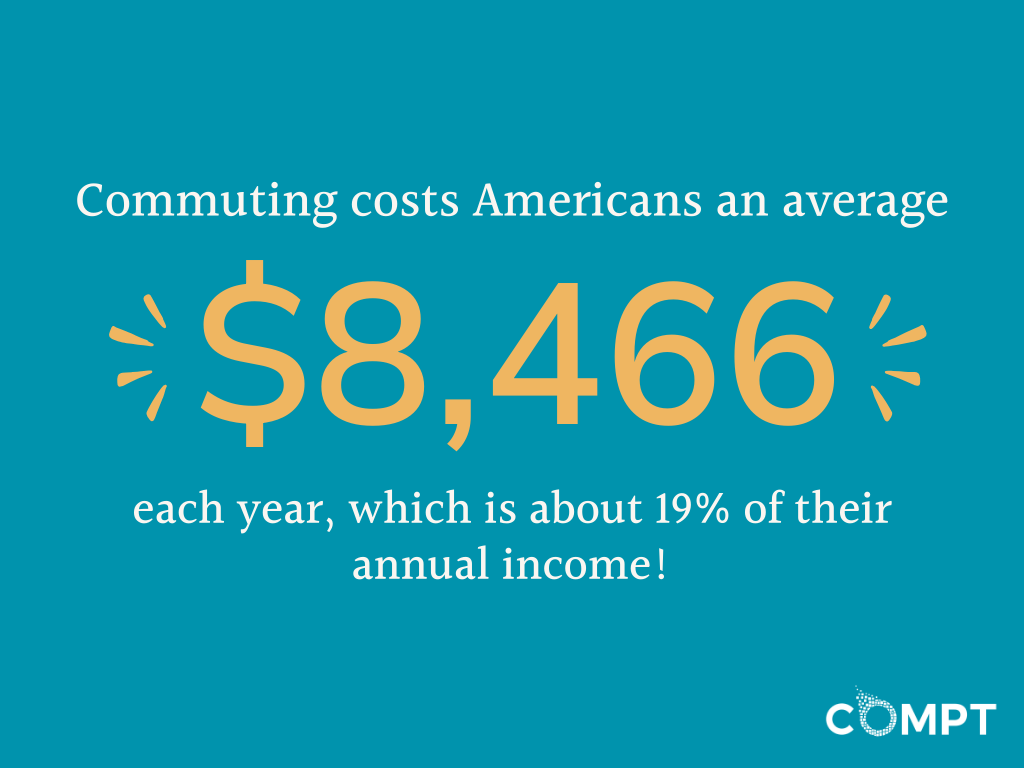
After three years of many employees being allowed to work from the comfort of their homes, perhaps for the first time in their careers, returning to the office can be a tough sell. After all, Americans, on average, spend nearly an hour (53.6 minutes) traveling to and from work each day, according to U.S. Census Bureau data. That commute costs Americans, on average, $8,466 each year — about 19% of their annual income — according to Clever Real Estate.
However, HR leaders can ease that burden by implementing a commuter benefits program.
What are Commuter Benefits?
Commuter benefits are employee perks that offset or reduce transit and parking expenses for getting to and from work.
For nearly 40 years, companies have been able to help pay commuting costs thanks to the Tax Reform Act of 1984, according to Pace Law Review.
While the federal government doesn’t mandate these benefits, several cities have passed laws that require employers with a certain number of employees to offer commuter benefit programs on a pre-tax basis.
- The San Francisco Bay Area requires companies with 50 or more full-time employees to offer such benefits.
- Philadelphia’s ordinance also applies to companies with 50 or more employees who worked an average of 30 or more hours a week for the past 12 months
- Washington, D.C., New York City, and Seattle ordinances apply to companies with 20 or more full-time employees.
- New Jersey is the only state to have enacted such legislation, which applies to all companies with at least 20 employees.
Employers in many cities without those laws also offer commuter benefits to help cover the cost of parking, public transportation, and other commuter expenses. In fact, in 2024, approximately 72% of companies across the United States offered them to their employees in some form.
As the RTO tug-of-war between companies and workers continues, that percentage has probably risen in the two years since then.

Types of Commuter Benefits
Commuter benefits fall under two categories: pre-tax and after-tax.
The former means that employees’ pre-tax dollars fund these benefits. According to the IRS, these transportation benefits include fully or partially covering:
- Parking expenses, such as fees for using parking lots, parking garages, and parking meters
- Public transit expenses, including riding the bus, ferry, train, subway, and trolley
- Van pooling, in which there’s seating capacity for at least six adults (excluding the driver) and for which at least 80% of the vehicle’s annual mileage is for transporting employees to and from work
The latter is when companies pay for transit and parking expenses that exceed pre-tax contribution limits. These transportation benefits include:
- Gas stipends
- Toll reimbursement
- Flexibility to work from home
- Carpool system
- Monthly stipend for Uber, Lyft, or other ride-sharing apps
- Annual stipend for vehicle maintenance
- Monthly stipend for bicycle repairs
Before 2018, employees who commuted by bike could be reimbursed with pre-tax dollars. Then, the Tax Cuts and Jobs Act (TCJA) removed bicycling from eligible transit benefits through 2025. The only glimmer of hope was the Bicycle Commuter Act of 2021, which would’ve repealed the TCJA’s suspension, but the bill failed to gain any traction.

How Commuter Benefits Work
As an employer, the Internal Revenue Service (IRS) allows you to pay for employees’ commuting expenses with pre-tax dollars, up to a certain amount per month.
Beginning in 2025, the monthly contribution limits are:
- Qualified parking expenses: $325, up from $315 in 2024.
- Commuter highway vehicle transportation and transit passes: $325, for combined expenses on transit passes and vanpooling.
It’s important to note that these limits are separate from one another. An employee could potentially exclude up to $650 per month if they incur both types of expenses.
Psst: See IRS Publication 15-B (2025) for more details.
Benefits of Offering Commuter Benefits
It’s no surprise that most people loathe commuting. It’s costly, time-consuming, and oftentimes aggravating, especially if you get stuck in rush hour traffic or miss your train. In a RingCentral survey, nearly half of the participants said they’d “rather clean toilets” than commute to a physical office or pre-pandemic workplace. Ouch!
It gets even crazier when you consider the fact many employees don’t have to work from an office. According to economists at the University of Chicago, more than one-third of today’s jobs can be done from home.
And according to the most recent data from Gallup, among U.S. employees in remote-capable roles:
- 21% worked exclusively on-site
- 27% worked entirely remotely
- 53% follow a hybrid schedule, splitting time between remote and on-site work
This means around 74% of remote-capable employees commute to their workplace at least occasionally.
Although eliminating mass transit and parking headaches may be out of HR leaders’ hands, they can still give their employees some much-needed relief.
Improve employee morale and engagement
Commuter benefits funded by pre-tax dollars can improve employee morale and engagement by helping team members save money on their commuting expenses.
Your staff will appreciate not having to pay their own way to come to work, which can ultimately reduce employee turnover. And, as every HR leader can attest, it’s much cheaper to keep someone than to recruit, onboard and train a new team member.
Improve talent acquisition strategy
However, a commuter benefit can also enhance your talent acquisition strategy. Nearly two-thirds (64%) of employees cited ‘pay and benefits’ as the most important factor in accepting a job offer, according to a 2022 Gallup poll. Believe it or not, offering parking benefits and assistance with transit expenses can be a difference maker, especially if employers are demanding a return to office.
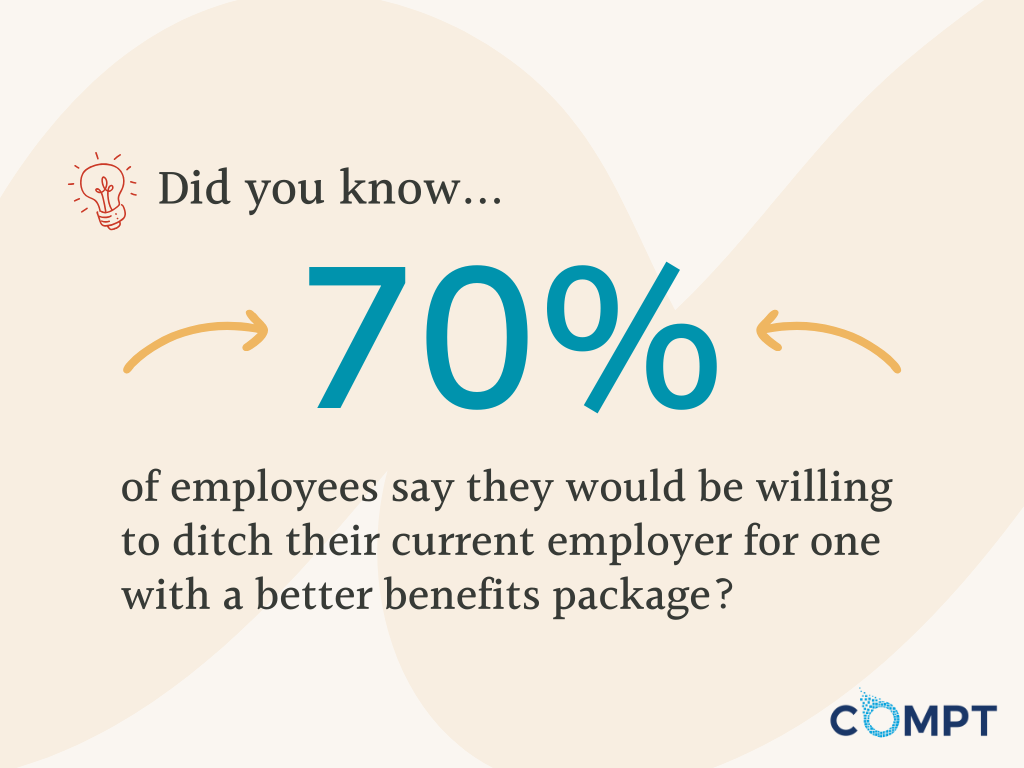
And a 2024 Economist Impact study revealed that 70% of employees would be willing to ditch their current employer for one with a better benefits package.
Tax benefit savings
Don’t forget the tax benefits. With less taxable income to account for, employees will see higher tax savings and keep more money in their pockets. Meanwhile, employers can save up to 10% on Federal Insurance Contributions Act (FICA) and payroll taxes, according to Philadelphia city officials, who enacted an ordinance requiring commuter benefit programs starting this year.
In addition to the tax savings, a commuter program can reduce an organization’s carbon footprint by promoting ride-sharing and public transit rather than more cars on the road.
Commuter benefits is a top perk to offer your people
Giving compensation, health insurance and paid time off (PTO) simply isn’t enough anymore. Companies have to supply their talent with a comprehensive benefits package that supports workers’ holistically. That means their time inside, outside, and for the purposes of this blog post, on the way to and from the office.
If you want to attract, engage and retain top talent, you must provide commuter benefits, especially if you’re trying to transition your workforce from remote work to an in-office environment.
Every dollar your employees spend just to get to work—on gas, parking, or transit—is a dollar they can’t spend on what actually improves their lives; a commuter stipend turns a daily burden into a powerful signal that your company values their time, money, and well-being.
It’s not just a goodwill gesture, though, because those benefits will have a ripple effect throughout the company. By demonstrating how much you care about your team members, even when they’re off the clock, productivity, morale, and retention will all increase.
The commute may not be any shorter, but they’ll be happier about the destination.
Real Employee Quotes Using Compt Commuter Benefits Stipends
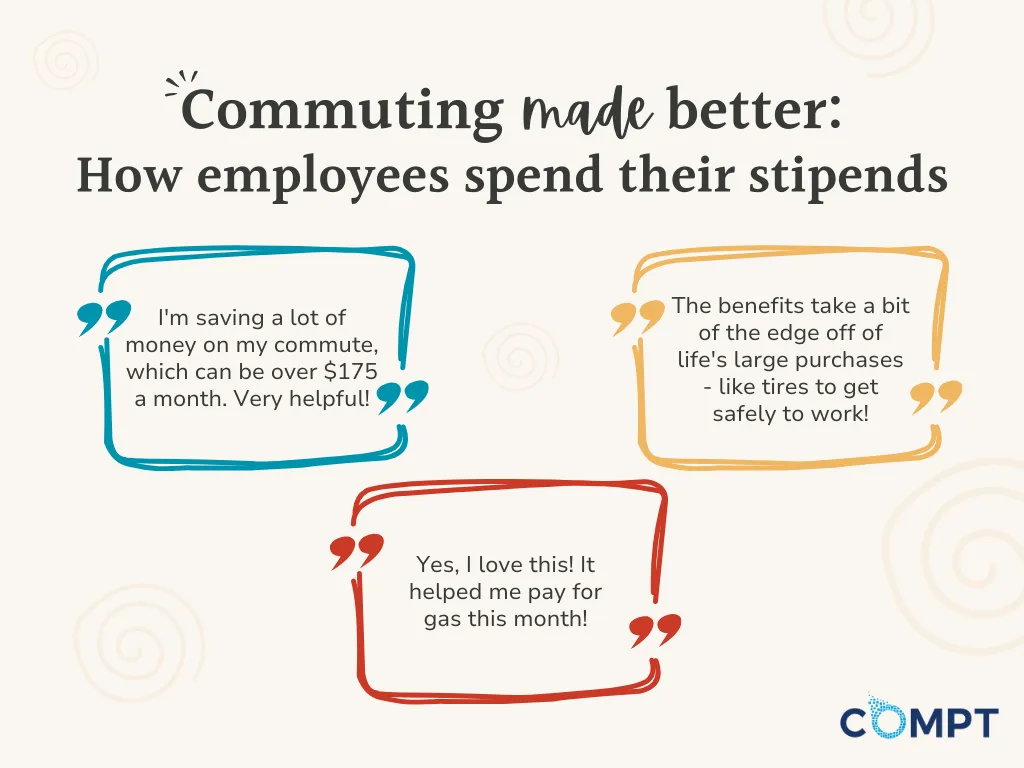
Here are some examples from Compt customers on how they’re using their commuter benefit stipends:
- “I’m saving a lot of money on my commute, which can be over $175 a month. Very helpful.”
- “The benefits take a bit of the edge off of life’s larger purchases – like tires to get safely to work.”
- “Yes, I love this! It helped me pay for gas this month!”
Accessing Transportation Benefits
Employees can access their pre-tax money through various payment options, such as a benefits debit card, voucher or pre-paid transit passes. For example, one swipe of the benefits debit card allows employees to cover their bus fare, ferry tickets, transit passes, parking permits, etc. Employees also have the option to pay out of pocket and then file a claim for reimbursement.
Nowadays, a lot of employers also use benefits software like Compt to either offer a stipend for commuting expenses or have employees pay out of pocket and then file a claim for reimbursement. Using a reimbursement stipend ensures you’re only covering costs that people actually use, which doesn’t happen when you front-load transit or debit card passes. If you want to save money while offering your employees a commuter stipend, Compt ensures compliance by adhering to IRS regulations regarding commuter benefits, which reduces administrative burdens, questions, and headaches.
How to Implement a Commuter Benefits Program
If you’re considering launching a commuter benefits program, here’s a step-by-step guide for you to follow:
1. Find out your team members’ needs
As with any benefits program, HR leaders should gauge employee interest before investing time, energy and resources into its creation. Send out a pulse survey asking team members if they’d participate in such a program, their current commute challenges, and what solutions they’d prefer.
For example, if most employees drive to work, focusing on public transportation expenses wouldn’t make sense. Instead, parking benefits would be a popular addition to your offering.
2. Set your budget
After you learn how many team members will participate and what benefits they find most desirable, it’s time to crunch the numbers. While a commuter benefit program does provide tax savings for both employee and employer, you want to ensure it’s fiscally feasible for your current needs. Of course, you want to maximize your benefits budget, but you must perform due diligence before committing to such an endeavor.
3. Determine who’s in charge
Depending on how you design this program, managing it can be a full-time job, and HR leaders are already overworked. Rather than adding yet another task to their plate, companies may want to rely upon an HR technology provider, such as Compt.
The 100% IRS-compliant reimbursement platform helps companies offer inclusive, personalized, and flexible compensation and benefits programs, including commuter benefits. Plus, our customers don’t have to worry about trouble with their tax advisor, as Compt’s software automatically limits employees to claim no more than the $325 maximum for transit and parking expenses.
4. Establish your policy
Your commuter benefits policy should include the eligible transit and parking expenses that can be covered or reimbursed, the IRS-mandated limits, and how team members can take advantage of these tax benefits by using a debit card, voucher, pre-paid transit passes, or reimbursement.
5. Promote and educate on how to access the benefit
Congratulations! Now that you’ve established your commuter benefits policy, it’s time to roll out the program.
As with any new employee benefits program, clear and consistent communication is vital for a successful launch. HR should engage in an all-out media blitz: webinars, email blasts, intranet postings, posters around the office, fliers and pamphlets mailed to team members’ homes, etc. During weekly meetings or check-ins, managers should also remind their direct reports about the program. The more you communicate, the more likely employees are to see and access the benefits you’re providing.
If there’s room in the budget, perhaps HR could even purchase promotional products, such as windshield scrapers or key chains, to hand out as a physical reminder of the launch.
As part of the benefits communications strategy, HR should inform employees when and how they can register for a commuter benefits account, as well as the accompanying tax benefits. You can’t stress the savings enough.
Be loud and proud that by enrolling in the program, team members will pay less and save more during their commute.
This isn’t just for internal messaging — promote the commuter benefit externally, too. Announce the program’s launch on your company website and social media channels, emphasizing to customers, competitors, and potential applicants that you’re fostering an employee-centric workplace.
These employee perks should be an essential part of your recruitment toolkit. If another company is requiring workers to come into the office without providing any assistance for commuter expenses, you instantly have a competitive advantage. Even if if you can’t match that company’s compensation, you may level the playing field when a candidate assesses the savings calculations by not having to pay as much for transit and parking expenses.
Put tax-compliant commuter benefits in place with ease through Compt

Interested in learning how Compt can help you administer commuter benefits and keep your finance team happy with tax compliance? Get in touch with our team to get started
Editor’s Note: Compt software supports the categorization and proper reporting of benefits according to IRS guidelines, helping businesses maintain compliance. However, Compt cannot provide tax advice, and users should consult their own tax, legal, and accounting advisors when necessary.
Originally published in 2023, this post has been recently updated for accuracy, clarity and relevance for our readers.

 No receipt chasing