
Parking reimbursement is a nontaxable fringe benefit where employers reimburse up to $340 per employee per month in work-related parking costs. Amounts up to the $340 IRS limit are excluded from federal income tax withholding, Social Security/Medicare, and unemployment taxes. Anything over $340 is taxable.
The work commute is a frustrating way to start (and finish) the day, especially if your office is in a huge metro area like LA, San Francisco, D.C., or Boston.
Employees already give up 30+ minutes each way just to get to the office. Having them pay for the privilege of parking, too, never quite sits right. But depending on your return-to-office policies or the nature of your industry, it could be necessary for your employees to make the trek.
What is employee parking reimbursement?
Employee parking reimbursement is a low-cost fringe benefit where employers pay back their employees for work-related parking expenses on a tax-free basis. Employees pay upfront for qualified expenses, submit a claim, and then receive the repayment through payroll.
Eligible expenses include:
- Parking fees, such as daily or monthly costs at a designated lot or garage
- Metered or timed parking on the street
- Parking expenses incurred while traveling for work
- Expenses for parking at a job site away from the employee’s regular workplace
You can offer parking reimbursement as a standalone benefit, but most companies include it in a more comprehensive commuter benefits package.
How parking reimbursement works
Aside from the tax-related technicalities (more on that next), the process is straightforward:
- Set a monthly cap and define eligible expense types.
- Employees submit claims with receipts or proof of payment.
- HR reviews and approves each claim.
- Approved reimbursements are disbursed through payroll on your company’s normal cycle.
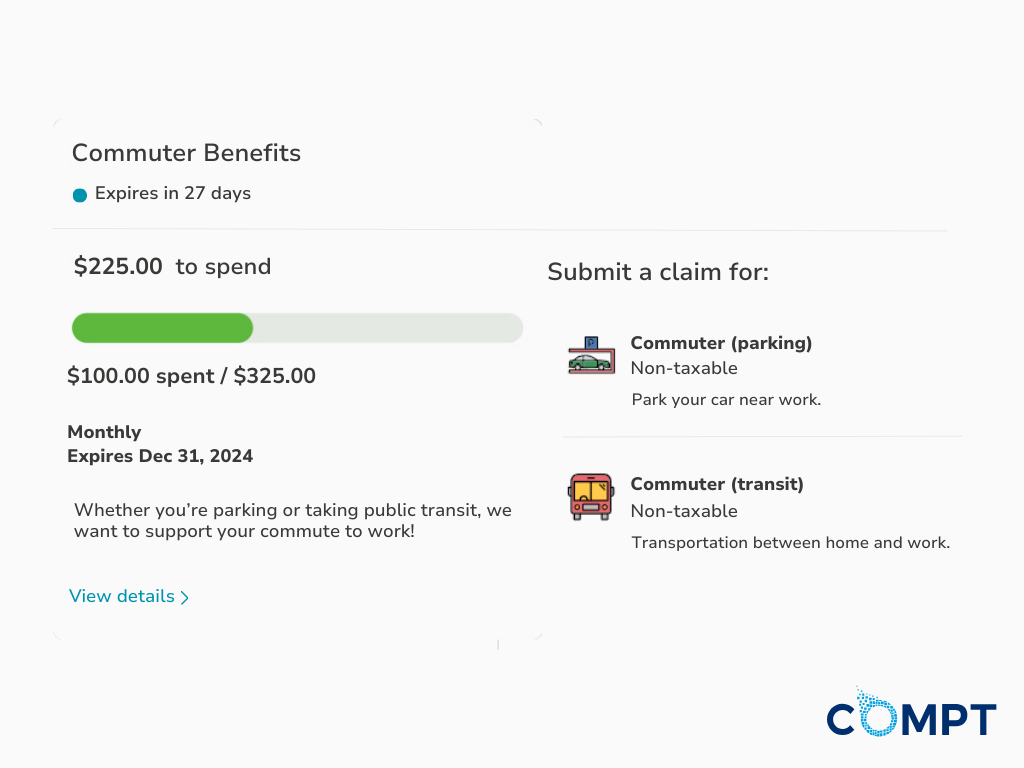
With a stipend platform like Compt, steps 2–4 can largely run themselves: receipt review can be automated by vendor or dollar amount, and approved reimbursements flow directly into payroll as a formatted report or through a direct integration, depending on your provider. You could even broaden the program to include reimbursements for gas and other commuting costs, though those would be taxable.
Ready to set up a parking reimbursement for your people?
Compt’s stipend reimbursement platform can help you quickly and painlessly set up a parking stipend, plus gain even more tax-compliant benefits.
Employee tax implications of parking reimbursement
In 2026, the monthly exclusion limit for qualified parking per IRS Publication 15-B is $340 per employee per month (an increase from $325 in 2025). This means employers can cover the cost of parking up to $340 per month for each employee without it being considered taxable income for the employee.
Suppose the value of a qualified parking benefit received in any month is more than the limit. In that case, the excess amount must be included in the employee’s wages, minus any amount the employee paid for the benefit. The excess is subject to FITW, FICA tax, and FUTA tax.
Keep in mind that under the Tax Cuts and Jobs Act (TCJA), the cost of providing qualified parking to employees is not tax-deductible as a business expense, whether you pay for it directly, reimburse employees, or offer it through a pre-tax salary reduction.
There is also a monthly exclusion of $340 for mass transit passes and commuter highway vehicle transportation. These two limits are separate and can only be used for their respective purposes.
Is reimbursement for employee parking expenses always tax-free?
Parking reimbursement is only considered a Qualified Transportation Fringe Benefit under specific circumstances. To qualify as a QTF under IRC §132(f), the parking has to be:
- On or near the employer’s business premises, or
- At a location from which the employee commutes (e.g., a park-and-ride lot), and
- Not on or near property that the employee uses for residential purposes.
So employer-paid parking that doesn’t meet those criteria — say, reimbursing an employee for parking at a personal errand stop, or at a location unrelated to their commute — wouldn’t qualify.
| Does your parking expense qualify for tax-free reimbursement? | |
|---|---|
| Parking location | Does it qualify? |
| Parking lot at or near the employer’s workplace | ✅ Yes |
| Park-and-ride lot the employee commutes from | ✅ Yes |
| Garage near a transit station the employee uses to commute | ✅ Yes |
| Parking at or near the employee’s home | ❌ No |
| Parking unrelated to the commute (e.g., personal errands) | ❌ No |
| Amounts above $340/month | ❌ Taxable wages |
Why offer parking reimbursement as a benefit?
Well, for starters: the money.
Parking costs add up fast.
In cities like New York, San Francisco, and D.C., commuting costs are particularly steep — in San Francisco alone, the average worker loses $12,650 a year to their commute. Parking is a significant part of that equation, running anywhere from $150 to $300 per month in most cities, and well over $300 in the densest metros.
According to Compt’s 2026 Annual Lifestyle Benefits Benchmark Report, the median commuter stipend among Compt customers is $2,400 per employee per year, or $200 per month, suggesting most employers are landing well within the $340 IRS limit.
Even in a hybrid work model, daily parking adds up fast — so much so that paying for a monthly parking pass is often cheaper, even if employees only come in a few times a week.
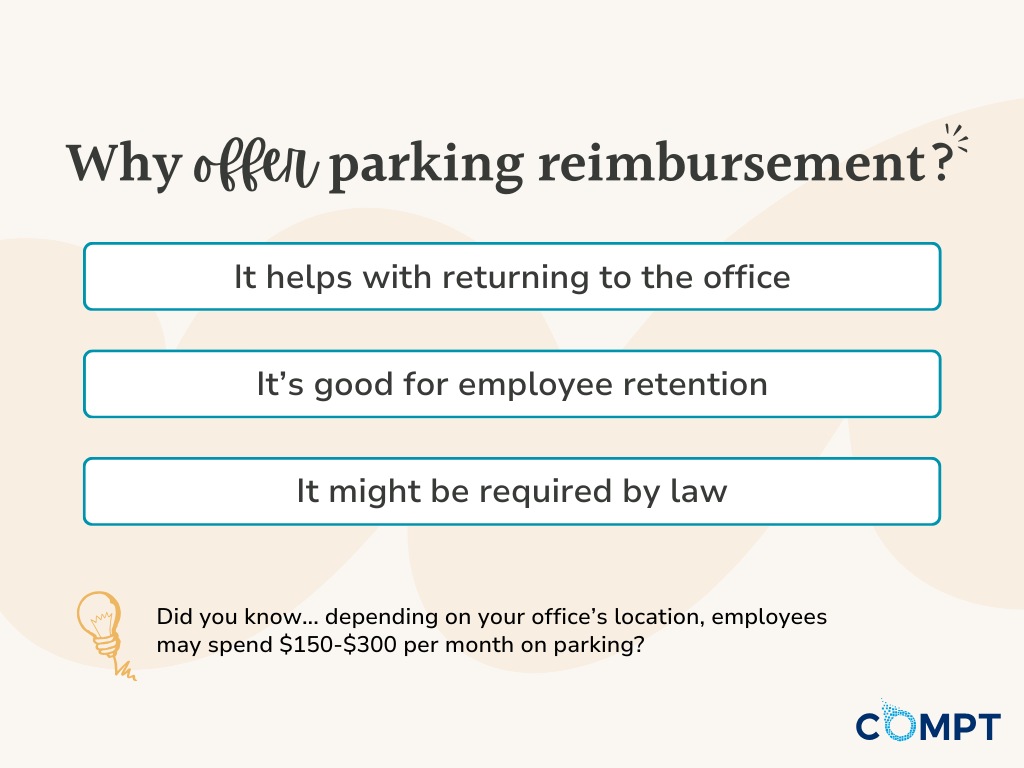
It helps with returning to the office.
As of 2025, 61% of companies had formally asked employees to return to the office at least sometimes after working fully remotely during the pandemic. By offering parking reimbursement, parking becomes one less cost they have to worry about.
It’s good for employee retention.
As of early 2025, nearly half of remote workers said they’d quit before accepting an RTO mandate. Covering parking costs won’t fix that — but it takes one friction point off the table.
It might be required by law.
Certain states and cities have requirements regarding offering commuter benefits to employees that work in those municipalities. This list includes New York City, New Jersey, Philadelphia, D.C., Chicago (and the surrounding RTA region), Seattle, Los Angeles, San Francisco, Richmond, and Berkeley, CA. This list is subject to change, so it’s good practice to review the regulations in the areas where your employees are located.
That means not offering this benefit can be a deal-breaker for your employees.
Parking reimbursement vs. parking stipend vs. pre-tax commuter benefit
Parking reimbursement, parking stipends, and pre-tax commuter benefits are three different mechanisms for helping employees cover parking costs, and they’re not interchangeable. The differences come down to how funds flow, when the tax exclusion applies, and how much admin your HR team takes on.
| Parking reimbursement | Parking stipend | Pre-tax commuter benefit | |
|---|---|---|---|
| How it works | Employee submits expenses after the fact; employer reimburses up to a set limit | Employer sets a fixed monthly cap; employee draws from the balance and submits receipts for reimbursement | Employee redirects pre-tax salary to cover parking costs |
| Tax treatment | Tax-free up to $340/month if IRS criteria are met | Taxable unless structured as a QTF reimbursement | Tax-free up to $340/month via payroll reduction |
| Who fronts the cost | Employee (until reimbursed) | Employee (reimbursed from a pre-funded balance) | Employee (from gross pay) |
| Admin lift | Moderate: receipt review and payroll processing required | Moderate: fixed allocation, but receipt review and payroll processing still required | Low-moderate: payroll processing required; no receipt review |
| Flexibility | High; works for any qualifying parking expense | High, but taxable if not tied to qualifying expenses | Lower; limited to IRS-defined commuter expenses |
Some platforms blur the line between reimbursement and stipend — for example, Compt uses a receipt-based model for both, which classifies every claim as taxable or nontaxable at the transaction level. That means you can offer parking reimbursement as a standalone benefit or roll it into a broader LSA, and it’ll automatically flag qualifying expenses against the $340 monthly exclusion.
Offer a parking stipend through Compt
Parking reimbursement is one of the easiest tax-free benefits to offer — and with Compt, the receipt review, tax classification, and payroll reporting run automatically.
Request a Compt demo to see it in action.

FAQs: Parking reimbursement stipends for employees
Parking reimbursement is tax-free up to $340 per employee per month in 2026, and Compt automatically flags whether each claim falls within that threshold so nothing gets miscategorized. Amounts above $340 are treated as taxable wages and subject to FITW, FICA, and FUTA. To qualify for the exclusion, the parking must be on or near your employer’s business premises, or at a location the employee commutes from — not at or near their home, and not for personal errands.
Can I reimburse employees for parking and transit in the same month?
Yes — and Compt handles both within the same program. The IRS sets separate $340/month exclusions for qualified parking and for transit passes and commuter highway vehicle transportation, meaning an employee can receive up to $340 tax-free for parking and another $340 tax-free for transit in the same month. The two limits can’t be combined or applied interchangeably — each can only be used for its respective expense type.
What happens if an employee’s parking costs exceed $340/month?
Anything above the $340 monthly limit becomes taxable — Compt flags the excess automatically and ensures it’s reported correctly through payroll. Specifically, the amount over $340, minus any portion the employee paid themselves, must be included in their wages and is subject to federal income tax withholding, Social Security, Medicare, and unemployment taxes. The cleanest way to handle this is to set your reimbursement cap at $340 so employees understand upfront what’s covered tax-free.
Is my company required to offer commuter benefits?
It depends on where your employees work. Compt is designed to support compliance across jurisdictions, but the mandate itself is determined by local law, not your company’s headquarters. Cities and regions with active requirements include New York City, New Jersey, Washington D.C., Seattle, Philadelphia, Los Angeles, Chicago and the surrounding RTA region, and several Bay Area counties including San Francisco, Richmond, and Berkeley. Employee thresholds vary — some mandates kick in at 10 employees, others at 20 or 50. This list is growing, so it’s worth reviewing the regulations for every location where your employees physically work.
Can employees be reimbursed for parking if they work hybrid?
Yes — hybrid employees are eligible for parking reimbursement on the days they commute in. Compt processes reimbursements per claim, so employees only submit for the parking they actually use, whether that’s a monthly pass or individual daily expenses. The IRS qualified parking rules don’t require employees to be in-office full time — they just require that the parking is at or near the employer’s workplace, or at a commute location like a park-and-ride. One thing to note: if an employee pays for a monthly parking pass but only comes in a few days a week, the full pass cost is still reimbursable as long as it doesn’t exceed $340/month, since a monthly pass is often cheaper than paying daily even for part-time office attendance.
Editor’s note: Compt software supports the categorization and proper reporting of benefits according to IRS guidelines, helping businesses maintain compliance. However, Compt cannot provide tax advice, and users should consult their own tax, legal, and accounting advisors when necessary.
Editor’s note: Originally published in 2024, this post has been recently updated for clarity and relevance for our readers.

 No receipt chasing