
The lifestyle benefits that registered nurses actually use — and are more likely to stay for — are flexible programs that fit shift-based work. These typically include mental health support available outside standard hours, childcare and family care benefits, food and grocery stipends, and flexible wellness or recovery-focused benefits.
Many healthcare employers now deliver these through a single Lifestyle Spending Account (LSA), an employer-funded benefit that allows nurses to use their benefits on what matters most to them instead of being limited to one fixed perk.
RN turnover is improving — but not fast enough to matter yet. The national RN turnover rate hit 16.4% in 2024, and the average cost of replacing one staff RN climbed to $61,110 in the same period. The average hospital still carries 47 open positions at any given time.
Benefits alone won’t close that gap. What they can do is influence whether the nurses you have feel supported enough to stay, and whether your offer looks better than the hospital across town when a candidate is weighing options. In a market this tight, that margin matters.
Why standard wellness benefits don’t work for registered nurses
Most employee wellness programs were designed with an office worker in mind. That isn’t a criticism; benefits vendors built products for the workforce that’s easiest to reach, and desk-based employees are a more uniform target thanks to their predictable schedules, consistent access to email and internal comms, and relatively standard daily routines.
Nursing doesn’t look like that. A floor nurse running three 12-hour shifts a week, with overnight slots and days off scattered across the calendar, isn’t on site during standard business hours. On-site gyms and lunchtime wellness workshops don’t work for them.
Childcare logistics compound this. Finding coverage for an overnight shift is a fundamentally harder problem than finding coverage for a standard workday. And backup care benefits designed around 9-to-5 gaps don’t solve it.
The result is that a lot of standard wellness perks see low utilization from nursing staff because the benefits don’t fit their lives. Low utilization means low perceived value, i.e., the program doesn’t register as a reason to stay.
In other words, having a weak benefits package will exacerbate your existing RN staffing and retention problems.
The takeaway isn’t that nurses won’t use benefits. It’s that they won’t use benefits that don’t fit how they live and work. When employers shift to more flexible models, the pattern changes. Across Compt’s benchmark data, which covers our entire customer base for the full-year 2025, hourly and front-line workers consistently show strong participation and utilization in lifestyle stipend programs, with nearly 90% of LSA and stipend funds used. See the graph below.
That pattern shows up at the organizational level as well. In one large U.S. healthcare system and Compt customer, a flexible lifestyle stipend program reached 87% activation and 94% utilization within the first three months of launch.

Lifestyle benefits that registered nurses actually want
The benefits that land with registered nurses are built around three realities of nursing shift work:
- Flexible timing
- Recovery-focused support
- Family care logistics that account for irregular schedules
With that in mind, here’s what the data (and nurses themselves) say matters to them.
What mental health benefits actually work for nurses on rotating shifts?
RNs constantly face traumatic situations and high-stakes decisions. So it should come as no surprise that in a 2024 nursing trends study conducted by IntentlyCare, 75.8% of them admitted they experienced significant burnout.
But the standard EAP doesn’t cut it. Even if your staff know it exists, utilization stays low because the format doesn’t fit the job. In fact, at the height of the COVID-19 pandemic when healthcare was arguably the most stressful place to work, only 5% of RNs used theirs.
When it comes to benefits for registered nurses, you need options that account for shift schedules:
- On-demand telehealth therapy
- Async mental health platforms
- An inclusive mental health stipend nurses can use to pay for appointments
- On-site mental health resources (if your facility is big enough to support it)
In Compt’s benchmark data, wellness benefits see significantly higher utilization when they’re delivered within a flexible LSA (86%) compared to standalone wellness stipend programs (62%).
How can hospitals give nurses more control over their schedules?
Mandatory overtime, last-minute shift changes, and on-call requirements make planning a life outside the hospital next to impossible. This is why 58% of nurses told AMN Healthcare that better schedules were extremely important to them. After pay and staffing ratios, it’s their third-highest priority.
There are a few ways you can give your nursing staff more control over their working hours:
- Job sharing
- Self-scheduling options
- Compressed work weeks
- The ability to swap shifts without bureaucratic friction
The best part about these is that they’re not expensive benefits to offer. But they do require operational commitment from nurse managers and leadership in the form of predictable scheduling (that is, giving nurses advance notice of their shifts rather than rolling changes).
What benefits help nurses manage life around a 24/7 schedule?
24/7 care doesn’t negotiate, so as a healthcare HR leader, there are inherent scheduling challenges you simply can’t eliminate. The solution from a lifestyle benefits standpoint is to layer support for the life that exists around the schedule on top of scheduling flexibility:
- Meal benefits such as meal delivery credits or subsidized on-site food options remove one decision from an already depleted RN’s day.
- Commuter support such as transit benefits, parking subsidies, and rideshare credits ease the financial burden of getting to and from work (plus some are nontaxable!).
- Grocery stipends acknowledge that basic household maintenance is harder when your days off are unpredictable.
According to Compt customer benchmarks, groceries in particular are a high-impact expense to cover. Nearly one in 10 stipend dollars is already being spent at grocery retailers.
Why do childcare benefits matter more for nurses than many other workers?
Despite the fact that many of your RNs are working parents, BLS data shows that as of 2024, less than one-third (28%) of them have access to childcare benefits like on-site childcare or stipends to help offset costs.
The most practical options, depending on your system’s size and resources, are:
- On-site childcare for larger hospital campuses
- Backup care partnerships for last-minute coverage
- Family care benefits nurses can apply to whatever childcare arrangement fits their situation
This is another high-impact lifestyle benefit because childcare coverage for an overnight shift or a weekend rotation is way harder than finding one for the 9-to-5 workday. And when that coverage falls through, nurses call out.
Short-term, you’re dealing with even greater staffing shortages. When it’s a recurring problem, they start looking for jobs with more predictable hours.
At one large U.S. healthcare system, shifting to flexible lifestyle stipends for wellness and childcare with Compt led to improved retention in high-turnover nursing units, 87% activation, and 94% utilization within the first three months. In employee survey results, 58% said the benefit made them more likely to stay with the company.
What financial wellness benefits do registered nurses need most?
One aspect of health and wellness healthcare HR leaders tend to overlook is financial wellness.
One in three registered nurses carries a student loan balance, the median of which is $33,210. Add that to the constantly rising cost of living (which pay generally doesn’t keep up with), and you’ll start to realize a huge portion of your workforce is under real financial pressure.
The practical financial wellness benefits worth offering to RNs are:
- Student loan repayment assistance
- Tuition reimbursement
- Financial coaching
- Emergency savings programs
- Earned wage access for pre-payday expenses
What fitness benefits work for nurses who aren’t on a predictable schedule?
A subsidized gym membership is fine for nurses who live near a partner gym and have predictable days off. That’s not most of them. What tends to get used more consistently is a flexible benefit nurses can apply to whatever fits their life.
One nurse might use it on a gym membership. Another might put it toward a Peloton, a running app, massage therapy, PT copays, or a yoga studio near their home. The format matters less than the flexibility.
Pro tip: For registered nurses specifically, recovery-focused fitness benefits are worth calling out explicitly in how you communicate the program. Massage therapy, stretching classes, and physical therapy support directly address the physical wear of a job that involves 12 hours on your feet, patient lifting, and constant movement.

How can hospitals support nurse career growth without bureaucratic friction?
In our 2026 benchmarking data, professional development is among the top five stipends offered by Compt customers.
The catch with nurses is that high-acuity work leaves little bandwidth for continuing education. A rigid reimbursement policy with pre-approval requirements, narrow eligible expense categories, and timelines that stretch months? The bureaucracy alone is enough to kill utilization.
What works better for RNs is a flexible professional development account they can apply to what’s relevant to their career, be it a certification prep course, specialty training, conference attendance, clinical skills workshops, or advanced degree programs.
Comparison table: Best lifestyle benefits for registered nurses in 2026
| Benefit type | What it covers | Best for … |
| Mental health benefits | Therapy, telehealth, async support | Burnout, emotional strain, irregular schedules |
| Flexible scheduling | Self-scheduling, shift swaps, compressed workweeks | Nurses managing unpredictable or rotating shifts |
| Food and grocery stipends | Groceries, meal delivery, on-site meals | Shift workers with limited time for daily logistics |
| Commuter and schedule-adjacent benefits | Transit, parking, rideshare | Reducing friction around long or inconsistent schedules |
| Childcare and family care | Backup care, childcare stipends, family support | Nurses working nights, weekends, or variable shifts |
| Financial wellness | Student loan repayment, emergency savings, financial support | Employees under financial pressure or managing debt |
| Flexible fitness and recovery benefits | Gym memberships, PT, massage therapy, recovery-focused care | Physical strain from long shifts, injury prevention, recovery |
| Professional development | Certifications, courses, tools | Career growth without rigid reimbursement rules |
| Lifestyle Spending Account (LSA) | Flexible, multicategory benefit covering any or all of the above | Supporting a diverse workforce with different needs |
The LSA framework: Why flexibility wins in healthcare
A Lifestyle Spending Account (LSA) is an employer-funded benefit that lets employees use allocated funds across defined categories such as wellness, family care, food, and professional development.
Here are some reasons to consider offering one:
Point solutions break down at scale.
A childcare stipend here, a fitness benefit there, a separate professional development budget … running these all separately is just more admin work, and many staff members won’t enroll in or use all of them.
For a healthcare HR team already managing credentialing, compliance, and high-volume hiring, high admin complexity leads to your benefits program getting deprioritized. That’s why, out of all the reasons to offer an LSA, this is the main one.
LSAs fit a diverse nursing workforce.
A new grad in her mid-20s working her first hospital job has completely different priorities than a 40-year-old experienced ICU nurse with two kids and a mortgage. A per-diem nurse with a second job values different benefits than a full-time FTE building toward a pension.
That’s the structural argument for LSAs over scattered stipends: No single perk works across that range, but a flexible LSA does. Instead of guessing what each nurse’s priorities are, they get a broad allowance they can spend on what matters to them.
The result is higher utilization and perceived value, and a benefit that feels personal. And when your nurses can manage their wellness in a way that’s effective for them, they’re more likely to (a) stay with you and (b) be more present when they’re on the floor.
That translates into both adoption and retention. Large healthcare employers using the Compt model have seen the majority of employees actively engage with the benefit shortly after launch, even among deskless and shift-based teams.
This is why nearly two-thirds of Compt customers now offer an all-inclusive LSA instead of individual perks or separate stipend programs.
How to build and communicate a lifestyle benefits program for nurses
Here’s the practical HR guidance: how to structure eligibility, communicate to shift workers who aren’t at a desk, and measure utilization.
1. Run an employee benefits survey.
A benefits survey will tell you what you’re already doing right when it comes to employee benefits and what your team thinks needs improvement. It’ll also give you an idea of what motivates them, which is info you can use to offer and promote the highest-impact perks.
2. Offer scheduling flexibility where you can.
Flexible scheduling is primarily an operations and nurse manager decision, but HR’s role is to make sure the policies exist that enable it: compressed workweeks, self-scheduling frameworks, part-time and per-diem pathways, and/or job-sharing arrangements.
If those policies aren’t formally documented and consistently applied, flexibility is a favor managers grant inconsistently, which creates its own retention problem.
3. Consolidate your lifestyle benefits into an all-inclusive LSA.
Having separate vendor relationships, separate eligibility rules, and different reimbursement processes for each benefit category makes both the initial setup and ongoing benefits admin a lot harder than it needs to be. And it makes for a fragmented experience for nurses who have to navigate five different programs to access their benefits.
Today, most employers consolidate their lifestyle benefits instead. With Compt, registered nurses can spend from an LSA allowance across 30+ different categories. In 2025, our users spent across more than 64,000 vendors globally.
Compt’s LSA platform also handles the tax complexity, including the distinction between taxable and nontaxable spend categories. Certain commuter and education benefits, for instance, have specific IRS pre-tax treatment.
4. Define your eligible spend categories.
That brings us to our next consideration: LSA-eligible expenses. What will you allow your nursing team to use their LSA funds for?
Our most successful users keep things as broad as possible. Anything that supports a nurse’s physical health, mental health, financial well-being, family care, or professional development is fair game.
What is never eligible?
- Medical expenses (LSAs are not HSAs!)
- Cash equivalents (e.g., gift cards)
- Anything already covered by other benefits
- Personal expenses with no clear link to well-being or growth (e.g., retail shopping)
5. Set your budget and funding cadence.
There’s no universal right answer on budget, but a practical starting point is to work backward from two questions: What are you currently spending on fragmented point-solution benefits, and what’s your cost-per-vacancy when an RN leaves?
If consolidating scattered perks into an LSA gets you to a similar per-employee spend with better utilization, that’s already a win. If even a modest reduction in turnover offsets the program cost, the math usually works in your favor.
A great starting point for a nursing-focused program is somewhere in the range of $700 to $800 per employee per year (Compt average is $780). That said, larger systems with more aggressive retention goals go higher.
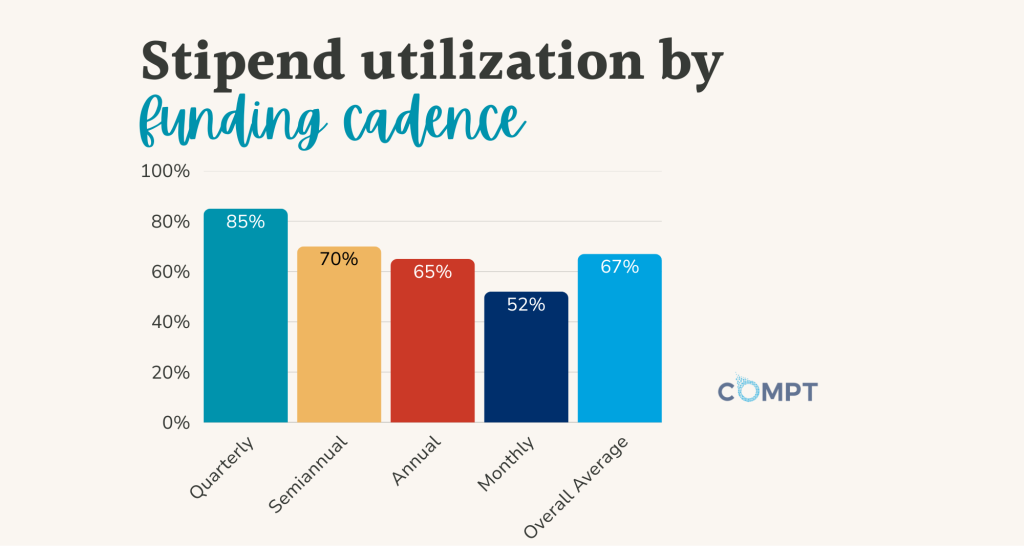
Then cadence matters as much as amount. Utilization varies dramatically by funding schedule:
- Quarterly funding: 85%
- Annual funding: 65%
- Monthly funding: 52%
Quarterly is the clear winner. And for a shift-based workforce that isn’t sitting at a desk checking internal communications, the cadence also affects awareness. A quarterly deposit is a natural touchpoint to remind nurses the benefit exists and prompt them to use it.
6. Communicate the program to your nursing staff.
Benefits communication is harder for a shift-based workforce because nurses aren’t sitting in front of a company intranet, and a single all-hands email gets buried fast.
A few best practices for getting your message seen:
- Brief in-person or unit-level announcements at shift handoff are more effective than email blasts.
- Lead with the dollar amount and what they can spend it on so they know what they’re getting and how to use it.
- Use mobile-first communication — any platform or communication that requires a desktop login will see lower engagement from deskless workers in general.
- Align reminder communications with your funding cadence. When the quarterly deposit hits, that’s your window to prompt utilization.
Structured communication matters for deskless healthcare teams: one large U.S. health system paired its Compt program launch with internal reminders, targeted outreach in lower-engagement departments, and real employee examples to increase adoption.
7. Track utilization and adjust.
Compt’s dashboards and reports give you visibility into utilization rates, spend by category, and participation trends across your workforce. Use that data to adjust your communication strategy and funding levels, and compare it to business outcomes to understand the ROI of your program.
Offer lifestyle benefits your nurses will love
Your nurses have enough to manage. A perk they can actually use on their schedule, for what their life requires, is one less thing working against them.
With:
- 30+ spend categories
- Simple onboarding flows for new hires
- Support for FTE, per-diem, and hourly staff
- 30 minutes of admin per month (on average)
- Streamlined tax classification and reporting
Compt makes that program easy to build, administer, and scale across your entire nursing workforce.
Request a Compt demo to see what it looks like for your team.

FAQs: Stipends and LSAs for registered nurses
The benefits that resonate most with registered nurses are those that reflect the realities of shift-based work, including irregular schedules, physical strain, and complex family logistics. That often leads HR and Finance decision-makers to look into flexible lifestyle benefits rather than fixed perks.
Programs that perform well typically include mental health support that works outside standard hours, childcare support that covers nights and weekends, food and grocery benefits, commuter assistance, and recovery-focused wellness options. Many hospitals are consolidating these into a single flexible stipend or Lifestyle Spending Account (LSA), allowing nurses to use the benefit on what matters most to them instead of being limited to one category.
What benefits actually improve nurse retention in hospitals?
Benefits improve nurse retention when they are both relevant and easy to use. Traditional programs often fall short because they don’t match nurses’ schedules or day-to-day realities. Flexible benefits that support real-life needs such as childcare, food, mental health, and financial wellness tend to have a stronger impact.
One large healthcare system and Compt customer told us that more than half of employees said a flexible lifestyle benefit made them more likely to stay, reinforcing that the perceived value of a benefit matters as much as the amount offered.
Why don’t traditional wellness programs work for nurses?
Most traditional wellness programs are designed for employees with predictable schedules and consistent access to workplace resources. Nurses operate in a very different environment, with long shifts, overnight schedules, and limited time during the workday. As a result, programs like on-site gyms or scheduled wellness sessions are often difficult to access and see low utilization. The issue is not lack of interest, but lack of fit. Benefits that can be used on each nurse’s own schedule tend to perform much better.
What’s the best way to structure benefits for shift-based or deskless healthcare workers?
The most effective approach is to design benefits around flexibility and accessibility. This usually means offering a reimbursement-based stipend or Lifestyle Spending Account (LSA) that employees can use on their own time. Programs should cover broad categories such as wellness, food, family care, and financial support, and should be easy to access from a mobile device. Communication also needs to match how these employees work, using timely reminders and in-person touchpoints instead of relying only on email.
This approach is supported by Compt benchmark data, where hourly and front-line workers consistently show high participation and utilization when benefits are delivered through flexible stipend programs rather than fixed, one-size-fits-all offerings; among these populations, nearly 90% of LSA funds are used in flexible stipend programs.
How do Lifestyle Spending Accounts (LSAs) work for healthcare employees?
A Lifestyle Spending Account (LSA) is an employer-funded benefit that allows employees to use allocated funds across a set of defined categories such as wellness, childcare, food, and professional development. Employees make purchases that fall within those categories and submit them for reimbursement, typically through payroll. For healthcare organizations, this model works well because it supports a wide range of needs across a diverse workforce without requiring separate programs for each benefit type.
Are flexible stipends more effective than traditional perks for nurses?
Flexible stipends are often more effective than traditional perks because they adapt to different schedules, life stages, and priorities. A single perk, such as a gym membership, may only appeal to a portion of employees, while a flexible benefit allows each nurse to choose what is most useful, whether that is therapy, groceries, childcare, or fitness. This flexibility tends to drive higher engagement and makes the benefit feel more relevant to the employee’s actual life.
Compt benchmark data shows this difference clearly. Wellness benefits see 86% utilization when delivered within a flexible LSA, compared to 62% when offered as a standalone program, highlighting how structure (not just the benefit itself) drives engagement.
Editor’s note: Compt software supports the categorization and proper reporting of benefits according to IRS guidelines, helping businesses maintain compliance. However, Compt cannot provide tax advice, and users should consult their own tax, legal, and accounting advisors when necessary.