

Employee wellness benefits have moved from “nice-to-have” to a baseline expectation, and not because employees suddenly became obsessed with step challenges.
In 2026, wellness is shaped by three realities employers can’t ignore: rising healthcare costs, persistent burnout, and everyday financial stress that shows up at work whether you measure it or not. When employees don’t feel well — physically, mentally, financially, or socially — engagement drops, absenteeism rises, and retention gets harder.
That’s why more employers are redesigning wellness benefits around what actually drives adoption: flexibility, relevance, and ease of use.
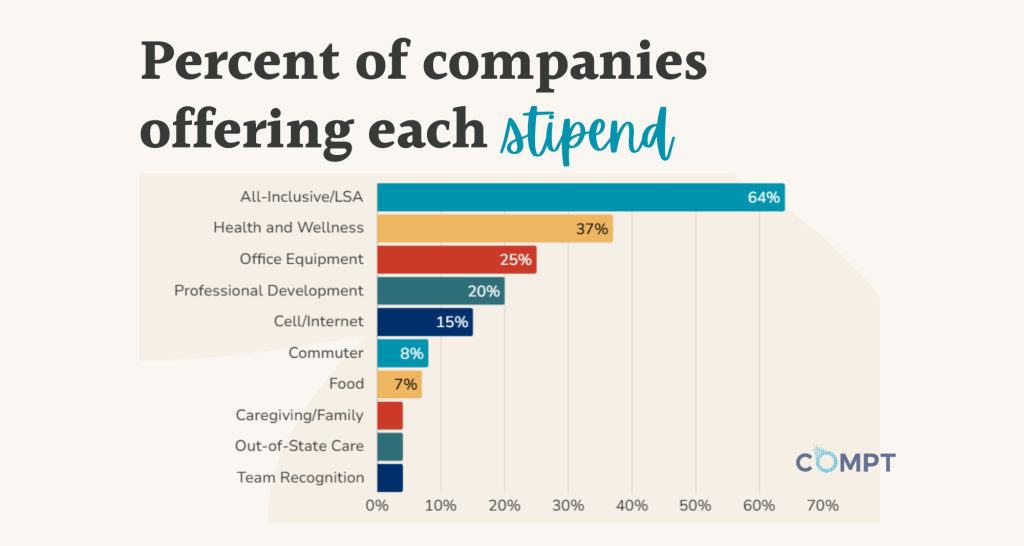
Compt’s 2026 Annual Lifestyle Benefits Benchmark Report shows just how central wellness has become inside modern benefits programs. Among Compt customers, health and wellness is the #2 stipend category offered, second only to all-inclusive Lifestyle Spending Accounts, or LSAs, most of which include wellness anyway. When companies offer wellness through flexible, reimbursement-based programs, employees use it consistently.
This guide breaks down what employee wellness benefits are, what “modern wellness” includes today, and how to build a program employees will actually participate in, complete with 2026 benchmarks you can use to sanity-check your budget and benefit design.
What are employee wellness benefits?
Employee wellness benefits are company-sponsored programs or initiatives designed to support employees’ physical, mental, emotional, and financial well-being.
At their core, wellness benefits aim to:
- Reduce workplace stress and burnout
- Encourage sustainable, healthy lifestyle habits
- Support work-life balance
- Help employees manage physical and mental health needs
- Improve retention, engagement, and overall job satisfaction
Traditionally, wellness programs focused heavily on gym memberships, fitness challenges, and employee assistance programs. Today, the definition is much broader.
Modern employee wellness benefits can include fitness reimbursements, therapy and mental health support, nutrition programs, grocery stipends, financial wellness tools, preventive care, and flexible spending programs that allow employees to choose what “wellness” means to them.
Increasingly, employers are delivering these benefits through reimbursement-based wellness stipends or all-inclusive Lifestyle Spending Accounts (LSAs), which give employees autonomy while simplifying administration for HR teams.
However you structure your program, the goal is the same: create a benefits framework that makes well-being accessible, flexible, and actually usable — not just available on paper.
How popular are employee wellness benefits in 2026?
Employee wellness benefits are no longer experimental or reserved for large enterprises. They are now a standard component of modern total rewards infrastructure.
Per our 2026 Annual Lifestyle Benefits Benchmark Report, 37% of companies offer a dedicated wellness stipend, and 64% have consolidated multiple lifestyle perks into an all-inclusive Lifestyle Spending Account (LSA).
But offering a wellness benefit is only part of the story. Employee participation and utilization tell a more important one.
Participation refers to the percentage of eligible employees who actively use a benefit by submitting at least one expense.
Utilization measures the percentage of allocated stipend funds that employees actually spend.
Together, these metrics show whether a wellness benefit is broadly adopted and whether funding levels align with real employee behavior.
Among Compt customers in 2025:
- Wellness benefits reached an 85% participation rate.
- Standalone wellness stipends saw 62% utilization.
- When wellness was embedded inside an all-inclusive LSA, utilization increased to 86%.
That gap is significant. It shows that employees are far more likely to use wellness benefits when they’re part of a flexible, consolidated program rather than a rigid, single-purpose perk.
Funding structure also plays a role. Quarterly-funded stipend programs reached 85% utilization across categories, outperforming monthly and annual models.
The takeaway for employers in 2026 isn’t just to “offer wellness.” It’s to design wellness benefits in a way that drives consistent engagement, with strategy, structure, funding cadence, and flexibility all working together.
Want to see how your program compares? Download the 2026 Annual Lifestyle Benefits Benchmark Report to explore funding ranges, participation benchmarks, and design patterns across company sizes.

Relating employee wellness benefits to the 4 pillars of employee well-being
Employee wellness isn’t one-dimensional. In 2026, employers are thinking about well-being across four interconnected pillars: physical, mental, financial, and social wellness.
These pillars reflect the reality that employees don’t experience stress, burnout, or financial strain in isolation. Physical health affects mental health. Financial stress impacts productivity. Social connection influences engagement and retention.
Designing an effective wellness benefits program means supporting all four areas, not just offering a gym reimbursement and calling it a day.
The four pillars of employee wellness include:
- Physical wellness
- Mental wellness
- Financial wellness
- Social wellness
When these pillars are supported through flexible, accessible benefits, employees are more likely to participate consistently, and HR and Finance teams are more likely to see measurable impact on the business.

Pillar one: Physical wellness
Physical wellness is often the first thing employers think of when designing a wellness program, but it’s much broader than gym access alone.
It includes the everyday behaviors and resources that help employees function at their best, including:
- Physical activity
- Nutrition
- Sleep habits
- Preventive care and healthcare access
- Lifestyle choices that support long-term health
While fitness memberships and exercise classes remain common offerings, physical wellness in 2026 also includes recovery tools, ergonomic support, supplements, preventive appointments, and small but meaningful health-related expenses that may not be fully covered by traditional insurance.
Benchmark data shows that fitness-related expenses still represent the largest share of wellness transactions, but employees use wellness funds across a wide range of needs that shift month to month. That’s why broader, reimbursement-based programs consistently outperform rigid, single-category perks in participation — they allow employees to prioritize what their bodies actually need, rather than limiting support to a single type of activity.
A modern physical wellness strategy isn’t about encouraging everyone to train for a marathon. It’s about making it easier for employees to maintain sustainable, healthy routines that support performance at work and well-being outside of it.

Pillar two: Mental wellness
Mental wellness has become one of the defining workplace challenges of the past several years. According to Gallup’s 2025 workplace data, roughly 27–28% of U.S. employees report feeling burned out at work “very often” or “always.” That’s nearly one in three employees experiencing persistent burnout. When chronic stress goes unaddressed, it affects productivity, absenteeism, and long-term retention.
Yet mental health support is often where traditional wellness programs fall short.
Many organizations offer employee assistance programs (EAPs) or limited counseling sessions, but usage rates historically lag behind availability. When mental health benefits are difficult to access, narrowly defined, or disconnected from employees’ day-to-day realities, participation suffers.
Barriers commonly include:
- Stigma around seeking support
- Lack of awareness about available resources
- Fear of professional repercussions
- Long wait times or limited provider networks
Addressing mental wellness effectively means reducing these barriers and expanding how support is delivered. In practice, that can include therapy and telehealth reimbursements, mental health apps, stress management programs, coaching, recovery services, and even everyday self-care expenses that help employees regulate stress before it escalates.
Flexible wellness stipends and LSAs tend to see stronger participation because they allow employees to define mental wellness for themselves, whether that’s therapy, mindfulness training, stress management tools, gym memberships, or other forms of preventive care that improve emotional resilience and lower stress.
Mental wellness isn’t a one-size-fits-all category. Programs that recognize that reality and build in flexibility accordingly are far more likely to be used consistently.
Pillar three: Financial wellness
Financial wellness focuses on helping employees feel stable, secure, and confident in their ability to manage day-to-day and long-term financial obligations.
In 2026, this pillar has become increasingly important. According to the Federal Reserve’s most recent report on the economic well-being of U.S. households, 17% of adults report being unable to pay all of their bills in full. Financial strain doesn’t stay at home — it follows employees into the workplace, affecting focus, stress levels, and overall performance.
Beyond compensation, financial wellness benefits may support:
- Retirement savings
- Debt management
- Budgeting tools and education
- Emergency savings
- Health care costs
- Student loan repayment
Importantly, employees are increasingly using flexible benefits to offset everyday living expenses. Data from Compt’s 2026 Annual Lifestyle Benefits Benchmark Report shows that nearly 1 in 10 stipend dollars is now spent at grocery retailers, and food-related categories remain among the most consistently used benefits.
This shift reflects a broader reality: when employees are given flexibility, they often prioritize stability. Programs that allow funds to be used for real-life needs, whether that’s groceries, connectivity, or other essential expenses, tend to see stronger participation and sustained engagement than more limited employee lifestyle benefits.
Financial wellness isn’t only about long-term wealth building. Often, it’s about reducing immediate pressure so employees can focus on their work without carrying constant financial stress.
Pillar four: Social wellness
Social wellness centers on connection: the relationships employees build with colleagues, leaders, and the organization as a whole. Strong workplace relationships foster trust, belonging, and a sense of shared purpose.
When employees feel disconnected, engagement drops. Gallup’s most recent workplace research continues to show that a large portion of the workforce remains actively disengaged, often citing lack of recognition, limited trust in leadership, and weak team relationships as contributing factors.
Supporting social wellness can include:
- Mentorship programs
- Team-building events and offsites
- Employee recognition initiatives
- Transparent communication channels
- Peer-to-peer appreciation programs
This pillar is especially important for remote, hybrid, and deskless workforces, where face-to-face interaction is limited and informal connection doesn’t happen naturally.
Flexible lifestyle benefits can also support social wellness indirectly by funding team experiences, shared meals, recognition budgets, and employee-led initiatives like book clubs — an approach many Compt customers use to encourage connection beyond day-to-day work.
At its core, social wellness is about helping employees feel seen, supported, and connected, not just productive.
5 reasons to prioritize employee wellness initiatives through your employee well-being benefits
Even with strong participation benchmarks and growing adoption, the question for many employers isn’t whether to offer wellness benefits — it’s why to invest in them intentionally.
Here are five tangible reasons employee wellness initiatives matter in 2026:
1. They increase day-to-day engagement and morale.
When employees feel supported across physical, mental, financial, and social dimensions, they’re more likely to stay engaged in their work.
This doesn’t require elaborate programming. Celebrating milestones, funding team experiences, supporting fitness routines, or offering stipends that employees can use for preventive care all signal that well-being is valued. Small, consistent signals of support often drive stronger engagement than one-time initiatives.
Programs that are flexible and easy to access tend to see broader participation, which means the impact isn’t limited to a small subset of employees.
2. They help reduce absenteeism and long-term risk.
Chronic stress, unmanaged health conditions, and financial strain all contribute to higher absenteeism and reduced productivity.
While legacy ROI studies often cite large cost savings tied to wellness investments, modern employers evaluate success differently. Participation rates, sustained utilization, and preventive behavior shifts are better indicators of long-term impact than short-term cost calculations alone.
When benefits support preventive care, mental health access, and everyday stability, they reduce the likelihood that small issues become larger disruptions.
3. They strengthen your talent strategy.
Today’s candidates evaluate total rewards holistically. Salary still matters, but so does whether a company understands the realities of modern life and provides perks to match. When benefits don’t meet market expectations, the impact is measurable: roles become harder to fill, offer acceptance rates decline, and retention pressure increases.
Wellness benefits that feel relevant demonstrate that your organization invests in people, not just roles. That perception influences offer acceptance, employer brand, and long-term retention.
When employees see real value in their benefits, they’re less likely to view them as symbolic.
“The whole purpose of benefits and rewards in general is to attract and retain talent. If we don’t have a benefit, or if our benefit isn’t as good as what is out there in the market for the talent that we want to get, then that’s a gap that we need to close.”
— Head of Total Rewards, midsize B2B HR tech company
4. They reinforce culture and belonging.
Culture is shaped by what an organization funds and prioritizes.
Mentorship programs, recognition initiatives, team-building events, book clubs, and shared experiences all contribute to social wellness. When employees feel connected to colleagues and leadership, trust increases and disengagement declines.
Wellness initiatives, when designed inclusively, support that sense of belonging across remote, hybrid, and deskless teams alike.
5. They support sustainable performance, not only short-term output.
Work-life balance and long-term performance are closely linked. Employees who lack recovery time or carry persistent stress are more likely to burn out.
Wellness benefits that encourage preventive care, stress management, physical activity, and healthy routines help employees maintain sustainable performance over time. The goal isn’t to push people harder — it’s to support the habits that allow them to work well without sacrificing their well-being.
Organizations that treat wellness as strategy and infrastructure, rather than a perk, are better positioned for long-term stability.
What benefits can be included in an employee wellness program?
There are countless ways to design a wellness program, but the most effective ones share a common trait: they align with how employees actually use benefits in real life.
In 2026, that increasingly means flexibility, preventive care, and support that extends beyond traditional wellness.
Below are some of the most common and effective stipend categories employers include in modern wellness programs.
Flexible wellness stipends and Lifestyle Spending Accounts (LSAs)
Flexible stipends and LSAs have become one of the most common ways to deliver wellness benefits. Rather than limiting employees to a narrow vendor list, reimbursement-based programs allow them to spend allocated funds on approved wellness-related expenses that fit their individual needs.
According to Compt’s 2026 benchmark data, 64% of companies now offer an all-inclusive LSA, and wellness benefits see significantly higher utilization when embedded within a flexible program (86%) compared to standalone wellness stipends (62%).
ButterflyMX, for example, offers a quarterly self-care stipend to its global workforce, providing employees with funds in their local currency to use on wellness-related expenses of their choice. The program consistently sees strong participation, with employees using funds for fitness memberships, preventive care, ergonomic equipment, and everyday well-being needs.
Because flexible programs meet employees where they are, they tend to drive higher participation and sustained engagement over time.
Want to see how your wellness program would compare? Request a demo to model your stipend structure and funding cadence.
Fitness classes, gym reimbursements, and physical health benefits
Traditional physical wellness benefits still play an important role.
Some organizations offer on-site or virtual fitness classes, health coaching, and wellness centers.
Others provide gym reimbursements, giving employees the freedom to choose the facility, studio, or activity that works best for them. Whether it’s a traditional gym membership, group classes at a gym, or a membership to a specialty fitness center like CrossFit, SoulCycle, or a pilates studio, you have the flexibility to approve and fund any option that helps your team members stay active.
The advantage of reimbursement-based gym benefits is flexibility. Instead of negotiating with specific vendors, employers can approve a range of eligible expenses while maintaining centralized oversight and tax compliance.
This approach supports preventive care and consistent movement without forcing employees into a single model of participation.

Mental health and preventive care support
Mental wellness continues to be a central pillar of employee well-being. As noted earlier, nearly one in three U.S. employees report feeling burned out very often or always, according to Gallup.
Beyond traditional employee assistance programs, employers are expanding mental health offerings to include:
- Therapy and telehealth reimbursements
- Coaching and stress management tools
- Mental health apps
- Preventive care expenses not fully covered by insurance
- Dedicated mental health days within PTO policies
Programs that allow employees to access these services flexibly tend to see higher participation than rigid, pre-selected vendor models.
Broader medical and financial wellness support
Wellness programs often intersect with coverage gaps and financial planning needs.
Employers may choose to support expenses such as copays, preventive care services, health-related supplies, or student loan repayment through stipends or broader lifestyle programs. The goal is not to replace traditional benefits, but to supplement them in areas where employees frequently experience friction.
When structured thoughtfully, these programs can provide practical relief without adding administrative complexity.
Family and caregiving support
Some employers extend wellness programming to include family and caregiving support.
This may include childcare assistance, elder care support, fertility benefits, or emergency care expenses. Organizations can manage these as a standalone category or layer them into a broader stipend structure, depending on workforce demographics and budget priorities.
Clear category boundaries and eligibility rules are essential to keep administration simple and compliant.
Flexible work policies and remote support
Wellness is also influenced by how work is structured.
Hybrid schedules, remote work options, floating holidays, and sabbaticals all contribute to long-term sustainability. For distributed teams, pairing flexible policies with remote work stipends can ensure employees have the equipment and connectivity needed to work comfortably and effectively.
These structural supports often reinforce the impact of direct wellness benefits.
Run your wellness program with Compt.
Wellness benefits only work if employees actually use them.
Compt helps employers design reimbursement-based wellness stipends and Lifestyle Spending Accounts that drive participation, simplify administration, and scale across distributed teams.
With Compt, you can:
- Set and adjust funding levels with full budget visibility.
- Give employees flexible access to eligible wellness categories.
- Automate expense approvals and tax logic.
- Track participation and utilization in real time.
- Consolidate fragmented perks into a single, manageable program.
Instead of adding another vendor or rigid perk, you can build a flexible structure that adapts to your workforce.
Request a demo to see how your wellness program could be structured for stronger participation and measurable impact.
FAQs: Employee wellness benefits
Employee wellness benefits are employer-sponsored programs designed to support employees’ physical, mental, financial, and social well-being. They can include gym reimbursements, therapy support, preventive care coverage, financial wellness assistance, flexible stipends, or Lifestyle Spending Accounts (LSAs). Modern wellness benefits prioritize flexibility and participation, ensuring employees can use funds in ways that align with their real-life needs.
How popular are employee wellness benefits in 2026?
Wellness benefits are now a standard part of competitive total rewards strategies. According to Compt’s 2026 Annual Lifestyle Benefits Benchmark Report, 37% of companies offer a dedicated wellness stipend, and 64% offer an all-inclusive LSA that often includes wellness categories. Participation rates for wellness benefits reach 85%, with utilization significantly higher when wellness is embedded within a flexible LSA structure.
What does Compt consider a good participation rate for a modern wellness program?
Compt benchmark data shows that wellness benefits reach approximately 85% participation among eligible employees. When wellness is delivered through a flexible LSA, utilization increases to 86%, compared to 62% for standalone wellness stipends. A strong participation rate typically indicates that the program is accessible, relevant, and easy to use.
How does Compt define a wellness stipend?
Compt defines a wellness stipend as a reimbursement-based benefit that provides employees with allocated funds to spend on approved health and well-being expenses. Wellness stipends can be offered as standalone programs or embedded within a broader Lifestyle Spending Account. Funds are typically post-tax and managed via Compt with built-in tax logic to ensure compliance while maintaining flexibility for employees.
Why does Compt advocate for reimbursement-based stipends over paycheck additions?
Reimbursement-based stipends allow employers to fund wellness benefits without automatically issuing funds through payroll. This structure ensures that dollars are spent intentionally rather than treated as additional compensation. It also provides clearer tracking, built-in tax categorization, and better visibility into participation and utilization, helping employers align funding with actual employee behavior.
Lifestyle Spending Accounts (LSAs) provide broader flexibility than standalone wellness stipends. While standalone wellness programs focus on specific categories, LSAs allow multiple eligible categories within one consolidated framework. Compt benchmark data shows that wellness utilization reaches 86% when embedded within an LSA, compared to 62% when offered alone.
Are wellness stipends taxable?
Most wellness stipends are taxable because they cover expenses that do not qualify as IRS-defined medical benefits. However, certain categories, such as cell and internet reimbursements or commuter benefits, may qualify for different tax treatment depending on how the program is structured. Platforms like Compt apply tax logic automatically to help employers manage compliance accurately.
What are the benchmarks for wellness stipends by company size?
Compt’s 2026 benchmark data shows that the median annual wellness stipend is $735 per employee per year. Overall lifestyle benefit funding averages $850 per employee per year, with small companies often allocating more per employee than large organizations. Funding cadence also impacts utilization, with quarterly-funded programs consistently outperforming monthly or annual structures.
How can employers design a wellness program that employees actually use?
Programs that drive strong participation share three characteristics: flexibility, clear communication, and simple reimbursement processes. Embedding wellness within a broader LSA, funding stipends quarterly, and minimizing vendor restrictions all increase utilization. Measuring participation and utilization rates over time allows employers to adjust categories and funding levels based on real behavior rather than assumptions.