

One-size-fits-all perks don’t typically align with today’s employees’ lives and preferences. People simply like too many different things for an employer to decide what the perfect benefit is for everyone on their staff. That’s the beauty of Lifestyle Spending Accounts (LSAs): a flexible lifestyle benefit that provides endless choice and personalization, alongside easy budget predictability for you, the employer. Like any benefits program, though, LSAs do come with some tradeoffs. This guide breaks down the LSA pros and cons to be aware of as we head into 2026, plus answers the most common questions we hear from HR and Finance leaders.
At Compt, we’ve helped hundreds of companies design LSAs that actually work. Our programs see 93% employee participation — nearly triple traditional perk usage — because when employees have the option to choose benefits that fit their real lives, they use them.
Let’s unpack the data, dig into those LSA pros and cons, and uncover why LSAs are becoming the centerpiece of modern benefits strategies.
What is a Lifestyle Spending Account?
Starting from the basics, a Lifestyle Spending Account is an employer-funded benefit that allows employees to spend on categories you define: wellness, caregiving, professional development, food, home office, and more — Compt offers 28 stipend categories. Instead of locking money into gift cards, marketplaces, or individual vendor contracts, LSAs give employees freedom to buy from the vendors they know and trust, and then get reimbursed.
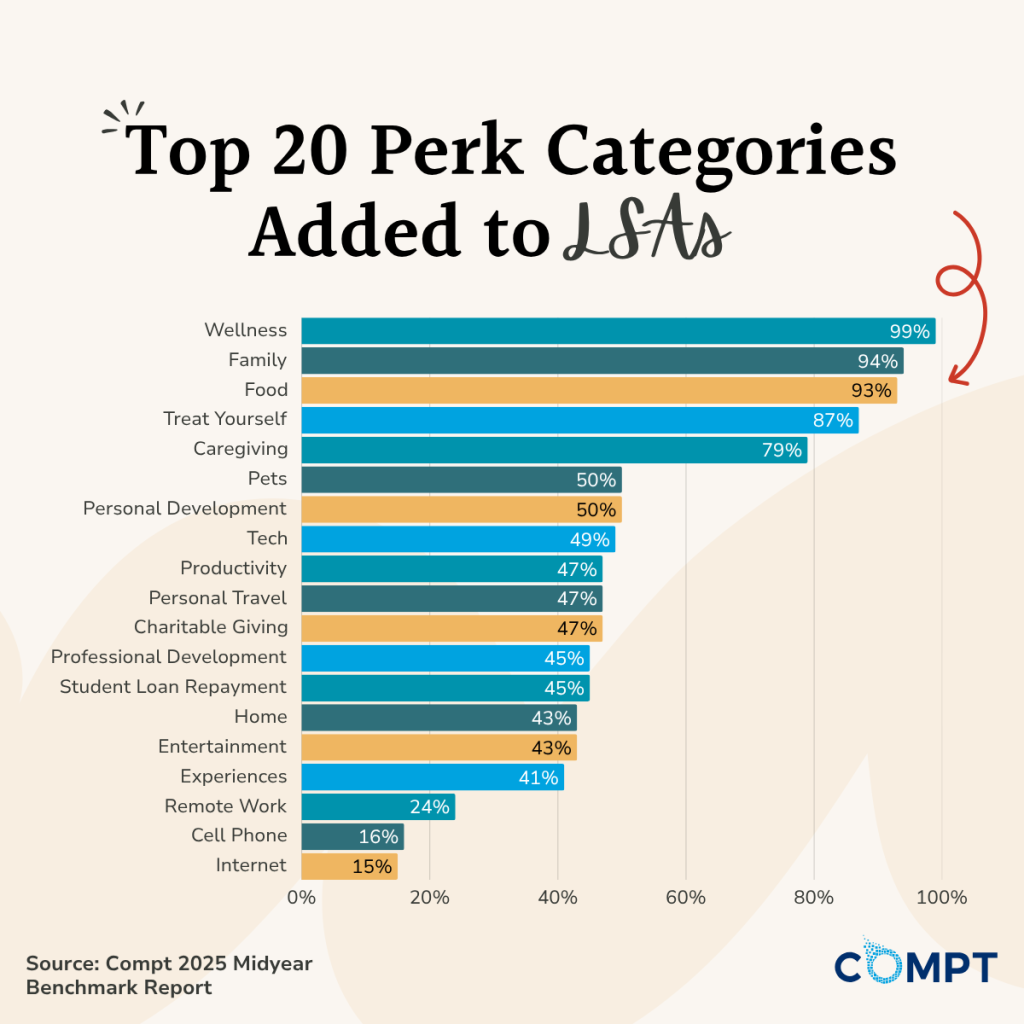
In the chart below, categories near the top — like wellness (99%) and family (94%) — appear in nearly every LSA program. Those at the bottom — like cell phone (16%) and internet (15%) — are included but far less common.
Employers stay in control by setting a budget, cadence (quarterly is most common for Compt customers per our midyear benchmarking, though annually tends to work well for specific categories like professional development), and eligible categories that align with your culture and values.
When weighing LSA pros and cons for your lifestyle benefits program, this balance of flexibility and control is one of the clearest advantages.
“We let people use it on basically anything because we want them to have the ultimate freedom. We use the Slack integration so people can share what they’ve used their stipend for, and they’ve really used it on everything.”
— Lucy Lemons, Chief People Officer, ButterflyMX
LSA pros: Why Lifestyle Spending Accounts work
Flexibility and personalization
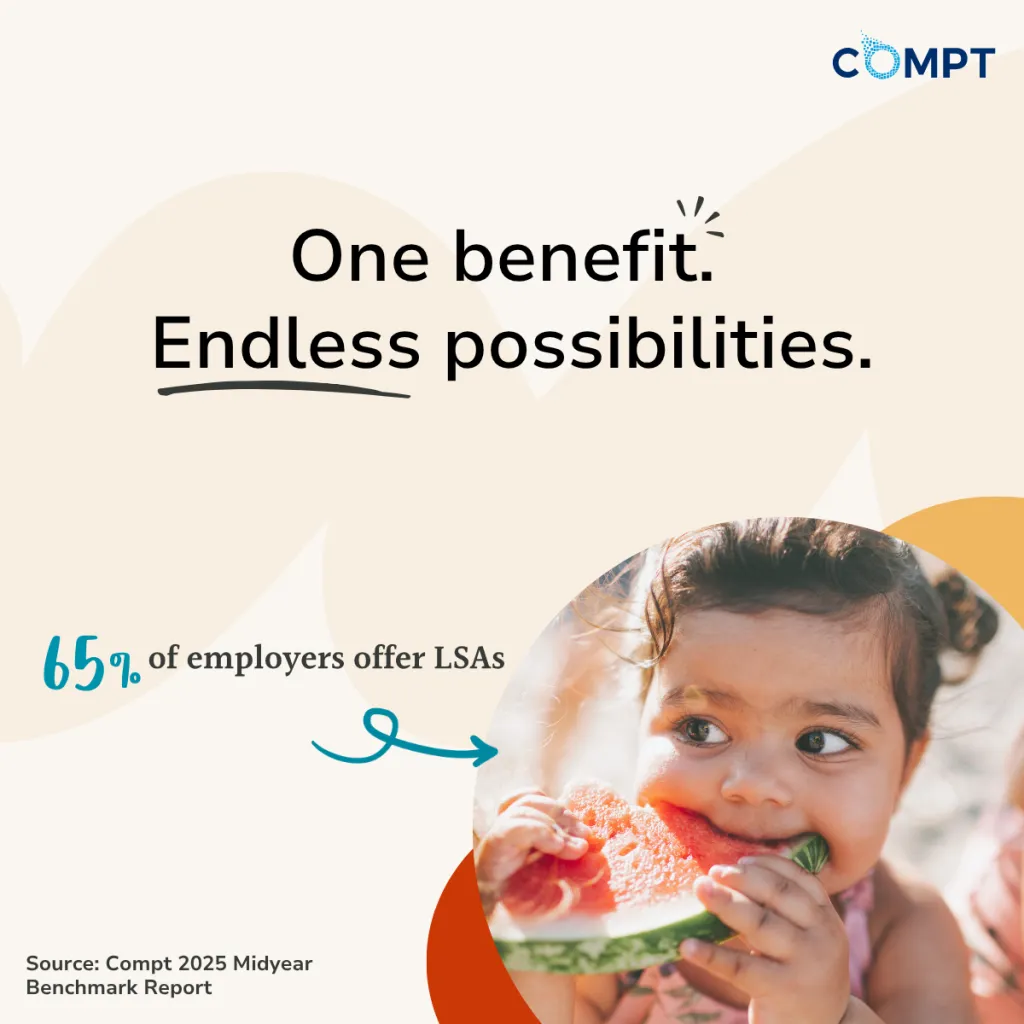
You know as well as we do that no two employees are alike. Some like going to the gym, while others may prefer to use their Peloton in the privacy of home. One may need help affording childcare, and another may want to pay off their student loans faster. LSAs meet those needs (and more!) under one, overarching program. That flexibility is why 65% of Compt customers now offer an all-inclusive LSA.
Improved well-being and engagement
Only 28% of employees surveyed by benefits broker NFP report making maximum use of perks and benefits because of “the misfit of benefits offered versus what is valued.” By contrast, Compt LSAs consistently top 90% participation. When employees are given permission to spend on what matters to them, whether that’s therapy sessions, groceries, or a standing desk, they feel supported and appreciated — even when you control the budget and categories. Healthier, less stressed employees bring more focus, energy, and discretionary effort to their work. In the LSA pros and cons conversation, high engagement is one of more compelling reasons to invest.
Talent attraction and retention
Candidates always want benefits that feel modern and inclusive, no matter the state of the job market. Listing an LSA as a benefit on a job description tells prospective employees that you trust them to choose what support looks like for them. That type of message resonates in recruiting and retention. According to internal data from one of our healthcare customers, adding wellness and caregiver stipends increased retention among nurses — a notoriously high-turnover role.
Predictable budget for Finance
Unlike open-ended perks or expensive vendor contracts, LSAs come with a set cap. Whether you allocate $500 quarterly or $1,500 annually, that’s your maximum liability.
Because LSAs can scale effortlessly with headcount, they work for any company size — whether you have 10, 100, 1,000, or 10,000 employees. As your workforce grows or shifts, you can update budgets, categories, and reimbursements in just a few clicks.
Taxes are also accounted for automatically in Compt, unlike other point-solution tools with which HR and Finance teams must manually calculate deductions or risk audit exposure.
Cost savings
LSA funds are only spent when employees use them — no more wasted gift cards or unused vendor marketplaces. At midyear 2025, the average LSA/stipend budget per employee per year rose to $1,029, but employers remained in control by defining the cadence, categories, and overall limits.
Simplified benefits consolidation
Speaking of saving money, how about reducing the sheer amount of benefits vendors in your portfolio? By replacing disconnected and underperforming perks (think ClassPass memberships, gift-card platforms, or niche wellness apps that only a fraction of employees use) with an all-inclusive LSA, you can simplify your tech stack and stretch every dollar even further — a massive win for Finance and your organization’s bottom line.
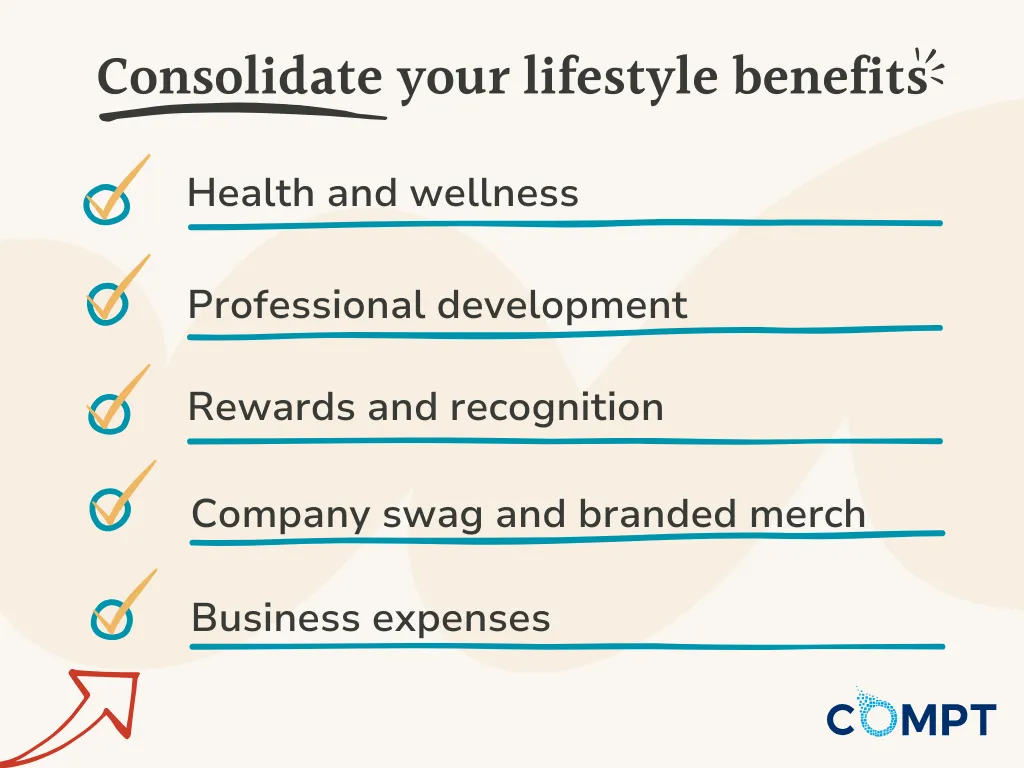
With Compt, LSAs can be designed to act as an entire perks program in one software platform, encompassing wellness, professional development, rewards and recognition, company swag and branded merchandise, and business expenses. In short, if it can be reimbursed, Compt covers it. This eliminates redundant contracts and improves your lifestyle benefits utilization.
Inclusive by design
Rigid perks often leave some employees out. These well-intentioned benefit offerings can accidentally exclude people with chronic conditions, caregiving responsibilities, or limited on-site or location-based access. LSAs fill that gap (without calling attention to it) by providing access to care on each person’s own terms. Because choice is inherently inclusive, LSAs quietly support DEI efforts in action, not just in policy.
Simplified administration
Managing multiple perks vendors eats up HR’s time, effort, and brainpower. You likely know that just as well as we do. LSAs can consolidate it all into one program. Compt LSAs take it a step further: reimbursements flow into payroll automatically, IRS compliance is built in, and admins spend minutes per month (not hours!) running the program.
“We cut our benefits processing time from days to just 90 minutes.”
— Kevin Sullivan, Global Benefits Manager, Quickbase
Boosts company culture and brand perception
An LSA sends a strong vibe on how you manage your culture. It says, “We see you as a whole person.” Employees notice. Glassdoor reviews, engagement surveys, and LinkedIn posts often reflect the goodwill that comes from providing benefits that employees actually like to use. (Have you ever written a post about how awesome your EAP is? I haven’t. And with good reason — EAPs see 5-7% utilization on average) In the LSA pros and cons debate, this is one of the most overlooked but powerful items in the “pro” column.
Get all-in-one software with Compt
If you have lifestyle benefits needs that go beyond LSAs, which LSA platform you choose becomes even more important. Pick one that allows for reimbursements in every category you want to offer, such as tuition reimbursement, caregiving (for childcare and/or elder care expenses), company swag, recognition, wellness, professional development, and more.
With Compt, all these benefits live in one place: a unifed, vendor-agnostic LSA platform in which Finance controls spend, HR manages culture, and employees can see every lifestyle benefit for which they’re eligible. It’s one source of truth for stipends, rewards, spot bonuses, and reimbursements that scales along with your company.
Perks collecting dust? It’s time for an upgrade. Compt LSAs turn “nice-to-have” benefits into programs your team will actually use (and your Finance team will actually love). Request a demo today.
LSA cons: What to watch out for
Taxable in most cases
Like most perks, many LSA categories (like wellness and food) are considered taxable income. Other categories, like professional development or internet reimbursements, may be nontaxable depending on use. This doesn’t make LSAs any less valuable; it simply means taxes need to be addressed and managed appropriately, and it’s important to prioritize clear communication so employees know what to expect. Compt automates IRS coding and tax classification in real time, ensuring HR and Finance stay compliant without manual tracking or audit risk.
While taxes are one of the few true “cons” of LSAs, they’re a normal part of most modern perks (and entirely manageable with the right platform).
Upfront design required
Building an LSA program requires some thought before you roll it out. How much funding? Which categories? How often is it distributed? Without structure, even the most flexible of lifestyle benefits program can feel confusing. The good news, though, is that once your LSA is designed, it practically runs itself. And your Compt Customer Success team is available to help you make decisions.
Compt has an 85% Customer Satisfaction Score (CSAT) from admins and employees.
Potential overlap with existing perks
If you already subsidize gym memberships, commuter passes, lunches through DoorDash, or point-solution vendors, an LSA may duplicate these efforts. Many companies consolidate by replacing these one-off contracts with an all-in-one LSA (and if it includes rewards and recognition or swag, even better). When consolidating, make sure to communicate changes to your employees and keep them aware of how any new benefits might affect them. Ultimately, this is a neutral point in the LSA pros and cons discussion; it’s a challenge only if you don’t use consolidation strategically.
Ready to see for yourself? Request a demo with Compt.
When you weigh the LSA pros and cons, the advantages of an LSA with Compt clearly outweigh the drawbacks. Our LSAs deliver personalization, predictability, and inclusivity in a way that outdated perk approaches simply can’t. Programs launch in as little as two weeks, drive 93% participation, and eliminate redundant vendors with a comprehensive, five-in-one approach to lifestyle benefits.
Request a demo with a Compt Benefits Specialist to see how well an LSA could work for your team.
FAQs: LSA pros and cons
The main LSA pros and cons come down to balance. On the pro side: flexibility, inclusivity, high engagement, predictable budgets, and easier admin. On the con side: taxable categories, upfront program design work, and potential overlap with existing perks.
Is an LSA platform better than giving everyone a corporate card or debit card?
Yes, an LSA platform is better than offering employees corporate cards or debit cards. Debit cards lock employees into a merchant network and create reconciliation headaches, and corporate cards often don’t meet modern compliance needs. With a reimbursement-based LSA, employees can safely and compliantly buy from any vendor, anywhere, as long as it fits your policy. That flexibility boosts inclusivity, utilization, participation, and engagement.
How do LSAs keep spending predictable while giving employees freedom?
Employers define the allowance. Employees can use that allowance broadly, but only up to the budgeted cap and within the categories you define. That means Finance has a fixed liability and employees feel trusted to make the right choices.
What features should I prioritize when comparing LSA providers?
-Compliance automation and high security standards (IRS, SOC 2, GDPR)
-Vendor-free flexibility (no gift cards, no catalogs, no marketplaces, no debit cards)
-HRIS/payroll integrations for reimbursements
-Reporting and analytics
-Global support for distributed teams
How do LSAs align with DEI and inclusion strategies?
Choice is equity. As of midyear 2025, 70% of stipend and LSA spending went to independent and local vendors, which is proof that employees prefer to use their benefits in ways that connect to the cultural context of their daily lives. Whether it’s fertility care, elder care, food support, or other needs, LSAs empower each employee to define inclusivity for themselves, at least when it comes to their lifestyle benefits.
How do LSAs support employer branding?
Personalized benefits stand out in recruiting. Candidates and employees talk about them in interviews, on social media and review sites, and in surveys (including biggies like Great Place to Work®). LSAs help prove to folks on the outside that you value employees as whole people, which is a differentiator no matter the state of the job market.
How do I build a business case for LSAs for my CFO?
CFOs care about predictability and proven ROI. LSAs with Compt deliver all that and more:
-One platform, five uses: consolidate lifestyle benefits (LSAs/stipends) with rewards and recognition, professional development, company swag and branded merchandise, and business expense management
-Fixed per-employee budget and no wasted spend (i.e., only pay when employees use the benefit)
-No prepaid liability on the books, unlike with debit cards and point-based systems
-Employment tax compliant by design, so there are no surprises at tax time
-Clean audit trail for every transaction, including easy-to-use reporting on spend, utilization, and adjustments
-Integrations with Workday, ADP, Gusto, BambooHR, and other payroll and HRIS systems
-Available in all 50 states and 75+ countries
-Compliant with GDPR, SOC 2, and ISO 27001 for data security
Depending on your CFO’s priorities, the Compt team can work with you to design a business case that will resonate with their goals.
What’s the ROI of an LSA vs. traditional perks?
Traditional perks see less than 30% utilization, as reported by benefits broker NFP. Compt customers, by contrast, average above 90%. That’s triple the impact for the same budget, or potentially even less budget. Plus, LSA funds are only spent when employees submit a claim, unlike underused perk vendors who offer limiting debit cards, marketplaces, or random discounts.
What documentation from my LSA do I need for an audit?
With Compt, every receipt, reimbursement, and taxable classification is stored in one place. You can export full reports at any time, giving HR and Finance audit-ready documentation without extra work.
How do LSAs scale for remote and global teams?
With Compt, LSAs scale seamlessly. Funds can be dispersed and reimbursed in local currencies, and employees can submit receipts from any vendor in 75+ countries. That makes LSAs ideal for distributed teams who would otherwise miss out on HQ-centric perks.

 No receipt chasing