As you’re considering which employee perks to include in your benefits package, don’t sleep on fertility assistance and specialized fertility benefits for employees.
The World Health Organization (WHO) estimates that 1 in 6 of the global adult population is affected by infertility. In the United States, 19% of married women aged 15 to 49 with no prior births are unable to achieve pregnancy after one year of trying, according to the Centers for Disease Control and Prevention (CDC). Of course, single parents and same-sex couples also struggle with fertility and family planning.
While everyone on this journey faces different emotional and legal challenges, the financial burden is universal. Despite growing demand, most traditional health insurance plans offer limited or no fertility coverage — and employees are feeling it. According to Maven Clinic’s 2025 report, 45% of employees have delayed or foregone other financial priorities due to fertility-related healthcare costs, and 28% have incurred debt to cover them.
Infertility can weigh on a person’s mind, impacting their performance in the workplace and even motivating them to switch employers or careers. However, HR leaders can help alleviate some of the stress of family planning by offering fertility benefits.
A family or fertility stipend is employer-provided funds employees can spend on the family-building path that’s right for them — IVF, adoption, surrogacy, egg freezing, childcare, and more. Compt lets employers set one up in days.
What are fertility benefits?
Fertility benefits are employer-sponsored treatments and services that support family planning, such as assisted reproductive technology, which includes all fertility treatments in which eggs or embryos are handled. Some examples are egg freezing, in vitro fertilization (IVF), and gestational surrogacy. Fertility benefits are sometimes referred to as family-building benefits, although the latter can cover a wider variety of benefits.
The CDC defines these procedures as surgically removing eggs from a woman’s ovaries, combining them with sperm, and then either returning them to the woman’s body or donating them to another woman. It’s important to note the distinction; fertility treatments in which only sperm are handled, such as intrauterine insemination (IUI) or artificial insemination, are excluded.
Fertility services in general are on the rise, with 42% of U.S. employers offering fertility benefits in 2024, according to the IFEBP’s Employee Benefits Survey: 2024 Report. That’s up from just 30% in 2020, a signal that family-building support has moved from a niche perk to a mainstream expectation.
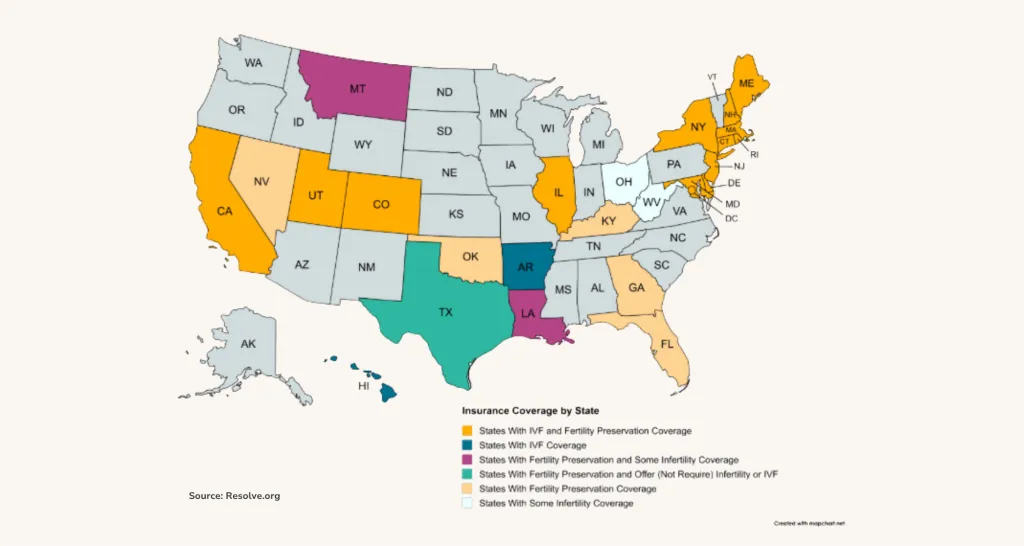
Although there’s no federal law that requires employers to provide fertility benefits, as of 2026 at least 25 states (plus Washington, D.C.) have laws requiring some form of fertility coverage, according to MultiState’s April 2026 legislative analysis. Recent additions include Virginia (IVF coverage mandate effective 2028) and California (IVF and infertility treatment coverage effective January 2026 for large group plans).
States with mandates include Arkansas, California, Colorado, Connecticut, Delaware, Hawaii, Illinois, Louisiana, Maine, Maryland, Massachusetts, Montana, New Hampshire, New Jersey, New York, Ohio, Rhode Island, Tennessee, Texas, Utah, Virginia, and Washington, D.C., among others. Because this landscape is changing rapidly, with new bills advancing in states like Arizona and Hawaii, check Resolve’s live state-by-state tracker for the most current information.
Types of fertility benefits
The types of fertility benefits that employers offer vary widely depending on their health coverage. Below are examples of fertility services and treatments sometimes included in insurance plans:
Genetic testing
Many health insurance providers cover fertility testing, even if they don’t cover fertility treatment. In fact, most health plans will include fertility services only if the patient has received an infertility diagnosis. Fertility testing can help employees learn not only when they’re most likely to get pregnant but also the causes of their infertility, such as genetics.
Doctors recommend genetic testing as part of pregnancy planning to determine if a patient or couple has recessive genes that could affect their offspring. Roughly 16% of U.S. employers currently cover genetic testing, according to the IFEBP’s 2024 Employee Benefits Survey.
Drug therapy
Depending on the infertility diagnosis, doctors may prescribe fertility drugs to help patients achieve pregnancy. Fertility medications can be quite costly, and some health plans may reduce employees’ out-of-pocket medication costs. The IFEBP reports that 28% of U.S. employers currently cover fertility medications, more than triple the amount (8%) in 2016, according to their 2024 survey.
Fertility preservation
The National Institutes of Health (NIH) defines fertility preservation as the process of saving eggs, sperm, or reproductive tissue so that a person can use them to have biological children in the future. Fertility preservation procedures include egg freezing, sperm freezing, and embryo freezing. One of the fastest-growing family planning benefits, egg freezing is now offered by 16% of U.S. employers compared to just 2% in 2016, according to the IFEBP’s 2024 report.
Third-party reproduction
Third-party reproduction is when eggs, sperm, or embryos have been donated by someone else to facilitate an infertile individual’s pregnancy. Unfortunately, health plans rarely cover the cost of donor sperm or donor egg services, which can break the bank.
According to a 2025 analysis published in Fertility and Sterility, the median cost of a donor sperm vial has risen to approximately $1,625 (ranging from $1,170 to $2,195) — a 40–80% increase over just two years. The cost of a donor egg cycle is steeper still: the average fresh donor egg IVF cycle in the U.S. now runs around $38,000–$40,000, though frozen donor egg cycles offer a more affordable alternative at roughly $12,000, according to a 2025 fertility cost guide by Gaia Family.
Intrauterine insemination (IUI)
Intrauterine insemination (IUI) is a form of artificial insemination, in which donor sperm or an intended parent’s sperm is washed, concentrated, and implanted into the uterus around the time of ovulation. Before IUI, employees may take fertility medications to prepare their eggs. Less expensive than other fertility treatments, the IUI procedure itself generally costs $300–$1,000 without insurance, according to Planned Parenthood — but when monitoring appointments and medications are included, a full IUI cycle typically runs $1,200 to $2,350+ out of pocket, according to Illume Fertility’s 2025 cost guide.
In vitro fertilization (IVF)
Considered the most effective form of assisted reproductive technology by the Mayo Clinic, in vitro fertilization (IVF) is a multistep process that involves retrieving eggs from ovaries and fertilizing them with sperm in a laboratory. Once the embryo is created, preimplantation genetic screening can be performed, ensuring that the embryo has the correct number of chromosomes. Finally, the embryo is ready to be transferred to the uterus.
One IVF cycle can last at least three weeks, if not longer when genetic testing is conducted. Also, employees may face clinic restrictions, such as age limits on allowing IVF treatment of women between the ages of 42 and 45 using their own eggs, according to the Advanced Fertility Center of Chicago.
Even though IVF success depends on a variety of factors, including age and overall health of the patient, cumulative pregnancy rates tend to increase after more than three cycles, according to UT Health San Antonio. That’s quite the investment: the average cost of a single IVF cycle in the U.S. is now approximately $23,000, not including fertility drugs, according to Maven Clinic’s 2025 analysis. With medication costs accounting for up to 35% of total cycle costs, many patients face out-of-pocket totals well above that figure.
IVF coverage has expanded significantly: according to the KFF 2024 Employer Health Benefits Survey, 27% of all firms now cover IVF — and that figure rises to 53% among large employers (5,000+ workers). Mercer separately found that IVF coverage among large employers doubled between 2019 and 2023, reaching 45%.
Surrogacy services
Traditional surrogacy is when a woman is artificially inseminated with the father’s sperm and then carries the baby to birth to give to the parents. Gestational surrogacy is when an embryo created from IVF is implanted in the uterus of a third party, who carries the baby to birth to give to the parents.
Most employer-provided health insurance plans don’t cover surrogacy services, so employees typically take out supplemental insurance policies. Insurance issues should be ironed out when negotiating the contract. As for total cost of surrogacy, including base compensation, insurance, and legal fees, most journeys in the United States now cost between $150,000 and $220,000, depending on the surrogate’s location, medical needs, and legal structure.
Adoption benefits
Family planning benefits may also focus on adoption. According to the IFEBP’s 2024 Employee Benefits Survey, 37% of U.S. employers offer paid adoption leave — up from 34% in 2022 and 27% in 2020. One in five (20%) offer financial assistance to cover adoption fees and legal expenses.
The real fertility costs employees are carrying
Even employees who research their benefits often don’t realize how steep the out-of-pocket exposure is until they’re already in the middle of treatment. Here’s a snapshot of the hidden financial burden:
These aren’t rare edge cases — they’re the expected costs for employees pursuing the most common paths to parenthood. When your benefits package doesn’t address them, employees either go into debt or go to a competitor who does.
“Competitive positioning is one of the clearest ways to frame employee benefits ROI. … Nothing activates the executive team’s emotional brain more than hearing competitors are outcompeting them, and it often results in swift approvals for your request.”
Just 32% of employees around the world say they can afford fertility treatments if needed, according to the 2023 Global Fertility at Work report by Carrot Fertility. Meanwhile, 39% would have to dip into savings to afford fertility treatment and 29% may incur debt to pay for it.
That’s because most insurance coverage doesn’t include fertility care. And if it does, an infertility diagnosis is usually required, which excludes same-sex couples and people who want to be single parents. LGBTQ+ employees feel this gap acutely: according to Progyny’s 2024 LGBTQ+ Family Building Survey of over 1,100 individuals, 54% said the cost of family building had prevented them from growing their family — and 83% said they would consider leaving their employer for one that offered family-building benefits.
If your company is firmly committed to diversity, equity, and inclusion (DEI), you need to implement family-forming benefits without any strings attached. These inclusive benefits promote economic equity in the workplace, with as many as 75% of employees considering fertility benefits to be an important part of an inclusive company culture, according to the Carrot report.
Family-planning benefits can also boost recruitment and retention. Taking into account the financial hurdles that people trying to start a family encounter, it’s no surprise that 42% of job seekers say that a new job offer with no fertility benefits would be a “deal breaker,” according to the Carrot report. Maven Clinic’s 2025 data puts the stakes even higher: 66% of employees have taken or seriously considered a new job specifically because of better reproductive and family health benefits. Furthermore, nearly three quarters (72%) say they would stay at their company longer if they had access to fertility benefits, per Carrot.
In addition to lowering their attrition rate, organizations that offer fertility benefits experience higher employee engagement, morale, and productivity. More than half of employees (55%) say that fertility challenges have hindered their work performance, and 65% admit to spending time at work researching fertility treatments, benefits, and family forming, per the Carrot report.
By alleviating some of the stress and anxiety associated with fertility care, HR leaders can bring relief to struggling employees, strengthening their concentration and resolve in the workplace. Best of all, 97% of employers who expanded their fertility coverage didn’t experience a “significant increase” in health care costs, according to Resolve’s Survey on Fertility Benefits.
12 companies with fertility and family-forming benefits
Dollar amounts and program details are subject to change at open enrollment. Some figures are drawn from official company benefits documents; others rely on secondary sources such as benefits databases and HR publications.
Hinge: $15,000 toward fertility preservation for U.S.-based employees, plus access to fertility care through Carrot (spouse/domestic partner eligible).
Publicis Groupe: Fertility treatment coverage, including IUI and IVF, up to a $15,000 lifetime maximum.
Zillow: Fertility coverage and adoption/surrogacy assistance; some secondary sources report $10,000 per household for adoption assistance.
Rubrik: Up to $25,000 lifetime reimbursement for fertility, surrogacy, and adoption assistance through Carrot.
Unilever: Reported coverage and reimbursement for IVF, egg freezing, and surrogacy expenses.
Spotify: Reported unlimited IVF coverage and genetic testing/PGT support.
Instacart: Reported up to $10,000 for adoption assistance, fertility assistance, and family planning.
Google: Reported fertility benefits up to $75,000, including IVF and fertility preservation.
Gusto: Up to $20,000 lifetime fertility/family-forming benefit, including egg and embryo freezing (one-year employment requirement applies).
Reddit: $25,000 lifetime family planning benefit through Carrot for IVF, egg freezing, adoption fees, and related services.
A&E: Reported $50,000 lifetime maximum for IVF treatment and pre-implantation genetic testing coverage.
Starbucks: Up to $25,000 for fertility services and $10,000 for fertility medications; eligible full- and part-time employees can qualify. Surrogacy/adoption reimbursement reported as up to $10,000 per qualifying event, with a $30,000 lifetime maximum.
Did you know? The company behind many of the fertility benefits listed above uses Compt to run stipends for their own team — and hit 92% benefit utilization across their fully distributed workforce.
For companies looking to turn support into a truly relevant and modern benefit, Compt offers a smarter approach — a family-building stipend designed for employees on the path to parenthood.
Unlike one-off point solutions like Kindbody, Care.com, or Maven, Compt isn’t limited to a specific network or provider. Employees can choose the best path for their unique journey: access care locally or globally, use providers they prefer and trust, and get support at every stage of family building. Employers benefit from easier administration, fewer vendor contracts, and more impactful, cost-efficient programs.
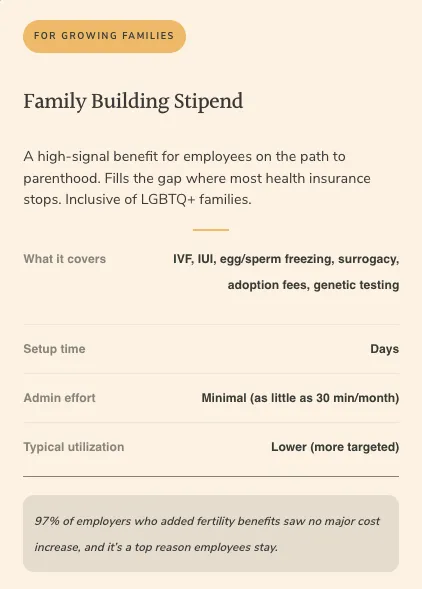
Family-building stipend details
Setup time: Days
Admin effort: Minimal (as little as 30 min/month)
Typical utilization: Lower (more targeted)
What a family-building stipend with Compt can cover
Compt handles tax categorization automatically, so your team doesn’t have to sort through compliance questions on every reimbursement.
Compt also offers two complementary stipends for companies that want broader family support. A caregiving stipend covers the daily costs working parents and caregivers carry, such as childcare, after-school programs, elder care, and dedicated support for individual needs. A family stipend covers the activities and enrichment that keep kids thriving: summer camp, sports, tutoring, school supplies, and extracurriculars. All three can run separately with distinct budgets and eligibility rules, or be combined into a single stipend or LSA program — everything from one dashboard.
How a Compt stipend differs from insurance
Traditional health insurance typically covers only clinical infertility, which requires a medical diagnosis. That model excludes:
Adoption and surrogacy
Egg freezing for nonmedical reasons
Most LGBTQ+ paths to parenthood
A Compt family stipend covers what the insurance plan doesn’t. It’s not subject to ERISA, requires no plan documents, and has no enrollment window. It works alongside your existing health benefits, filling the gaps without adding administrative complexity.
Making the case internally for a family stipend
Two things leadership typically wants to hear:
A Compt stipend is a capped, predictable expense. You set the budget and choose what expenses are eligible, and you only pay for what employees actually use. Unlike a premium increase, there’s no runaway cost risk — unused funds stay with the company.
A Compt stipend keeps costs low and improves retention. 97% of employers who added family-building benefits saw no significant cost increase. Meanwhile, replacing an employee costs 50–200% of their salary. The math is straightforward.
Compt can provide a one-pager to help you make the case to your Finance or leadership team. Contact us to request it.
How to maximize your fertility benefits package
If you’re truly invested in supporting employees with fertility issues, there are several ways you can administer fertility benefits.
Shop for all-encompassing health plans
Select a health insurance plan with comprehensive coverage of fertility services. That means avoiding any plan that requires an infertility diagnosis, which prevents same-sex couples and aspiring single parents from accessing covered services most beneficial to their situations, like fertility preservation, artificial insemination, and IVF.
In order for these to be inclusive benefits, make sure the plan doesn’t impose less invasive treatments before employees are eligible for IVF or IUI. You don’t want employees to max out their coverage before it’s time for the necessary procedure.
Expand your health insurance coverage
You can also partner with a third-party provider to supplement your existing health insurance plan with fertility coverage. Although a third-party provider comes with another price tag, the return-on-investment (ROI) will be worth it because your workforce will appreciate and value the wider range of covered services.
Give emotional support
Employees grappling with infertility challenges need all the help they can get. It’s up to HR to provide emotional support, either through counseling and other mental health resources or an employee resource group (ERG). Consisting of team members who volunteer their time and effort to champion an inclusive workplace, ERGs are comprised of employees of a similar background or shared experience, such as infertility. ERGs promote camaraderie among different segments of the workforce, resulting in higher talent retention.
Be flexible
Family forming takes time, which is why employers should arrange flexible work schedules to accommodate employees’ fertility health needs, like attending a doctor’s appointment or taking foster kids to school. Other forms of flexibility can include remote work, parental leave, and even paid time off (PTO) for fertility treatments.
Provide fertility support resources
Below are reputable resources to help employees locate fertility clinics, compare providers, and access education and support. These tools are available to individuals across different locations, including U.S. and international employees.
IVF Worldwide: A global directory of fertility and IVF clinics covering many countries. Employees can search by country or region to find clinic contact information and services offered. Best for: Employees located outside the U.S. or those seeking international care options.
FertilityListings: A searchable directory that allows users to filter clinics by location, treatment type, and other criteria. Includes clinic profiles and comparison features. Best for: Employees who want to compare clinic options across regions.
Your IVF Path: A clinic search and comparison platform that helps users identify fertility centers near them and explore available services. Best for: Employees looking for a guided clinic search experience.
SART Clinic Finder (Society for Assisted Reproductive Technology): A searchable database of U.S. fertility clinics that report treatment outcomes to SART. Provides standardized clinic information. Best for: U.S.-based employees seeking clinics with published success reporting.
ASRM “Find a Health Professional” (ReproductiveFacts.org): A directory of reproductive endocrinologists and fertility specialists affiliated with the American Society for Reproductive Medicine. Best for: Employees who want to locate individual fertility specialists.
RESOLVE: The National Infertility Association: A nonprofit organization providing education, support groups, advocacy resources, and information about navigating fertility treatment and insurance coverage. Best for: Employees seeking guidance, community support, and information about fertility treatment options.
Important note: These resources are provided for informational purposes only. Employees should review provider credentials, treatment options, and insurance coverage, and consult with a medical professional when making healthcare decisions.
Support every family-building journey with Compt’s fertility and family benefits
Innovative, modern companies are making fertility services accessible to all employees, regardless of marital status, gender identity, and sexual orientation. But staying competitive means going beyond insurance to meet employees at every stage of the family-building journey.
With Compt, you can offer the right stipend for where your employees are — family-building, caregiving, or the more general family stipend — run separately or together, all from a single dashboard, with minimal admin and a cost you control.
FAQs: Family-building and fertility benefits for employees
We’re planning fertility and family-planning perks — could these be folded into a broader lifestyle spending wallet instead of separate vendors?
Yes, and this is how most Compt customers approach it. According to Compt’s 2026 Annual Lifestyle Benefits Benchmark Report, 64% of employers now run lifestyle benefits through an all-inclusive LSA — up from 55% in 2024.
Rather than signing separate contracts with a dedicated fertility platform, a childcare app, and a wellness vendor, you can run a family stipend through a single Compt program, with distinct budgets and eligibility rules for each. The advantages: employees aren’t locked into one network or provider, your HR team manages one dashboard instead of three, and you eliminate the administrative overhead of multiple vendor contracts. Many companies launch with one stipend and add others at renewal.
What’s the difference between a family-building stipend, a caregiving stipend, and a family stipend?
These are three distinct programs that address different stages of family life; with Compt, you can pick between or combine them to fit the needs of your employees.
The family-building stipend is for employees on the path to parenthood — it covers IVF, IUI, egg/sperm freezing, surrogacy, adoption fees, and genetic testing.
The caregiving stipend is for working parents and caregivers managing everyday costs: childcare, after-school programs, elder care, and dedicated learning support.
The family stipend — Compt’s most popular — supports the activities and enrichment that keep kids thriving: summer camp, sports, tutoring, school supplies, and extracurriculars.
They can run as separate programs with different budgets, or be combined with an LSA. The family-building stipend tends to see lower but more targeted utilization by design; the caregiving and family stipends see 78% participation and 46% utilization across Compt customers.
How much should we budget for a family-building stipend?
How much you budget for a family stipend depends on your workforce and goals. For caregiving and family stipends, Compt customers typically set $1,000–$12,000 per employee per year, with a median around $2,500.
Family-building stipends, which cover higher-cost, lower-frequency expenses like IVF and surrogacy, are often structured as lifetime maximums rather than annual allotments — $10,000–$25,000 is a common range, as reflected in the company examples earlier in this post. The key advantage of a reimbursement-based stipend over insurance or other stipend models: you only pay for what employees actually use, so the budget ceiling rarely becomes the actual cost.
What funding cadence works best for family stipends?
Quarterly tends to outperform both monthly and annual. According to Compt’s 2026 Benchmark Report, quarterly-funded programs reached 85% utilization, compared to 52% for monthly programs and 65% for annual. The pattern reflects how employees actually use family benefits — in bursts tied to real life events — rather than a steady monthly trickle.
For family-building stipends specifically, a lifetime cap with no cadence restriction often makes more sense given the irregular timing of fertility treatments.
Is a family-building stipend taxable?
In most cases, yes — employer-provided stipends for fertility treatments, adoption, and surrogacy are treated as taxable income unless a specific IRS exclusion applies (such as the adoption assistance exclusion under IRC §137). This differs from some dedicated fertility platforms that use direct-pay models, which can be nontaxable. Compt handles tax categorization automatically, but we recommend consulting your benefits counsel on the specifics of your program design.
Does offering fertility benefits significantly increase costs?
Generally, no. According to Resolve’s Survey on Fertility Benefits, 97% of employers who expanded fertility coverage did not experience a significant increase in healthcare costs. With a Compt stipend, your exposure is capped by design — you set the budget, and you only pay for what employees use. There’s no premium risk.
Which employees are eligible for family-building benefits?
Your Compt CSM will help you define the eligibility rules when you set up the program. Compt supports eligibility by employment type, tenure, department, location, or seniority, and we can set up eligibility so employees must be with your company for a certain amount of time before they gain access to the benefit.
Notably, Compt’s 2026 Benchmark Report found that when benefits are designed around real-life needs and personal choice, they scale equally well across hourly and salaried employees, without requiring separate programs or differentiated rules.
Editor’s note: Originally published in 2023, this guide has been recently updated for clarity and relevance for our readers.
Lauren Schneider is the Head of Brand and Communications at Compt, where she channels her passion for people-centric storytelling into shaping the future of employee benefits. With a knack for blending creativity and strategy, Lauren is dedicated to making workplaces more human and impactful. When she's not crafting content, you can find her making connections on LinkedIn, honing her improv skills, or enjoying time with family.
Compt’s stipend and Lifestyle Spending Account (LSA) expense review process checks each reimbursement request against the employee’s supporting documentation and the employer’s policy before the...
An employee stipend policy should spell out the specifics of who is eligible for the benefit, how much funding employees receive, when that funding becomes...
On a short call, we’ll show you your product choices, how it will be customized with your branding, and how swag stipends work.
Access the tour
Explore Professional Development Pro™ by Compt with an interactive tour and see how it can easily elevate your employee professional development program.
Schedule a demo
Step confidently into the future of Professional Development management with Compt, where flexibility is limitless (or limited – the choice is yours!) and personalization is paramount.