
If you’ve connected your HRIS using an API or SFTP integration, Compt builds eligibility groups from location, department, employment type, seniority, or custom columns you’ve added (like dependent count) straight from your HRIS data. Then, groups sync automatically, so when someone gets promoted, changes departments, or moves offices, their stipend eligibility updates on the next sync.
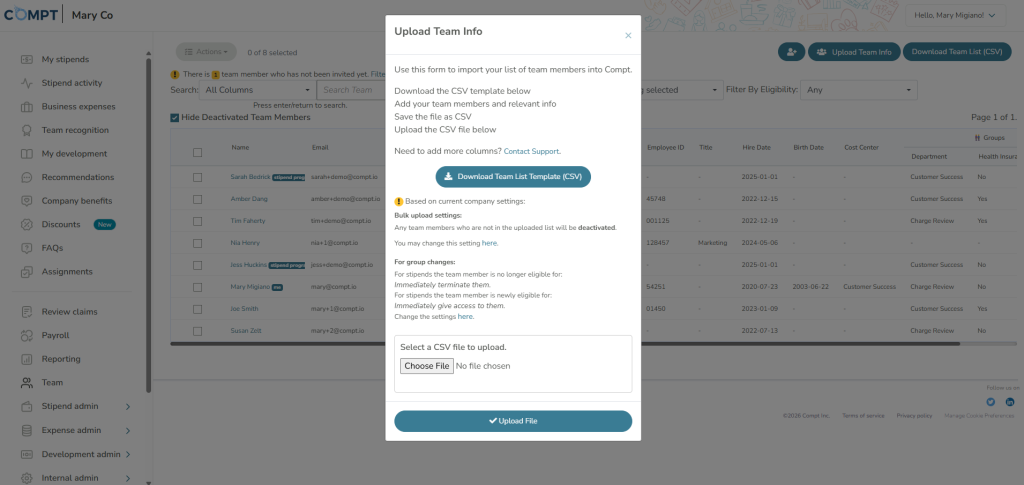
Otherwise, you’re able to manage it in Compt via the bulk upload feature or directly on the Team list (both of which take just a couple of clicks).
That’s the core mechanic behind custom eligibility rules in Compt: no manual roster management or rebuilding the program every time someone’s situation changes.
In today’s guide, I’ll walk you through how to configure them.
How Compt builds eligibility groups from your HRIS data
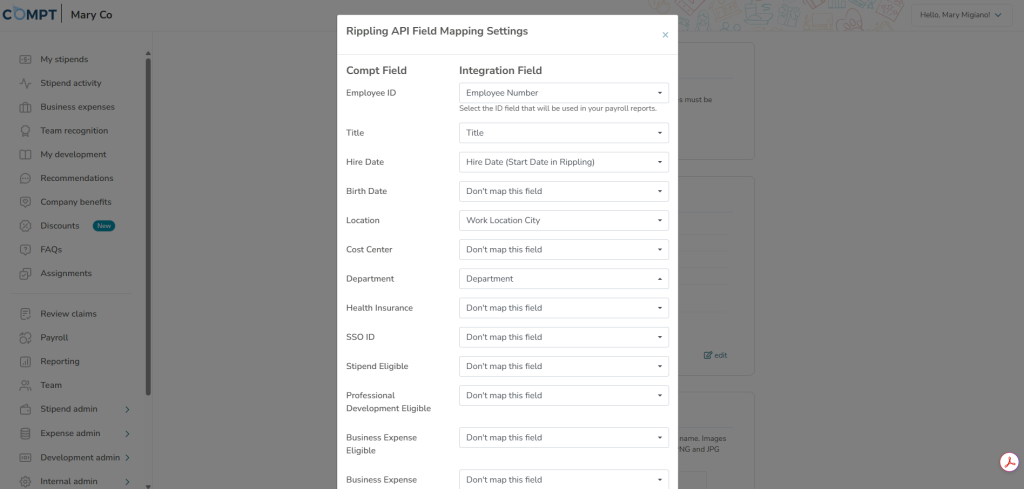
Compt connects to your HRIS with automatic daily sync as the default, so eligibility groups are always current, without HR having to manually export and upload a spreadsheet with each change. And if you’re an ADP customer, hourly sync is available as well.
Manual roster upload is still an option too, and some smaller companies prefer it: if you only see a handful of changes a year, setting up a full integration may not be worth it. Either way, once an employee’s data updates, their stipend eligibility updates on the next sync.
It builds groups from whatever fields already exist in your HRIS plus custom ones you’ve added, and hires enroll automatically based on the group rules that match their profile. When someone’s situation changes, it auto-provisions and deprovisions benefits for employees based on that change.
Group changes also carry a timing decision. When an employee moves from one group to another, admins choose when the new eligibility amount takes effect:
- Immediately (best for promotions or urgent corrections where you don’t want a lag)
- First of the following month (keeps budget periods clean and easier to reconcile)
- First of the next benefit cycle (better when the benefit runs quarterly or annually and you don’t want a mid-cycle amount change)
Configuration examples: department, location, seniority, and tenure
Compt’s LSA software supports several ways to tier eligibility based on department, location, and seniority as standard group variables, plus tenure through a dedicated anniversary stipend mechanism. To help you understand the different ways you can configure custom eligibility rules, let’s look at a few real-world examples.
Department
Compt can set different stipend amounts or categories by department, so budgets match how each team works.
Let’s say your Sales team gets a $75/month wellness stipend, while Engineering gets $75/month wellness plus a $100/quarter professional development stipend for conferences and certifications.
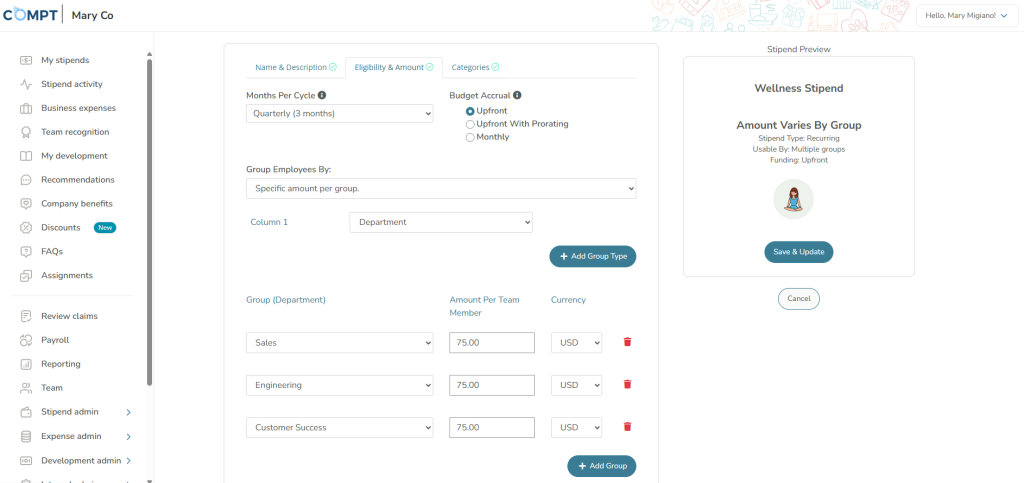
This works the same way whether you’re splitting two departments or twenty. The rule lives in the group definition and Compt applies them to everyone in that group.
Location
Location-based eligibility rules let you match the cost-of-living reality everywhere you have an office.
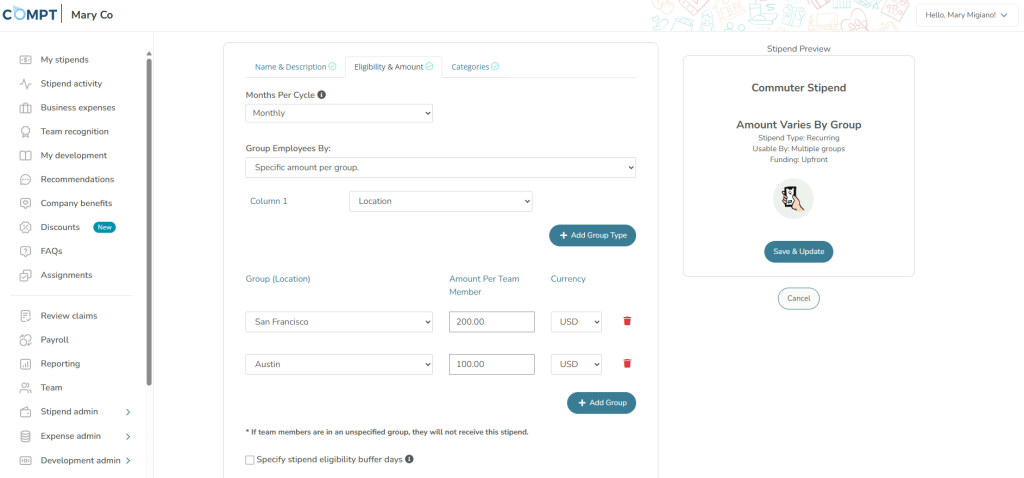
Suppose employees in your San Francisco office get a $200/month commuter stipend, while employees in your Austin office get $100/month, since the cost and need for transit support differ by city.
Regional funding gaps show up across our own customer base as well. In 2025, employers in the Northeast funded stipends at an average of $1,279 per employee, while the Midwest averaged $647. That’s nearly half as much.
And this eligibility rule also covers remote employees. You can define a group by “Remote” as a location value as well, so distributed teams get their own eligibility rule without extra setup.
Seniority
Senior-level people generally get sweeter benefits packages as part of their total comp plans, and that’s something you can do inside Compt as well.
If senior engineers in New York get a $300/quarter professional development stipend, while junior engineers get $150/quarter, that’s the same stipend category and team, but the amount differs based on level.
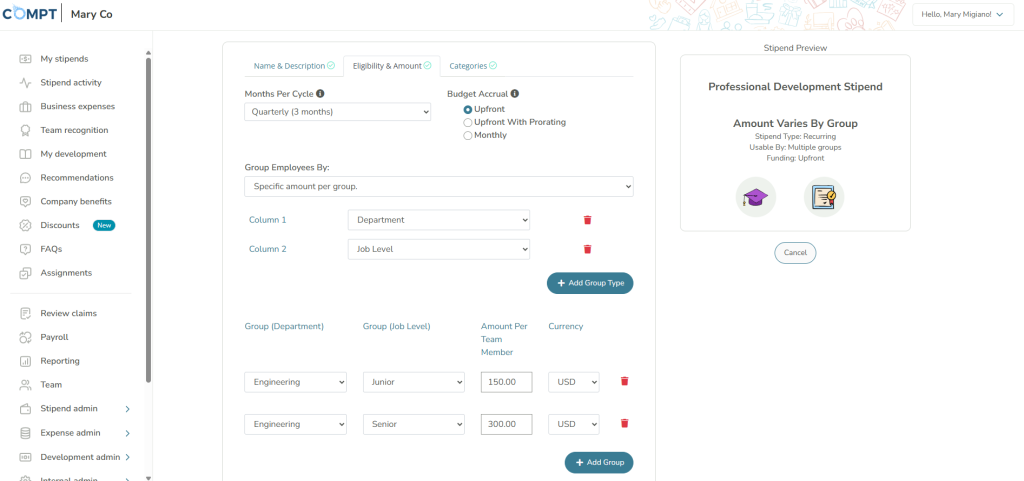
This doesn’t invalidate other rules either. So a senior engineer in New York and a senior engineer in Austin can land in different groups entirely, because seniority and location rules stack.
Tenure
Compt supports tenure-based retention bonuses through an anniversary stipend tied to each employee’s hire date. Admins set the amount an employee receives each year on their work anniversary, with the flexibility to increase, decrease, or stop the bonus at specific years.
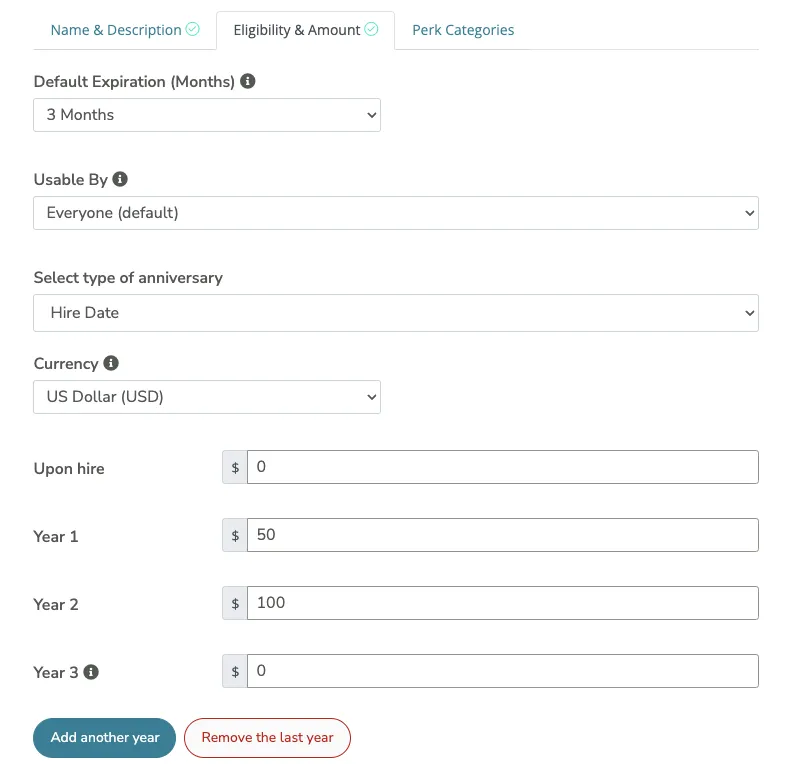
For example, you might fund years one through five, then set the amount to $0 for year six onward if the bonus is meant to taper off. Or you could reward milestone years specifically — e.g., a bigger amount at the 5-year and 10-year anniversaries with smaller amounts the years in between, so the bonus lands as a meaningful moment rather than a flat yearly add-on.
This runs as its own stipend, separate from recurring category-based funding, and follows the same payroll and category rules as any other Compt stipend.
Custom columns
What makes Compt unique is that it isn’t limited to standard HRIS fields. If your eligibility rules depend on something that isn’t a default field (like dependent count, a certification level, or an internal program tag), Compt can add it as a custom group column on request.
Say your company wants to vary a family stipend by number of dependents. That column doesn’t exist in most HRIS systems by default, so an admin requests it from Compt’s support team, has it added to the Team page, and assigns employees to the right values.
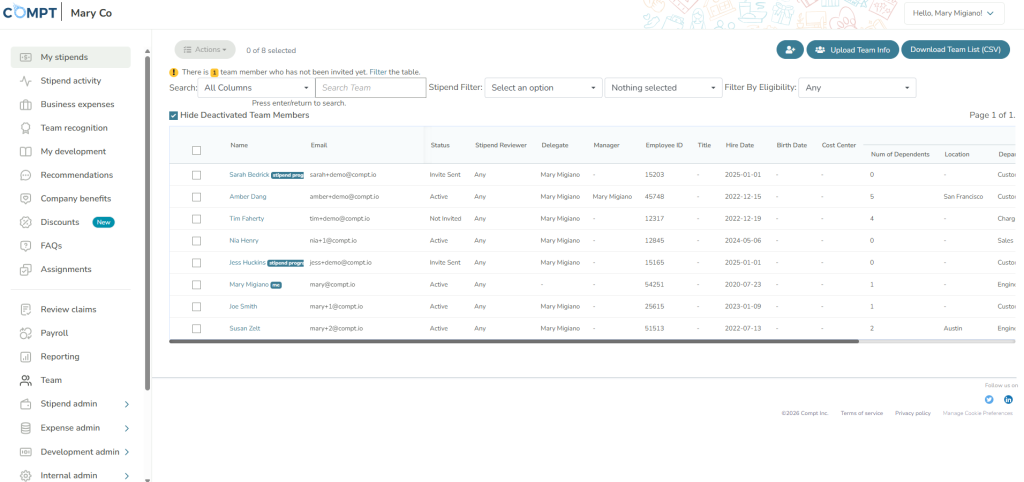
From there it works exactly like any standard field, so you’re able to combine it with department, location, and/or seniority in a single stipend’s eligibility rules.
Note: Custom columns aren’t self-serve. Adding a new one means sending a request to your Customer Success Manager (every Compt customer gets a dedicated CSM). Once it exists, though, it behaves like any other group column and you can reuse it across as many stipends as you want.
New-hire timing and buffer days for stipend enrollment
Some stipends benefit from a longer runway. Professional development is the clearest example: with a larger budget attached, a company generally doesn’t want a new hire spending $1,000 on a course, then leaving in week four. Not to mention, some new hires might take the job specifically to cash in on a big one-time perk (like a course they wanted to take but didn’t want to pay for) before moving on.
A 90-day buffer solves this; the stipend doesn’t activate until the employee clears their first 90 days to reduce that flight risk exposure. You can set this up within the stipend’s new-hire timing settings, where the buffer period is a configurable field alongside the stipend’s start date.
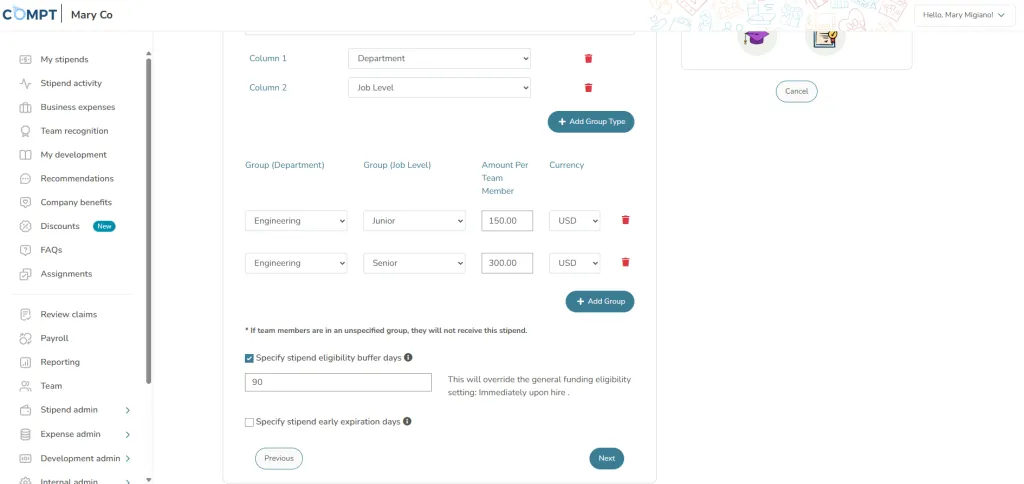
The most common setup is funding on the first of the month following an employee’s hire date. For most stipend categories, this is the default and as such doesn’t need any further configuration. For example, wellness typically runs with no buffer at all because the amounts are smaller and the goal is getting new hires using the benefit right away.
Edge cases: midyear changes, rehires, and part-time employees
There are three edge cases to consider when configuring custom eligibility rules for LSAs and stipends:
1. Midyear changes
Org charts don’t wait for renewal season. Someone gets promoted in March or transfers teams in July and their eligibility needs to update. Compt handles this through the same live HRIS sync that powers everything else, which is what makes it one of the best LSA and stipend vendors.
2. Rehires
Rehired employees create a unique data problem: does their tenure clock restart, or pick up where it left off? Editing the original hire date to reflect reinstated tenure sounds like the obvious fix, but it risks corrupting a historical record other systems rely on for reporting and compliance.
Because tenure-based stipends run off the hire date directly, a custom group can’t solve this the way it can for department or location differences. Instead, Compt can apply a backend adjustment so a rehired employee gets access to the correct funds without altering their original hire date record.
Like custom columns, though, this isn’t a self-serve setting; it’s something your Compt Customer Success Manager will work through with you.
3. Part-time employees
An employee working 15 hours one week and 30 the next doesn’t fit cleanly into a fixed monthly or quarterly amount, and you can’t prorate employees’ stipend or LSA amounts by the hour.
To circumvent that, you can calculate the prorated amount on your own and give it to your part-time workers as a spot bonus, which is a manual funding adjustment that adds extra money directly to an employee’s stipend balance.
If the employee doesn’t already have an eligible stipend, admins can create a dedicated spot bonus stipend first and issue it there instead.
Global multicurrency support for international and EOR employees
For international employees, admins configure how currency conversion works when setting up the program: employees can be reimbursed in their local currency or in USD, depending on company preference, and the exchange rate itself is set by the admin (e.g., using either a same-day rate or a fixed rate the company sets for a given period). Compt doesn’t maintain a live FX rate table, so this is a configuration the company manages rather than an automatic conversion.
Tax treatment adds a layer international teams need to plan for. Compt defaults all non-U.S. categories to taxable, and admins are able to configure taxability on a per-category, per-country basis based on local laws. Payroll reports are then split by country, so each region’s output matches what that local payroll system expects.
Employer of record (EOR) arrangements work within this same structure. An EOR employee’s eligibility and stipend rules sync the same way as any other employee’s, and reimbursement still routes through local payroll in local currency.
In 2025, 20% of Compt customers supported employees outside the U.S.!
Nondiscrimination and objective eligibility criteria
Because Lifestyle Spending Accounts (and most stipends) are structured as post-tax benefits, they fall outside Section 125’s nondiscrimination testing. This means a tiered structure can pay senior or highly compensated employees more without triggering the testing that governs pre-tax cafeteria plans.
That doesn’t mean eligibility design is a nonissue, though, because labor law still expects eligibility criteria to be objective and consistently applied (i.e., tied to role, location, seniority, or tenure) and not applied arbitrarily between employees in comparable positions.
A tiered lifestyle benefit can help balance perks between highly compensated execs and rank-and-file employees without triggering discrimination tests, as long as the tiers are built on objective criteria rather than ad hoc decisions. Compt’s group-based eligibility structure makes this easy because it keeps every rule tied to a defined HRIS field.
Why custom eligibility rules matter to Finance
Custom eligibility rules for stipends and LSAs give Finance direct control over where your lifestyle benefits budget goes.
Compt’s own benchmark data shows how much that “right” number can vary: companies with fewer than 100 employees averaged $1,675 per employee in stipend funding in 2025, compared to $649 for orgs with 1,000+ employees.
A single flat per-employee amount, applied without any segmentation, normally ends up being too high for some groups and too low for others. Eligibility rules let Finance set that amount deliberately by segment instead of guessing at one number for everyone.
Group-based eligibility lets them make that same kind of deliberate choice at a more granular level — for example, by funding a wellness stipend differently for full-time vs. part-time staff, or scaling a professional development budget by seniority without maintaining separate programs for each.
And because eligibility ties back to defined HRIS fields rather than manual overrides, every group change is 100% traceable: when someone moves from one department, location, or level to another, the budget shift is visible and auditable.
Let Compt handle the eligibility math
Custom eligibility rules are only effective if the platform behind them keeps pace with how your company changes.
The reason our customers, on average, report spending just a few minutes per cycle reviewing exceptions is that Compt automatically applies your eligibility rules to new hires, promotions, moves, rehires, part-time shifts, and new offices straight from your HRIS.
And because stipend eligibility is so easy to configure on Compt’s point-and-click backend, the initial stipend setup only takes about an hour. Request a Compt demo to see how it works.
FAQs: How Compt’s custom eligibility rules work
Compt builds eligibility groups from whatever fields already exist in your HRIS (e.g., department, employment type, seniority, or custom columns you’ve added) and lets you set a different stipend amount or category mix for each group. A Sales team might get a $75/month wellness stipend while Engineering gets that same $75 plus a $100/quarter professional development stipend for conferences and certifications; the rule lives in the group definition, so it applies automatically to everyone who falls into that group, whether you’re splitting two departments or twenty.
Which stipend platforms let HR configure different benefit amounts by office location?
Compt supports location-based eligibility rules so funding can match cost-of-living differences across offices — for example, a $200/month commuter stipend in a high-cost city like San Francisco versus $100/month in a lower-cost market like Austin. This extends to remote employees too: “Remote” can be defined as its own location value, so distributed teams get their own eligibility rule without extra setup. Compt’s own regional benchmark data shows how much this can matter in practice; employers in the Northeast funded stipends at an average of $1,279 per employee in 2025, compared to $647 in the Midwest.
Which Lifestyle Spending Account and stipend software supports eligibility tiers based on department, location, seniority, tenure, or custom rules?
Compt supports department, location, and seniority as standard eligibility variables that stack rather than compete — a senior engineer in New York and a senior engineer in Austin can land in entirely different eligibility groups because seniority and location rules apply together, not as an either/or choice. Tenure works through a separate mechanism: a dedicated anniversary stipend tied to each employee’s hire date, rather than an assignable group field. Beyond these, Compt can also add custom group columns for variables that don’t exist in most HRIS systems by default, like dependent count or an internal certification level, so eligibility can be built around whatever actually drives your program design.
What is the best Lifestyle Spending Account software with nondiscrimination rule guardrails built into the eligibility configuration?
Because Lifestyle Spending Accounts (LSAs) are structured as post-tax benefits, they fall outside Section 125’s nondiscrimination testing, which means a tiered program can pay senior or highly compensated employees more without triggering the testing that governs pre-tax cafeteria plans. That doesn’t make eligibility design a nonissue, though — labor law still expects eligibility criteria to be objective and consistently applied, tied to defined attributes like role, location, seniority, or tenure rather than a manual, case-by-case decision. Compt’s group-based structure supports this by keeping every eligibility rule tied to a defined HRIS field, so a tiered benefit that pays executives more than rank-and-file employees stays defensible because the difference traces back to a documented rule.
Which Lifestyle Spending Account platforms are best for a company that wants to start with a single wellness category and expand to multicategory later?
Compt supports both single-category stipends and all-inclusive LSAs on the same underlying platform, so a company can launch with just a wellness stipend and add categories later without rebuilding the program or the HRIS integration. Expanding is a configuration change, with new categories added to existing eligibility groups and the same sync, not a new stipend or LSA implementation.
What is the best Lifestyle Spending Account software with daily HRIS sync and automatic new hire enrollment?
Compt connects to your HRIS with automatic daily sync as the default when you’ve set up an API or SFTP integration, and ADP customers get hourly sync as well. Manual roster upload or direct edits on the Team list are also supported for companies that don’t need a full integration. However you sync, eligibility groups stay current and new hires enroll automatically based on whichever group rules match their profile — including buffer periods, like a 90-day wait for professional development, without manual setup per employee.
Which Lifestyle Spending Account platforms auto-provision and deprovision employees based on HRIS data?
Compt auto-provisions and deprovisions stipend access as HRIS data changes, not just at hire and termination. When an employee is promoted, changes departments, or moves offices, the live HRIS sync updates their eligibility group on the next sync, and benefits adjust accordingly so no admin has to manually move anyone between programs.
Which Lifestyle Spending Account software can handle midyear eligibility changes?
Compt handles midyear changes through the same live HRIS sync that powers everything else, so a promotion in March or a department transfer in July updates eligibility without rebuilding the program. Admins also control the timing of when a new amount takes effect after a group change (e.g., immediately, first of the following month, or first of the next benefit cycle) so budget periods stay clean even when changes happen mid-cycle.