HR has a reputation for adopting new benefits slowly. I spent 20 years as a CFO and COO, often with HR reporting into me, so I know those conversations well: a new benefit means a new budget line, another vendor, more administration, and a decision that affects nearly every employee at your company.
That makes a bad bet much harder to hide. There’s a reason companies benchmark against their peers and wait to see what everyone else does first.
Then, at some point, the conversation flips. The benefits category that needed a business case every year becomes something candidates expect, brokers recommend, and CFOs budget for without having to explain why it exists.
Health Savings Accounts (HSAs) did exactly that.
Lifestyle Spending Accounts (LSAs) are following the same pattern, but according to the data and what I’m hearing in conversations every day, I don’t think they’ll need nearly as long to get there.
HSAs took about a decade to reach critical mass.
Even with federal policy working in their favor, HSAs took years to gain traction. They became available in 2004 after the Medicare Prescription Drug, Improvement, and Modernization Act added them to the tax code.
According to KFF’s employer benefits surveys, 6% of covered workers were enrolled in an HSA-qualified high-deductible health plan in 2009. That rose to 11% in 2012 and 15% by 2015.
By late 2015, even HealthEquity was describing HSAs as “reaching critical mass.” At the time, there were 14.5 million accounts holding $28.4 billion in assets, according to the company’s announcement citing Devenir research.
Then the financial side of the category really took off.
Devenir reported that HSA assets crossed $100 billion at the end of 2021, spread across more than 33 million accounts. Today, KFF reports that 31% of employers offering health benefits offer an HSA-qualified plan and 29% of covered workers are enrolled in one.
It still took ages for employers, employees, providers, and the rest of the benefits ecosystem to catch up. LSAs don’t have the same built-in policy support, and their growth is coming from employer demand instead.
LSAs are already past the experiment stage.
There’s real evidence that employers understand the value of LSAs.
Sequoia’s 2025 Benefits Benchmarking Report found LSA adoption among midsize employers more than doubled in one year, from 8% to 19%. Among enterprise employers, it jumped from 17% to 29%.
I see the same progression from inside Compt. A few years ago, we spent a lot more time explaining what an LSA was. Now HR and Finance leaders come to us with much more specific questions: How could we consolidate our wellness, professional development, commuter, and other programs? How do we handle different eligibility rules? How will taxable reimbursements flow to payroll? Which systems does this need to integrate with?
Our own benchmark data tells the same story. The share of Compt customers offering an all-inclusive LSA grew from 55% in 2024 to 64% in 2025. In the first half of 2026, it was 65%.
A one-point increase from 64% to 65% isn’t exciting, but the stability is. Nearly two-thirds of our customers are already using the all-inclusive LSA structure.
What keeps changing is what employers put inside it. People are used to having choices and personalization in almost every part of their lives, and benefits are no exception. LSAs let you offer more choice without creating a separate program for every priority that pops up: our midyear data showed employer adoption increasing across 13 of 20 comparable stipend categories.
Employers who have adopted LSAs are figuring out how much more they can do with the infrastructure they already have. They can add, change, or remove categories as their priorities shift.
HSAs and LSAs have very different constraints.
The HSA comparison has limits because the two products work very differently:
- An HSA is a federally defined, tax-advantaged account. Federal rules determine eligibility, annual funding limits, and which expenses qualify for tax-free distributions. Employees generally need an HSA-qualified high-deductible health plan to contribute.
- An LSA, by contrast, is employer-funded and employer-designed. Most LSA reimbursements are taxable unless the individual expense qualifies for a separate tax exclusion.
Those differences are also why I expect the LSA timeline to be shorter.
HSAs operate inside a framework Congress and the IRS define, and that makes the tax advantages possible. LSAs can evolve whenever you decide your employee benefits program should evolve.
We’ve seen that difference come to life over the last few years: remote work made internet and home-office support more relevant, return-to-office plans increased interest in commuting and food, and GLP-1s changed the conversation around wellness benefits.
Now AI is pushing companies to rethink professional development: in Compt’s midyear 2026 dataset, median professional development funding doubled from $800 to $1,600, with 18% of traditional professional development stipend spending going toward AI-related tools and learning.
Nobody designing a benefits program five years ago knew exactly which AI tools employees would need in 2026, and with LSAs, they didn’t need to. With a flexible structure, the categories it covers can change right along with the trends.
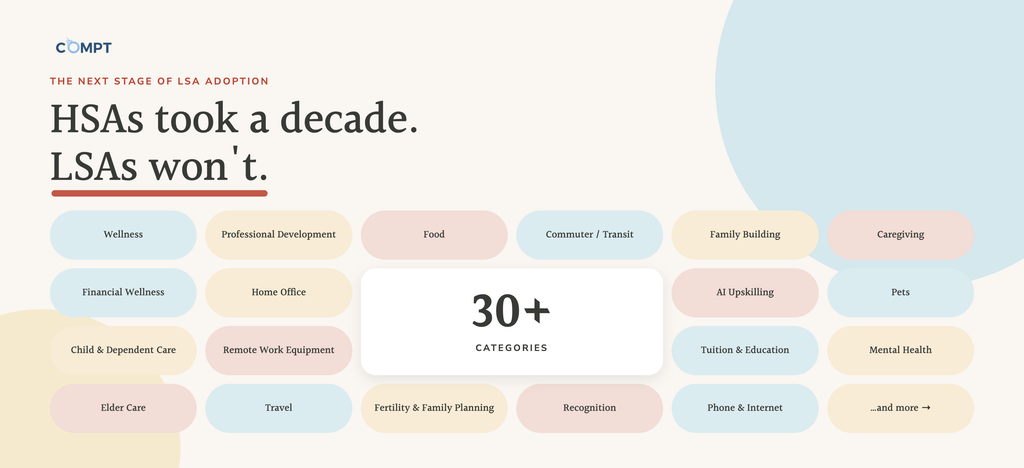
LSAs can become standard without becoming standardized.
An HSA is recognizable partly because federal rules define what it is. LSAs are never going to work that way.
One employer might build an LSA around wellness, food, and family support.
Another might prioritize professional development, commuting, financial wellness, and home-office expenses.
A third might decide next year that the mix needs to change again.
I’ve spent years watching the alternative play out. At one company where I was CFO, we installed beer taps because that seemed like a fun perk employees would appreciate. Then came the requests: cider for the gluten-free employees, wine for people who didn’t like beer, and what about the pregnant employees and the folks who don’t drink alcohol at all?
The problem wasn’t beer — it’s that I was spending company money trying to guess what hundreds of individual people would value. Scale that approach across wellness, learning, caregiving, food, commuting, recognition, and every new priority employers encounter, and you end up with more programs, more vendors, more administration, and still absolutely zero guarantee you’ve picked the right things.
LSAs standardize the infrastructure without standardizing what employees need.
That distinction is a big reason I built Compt in the first place, and it’s why I remain convinced this category has room to get much larger.
The HSA incumbents have already noticed.
Several of the largest HSA providers already offer LSAs alongside their existing benefits accounts. They obviously know LSAs exist. But what will they do with them next?
You can treat an LSA as another reimbursement account on a long product menu. Or you can look at what employers are actually doing and see the bigger possibility before you: one flexible layer that can support wellness, professional development, family needs, commuting, recognition, and the next category employers need to add.
Category leaders have an incredible advantage when the market expands around them. They already have the customers, distribution, expertise, and trust. But incumbency can also make it tempting to ignore the wider opportunity and treat the next category as a mere add-on to the business that already works.
My two-year bet on LSAs
Within two years, I expect LSAs to feel as ordinary in a competitive benefits package as HSAs do today.
I don’t mean every company will offer one. Every company doesn’t offer an HSA-qualified plan today, either. I mean the category itself won’t require much explanation. Candidates will know what an LSA is. Brokers will expect to discuss it. HR and Finance teams will spend their time comparing program design, administration, and funding instead of debating whether flexible lifestyle benefits belong in the package at all.
And I have evidence: employers with Compt LSAs are already consolidating programs, testing different funding cadences, expanding eligibility, and changing categories without rebuilding their entire benefits stack or adding more vendors and point solutions.
HSAs took roughly a decade to reach what HealthEquity itself called “critical mass” and nearly two decades to become a $100 billion market. LSAs have a different set of conditions and a lot fewer structural constraints on how the category can develop.
I don’t expect LSAs to take nearly as long. Two years from now, I anticipate employers will be comparing LSA design the way they compare HSA providers today.
Curious what an LSA designed for your business and your people could look like? Request a Compt demo.