
Among the things growing in importance for today’s employees is professional development.
SHRM’s 2023-2024 State of the Workplace report found that opportunities for growth within the workplace are the single biggest factor in employees’ overall mental well-being. In addition, career-related factors like limited advancement and lack of development opportunities remain the top reasons employees leave their jobs. And among newer entrants to the workforce, nearly one-third of recent graduates expect to stay in their current or next job for four or more years, with access to professional growth (including formal professional development programs) playing a major role in that decision.
Our data on actual benefits usage confirms the trend. In Compt’s 2025 Midyear Benchmark Report, we found:
- 18% of Compt customers now offer their employees a professional development stipend.
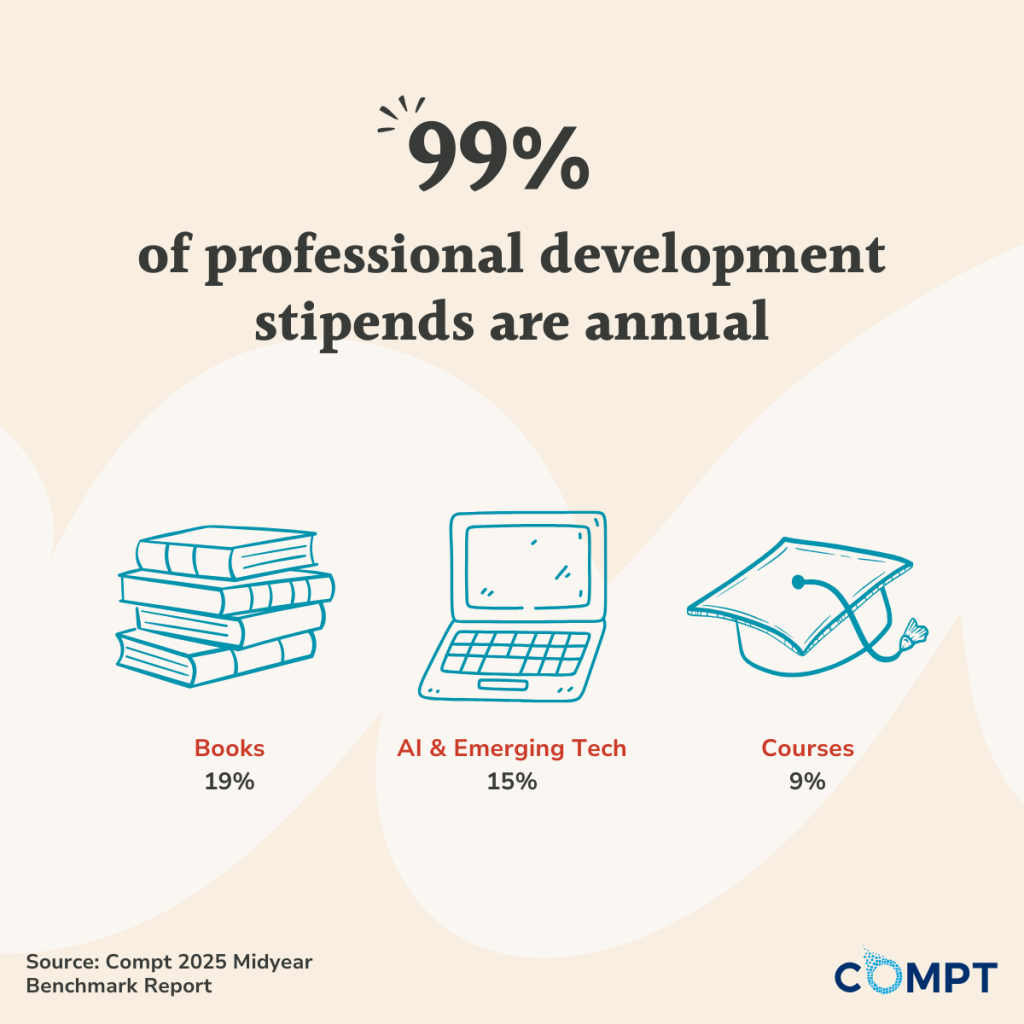
- “Professional Development” ranked among the top stipend categories companies offer their employees, covering books, AI tools, courses, and certifications.
- Nearly 99% of these stipends are funded annually, supporting long-term growth and skill-building.
- The category continues to grow year over year, emerging as a standout opportunity for 2026 planning.
To facilitate growth, it’s vital to encourage your employees to learn, practice, and develop new skills. And that’s where a professional development program can help your lifestyle benefits offerings really shine.
What is a professional development program?
First, a quick definition:
A professional development program is a structured plan that helps employees build the skills, knowledge, and experience they need to grow in their roles and within the company.
At its core, a professional development program aligns two things:
- What the employee wants to learn
- What your organization needs them to master
It can include on-the-job training, external courses, certifications, AI tool upskilling, mentorship, job shadowing, or even conference attendance. And to help employees choose (and afford) what would be most helpful to them, it can also include a professional development stipend. If you need more structure as you scale, Compt’s Professional Development Pro™ module uses the same stipend model with added controls. We’ll cover that later in this post.
Whether set up as a fixed amount on a specific cadence or reviewed on a case-by-case basis, a stipend for professional development only works if employees actually use it. Most companies offer a professional development budget, but if it’s stuck in a spreadsheet or limited to a handful of vendors, it’s not really a benefit.
Let’s take a closer look at the details behind creating a successful professional development program.
What expenses can a professional development program cover?
A professional development program can be as lean or as comprehensive as your budget allows.
At a minimum, it should support:
- Online learning platforms (e.g., Coursera, LinkedIn Learning, Udemy)
- Job-specific certifications and licenses
- Industry conference attendance (including registration fees)
- Upskilling related to AI tools
- Workshops and short courses
- Career coaching and mentorship
This is the foundational layer. It shows employees you’re willing to invest in their growth and equips them with relevant, role-based skills.
But these are all things you pay for and the employee handles themselves. Mature companies also create in-house resources for their team members: things like internal learning and training sessions, manager coaching or leadership training, and cross-training or rotational programs.
And best-in-class orgs turn development into a cultural advantage by covering things like tuition reimbursement for accredited courses, executive coaching or high-potential talent accelerators, access to industry masterminds or peer groups, individualized career roadmapping sessions, and personal development support (like wellness, productivity coaching, or communication skills).
Why are you offering a professional development program?
Eighteen percent of Compt customers give their employees funds specifically for professional development. But offering a professional development program just because “everyone else is doing it” isn’t a complete strategy.
Yes, it’s a retention tool. And yes, it helps you compete for top talent. If you’re serious about impact, though, your professional development program needs to tie directly to your business goals.
As Matthew Thomas, VP of People and Organizational Development at Conger Construction, said in a recent Getting Personal podcast episode, “Promotion is optional, but growth is mandatory.”
Thomas emphasizes that organizations should prioritize continuous learning and development opportunities for employees, regardless of their position or promotion trajectory.
With that in mind, ask yourself:
- What capabilities do we need to build across the org this year?
- Where are we seeing performance gaps on teams?
- What skills will be critical for us 12-24 months from now?
- Which ones are going to become obsolete?
The World Economic Forum says that, on average, two-fifths of an individual worker’s skills will need to be updated by the year 2030, or they’ll become outdated.
And to measure whether you’re on track to achieve your goals, you’ll need to look at:
- Participation rates
- Employee feedback
- Skill development (self-assessments + manager evaluations pre/post-training)
- Internal mobility (i.e., are more employees moving into new roles or leadership tracks?)
- Retention and performance metrics (e.g., quota attainment for sales teams)
How will you implement and manage a professional development program?
There’s no one-size-fits-all setup. But if you’re looking for the most inclusive, scalable starting point?
A professional development account is often the best place to start.
This employer-funded stipend or reimbursement program lets employees choose their own learning opportunities. It’s flexible, easy to administer, and tax-optimized (i.e., some professional development program benefits are taxable, while others aren’t). And with it, employees take ownership of their own growth. For larger or global organizations, Professional Development Pro brings even more structure and compliance to the entire process.
There’s a lot more to a full-on program, which we’ll dive more into below, but here’s the rundown on what you’ll need to have figured out:
- Budget and how much you’re looking to spend per employee
- Eligibility criteria (i.e., full-time staff only, or will you include part-timers or contractors?)
- Expense submission and reimbursement process
- Permitted expenses and anything that’s excluded
- Communication plan for employees/managers
- Expense, performance, and ROI tracking systems
The good news? Compt makes all of the above incredibly easy for HR and People teams. We support flexible stipends at every company stage. You can start small with a professional development stipend, or scale up to a more structured program using Professional Development Pro for custom budgets, approvals, reporting, and peer-approved learning recommendations.

8 steps to design a successful professional development program with Compt
It only takes about an hour to set up a stipend reimbursement program with Compt. But the success of your professional development program depends on how well you lay the groundwork.
1. Clarify your program’s purpose and strategic goals.
Before choosing platforms or setting budgets, get crystal clear on why you’re building this program.
Are you aiming to:
- Close specific skills gaps?
- Build a stronger leadership pipeline?
- Boost internal mobility?
- Compete in the talent market?
- Address employee feedback?
- Fix an existing employee benefit gap?
- Improve retention or DEI outcomes?
Your answers here shape every decision that follows — from the types of learning you support to how you measure success.
2. Assess your current capabilities and skills gaps.
This is where most programs fall short. They skip straight to courses and stipends without understanding the full picture. You need to get under the hood.
Use internal data (e.g., performance reviews, engagement metrics, retention numbers), manager input, and employee surveys to assess:
- What skills are missing (now and future)?
- What learning options already exist internally?
- Where do employees feel undersupported?
Once you’ve gathered qualitative and quantitative input, map it back to your company’s strategic priorities.
- Shifting upmarket into enterprise deals? Your sales and Customer Success teams might need advanced negotiation training, new sales methodologies, deeper product knowledge, and industry certifications to build credibility.
- Rolling out a new internal system or tool? Upskilling around change management, digital adoption, and data literacy can prevent bottlenecks and maximize ROI.
- Worried about missed opportunities in the age of AI? Supporting your people in learning and effectively using AI tools will go a long way.
Pro tip: Involve team leads in this process. They can validate reskilling and upskilling needs, identify role-specific gaps, and become early champions of the program.
3. Secure executive buy-in (and budget).
Professional development funding can range widely — from $200 per employee per year to $3,000+ among Compt customers. These numbers represent observed ranges from actual data, not maximums or limits (meaning some outliers may fund above that).
To determine the right number for you, start by finding the sweet spot between:
- What you can afford today
- What will actually move the needle on performance, internal mobility, or retention — whatever ROI metric(s) you’re hoping to improve by adding this benefit
When you bring this to execs:
- Tie the spend to outcomes. Show how even modest investment can reduce backfill costs, improve retention, or accelerate onboarding.
- Use benchmarks. Reference competitors, industry norms, or aspirational peers to ground the conversation.
- Start with a pilot. Propose a phased rollout to prove value before scaling companywide.
4. Define what “professional development” includes.
Don’t box yourself in here. One of the biggest mistakes employers make is being overly prescriptive, requiring employees to use specific tools, platforms, or providers when there are countless ways to learn the same skill.
Your program should set clear guidelines, not hard rules. Think:
- What types of learning are eligible? (Courses, books, coaching, AI tool subscriptions, conferences?)
- What are the learning formats? (Online, in-person, internal, external?)
- Are there guardrails? (Must it align with their specific role or career path?)
- Who approves what?
With Compt’s Professional Development Pro module, there are no vendor restrictions. Employees can choose their own learning providers and options that fit their needs, as long as they fall within your policy. When employees pick what’s most relevant for them, they learn faster, apply it sooner, and the employee and business experience better results quicker.
5. Choose the right delivery model.
Here are some common structures, which you can also combine:
- Centralized programs (company-led): Internal learning, manager coaching, and L&D-led tracks.
- Professional development stipends (employee-led, for smaller orgs): Employees get a fixed annual amount (e.g., $500-$2,000) to use on learning opportunities they pick. It’s flexible and easy to administer, especially with a platform like Compt.
- Centralized professional development accounts (employee-led, for larger orgs): Instead of giving everyone funds up front, employees submit learning requests from a shared company or team budget. This model gives you more control, works well at scale, and fits companies with centralized L&D strategies or more complex compliance needs.
Decide what mix works for your workforce. Distributed teams normally prefer flexible stipends; fast-scaling orgs might prioritize internal tracks to reinforce culture and internal processes, then offer a smaller stipend to supplement.
6. Structure your stipend for clarity and usability.
To keep your professional development stipend program fair, effective, and easy to manage, you need a structure that answers the “how,” not just the “what.”
Here’s how to set it up:
- Eligibility criteria: Limit access to full-time employees who’ve completed at least 90 days. This is a common industry standard that balances early access with a reasonable commitment window. If you want to be more inclusive, consider prorated access for part-time roles.
- Funding model and timing: Offer a set annual amount upfront (e.g., $500-$2,000/year). This makes it easier for employees to cover one-time expenses like certifications, tuition, or conferences rather than waiting months to accrue value.
- Approval process: Require manager sign-off for transparency and alignment with performance goals. For small purchases (like books or online courses), some companies waive approval altogether for speed and ease.
- Tax treatment: If these expenses qualify as work-related expenses, then they would fall under a working condition fringe benefit and would be deductible business expenses for the employer and nontaxable for the employee. In some instances, though, professional development is a taxable benefit. Compt handles this automatically so HR teams don’t need to manage it manually.
- Rollover and expiration: Keep it clean by resetting the budget annually with no rollover. That way, employees are encouraged to use the benefit each year and accounting is simplified.
Don’t leave any of this vague. A well-defined structure makes the program feel more valuable and sets it up for long-term success.
7. Build the infrastructure.
Once your program is scoped, you need the tools and workflows to run it smoothly.
- A platform to manage requests and track usage (like Compt!)
- A clear process for employees to submit expenses or sign up for learning
- Documentation of eligibility rules, FAQs, and manager resources — all easy to find
Don’t forget internal training. Managers need to know how to support team members’ learning goals and encourage use of the program.
8. Roll it out like a product.
A great program that no one uses isn’t a great program. That’s why you have to treat your launch like a product rollout:
- Create a strong internal announcement with clear benefits.
- Share how-tos: how to access funds, what to use them for, and where to start.
- Highlight real examples — what employees are learning, how it’s helping. (This is also easily visible with our Recommendations feature.)
Then keep it alive. Mention it during onboarding, performance reviews, and team meetings (and train all your managers to do the same). The more visible and easy-to-use it is, the more impact it’ll have.
Psst: Before you launch, here are 11 questions you need to ask.
Compt: the smart way to power professional development
Compt makes it effortless to offer professional development stipends that employees want to use without creating a compliance headache for HR or Finance.
With Compt, you can:
- Set custom eligibility rules and annual budgets by role or department
- Offer flexible learning options
- Automate approvals, receipts, and tax handling from one platform
- Track usage and impact with real-time reporting
Employees get the freedom to grow in the way that works for them. You get a program that’s structured, strategic, and scalable.
Request a demo to see how it works.
FAQs: Building a successful professional development program
Professional development stipends give employees freedom to learn in the ways that matter most to them. They improve engagement, retention, and performance by removing barriers to access. HR teams also benefit from a stipend program run through Compt, which reduces manual tracking and keeps everything tax-compliant and visible in one place.
How is Compt’s Professional Development Pro™ different from a stipend?
Both use the same stipend model. Professional Development Pro adds structure for growing or global teams: shared or individual budgets, automated multilevel approvals, customizable funding windows, learning recommendations from peers, and real-time reporting to track engagement, spot trends, and measure program impact. Many companies start with a professional development stipend and move to Professional Development Pro as they scale.
How do I set up a lifestyle stipend for professional development only?
Inside Compt, you can create a dedicated stipend category just for professional development. Choose your funding amount, set the eligible expense types such as courses, certifications, or AI tools, and pick a funding cadence that fits your budget. Employees submit receipts for approval, and Compt handles reimbursement and tax details automatically.
What should I include in a professional development stipend policy?
Your policy should clearly outline who is eligible to use the benefit, the annual or recurring funding amount, which expenses are covered and which are not, how employees request funds and get reimbursed, and how taxes and payroll are handled.
Which vendors offer Lifestyle Spending Accounts (LSAs) and professional development stipends?
Compt is a vendor-free, IRS-compliant platform that supports both Lifestyle Spending Accounts and professional development stipends in one place. Because spend isn’t limited to a catalog, employees can use the providers they trust while HR keeps policy and tax handling consistent.
Which benefits software manages both professional development and wellness stipends?
Compt does. You can manage professional development, wellness, family, recognition, swag, and more, all in one platform. Employees get a single, consistent experience while HR can track usage across every category.
How do companies decide how much to offer for professional development stipends?
According to Compt’s 2025 Midyear Benchmark Report, professional development stipends typically range from $200 to $3,000 per employee each year. Most employers fund them annually to match learning cycles and budget reviews.
How can HR process ad-hoc reimbursements for professional development?
Compt supports both structured stipends and ad-hoc reimbursements. Employees can submit learning-related expenses anytime, and Compt routes them for approval and payroll reimbursement automatically.
How can we merge different professional development budgets across teams?
Compt lets you consolidate department-level budgets under one dashboard. HR and Finance can assign funds by team, track participation, and adjust allocations without juggling multiple spreadsheets or systems.
What features should I look for in software that manages professional development accounts?
Look for vendor flexibility, built-in tax compliance, payroll integration, reporting tools, and the ability to group employees and set custom rules for eligibility and approvals. Compt includes all of these features and can be up and running in about two weeks.
How can companies keep professional development reimbursements tax compliant?
If these expenses qualify as work-related expenses, then they would fall under a working condition fringe benefit and would be deductible business expenses for the employer and nontaxable for the employee. Or, if the employer offers an Educational Assistance Program for student loan repayments, then professional development benefits can be tax-free up to the IRS limit of $5,250 per employee. Professional development outside of these cases would generally be considered a taxable benefit. Compt automatically categorizes each expense correctly so payroll reporting stays accurate.
What is the best way to roll out a professional development stipend?
Treat it like a new product launch or internal communications campaign. Announce it widely, make the guidelines easy to find, and share examples of how employees can use it (e.g., through Slack or a company intranet). Compt includes templates and built-in communication tools to help HR teams roll out programs smoothly.
How can professional development stipends help close the AI skills gap?
You can add an AI stipend category within your program so employees can pay for AI courses, tools, or certifications. This helps build companywide AI literacy while giving employees freedom to choose how they learn.
What metrics should Finance track to show ROI on professional development?
Track participation rates, employee feedback, skills growth, internal mobility, and retention data before and after rolling out a new program so you can see progress. Compt’s reporting dashboard makes it easy to see details on spend, utilization, and adjustments so you can tie those numbers to other company metrics.
How do lifestyle stipends support both professional development and wellness?
Professional development and wellness are separate categories, but they can live under the same lifestyle benefits program. For example, you might offer one stipend for learning and another for well-being, or combine both inside an all-inclusive Lifestyle Spending Account (LSA). Either way, with Compt, employees get the flexibility to choose what they need most, and HR keeps clear visibility into how funds are being used.
Is it better to fold professional development into an existing benefits program?
Yes, if it makes the benefit easier to manage and more visible to employees. Compt allows you to integrate professional development into your lifestyle benefits program so everything runs through one compliant, trackable system.