Employers can use four common types of employee stipends to support different goals: recurring stipends, one-time stipends, spot bonuses, and recognition stipends. Recurring stipends provide allowances on a set schedule, one-time stipends mark specific occasions, spot bonuses reward special achievements, and recognition stipends let managers and peers reward employees for their contributions.
With Compt, monetary stipends and bonuses use a reimbursement model: Employees make eligible purchases, submit receipts, and receive reimbursements through payroll.
So, which type of stipend should you offer? That depends on what you want the benefit to accomplish. One isn’t overall “better” than the others, per se; recurring stipends can cover everyday expenses or fun, discretionary purchases, while one-time stipends and spot bonuses can celebrate milestones, reward accomplishments, or create surprise-and-delight moments for employees.
Many companies offer multiple stipend types, sometimes all four, as part of a single lifestyle benefits strategy. This guide explains how each type works, when to use it, and how to choose the right combination for your workforce.
What is a recurring stipend, and how does it work?
A recurring stipend provides each employee with an allowance that renews on a set schedule. With Compt, employers offer recurring stipends monthly, quarterly, semiannually, annually, or biennially, depending on their priorities and overall program design.
Recurring stipends work well for ongoing expenses such as wellness, food, commuting, and professional development because they give employees predictable access to benefits throughout the year.
Here’s how recurring stipends work with Compt:
- The employer sets the stipend amount and funding cadence.
- Each employee’s available allowance resets or accrues according to the program’s settings.
- Employees make eligible purchases and submit receipts through Compt.
- Compt checks expense submissions against your program rules, with admin review when needed, and applies the configured tax treatment.
- Approved reimbursements are processed through payroll.
Because Compt uses a reimbursement model, employers only pay for approved expenses, with no unused prefunded balances to recover.
Should you offer a single-category stipend or an all-inclusive LSA?
There are two main recurring stipend types: single-category stipends and all-inclusive Lifestyle Spending Accounts (LSAs). The former covers one particular expense category, like health and wellness, while the latter covers several categories within a single allowance.
As the employer, a single spend category lets you direct funding toward a specific goal. So if you want specifically to promote healthy lifestyles as a part of your workplace culture, a health and wellness stipend keeps the benefit focused right where you want it.
An all-inclusive LSA lets you offer your employees more flexibility by covering a wide range of eligible expenses, all while you control which categories qualify under your benefit program rules. Compt’s benchmark data shows a notable difference in utilization between these two structures:
Wellness bundled into an all-inclusive LSA reached 86% utilization in 2025, compared to 62% for wellness offered as a standalone stipend, per Compt’s 2026 Annual Lifestyle Benefits Benchmark Report.
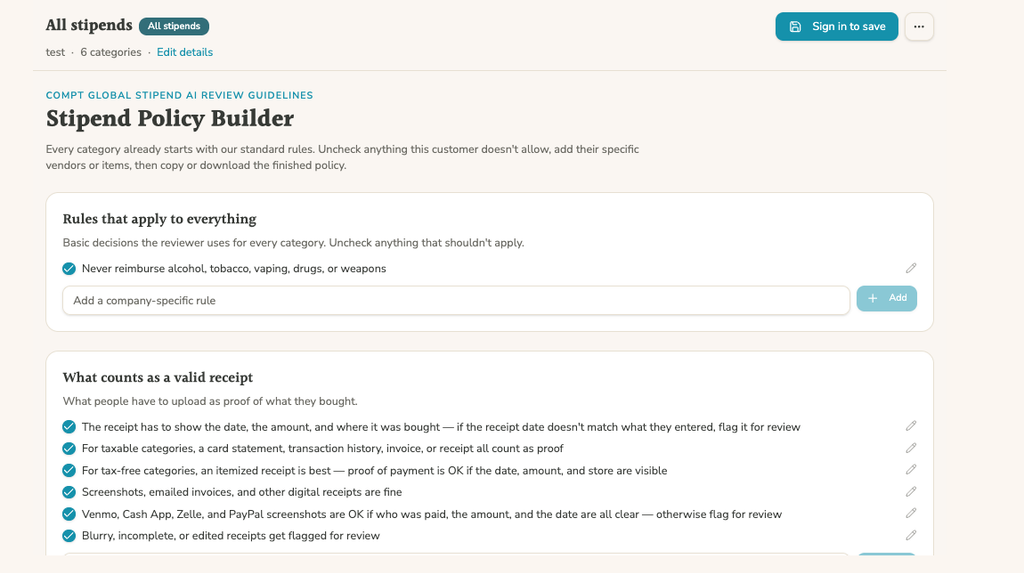
Your employee stipend policy, simplified.
Build a clear, customizable stipend policy for what’s covered, who’s eligible, and how expenses are handled. The Stipend Policy Builder starts with Compt’s LSA policy guidelines and lets you tailor the rules to your program.
How often should you fund a recurring stipend or LSA?
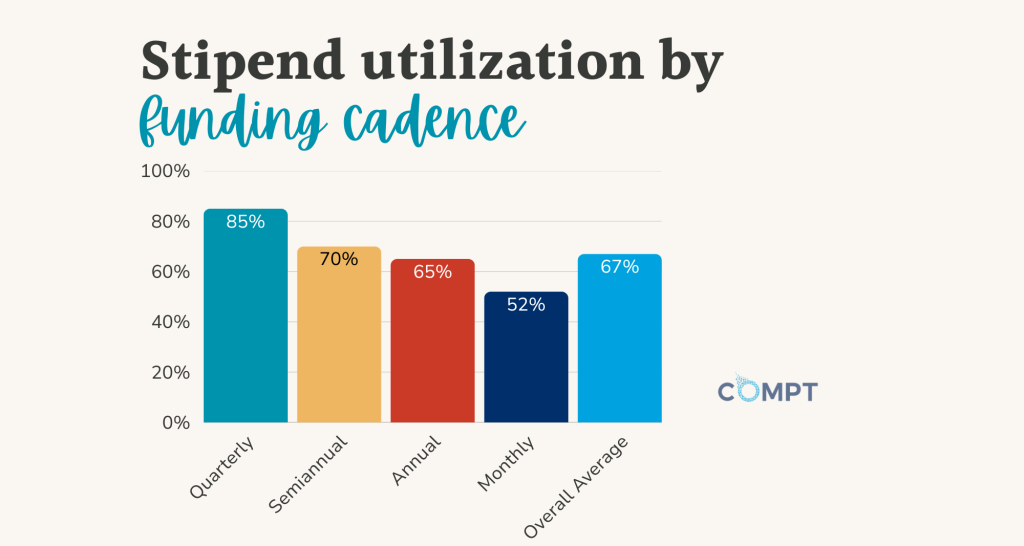
Annual funding is now the most common cadence among Compt customers, with 58% using it for at least one stipend or LSA program. According to Compt’s 2026 Midyear Lifestyle Benefits Benchmark Report, quarterly (39%) and monthly (36%) funding are also common, and many companies use more than one cadence across different programs.
But the most common cadence isn’t necessarily the one with the highest utilization. Compt’s 2026 Annual Lifestyle Benefits Benchmark Report, covering full-year 2025 data, found that quarterly-funded programs had the highest utilization at 85%, compared to 65% for annual funding and 52% for monthly funding.
Generally speaking, monthly funding works well for smaller, recurring expenses, while annual funding gives employees access to a larger allowance for expenses they might incur less frequently.
Quarterly funding offers a middle ground: large enough allowances for higher-value purchases and changing personal needs, with regular opportunities to use the benefit throughout the year.
If your program runs on an annual cadence today, it may be worth testing whether switching to quarterly improves how much of the benefit employees actually use.
There is nuance, though. Stipends covering monthly expenses like commuting costs and phone bills are naturally more aligned with a monthly cadence. Larger and more sporadic expenses, such as professional certifications and out-of-state care, may feel more streamlined on an annual basis.
For the full breakdown of how cadence affects utilization by category and how to choose the right one for your program, read our funding cadence guide.
When should you offer a one-time stipend?
A one-time stipend is tied to a specific date or event instead of a recurring cycle. You set the trigger and amount, and Compt automatically makes the allowance available on the scheduled date.
A few examples of one-time stipends you can offer with Compt include:
- New-hire stipends. Reduce onboarding friction by giving new team members an allowance for workplace necessities, home-office equipment, or company swag.
- Milestone and anniversary stipends. Create a custom one-time reward stipend for important employee milestones like certification/degree completion, promotions, and work anniversaries or service milestones.
- Birthday stipends. Set up a birthday stipend and the allowance will automatically become available on each employee’s special day (so HR doesn’t have to remember!).
These aren’t necessarily the core of your lifestyle benefits program (recurring stipends and LSAs typically carry that weight), but they can be highly effective for employee engagement because of how personal they are: well-timed gestures like remembering a birthday can deepen your employees’ emotional connection to the company. And given that Workhuman’s 2026 research found “61% of workers have never been recognized for a service milestone in a meaningful way,” it’s surprisingly simple to stand out as an employer.
How is a spot bonus different from a one-time stipend?
Unlike one-time stipends tied to planned dates or milestones, a spot bonus recognizes exceptional performance or an above-and-beyond contribution as it happens. A benefits admin can issue one whenever they want.
When might you give someone a spot bonus?
- Closing a major deal
- Pulling off a last-minute save before launch
- Going outside their usual scope to help on a big project
- Stepping up to cover for a teammate who is out sick or on leave
Although this is a one-off bonus and not a traditional stipend, it runs through the same reimbursement process as other monetary stipends in Compt. The admin makes the allowance available, then the employee makes an eligible purchase, submits a receipt, and gets reimbursed through payroll.
Pro tip: If your spot bonus software doesn’t also manage recurring lifestyle stipends, you may be juggling two separate systems. Compt runs regular stipends and spot bonuses through the same reimbursement infrastructure, so you can manage both in one place. Request a Compt demo to see how it works.
How do employee recognition stipends work?
Compt’s approach to rewards and recognition combines monetary recognition stipends with nonmonetary shoutouts, with both supporting peer-to-peer and manager-to-employee recognition.
Two layers make this up:
- Shoutouts. These are for giving public kudos to peers and direct reports without including a monetary reward.
- Team recognition stipends. These are small monetary rewards ($10 to $50, for example) that a manager or peer can give within the budget and rules the company sets.
Shoutouts are a form of nonmonetary recognition, which plays a fundamental role in solidifying recognition as a cultural value. Compt lets users give them through its in-platform activity feed, and recognition moments can also be pushed to your company’s existing Slack or Teams channels, if you set them up that way.
For team recognition stipends, employers configure who can give recognition, who can receive it, and how much each group can award. For example, you might give managers a larger recognition budget while allowing all employees to recognize their peers with smaller amounts. Budgets can renew on a monthly, quarterly, semiannual, or annual schedule, or be configured for one-time awards.
Gallup and Workhuman found that employees who considered themselves “well-recognized” were 45% less likely to have left their employer two years later.
With Compt’s peer-to-peer bonuses, employees give recognition dollars directly to eligible colleagues within your configured budgets and rules. Recipients then spend those dollars in eligible categories and submit receipts through the same reimbursement process as other monetary stipends.
Are employee stipends taxable?
Whether a reimbursement is taxable or not comes down to what the expense was for and how the benefit is structured rather than the stipend type itself. The IRS treats lifestyle benefits as taxable by default (78% of total stipend spend in 2025 was taxable), but certain expenses can qualify for exemptions.
Expenses that may qualify for nontaxable treatment include:
- Professional development, including student loan repayment and tuition reimbursement, up to a combined $5,250 per employee in 2026 under a qualifying educational assistance program. Certain job-related training may qualify separately.
- Cell and internet, when reimbursed for qualifying business use and properly documented.
- Commuter benefits up to $340 per month for transit passes and vanpooling combined, and a separate $340 for qualified parking expenses in 2026.
- Remote-work office equipment the employee needs to do their job, like an ergonomic chair or laptop, as long as the business expense is properly substantiated.
Within each potentially nontaxable category, there are technicalities to be aware of. For example, while qualified parking and transit benefits are tax-free up to statutory limits under IRC Section 132(f), ordinary gas purchases and personal Uber/Lyft commutes generally don’t qualify for that exclusion.
Spot bonuses and monetary recognition awards for employee performance are generally taxable, even when the employee receives the money through reimbursement.
For a full list, see our guide to taxable and nontaxable fringe benefits.
Do lifestyle perks have to go through payroll?
Whether a lifestyle perk such as a stipend or LSA needs to be reported through payroll depends on its tax treatment, not simply how the employee receives it. Taxable perks generally need to be included in employee wages, even when they’re delivered through cards or points. Qualifying nontaxable reimbursements, on the other hand, may be excluded from wages.
With Compt, monetary stipends and bonuses are reimbursed through payroll. Employees submit receipts, Compt checks expenses against the employer’s program rules, and the configured tax treatment is reflected in payroll reporting. Reimbursements follow the employer’s payroll schedule, so there’s no need to run payroll every time an employee submits a receipt.
Prepaid cards and points-based programs can also meet the IRS’s applicable tax requirements, but their expense tracking and reconciliation processes are often more complex. Some advantages of reimbursement-based stipends are that employers don’t need to prefund allowances, and eligible expenses can be reviewed before reimbursement.
And regardless of whether a purchase is taxable, having a formal expense-review process helps catch out-of-policy purchases and maintain accurate records for HR, Finance, and audits.
Comparison table: Which stipend type should you use? (2026)
The right stipend type depends on what you’re trying to support: a consistent need (recurring), a known upcoming milestone (one-time), an unplanned moment worth rewarding (spot bonus), or peer- or manager-driven appreciation (recognition stipends).
The table below breaks down each stipend type:
| Stipend type | Best for … | How the allowance works | Example |
|---|---|---|---|
| Recurring | Ongoing needs (wellness, professional development, cell/internet, LSA) | Available allowance renews or accrues on a set cadence | An annual all-inclusive LSA employees submit reimbursements against throughout the year |
| One-time | Marking a specific, planned moment (hire date, anniversary, birthday) | Allowance becomes available on a scheduled date or event; eligible purchases are reimbursed | A new-hire allowance that becomes available on an employee’s first day |
| Spot bonus | Reacting to something unplanned (an outstanding contribution or achievement) | One-time allowance issued as needed; eligible purchases are reimbursed | A bonus for pulling off a last-minute launch save |
| Recognition | Peer- or manager-driven appreciation | Employers configure who can give and receive monetary recognition, along with award budgets and cadence; nonmonetary shoutouts are also available | A peer giving a teammate $25 to spend on an eligible purchase |
These stipend types work well together as part of a single employee benefits strategy. Recurring stipends cover the day-to-day needs employees can plan around; one-off stipends go the extra mile to show you value your team; spot bonuses and recognition reinforce the cultural values you want to promote.
How do you design an employee stipend program?
When designing your stipend program, here are six steps to follow:
- Identify the need you’re solving for.
If your goal is to promote a cultural value (like team collaboration) or you know a large swath of your workforce fits a particular profile (like college grads with student loan debt), those are good places to start. Also, survey your team to get a feel for which benefits matter to them the most.
- Choose your program structure.
Some companies start with a focused set of stipend categories and expand over time based on employees’ usage and feedback. Others launch with an all-inclusive LSA from the get-go. What’s right for your team depends on your budget and how much flexibility you want to give them.
65% of Compt customers offered an all-inclusive LSA in the first half of 2026, according to Compt’s 2026 Midyear Lifestyle Benefits Benchmark Report. - Set the budget and cadence.
Decide how much each employee can access and how frequently the allowance should renew. The right cadence depends on the expenses you’re covering and how employees are likely to use the benefit. With Compt, you can offer different cadences across different stipends.
- Launch and watch the numbers.
Two important metrics to keep an eye on: participation measures the percentage of eligible and active employees who submit at least one eligible expense, while utilization measures how much of the available stipend funding employees spend.
See the video below for details. - Adjust or expand based on what the data shows.
You don’t need three separate platforms to offer wellness, WFH, and learning stipends. Compt lets you manage multiple categories in one place while varying eligibility and reimbursement amounts by employee group (that includes department, location, employment type, level, tenure, and other attributes in your HRIS).
With an HRIS integration, employee data syncs into Compt and eligibility updates as employees change roles, locations, or status, according to your configured rules and timing. You can also adjust categories or eligibility over time without rebuilding the whole program. - Add other stipend types based on your goals.
You can offer multiple stipend types from the start or add them as your program evolves. Once you’re up and running, your benefits admin time using Compt can be as little as 10 minutes per month, according to Compt’s 2026 Midyear Lifestyle Benefits Benchmark Report.
That gives HR more time to focus on organizational and cultural goals. One example might be building a rewards and recognition program using shoutouts and team recognition stipends.
Manage stipends and recognition together with Compt.
Compt runs recurring lifestyle benefits, one-time perks, spot bonuses, and recognition through the same admin dashboard. Monetary stipends and awards use the same reimbursement process with nonmonetary shoutouts managed alongside them.
HR isn’t stuck juggling a benefits platform, recognition tool, and spot bonus app that don’t talk to each other. Instead, they manage programs in Compt, with dedicated payroll reports that can be split by provider or country.
And because Compt is vendor-agnostic, employees can shop wherever they choose for eligible purchases rather than being limited to a closed marketplace of preapproved merchants.
Ready to see how different types of employee stipends could work together for your team? Request a personalized Compt demo.
FAQ: Types of employee stipends
The main difference is when the allowance becomes available and what it’s intended to support. Recurring stipends renew on a set schedule, while one-time stipends mark planned occasions like birthdays or anniversaries. Spot bonuses reward impressive achievements, and recognition stipends allow employees and managers to recognize colleagues within company-defined budgets and rules.
With Compt, all four types of monetary stipends use a reimbursement model. Rewards and recognition programs can also include nonmonetary shoutouts.
Is it better to fund a Lifestyle Spending Account (LSA) monthly, quarterly, or annually?
Quarterly funding had the highest utilization in Compt’s full-year 2025 benchmarks at 85%, compared to 65% for annual funding and 52% for monthly funding. However, the best cadence depends on the expenses your program covers.
Monthly funding can work well for recurring expenses like commuting and phone bills, while annual funding may be better suited to larger, occasional expenses like professional certifications. Quarterly funding offers a middle ground.
For more detail, see our funding cadence guide.
If we already use spot bonus software, when would a lifestyle stipend platform make more sense for ongoing perks?
A lifestyle stipend platform makes more sense when you want to support ongoing employee expenses alongside one-time rewards. Spot bonus software typically focuses on recognizing individual achievements. Compt can manage those bonuses alongside recurring allowances for wellness, professional development, commuting, and other benefits.
Compt supports both recurring stipends and spot bonuses through the same reimbursement infrastructure, so employers can manage ongoing benefits and monetary rewards without maintaining separate systems.
If I give a ‘lifestyle’ perk, does it have to be run through payroll every single time?
Not necessarily. Whether a lifestyle perk such as a Lifestyle Spending Account (LSA) or wellness stipend needs to be reported as wages depends on its tax treatment. Taxable benefits generally must be included in employee wages, while qualifying nontaxable reimbursements may be excluded.
With Compt, employees submit eligible expenses for reimbursement, and the configured tax treatment is reflected in payroll reporting. Employers process approved reimbursements according to their payroll schedule, so they don’t need to run payroll separately for every receipt.
For more information, see our guide to taxable and nontaxable employee reimbursements.
What platforms combine employee stipends and recognition?
Compt combines recurring stipends, one-time stipends, spot bonuses, and employee recognition in one platform. Monetary awards follow the same reimbursement process with nonmonetary shoutouts managed easily alongside them.
Employers can configure who can give and receive recognition, set budgets and eligible spending categories, and manage the programs through the same administrative dashboard. Employees can then choose eligible purchases from vendors they prefer rather than redeeming points through a closed rewards catalog.
How can we combine our wellness, remote-work, and learning benefits into one platform?
With Compt, you can easily combine wellness, remote-work, and professional development benefits through an all-inclusive Lifestyle Spending Account (LSA) or manage separate stipends, all within one platform.
You can set different eligible categories, allowances, and employee eligibility rules without needing separate systems for each benefit. Then your employees submit eligible purchases for reimbursement through the same platform, regardless of which stipend they’re using.
How does Compt handle tax treatment and payroll reporting for employee stipends and LSAs?
Compt helps employers establish tax rules by category, then applies their configured rules and limits to classify stipend and LSA reimbursements as taxable or nontaxable for payroll purposes.
Compt’s free Stipend Policy Builder provides category-specific guidance on which expenses are generally taxable and which may qualify for nontaxable treatment in the U.S., including documentation requirements. Employers can customize those rules and configure tax treatment by country.
Compt generates payroll reports reflecting the configured tax treatment, which can be split by payroll provider or country. Approved reimbursements are processed according to the employer’s payroll schedule.
Editor’s note: Compt applies the tax treatment and limits configured by employers to classify reimbursements for payroll reporting. Compt does not provide tax or legal advice. Employers should consult their tax, legal, and accounting advisors to determine the appropriate treatment of their benefits programs.

 No receipt chasing