
Unique employee benefits are nontraditional benefits that give your team personalized support beyond the standard health insurance, retirement plans, and PTO that are table stakes for today’s employers.
As an employer, you can offer them individually or consolidate several categories (like wellness, professional development, and WFH support) through an all-inclusive Lifestyle Spending Account (LSA). And with Compt’s vendor-agnostic lifestyle benefits platform, you’re able to manage those perks through one flexible program instead of adding a separate vendor or point solution for every single one.
Here are 20 of our favorite employee perks and benefits, plus quick examples of how to implement them.
What makes an employee benefit “unique”?
Unique employee benefits are certain fringe benefits that go beyond the standard benefits package by supporting needs like mental and physical health, work-life balance, personal and professional development, and responsibilities outside of work (like school and family).
The benefits most companies have offered for decades are the “traditional” ones:
- Medical, dental, and vision insurance
- Retirement contributions
- Paid time off (PTO)
- Life, disability, and workers’ compensation insurance
- Stock options
But today’s world is a lot different from the world we lived in 20 years ago. Traditional benefits remain foundational, but they don’t address every need employees bring to work.
The business case for nontraditional employee benefits
Unique benefits can make a compensation package more relevant to employees by supporting needs traditional benefits don’t always cover. That can strengthen both recruiting and retention, especially when the benefit is flexible enough to be useful across a broader workforce.
Business benefits may include:
- Improved recruitment and retention. Benefits remain an important part of the employee value proposition. WorldatWork’s 2026 State of Rewards found that 40% of employees rank benefits among their top three factors for staying with an employer long term, behind pay and flexibility. The research also suggests benefits function more like table stakes than a retention guarantee: they help create a competitive rewards package, but other parts of the employee experience influence whether people actually stay.
- Higher employee satisfaction and sense of purpose. Nontraditional benefits show employees you care about their goals, values, and life outside of work. MetLife’s 2026 research found that employees who feel connected to their workplace are 3x more likely to stay because they “want to.”
- Increased worker productivity. Employees who can focus on their other priorities are less likely to feel burnt out or overwhelmed by work.
- Stronger company culture. As an employer, you can use nontraditional benefits (like employee recognition or charitable giving) to reinforce the behaviors and cultural values you want your company to embody.
- Flexibility and inclusivity. Flexible benefits like LSAs give employees more choice in how they use employer-provided support, which makes that support feel more tangible across the workforce and aligns with broader DEI and inclusion strategies.
Pro tip: Run a confidential employee benefits survey before adding anything to your program to verify your chosen benefits align with your team’s needs and interests.
20 unique benefits your employees will love
The best unique employee benefits give employees more choice and support needs traditional benefits don’t always cover. Based on current trends (and our own research), here are 20 of the best employee benefits to make your company stand out:
1. Lifestyle Spending Accounts (LSAs)
A Lifestyle Spending Account is an employer-funded perk that gives each team member a set allowance they can spend across multiple eligible categories. As of mid-2026, 65% of Compt customers offer one, making it the most common lifestyle benefits structure in our dataset.
Compt LSAs are vendor-agnostic, so employers can support multiple benefit categories through one program instead of adding a separate point solution for each one. You can also use them to consolidate multiple benefits vendors into one program. For recruiting, you can also present the annual LSA contribution as part of an employee’s total compensation, along with examples of what the benefit can cover.
Here are a few examples of how different people on the same team might use their LSA funds:
- Health and wellness: a gym membership, fitness equipment, or health-monitoring products
- Everyday expenses: groceries, household essentials, other personal living expenses
- Remote and hybrid work: office equipment or a monthly cell/internet bill
- Professional development: courses, learning platforms, AI upskilling and tools, productivity software
- Personal needs: pet care, shoes, other lifestyle purchases
See our guide to LSA-eligible expenses for a full rundown of what could qualify, based on your company’s goals for your LSA program.
2. Health benefits for employees and contractors
Health benefits are common — for full-time employees, that is.
ADP Research’s November 2025 analysis, based on payroll data across more than 24 million American workers, discovered contract work is a full-time commitment for a huge swath of the workforce. While independent contractors averaged 85 hours per month, ~14% worked 180 hours or more.
While traditional benefits like employer-sponsored HSAs aren’t designed for 1099 contractors, an all-inclusive LSA is because it lets you offer flexible, employer-funded support without tying the benefit to a traditional employee health plan.
And if you work with international contractors, an LSA or healthcare stipend is a perfect addition to your international employee benefits package.
Example: Use Compt’s custom eligibility rules to offer an LSA to specific contractor groups based on your HRIS data.
3. Extensive mental health resources
Employees are human, and work can take a toll. NAMI’s 2026 Workplace Mental Health Poll of 2,153 full-time U.S. workers revealed that 53% experienced some kind of job-related burnout.
There are several ways you can support your employees’ mental health:
- A health insurance plan that covers counseling services
- Reimbursement for qualifying services
- Virtual therapy
- Meditation apps
- Mental health workshops
- Mental health days
- Onsite mental health resources
But simply having those resources won’t suffice if people don’t know about them or can’t comfortably use them. Only 6 in 10 of those survey participants said they knew how to access mental health care through their employer-sponsored insurance, which is why proper benefits communication and accessibility for different employee needs is so important.
Example: American Express’s Healthy Minds program gives team members 10 free counseling sessions with licensed therapists each year. It’s available virtually or in person.
4. Health and wellness stipends
Employers support their employees’ physical health in numerous ways. Gym reimbursement, onsite fitness classes, health screenings — all these employer-sponsored wellness benefits are beneficial. But what about the employee who works out at home? Or the one who prefers their neighborhood yoga studio over hitting the approved national gym?
If employee wellness is your priority, it’s much easier to offer a health and wellness stipend. Employees can choose the eligible wellness expenses that work for them instead of being limited to a specific gym, vendor, or service.
Example: Quickbase gives employees a $1,250 annual wellness benefit through Compt that they can use for expenses ranging from fitness and pet care to travel and student loans.
5. A recognition program with team recognition stipends
Some companies still overlook recognition in their employee benefits strategy, but nobody wants to work somewhere they aren’t seen, heard, and appreciated. Gallup’s longitudinal research on the subject finds that the issue is tied to retention: those who received high-quality recognition were 45% less likely to leave their company over a two-year period.
Compt’s team recognition stipends expand on the already existing spot-bonus functionality with peer-to-peer and manager-to-employee recognition. Companies can offer nonmonetary shoutouts alongside small recognition awards, typically $10 to $50. You define the program rules and budget, then employees can recognize and reward peers or managers directly through Compt.
When someone receives a monetary award, they can spend it within the redemption categories your company has configured and submit a receipt through the same reimbursement process as any other stipend.
Example: Give employees a set recognition budget they can use throughout the year to reward others for great work, collaboration, or living company values. Compt’s 2026 midyear benchmarking data shows team recognition stipends have a median annual funding of $200 per employee.
6. Pet-friendly benefits
In the U.S., 95 million households own a pet. But Synchrony’s 2025 Pet Lifetime of Care Study found that for nearly half of pet owners, unexpected pet expenses are a significant source of financial worry.
Pet insurance is a common buffer against those costs. But, as the employer, you’ll have to choose and administer the insurance policy. If that’s too much, or if employees don’t use the benefit, the easier way to offer pet care benefits is through a pet-care stipend so they can select their own insurance or use it for other pet-related needs.
Example: Vertafore provides its 2,500 employees with an insurance plan that reimburses 90% of the vet bill for exams, vaccinations, accidents, illnesses, and hereditary conditions.
7. Unlimited PTO
A lot of companies have made unlimited PTO their standard policy. It gives employees the freedom to take whatever holidays, special occasions, or personal time they want. They don’t have to worry about using their PTO before it runs out or needing 11 days instead of 10.
But keep in mind that if you offer unlimited PTO, you need a culture that encourages employees to use it, otherwise the ambiguity often works against the benefit’s intended purpose. PTO research from Empower shows that 35% of employees feel anxious asking for time off (even for vacation), and the anxiety around using “too much” could lead some employees to underuse the policy.
Example: In addition to forgoing the traditional 9-5 workday, Netflix (a pioneer of unlimited vacation time) simply encourages its employees to “take vacation” whenever they need.
8. Asynchronous work
Asynchronous work means your employees aren’t required to start at the same time each day. It’s an ideal way to support global teams or remote workers across the country. For software developers, data analysts, and other roles which don’t necessarily require real-time collaboration, “async” could also mean “work whenever you want as long as you get it done.”
Example: Set your meetings in the late morning or early afternoon to make things easier for team members on the West Coast. Allow each team member to start at the same time (e.g., 8:00 a.m.), no matter where they’re located.
9. Flexible workspaces
Whether your employees are traveling, moving to a new city without a nearby office, or just like a change of scenery every now and then, giving them somewhere outside their home or the office to work sometimes helps them be more productive.
Coworking spaces are the perfect example of this. A WeWork All Access membership, for instance, grants employees access to every location around the world.
Example: Encourage remote workers in nearby areas to meet once or twice per quarter to collaborate in person.
10. Home-office reimbursements
In 2025, nearly 35% of full-time workers worked from home at least some of the time, according to the Bureau of Labor Statistics, and that number is considerably higher (79%) when you isolate remote-capable employees. Yet, setting up a home office is expensive, so many employers reimburse employees for furniture, equipment, and other items they need to work effectively outside the office.
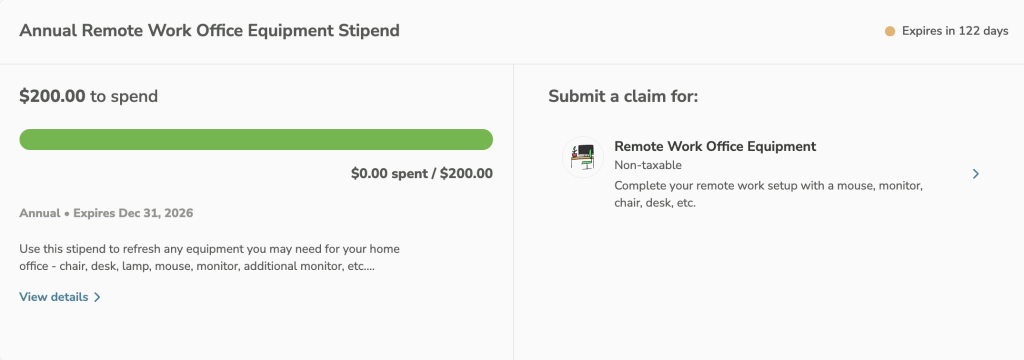
Benchmark: Compt’s 2026 midyear data shows median office-equipment stipend funding more than tripled, from $250 in 2025 to $800 per employee at midyear 2026.
11. Commuter benefits
One of the main advantages to remote work is that it eliminates the time and money employees would typically spend commuting. But for those who do commute, commuter benefits are becoming more common: Compt’s 2026 midyear data shows commuter stipend adoption rose from 7.6% to 9% of customers, while new dedicated commuter stipend launches increased 50% year over year.
Commuter stipends can help employees pay for:
- Parking and toll reimbursements
- Public transit subsidies
- Gas
- Rideshare app reimbursement
- A company car allowance
An advantage for you as the employer is that some benefits in this category qualify for a tax exemption. For 2026, the federal monthly exclusion is $340 for qualified parking and a separate $340 for combined transit passes and commuter highway vehicle transportation.
Example: Use Compt to reimburse eligible commuting expenses and categorize approved reimbursements for payroll reporting.
12. Family and caregiving stipends
You probably already offer paid parental leave for new parents, but that doesn’t always apply to anyone already raising a family, expecting a child soon, becoming a stepparent, blending their family, or caring for an elder.
Family stipends cover some or all of the following categories:
- Childcare
- Adoption
- Surrogacy
- Elder care
- Fertility
- Bereavement
- The ongoing costs of raising a child
Benchmark: Among Compt users who offer family and caregiving stipends, median funding is $2,000 per employee per year, and programs range from $1,200 to $12,000.
13. Employee assistance programs
An employee assistance program is a confidential and voluntary counseling service that helps employees with their personal or work-related concerns. EAPs provide confidential, short-term counseling for stress, grief, marital/family issues, and substance abuse disorder (among other things). Many also offer legal advice on taxes, mortgages, wills, etc., and financial services like budgeting and debt management.
Example: If an employee has a significant financial burden or substance abuse problem, they could confidentially connect with your EAP service provider for advice or resources at no cost.
14. Student loan repayment and tuition reimbursement
According to July 2026 data from the Education Data Initiative, the typical borrower has $39,633 in federal student loan debt. And among 2023–24 Bachelor’s degree recipients who borrowed, average cumulative debt was $29,560.
For the millions who couldn’t pay cash for their four-year degree, student loan repayment assistance will be a top benefit they’ll consider. If you want to source top specialized talent right out of college or grad school, you would be wise to offer it.
Tuition reimbursement is another option if you want to upskill your existing team or attract professionals in a particular field.
Example: Under a qualifying Section 127 educational assistance program, employers can exclude up to $5,250 per employee per year in eligible educational assistance, including qualifying student loan payments.
15. Learning and development budgets
Learning and development benefits are becoming a bigger part of benefits strategy as employers invest in new skills, including AI. Compt’s 2026 midyear data shows the median professional development stipend doubled from $800 to $1,600 per employee, while the share of customers offering one rose from 20% to 25%.
Employees can use professional development budgets for things like:
- Online courses and training
- Conferences and seminars
- Books and learning tools
- Professional certifications
- AI tools and upskilling
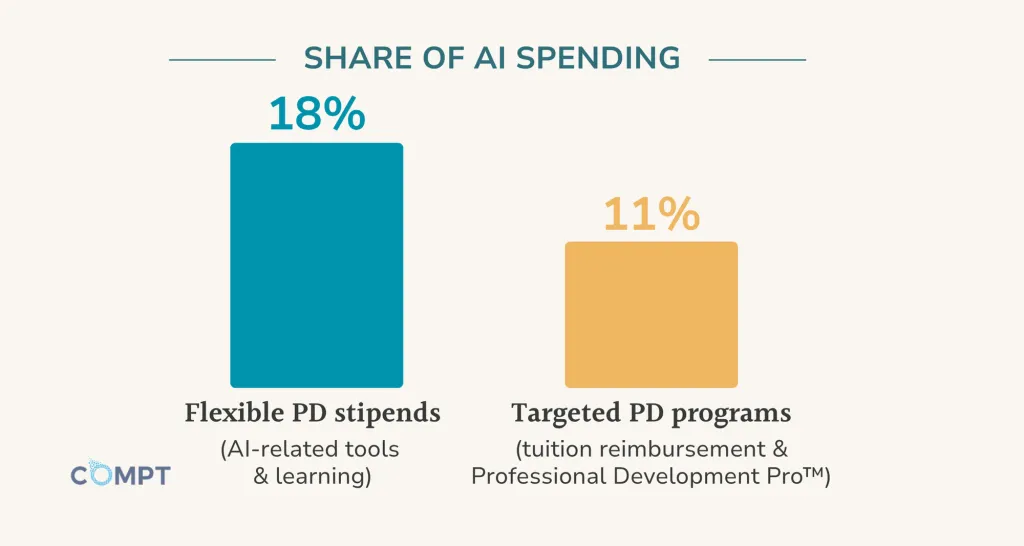
AI-related tools and learning accounted for 18% of traditional professional development stipend spend and 11% of spend in structured tuition and Professional Development Pro™ programs in H1 2026.
Even better: Some job-related education may also be nontaxable when it meets IRS working-condition benefit rules.
Example: Give employees a professional development budget they can use for role-specific training, certifications, conferences, or emerging skills like AI.
16. Employee referral bonuses
An employee referral program can help you find qualified candidates by turning your existing employees into another recruiting channel.
Research from Ashby shows that referrals make up a smaller share of applicants but convert much more efficiently. Despite making up just 18% of the typical applicant pool, 52% of them passed the initial screen compared with 35% of candidates overall, a trend that continues through on-site and offer stages.
Example: Let your team know when you’re hiring, then offer them $2,500 for submitted employees who accept the job offer and stay with the company for 3 months.
17. Workplace giving programs
Not all employee rewards programs need to be for personal gain. Many employees want to participate in their communities, and enabling them to support a good cause may improve their engagement at work. Workplace giving programs let your team donate money to causes they care about while you provide matching contributions.
Some employers sponsor charitable giving annually or quarterly. Others have an ongoing program anyone can participate in whenever they like.
Example: Run a year-end or Giving Tuesday matching campaign to gamify your charitable giving program. Let the team know they can donate to their favorite charities, and you’ll match their gift.
18. Inclusive employee benefits
It’s not only additional benefits that you should look into. It could be that your current benefits plan needs slight changes, with accessibility for the whole team in mind. That’s something worth considering.
For example:
- Instead of offering just maternal leave, offer paid paternal and adoption leaves as well to support same-sex couples and the household as a whole.
- Select a healthcare provider that covers domestic partners to include LGBTQ+ families and employees who choose not to get married.
- Instead of giving time off just for Christmas, offer flexible paid holidays for employees who don’t observe Christian holidays.
Example: Include paid leave for adoptive parents in your health insurance plan and/or family support policy.
19. Financial planning services
When it comes to financial wellness benefits, you don’t have to reinvent the wheel. But you should offer more than just a 401(k) match. Financial planning services are one great option because they give employees access to qualified professionals who can help them plan for the future.
This could include:
- One-on-one advice sessions with financial planners
- Retirement calculators and budgeting tools
- Financial education courses on debt management, investing, etc.
- Automatic savings plans
Benchmark: Financial wellness ranked among the top 10 LSA categories in Compt’s 2026 midyear data, coming in at No. 7.
20. Profit-sharing bonuses
Especially if you’re part of a startup or growth-stage company that can’t afford to provide everything under the sun, profit sharing is the perfect way to give your employees a stake in the success.
Employers set up profit sharing in one of a few ways:
- A flat percentage of profits
- A fixed amount for each employee
- A bonus based on a company’s performance metrics (e.g., sales growth)
Example: Set up an annual bonus plan that pays employees 5% of the company’s net profit when they meet certain targets.
Offer unique employee benefits with Compt.
Compt lets employers run stipends, LSAs, and employee recognition through one reimbursement-based platform. HR sets the budgets, eligible categories, and program rules; employees choose eligible expenses and vendors; and Compt categorizes approved reimbursements for payroll reporting.
That gives you a way to add or consolidate benefits without setting up a separate point solution for every category.
Ready to see what that could look like for your team? Request a Compt demo today.
FAQs: Unique employee benefits
With Compt, employers can include a wide range of LSA categories, including wellness, professional development, pet care, charitable giving, family support, financial wellness, technology, and everyday lifestyle expenses. Employers choose which categories are eligible, so the program can reflect their workforce instead of a fixed vendor catalog.
Compt’s 2026 midyear benchmark report shows just how broad that can get: Treat Yourself, Compt’s most flexible LSA category, became the No. 1 LSA category, ahead of wellness, food, pets, family, personal development, and financial wellness.
What are some examples of unique employee benefits?
Compt helps employers offer unique benefits like pet stipends, home-office reimbursements, commuter support, professional development budgets, recognition awards, student loan assistance, family and caregiving stipends, and financial wellness support. These can be provided to employees individually or combined within a flexible LSA.
The best options depend on what your employees actually need, so the goal is usually to give people useful choice rather than add another narrow perk or point solution that goes unused.
How do you choose unique employee benefits employees will actually use?
Compt recommends starting with your workforce rather than a list of trendy perks. Ask employees what expenses or needs their current benefits do not cover, review participation and utilization in existing programs, and prioritize benefits that are relevant across a broader group.
Flexible stipends and LSAs can also make it easier to support different needs through one program. Compt’s 2026 midyear data shows employers are increasingly using established stipend infrastructure to support a wider range of categories.
Can employers offer several unique employee benefits through one Lifestyle Spending Account?
Yes. With Compt, employers can combine multiple eligible categories, such as wellness, pet care, family support, financial wellness, professional development, and technology, within one all-inclusive LSA. HR defines the categories, budgets, eligibility rules, and program settings, while employees choose eligible expenses within those rules.
That structure is already common among Compt customers: 65% offer an all-inclusive LSA, according to our 2026 Midyear Employee Lifestyle Benefits Benchmark Report.

 No receipt chasing