
When an employee accepts a role that requires them to move, a relocation stipend helps them cover the expenses associated with starting over in a new place.
Even when the opportunity is exciting, the cost and disruption of moving can make a job offer difficult to accept. Employees may need to pay for movers, transportation, temporary housing, and other expenses, all while navigating the personal and financial challenges of relocating.
For an employer, offering relocation assistance removes a major barrier to hiring candidates outside their local area or retaining valuable employees who need to relocate for a new role or a return-to-office mandate.
But how much should you offer? Which expenses should you cover? And should you provide the money upfront or reimburse employees after they’ve paid?
This guide covers relocation stipend amounts, eligible expenses, payment methods, 2026 tax considerations, and how to create a policy that works for employees and employers.
What is a relocation stipend?
A relocation stipend is a fixed amount of financial assistance an employer provides to help an employee cover moving expenses for a work-related relocation. It can be paid upfront as a lump sum or offered as a reimbursement budget for approved expenses.
You, the employer, determine who qualifies, how much assistance they’ll receive, and which expenses are covered. Depending on your stipend policy, employees may receive a fixed cash payment to spend as needed or submit receipts for reimbursement up to a specified limit.
You’ll also hear related terms like:
- Relocation allowance: Typically refers to a fixed cash payment employees can use toward moving expenses.
- Relocation package: A broader arrangement that may combine financial assistance with employer-arranged services, temporary housing, or other support.
- Expatriation assistance: Relocation support specifically for employees relocating abroad (potentially including immigration services).
Some companies use the terms “stipend,” “allowance,” and “package” interchangeably, but the actual benefits and conditions ultimately depend on the decisions you’ve made in your employee relocation policy.
Are you ready to set up a relocation stipend?
Employees who move for a new job would love your help covering those costs. Learn how relocation reimbursement through Compt makes life easier for you and your employees.
What expenses can employers cover with a relocation stipend?
The exact expenses covered depend on your relocation policy, but relocation stipends and packages may include some or all of the following:
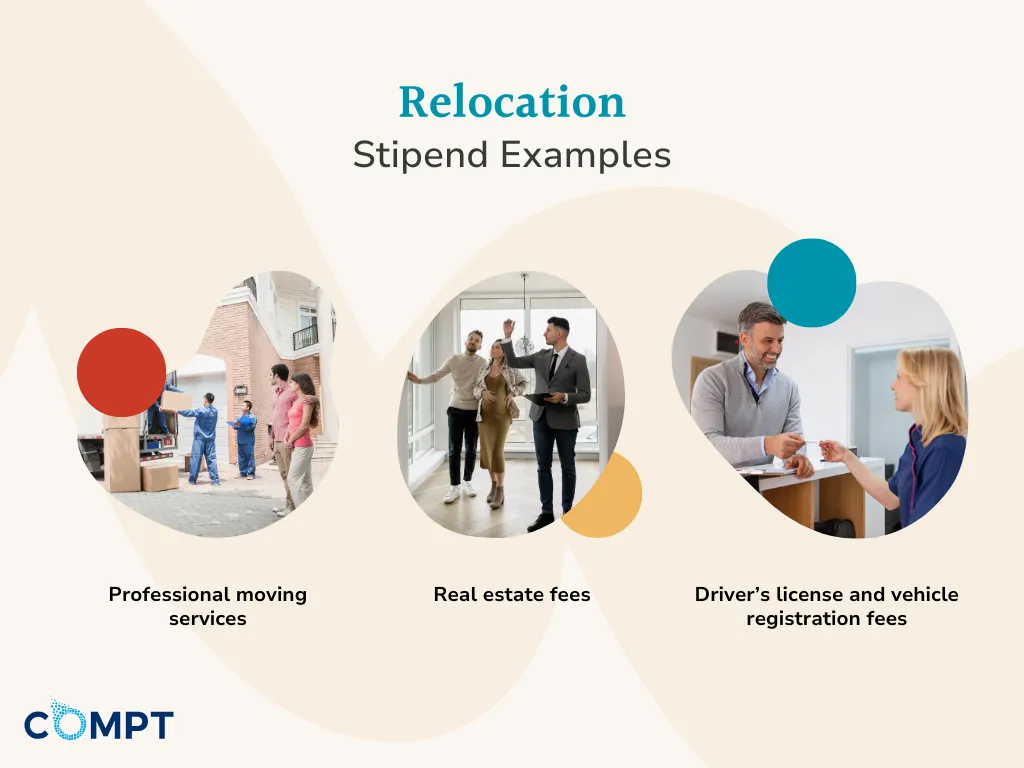
- Moving services and supplies: Professional movers, packing and unpacking services, moving truck rentals, packing materials, and moving insurance.
- Transportation and travel: Airfare, mileage, hotel stays during the move, and other travel-related costs.
- Temporary housing and storage: Short-term accommodations while employees find permanent housing, plus storage for their belongings.
- Housing-related expenses: House-hunting trips, lease termination fees, real estate closing costs, home-selling expenses, and mortgage assistance.
- International relocation support: Language training and immigration-related assistance for employees moving abroad.
- Family and miscellaneous expenses: Pet transportation, childcare, and other costs associated with moving a household.
Some employers also provide a per diem for meals and incidental expenses during the move or arrange certain services directly rather than reimbursing employees afterward.
Your relocation policy should make it clear which expenses qualify, whether any require preapproval, and how much the company will cover.
Benefits of relocation stipends
Convincing a worker to relocate is a huge challenge. Even if you give them a sweet deal, many people have a natural aversion to it.
In Bankrate’s 2025 Worker Intentions Survey, just 18% of American workers surveyed said they’d be likely to relocate for a job within the next 12 months. And in Atlas Van Lines’ 2026 Corporate Relocation Survey, 59% of participating employers reported that at least one team member had declined to relocate in 2025.
Offering a relocation stipend won’t fully eliminate concerns about family ties, housing, or a spouse’s career. But it can make a move more financially feasible by covering some of the expenses employees would otherwise have to pay themselves.
Here’s how that translates into benefits for employers.
A wider talent pool
Remote work gives companies access to talent beyond their immediate area. Many roles are hybrid or fully in-person now, though, after the return-to-office mandates of the last few years, and roles that require regular office attendance still limit recruiting to people within commuting distance.
Offering relocation assistance makes it easier for candidates outside your immediate area to consider the opportunity, and it can make your company more competitive when a strong candidate is offered positions in different locations.
Cost savings on employee retention
Retaining an experienced employee is often more economical than hiring and training their replacement.
According to SHRM’s 2025 HR benchmarking research, the average cost per hire is $5,475 for nonexecutive employees and $35,879 for executives. Those figures don’t account for every cost associated with employee turnover, such as lost productivity and time spent onboarding.
When an existing employee is considering a promotion or internal transfer that requires relocation, a stipend can remove a major financial obstacle. Your company retains their institutional knowledge, all while giving them an opportunity to grow and avoiding the aforementioned recruitment costs.
Ability to compete with bigger companies
Small and midsize companies can’t always compete with larger employers on total compensation or match their extensive relocation packages. But a defined relocation stipend can still make a job offer more attractive, particularly when it covers expenses the employee would otherwise struggle to afford.
And if there’s a candidate you really want to hire, having a relocation stipend program already in place gives you a starting point for negotiating additional one-time relocation assistance to meet their needs.
Easier stipend administration
With a reimbursement-based platform like Compt, you can offer one-time relocation stipends with configurable reimbursement limits, eligible expenses, and employee eligibility rules.
That gives employees the freedom to compare and choose the moving companies, transportation providers, and other services that best meet their needs, as long as the expenses comply with your policy. They submit receipts for eligible expenses and receive approved reimbursements through your regular payroll process.
That flexibility extends to your budget, too. Instead of paying the full allowance upfront, you only reimburse expenses employees submit and get approved, up to the limit you’ve set. If they don’t use the full amount, the rest stays with your company.
Compt was purpose-built to create less work for HR. It keeps your expense records in one place, applies your configured tax classifications, and gives Finance the payroll-ready reports they need. And with unlimited stipend and LSA programs in Compt, your relocation benefit fits right alongside the wellness, home-office, or professional development stipends you already offer.
Important: Most U.S. relocation reimbursements are taxable compensation in 2026, even with receipts.
Examples of companies offering relocation assistance
Relocation assistance is a well-established hiring incentive among large employers, but it isn’t one-size fits all. In Atlas Van Lines’ 2026 Corporate Relocation Survey, 47% of employee relocations were fully reimbursed, while 23% received partial reimbursement and 19% used lump-sum payments.
Here are some examples of major companies offering relocation assistance today:
- Amazon: Lists relocation assistance among its U.S. employee benefits, with eligibility varying by role.
- Apple: Lists relocation assistance as a potential benefit for certain positions. (Here’s one example at the time of publication, but note the job posting may expire.)
- Microsoft: Offers several relocation package options for eligible candidates in its early-career programs, with details provided during recruitment.
- American Airlines: Provides relocation stipends to eligible interns and early-career hires, although housing isn’t provided directly.
- Netflix: Provides relocation support for employees and their families when relocating to another office at the company’s request.
- Salesforce: Offers relocation support for eligible roles, including a Dublin program with assistance finding housing and navigating local paperwork.
- Sourcegraph: Offers a $1,000 annual moving reimbursement for U.S.-based employees, whether they’re new hires or existing team members. It covers professional movers or self-managed moving expenses.
- Dynatrace: Provides relocation assistance for eligible positions, with its Austria program covering moving expenses, temporary housing, visa assistance, and support settling into a new country.
You’ll notice most companies don’t publicly disclose the actual value of their relocation packages. Relocation needs vary considerably, though. A new graduate moving alone may need very different assistance than an employee relocating internationally with their family.
Your relocation policy should reflect those differences by tailoring your relocation assistance to the employee’s situation, the role’s requirements, and your available budget.
How employee relocation stipends work
Employers generally offer relocation assistance in three ways: an upfront lump-sum allowance, reimbursement for approved expenses, or a comprehensive relocation package that combines financial assistance with additional services.
The right approach depends on how much support your employees need and how involved your company wants to be in the moving process.
1. Upfront lump-sum relocation allowance
With a lump-sum allowance, you give employees a fixed amount of money before they relocate. They have the freedom to arrange their move independently without having to cover the full cost upfront or waiting for reimbursement.
It’s a straightforward approach that gives employees flexibility, especially when they’re facing significant upfront costs. But your company pays the full allowance regardless of how much the employee spends, and you have zero visibility into where that money goes.
Example: A growing tech company offers its new CFO a one-time $10,000 relocation allowance to arrange their move.
2. Reimbursement for approved, itemized expenses
With expense-based reimbursement, you establish a spending limit and decide which relocation expenses qualify. Employees choose their own vendors, pay for their expenses, and submit receipts for reimbursement. Once approved, reimbursements are processed through your company’s payroll workflow.
This gives you the most control over how company funds are spent. Reviewing receipts against your relocation policy reduces the risk of reimbursing ineligible expenses. You have documentation of what employees purchase and only reimburse expenses that meet your policy, rather than paying out a full allowance regardless of actual costs.
The tradeoff? Employees need to cover their moving expenses upfront and wait for reimbursement, which may be difficult when costs are high. Your HR team also needs a way to review claims and track spending against each employee’s limit.
Fortunately, Compt takes much of that administrative work off your plate.
Example: A marketing agency hires a campaign manager from another state. Instead of providing a lump sum, it agrees to reimburse approved moving services and temporary housing expenses up to $5,000.
3. Adding a stipend to a comprehensive relocation package
For more complicated moves, you may offer a comprehensive relocation package that combines financial assistance with services arranged on the employee’s behalf.
This is especially useful for international employment transfers or employees moving with their families. Instead of expecting the employee to coordinate every aspect of the move themselves, the employer might arrange professional movers, provide temporary housing, or assist with immigration paperwork.
A comprehensive package reduces the logistical burden on employees as well as the financial one. However, it typically requires more coordination and a larger budget.
Example: A U.S. company transfers a director to lead its new London office. It arranges international movers and temporary housing, then provides a separate stipend for incidental expenses.
How to set up your own relocation package policy
A solid relocation policy makes it clear who qualifies for assistance, what your company will pay for, and how employees will be reimbursed.
Here’s how to put one together.
1. Decide who’s eligible and what’s covered.
Start by defining which employees qualify for relocation assistance. You might offer it to new hires recruited from outside your local area, existing employees transferring offices, or both.
Then, outline the expenses you’ll cover. These might include moving services, transportation, or temporary housing, depending on the type of relocation assistance you’re offering.
Be specific about exclusions and which expenses require preapproval. For example, you might approve standard moving costs within a set limit but require additional authorization before an employee books several weeks of temporary housing.
Your employee stipend policy should also explain what documentation employees need to provide, so there aren’t surprises when it’s time to request reimbursement.
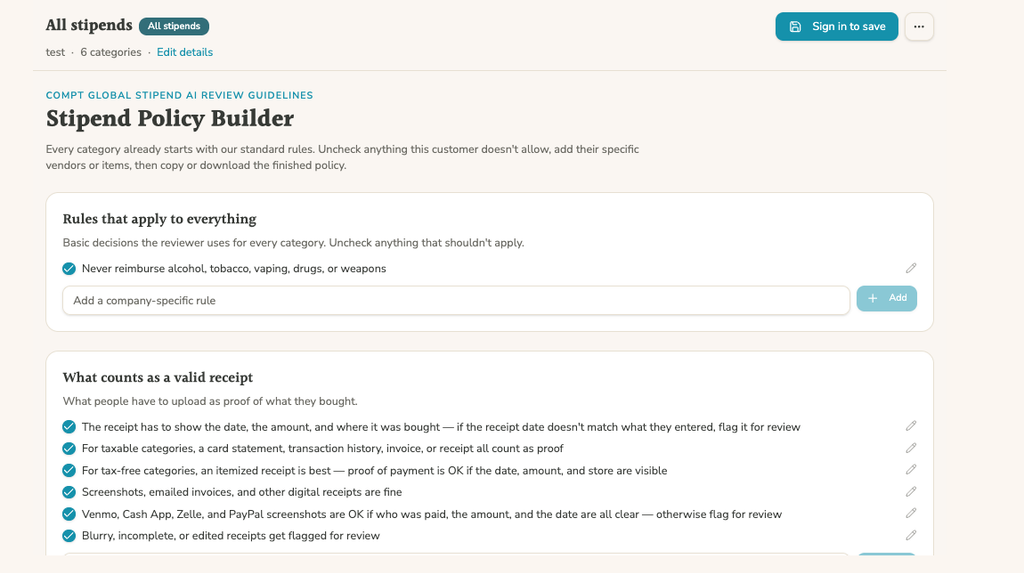
Your employee stipend policy, simplified.
Build a clear, customizable stipend policy for what’s covered, who’s eligible, and how expenses are handled. The Stipend Policy Builder starts with Compt’s LSA policy guidelines and lets you tailor the rules to your program.
2. Set your budget.
There’s no universal relocation stipend amount. What makes sense for an entry-level employee moving alone will be very different from what a senior executive relocating with their family needs.
For context, Atlas Van Lines’ 2026 Corporate Relocation Survey found that the most commonly reported lump-sum payment range was $10,000–$12,499. That’s helpful as a reference point, but it isn’t necessarily what you’d want to offer as a reimbursement-based stipend.
Instead, consider the circumstances of the move when establishing an allowance or reimbursement limit:
| Budget factor | What to consider |
|---|---|
| Role and seniority | The requirements of the position, difficulty of recruitment, and whether additional assistance is needed to secure a candidate. |
| Moving distance | A local move generally costs less than a cross-country or international relocation. Get quotes before setting a final reimbursement amount. |
| Family circumstances | Employees relocating with partners, children, pets, or other dependents may face higher costs during their move. |
| Housing situation | Renters may have lease termination expenses, while homeowners will face the process of selling or renting out their property. Relocating employees may also need temporary accommodation at their new location. |
| Destination and timing | Local housing prices and the time available to complete the move will make a substantial difference. |
Some employers establish standard funding tiers for different employee groups, with room to approve exceptions when circumstances warrant additional support.
You’ll also need to decide whether to provide a tax gross-up: additional compensation intended to offset some or all of the employee’s tax burden on taxable relocation assistance.
3. Build your relocation program.
Once you’ve established eligibility and funding limits, you need a way to administer the benefit.
With Compt’s stipend platform and custom eligibility rules, you can:
- Customize eligibility for new hires, existing employees transferring offices, or both.
- Set location-based budgets and reimburse international employees in USD or their local currency.
- Use employee attributes like department, seniority, tenure, and number of dependents (where available in your HRIS) to determine eligibility and funding amounts.
- Control expense coverage by limiting reimbursements to approved categories or covering all eligible expenses up to a predefined budget.
- Create one-time reimbursement programs with their own spending limits, eligible expense categories, and expiration dates.
Example: You offer an eligible employee $5,000 toward relocation expenses, available for 90 days. Through Compt, they submit receipts for approved moving services, transportation, and temporary housing. You reimburse qualifying expenses up to the $5,000 limit.
Here’s an overview of the stipend admin process in Compt:
And because Compt supports unlimited stipend and LSA programs, it’s easy to manage relocation assistance alongside other stipends.
That kind of consolidation is already common. According to Compt’s 2026 Midyear Lifestyle Benefits Benchmark Report, 65% of customers offer an all-inclusive LSA, bringing multiple benefits categories under one program. Relocation assistance can still have its own budget and eligibility rules without adding another system.
4. Get your employees onboarded.
Employees should understand their relocation benefits before accepting an offer or agreeing to a transfer.
Include the key terms in their offer letter or relocation agreement, then provide a written policy that explains how reimbursement works. Be especially clear about when expenses must be incurred versus when receipts must be submitted. Those aren’t necessarily the same deadline.
Employees should also know what happens if they don’t use their full allowance or their move gets canceled. If your company requires repayment when someone leaves shortly after relocating, spell out those conditions in the relocation agreement and have them reviewed for applicable legal requirements.
If you’re starting with a blank page, Compt’s free Stipend & LSA Policy Builder offers a starting point for drafting written program rules.
5. Reimburse through payroll and track expenses.
Once employees submit their claims, the next step is to review them against your policy and approve qualifying expenses for reimbursement.
For ordinary U.S. employees, relocation reimbursements are generally taxable compensation, even when supported by receipts. Your payroll team needs to account for applicable withholding and reporting requirements. International relocations may require different treatment depending on the jurisdiction.
Compt keeps expense documentation and reimbursement records together, applies the tax classifications your company has configured, and generates payroll-ready reports. That gives Finance the information it needs to process reimbursements and reconcile spending without tracking everything manually.
Make relocation reimbursements easy with Compt.
Relocation assistance shouldn’t create more work for HR and Finance. And it doesn’t have to.
With Compt, employees get the freedom to choose how they move, while you decide which expenses qualify and how much to reimburse. They submit receipts through Compt, and approved reimbursements are processed through your regular payroll workflow.
And there’s no need for another benefits system just to manage relocation assistance. Compt keeps your expense records organized and gives Finance the reporting it needs, whether you’re managing a one-time relocation stipend or your entire employee benefits program.
Ready to see for yourself? Request a Compt demo today.
FAQ: Employee relocation stipends
There’s no universal amount. Your relocation budget should reflect the expected cost of the move and how much assistance your company intends to provide. Atlas Van Lines’ 2026 Corporate Relocation Survey found that $10,000–$12,499 was the most commonly reported lump-sum payment range, but that isn’t a recommended amount for every employee relocation stipend or reimbursement program.
Are employee relocation stipends taxable in the U.S. in 2026?
Yes. For most U.S. employees, relocation stipends and moving-expense reimbursements are taxable compensation in 2026, even when employees submit receipts. Limited exceptions apply to certain qualifying military and intelligence-community relocations. Employers should account for applicable withholding and payroll reporting requirements when designing their programs.
When do employees receive their relocation stipend?
It depends on how the employer structures the benefit. An upfront lump-sum allowance typically gives employees money before the move, while a reimbursement-based stipend pays employees after they’ve incurred eligible expenses and submitted approved claims.
With Compt, approved reimbursements are processed according to the employer’s payroll schedule.
Can employers offer different relocation stipend amounts to different employee groups?
Yes. Employers may establish different relocation budgets based on the position, type of move, or other defined eligibility criteria. Compt supports different funding amounts and eligibility rules for employee groups, allowing companies to tailor relocation assistance without administering every reimbursement manually.
What happens if an employee doesn’t use their full relocation stipend?
With a reimbursement-based program like Compt, unused funding remains with the employer. For example, if an employee has a $5,000 relocation budget but submits only $3,500 in approved expenses, the remaining $1,500 isn’t automatically paid out.
Upfront lump-sum arrangements work differently, and any repayment conditions depend on your established policy.
Can employers manage relocation stipends alongside other employee benefits?
Yes. Compt supports unlimited stipend and LSA programs within one platform, so employers can manage relocation assistance alongside ongoing employee benefits such as wellness stipends or professional development accounts. Each program can retain its own funding limits and eligibility rules, giving HR one place to manage benefits without requiring every employee to receive the same allowance.
Editor’s note: Compt software supports the categorization and proper reporting of benefits according to IRS guidelines, helping businesses maintain compliance. However, Compt cannot provide tax advice, and users should consult their own tax, legal, and accounting advisors when necessary.
Editor’s note: Originally published in 2023, this post has been recently updated for clarity and relevance for our readers.

 No receipt chasing