
HR leaders don’t wake up thinking, “I hope I add another vendor to manage today.”
They think:
- How do I move work off my plate?
- How do I reduce admin headaches?
- How do I make benefits easy for employees?
- How do I prove to Finance we’re not paying for unused benefits?
- How do I consolidate perks without creating more complexity somewhere else?
In 2026, “easy-to-use employee benefits software” isn’t about a prettier UI. After talking about flexible employee stipends and Lifestyle Spending Accounts (LSAs) with hundreds of HR, Total Rewards, Finance, and Payroll leaders across tech, healthcare, logistics, and global organizations, one theme is consistent:
Leaders measure ease by what happens after launch.
In fact, 64% of Compt customers now run an all-inclusive LSA — up from 55% the year before — often after starting with multiple standalone stipends and deciding to consolidate them into one operational framework.
When these leaders evaluate Compt, the conversation usually centers around a handful of structural decisions that determine whether the platform actually reduces work. And these are the reasons customers tell us the platform feels simple and manageable once it’s live.
Here are some of the features they consistently point as priorities in easy-to-use employee benefits software.
1. Platform for multiple stipends or an LSA (without adding vendors)
Most midsize companies don’t run just one stipend. They run several:
- Wellness
- Professional development
- Remote work
- Commuter benefits
- Company swag
- Recognition or spot bonuses
- See Compt’s 28 stipend categories for more ideas
Managing each through a separate vendor creates fragmented reporting and duplicated work.
One People leader shared:
“The more and more you can get into one place, I think the better off you are.”
Another put it this way:
“I like that the entire [Compt] product is designed around simplification. … [With our current solution], we’re paying for a lot of things that our team members just aren’t using because there’s too much complexity.”
What customers consistently value is being able to manage multiple benefit categories inside a single system, with one clean integration into payroll and HRIS.
The first goal of creating a lifestyle benefits platform that prioritizes admin simplicity is subtracting work so you end up with fewer workflows, not fewer perks.
2. Reimbursement-first funding (over prepaid cards and payroll-based stipends)
Prefunded debit cards create several predictable issues:
- Unused balances that sit in limbo
- Cash tied up for 100% allocation regardless of participation
- Questions from your Finance team regarding accruals and forecasting
- Card fees, replacements, and admin overhead
- Embarrassing transaction declines and MCC blocks at checkout
- Limited vendor flexibility based on platform restrictions
- IRS compliance complexity and audit risk because receipts aren’t tied to spend
Stipends issued directly through paychecks add another structural challenge:
- 100% payout regardless of actual usage
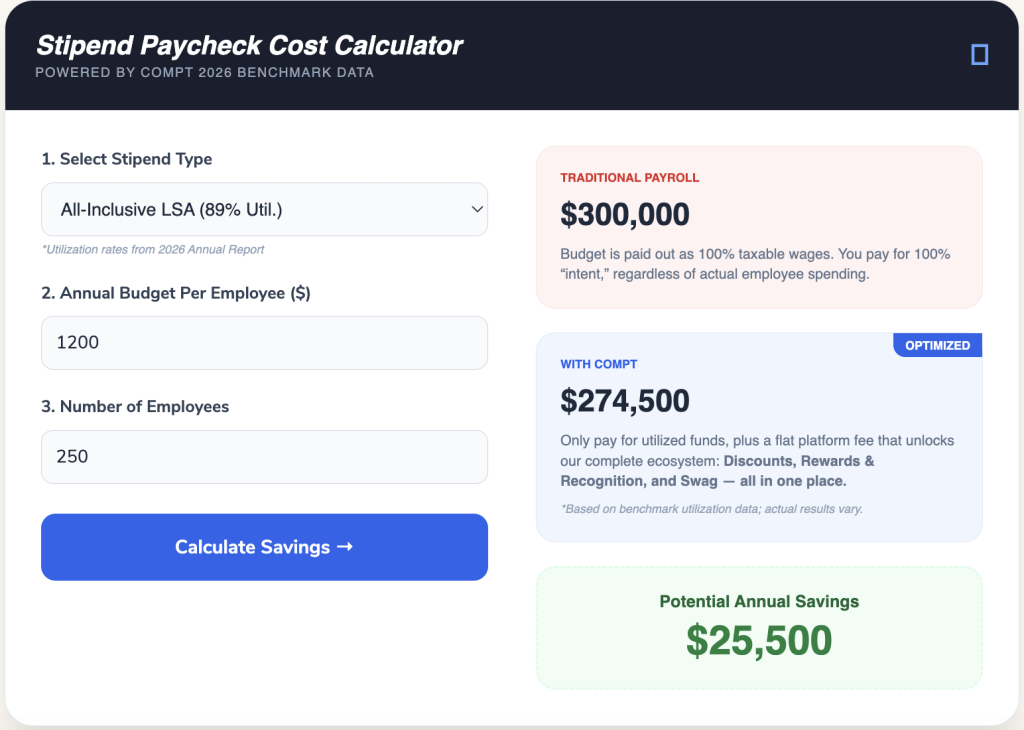
Stop overpaying for underused benefits.
Traditional payroll stipends are paid out 100% regardless of actual use.
With Compt, you only pay for the funds employees spend, saving you thousands while increasing benefits engagement.
Customers regularly tell us this difference matters more than they expected. It’s less about the surface experience and more about what the funding model does to cash flow, reporting, and operational lift over time.
One leader evaluating stipend models said:
“There’s no prefunded budget … so there’s no chance of losing those funds from the company perspective.”
Another emphasized the financial control aspect:
“Financial control will be a big one. … How do we protect against unexpected spikes in spending?”
A reimbursement-first structure changes that dynamic:
- Funds are only paid when the employee claims their reimbursement.
- Reporting reflects real employee usage and can be used to support decision-making.
- No juggling prepaid card balances, fees, and replacements.
- Receipts support tax handling and IRS compliance.
For Finance, the clarity that comes with a Compt program changes the conversation from “What are we exposed to?” to “What are we actually seeing?” And that matters once you scale beyond a few dozen employees.
3. Clean payroll and HRIS integration (without duplicative work)
When HR leaders seriously evaluate easy-to-use employee benefits software, this comes up almost immediately.
A VP of People told us:
“Best-in-class is definitely a priority … but what would definitely make me select that software is if there was some sort of file feed from our ADP. … We don’t want to have to do duplicative work.”
Another leader put it even more directly:
“It’s all about: how does the data get into the benefit system, how does it get out to payroll?”
That’s the operational reality.
If HR is manually exporting files, reformatting payroll data, tracking eligibility in spreadsheets, or reconciling headcount changes across systems, then the platform isn’t actually easy to use; it just transferred the work somewhere else.
Compt customers talk about integrations the way payroll teams talk about them: the employee data stays current, eligibility doesn’t require babysitting, and the report you need is there when you need it (all without asking someone to build it for you).
Customers care about whether the system runs in the background without constant oversight — whether they can set the rule once and not have to think about it again.
Integration isn’t flashy. But it’s where hours are saved every month.
4. Built-in tax logic and compliance guardrails (so Payroll isn’t cleaning it up later)
Tax handling is where simplicity in easy-to-use employee benefits software often falls apart.
Simplicity often breaks down when companies need to consider mixed-use items, taxable vs. nontaxable stipend categories, commuter rules, tuition exclusions, and multistate payroll considerations.
For example, the IRS allows up to $5,250 per year in tax-free educational assistance and sets monthly limits on qualified commuter benefits (such as the $340 per month cap for transit and parking in 2025). If you’re tracking those thresholds manually in spreadsheets and adjusting payroll when someone crosses them, that becomes very operationally painful, very fast.
A Head of Total Rewards said:
“I like the reimbursement feature from a compliance standpoint.”
IRS compliance for lifestyle benefits isn’t optional. Under IRS Publication 15-B, fringe benefits are taxable unless a specific exclusion applies — and the burden of proving that exclusion sits firmly with the employer.
Compt customers consistently value:
- Category-level tax designation
- Clear taxable vs. nontaxable logic
- Receipt documentation tied to spend
- Centralized reporting for audit purposes
When those rules are set once and enforced consistently, HR isn’t revisiting policy interpretation every quarter. That’s admin simplicity in practice.
5. Broad category definitions (without sacrificing control)
Low employee participation in a benefit rarely comes from lack of budget. When employee perks are tied to one vendor, one marketplace, or one rigid list, engagement drops over time as employees struggle to find a way to use the benefit.
One leader evaluating stipends shared:
“I love the idea of a Lifestyle Spending Account because it puts choice back in the hands of employees. Instead of a one-size-fits-all perk, people can select what truly matters and makes a difference to them. … I think that’s the future of benefits.”
Another said:
“The flexibility to reimburse people in different categories helps solve for some of the personalization that needs to come with benefits.”
Customers consistently point to Compt’s vendor-agnostic flexibility as one of its most valuable features.
It allows employees to:
- Use local providers
- Choose services that match their life stage
- Spend funds where they already shop
At the same time, policy guardrails remain centralized, categories are defined clearly, receipts are reviewed, and tax logic is applied consistently. Flexible doesn’t have to mean chaotic.
6. Visibility into participation (not just allocation)
Finance doesn’t want to hear that participation “feels strong.” They want numbers.
For example, in 2025, all-inclusive LSAs reached 93% participation and 89% utilization, according to our 2026 Annual Lifestyle Benefits Benchmark Report.
HR leaders want to see:
- Engagement trends over time
- Claimed vs. allocated funds
- Vendor diversity
- Category usage patterns
One Total Rewards leader said it plainly:
“Reduced admin time doesn’t always land home. … The story needs to be told in dollars and cents.”
For a multicountry SaaS organization with just under 1,000 employees, participation recently climbed into the high 90%s after consolidating stipends into one reimbursement-first platform. Nearly 11,000 claims were processed across 1,000+ vendors in a year. Participation even spiked in December as employees saw remaining balances and used the program before year-end — an insight that only became visible once reporting was centralized.
Pictured from a wider lens, 64,000 different vendors were represented among all Compt customers in 2025, according to our 2026 Annual Lifestyle Benefits Benchmark Report. Of those, 70% of employee spending went to independent, local, or niche vendors, with only 30% going to big names such as Amazon and Walmart.
That kind of visibility changes how benefits are discussed internally and helps move the conversation from anecdotal to measurable.
7. Scalability for growing, distributed, and global teams (without adding local exceptions)
As organizations grow, complexity multiplies.
One Benefits Manager shared:
“We have employees in about 46 states … finding perks that work for everyone is just really challenging.”
Global teams introduce currency differences, tax variation, regional expectations, and compliance nuances, all of which compound as your team grows.
They also introduce equity challenges. A gym chain available in New York may not exist in rural Australia. A commuter subsidy that works in London doesn’t apply to a fully remote team in Texas. Cost-of-living differences and vendor access make point-solution perks difficult to scale globally.
Stipends make that manageable. Instead of negotiating separate vendors by geography, employers can define their budget by region or employment type while allowing employees to spend locally within clear policy guardrails. The policy stays centralized; the usage adapts to where people actually live.
That structure keeps reporting consistent across regions and prevents growth from turning into administrative sprawl — which matters far more at 1,000 employees than it does at 100.
8. Embedded discounts (without creating a second portal)
Employees don’t want to change how or where they shop just to use a benefit. At the same time, Finance teams are under pressure to stretch every dollar without expanding budget.
Embedded discounts solve that tension.
Because Employee Discounts from Compt + PerkSpot live inside the same platform employees already use to submit reimbursements:
- There’s no new portal
- No additional vendor relationship
- No separate reporting stream
- No new workflow for HR to manage
Employees can apply a discount to a purchase they already planned to make, submit the lower receipt within the eligible category, and stretch their stipend without increasing employer spend.
The operational advantage isn’t just the discount. It’s that the value is layered into the same workflow.
Why HR leaders choose Compt for easy-to-use employee benefits software
If administrative simplicity is on your evaluation checklist, start with one question: will this reduce operational drag after launch, or just reorganize it?
Compt was built specifically to make it easy to:
- Consolidate stipends and LSAs into one system
- Reimburse instead of prefund
- Integrate cleanly into payroll and HRIS/HCM
- Embed IRS tax logic and compliance guardrails
- Provide reporting Finance can use and trust
The result goes beyond flexibility for employees to fewer workflows for HR, cleaner data for Payroll, and clearer forecasting for Finance.
If you’re evaluating stipend or LSA platforms and want to see how this works in practice, request a demo.

FAQs: Operational efficiency and easy-to-use employee benefits software
Compt emphasizes operational efficiency because that is what determines whether benefits software remains manageable after launch. Many platforms highlight category breadth or employee-facing design, but long-term simplicity depends on how funds are distributed, how reimbursements are processed, how tax treatment is applied, and how data moves into payroll.
Compt’s reimbursement-first structure, transaction-level tax logic, payroll integration, and centralized reporting reduce duplicated work and manual reconciliation. The result is fewer moving parts for HR and cleaner visibility for Finance.
How does Compt help HR prove to CFOs that they aren’t paying for “unused” benefits?
The distinction lies between allocated dollars and actual expense. Prefunded cards and paycheck-based stipends distribute funds regardless of whether employees use them. A reimbursement-based model only expenses funds when documented claims are submitted. That allows HR to report on participation, utilization, spend-to-budget ratio, and payroll-adjusted totals using real data. When exposure is capped per employee and tied to actual reimbursement activity, Finance gains predictability and avoids relying on theoretical allocation assumptions.
How does Compt quantify the hidden costs of managing employee stipends manually?
Manual administration often requires spreadsheet tracking, separate payroll adjustments, email-based receipt collection, and inconsistent tax categorization. Those processes create operational friction, increase administrative hours, and elevate compliance risk.
Compt consolidates approvals, documentation, categorization, and payroll sync into one system. By reducing payroll corrections and eliminating duplicate workflows, the platform surfaces operational savings that are often overlooked when stipends are managed across disconnected tools.
What key “CFO metrics” does Compt emphasize when selling the value of employee benefits?
CFOs typically evaluate participation rate, utilization rate, spend-to-budget ratio, tax exposure, vendor consolidation impact, and forecast stability. According to Compt’s 2026 Annual Lifestyle Benefits Benchmark Report, all-inclusive LSAs reached 93% participation and 89% utilization in 2025. When HR can present clean participation data alongside capped per-employee exposure and audit-ready documentation, the benefits program becomes measurable in financial terms rather than framed purely as a morale initiative.
How does Compt solve the challenge of providing uniform stipends for distributed workforces?
Distributed teams vary by location, role, and tax treatment. A stipend that works for a remote employee may need different rules for a front-line worker who requires safety gear or uniforms.
Compt allows employers to set centralized policies while applying role- and jurisdiction-specific rules underneath. For example, certain required safety equipment or non-adaptable uniforms may qualify as nontaxable working condition benefits under IRC Section 132(a)(3) when they are required for the job and reimbursed under an accountable plan. Items that can be worn outside of work are generally taxable.
Instead of managing separate vendors or manual exceptions by state or country, employers can define eligible categories by employee group, apply the appropriate tax treatment at the transaction level, and sync reimbursements directly to payroll. That structure keeps governance consistent while allowing for regional and role-based differences.
How does Compt’s tax logic handle “mixed-use” items like laptops to ensure compliance?
Mixed-use expenses can create compliance gaps when business and personal usage overlap. Compt evaluates reimbursements at the transaction level rather than treating the stipend itself as a tax category. Each expense is categorized against policy rules and IRS guidance before reimbursement is finalized. If an item qualifies for exclusion, it is documented accordingly. If it does not, it is treated as taxable and synced to payroll automatically. This rules-based approach reduces inconsistent treatment and prevents retroactive payroll corrections.
Why does Compt advocate for reimbursement-based stipends over paycheck additions?
Paycheck additions distribute the full allocated amount regardless of employee usage, which removes visibility into how the benefit is actually spent. A reimbursement-based structure requires documented claims before funds are issued. That creates clearer reporting, supports proper tax handling, and protects against unused allocation. Reimbursement improves predictability for Finance and preserves employee flexibility without sacrificing HR oversight.
What solutions does Compt propose for companies with great perks but low adoption rates?
Low adoption often stems from fragmentation rather than lack of generosity. When perks are tied to rigid marketplaces or spread across multiple vendors, employees struggle to engage consistently. Compt addresses this by consolidating multiple categories and perks programs into one system, allowing vendor-agnostic reimbursements, and providing transparent balance visibility. Clear funding cadence and centralized reporting also support stronger communication. When employees can use funds where they already spend and understand their remaining balance, engagement improves organically.