
Health benefit costs rose 6% in 2025 and are projected to rise another 6.7% in 2026, and that’s only what Mercer is reporting; in reality, many employers are seeing significantly higher renewal increases. At the same time, 17% of adults can’t pay all their bills.
Those two realities are reshaping how HR and Finance leaders think about benefits. Company budgets are under pressure, and employees are navigating very real financial strain.
That tension is why so many organizations are reevaluating alternatives to cash stipends. In practice, “cash stipends” often mean gift cards or funds issued through payroll, whether as flat allowances or bonuses. They’re easy to distribute, but they’re hard to measure, difficult to align to benefit goals, and nearly impossible to optimize once they blend into general compensation.
The issue isn’t whether employees value the money. It’s that payroll-issued cash has a fixed ceiling. A $100 payout buys $100 of goods at retail price. It offsets cost, but it doesn’t change the math.
The question for HR and Finance leaders is how to structure or redesign employee financial support so every dollar works harder than its face value.
What are alternatives to cash stipends for employees?
Let’s start with the basics.
Flexible stipends and Lifestyle Spending Accounts (LSAs) have become the most common alternative to cash stipends in payroll because they replace unrestricted cash with a defined, reimbursement-first framework.
In 2025, 64% of employers included in Compt’s benchmark data offered an all-inclusive LSA, up 9% from the prior year.
The appeal goes beyond flexibility and consolidation to accountability. A structured stipend allows employers to define eligible categories, set funding cadence, and measure participation in a way payroll allowances simply can’t. When offered through a flexible stipend platform like Compt, stipends and LSAs also account for all the nuance and complexity required for IRS compliance.
The shift from distributed cash to structured reimbursement is the first real evolution in how employers deliver financial support.
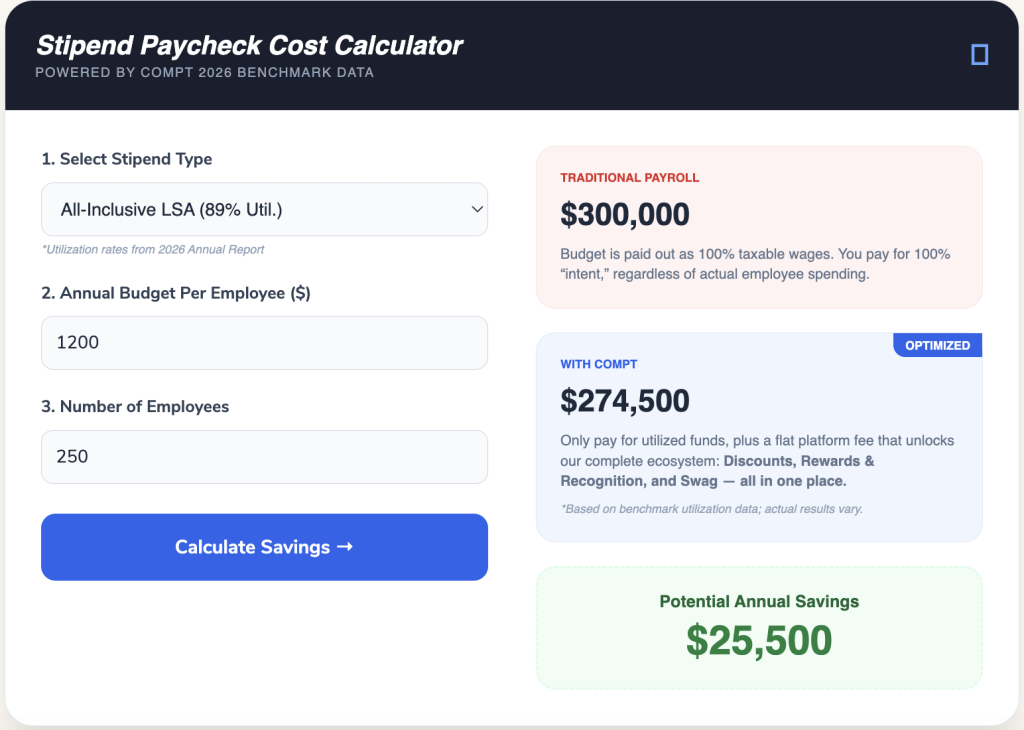
Stop overpaying for underused benefits.
Traditional payroll stipends are paid out 100% regardless of actual use.
With Compt, you only pay for the funds employees spend, saving you thousands while increasing benefits engagement.
Are gift cards or cash bonuses effective employee benefits?
Cash and gift cards are rarely unwelcome. But they don’t produce sustained engagement and a measurable outcome beyond “we issued the money.”
What’s interesting is what happens after you introduce structure. Does engagement actually improve? Do employees consistently use the funds that are allocated?
In our 2025 customer data, as reported in the 2026 Annual Lifestyle Benefits Benchmark Report, engagement on flexible benefits programs is notably high:
- 95% of invited employees activated their benefits.
- 93% of active users participated by submitting at least one expense.
- All-inclusive LSAs reached 89% utilization, meaning 89% of issued funds were actually spent within program cadence.
That last number matters. Utilization reflects whether allocated funds are actually being spent in the way the program intended. The fact that all-inclusive LSAs approach 90% utilization shows that a well-designed, flexible structure can achieve both broad participation and efficient use of dollars.
That said, even strong utilization has its limits. If purchases are consistently made at full retail price, the purchasing power of your benefit is capped. The structure may perform well, yet the underlying economics stay static.
That’s where the conversation shifts from structure to purchasing power.
How can companies make employee benefits budgets go further?
Once structure and engagement are in place, the next question is economic: can the dollars themselves do more work?
To answer that, it helps to look at how employees are actually spending their benefits. The 2025 benchmark data shows two meaningful patterns:
- Nearly 1 in 10 stipend dollars was spent at grocery retailers.
- 70% of total stipend spend flowed to local, regional, independent, or niche vendors; the remaining 30% flowed to only 10 distinct vendors, including Amazon and Walmart.
This tells us something important. Employees are not using benefits as occasional perks. They are using them to support recurring expenses. Groceries. Fitness. Internet plans. Childcare costs. Car maintenance. The benefit is landing where real financial pressure exists.
That behavioral shift reframes the opportunity. When stipends are used for essentials, their relevance increases, but their economic effect is still constrained by market pricing. Even a well-designed program can’t stretch dollars beyond what retail allows.
Maximizing a benefits budget, then, isn’t about issuing more money. It’s about increasing the effective value of the money already issued.
If a $100 stipend is used at full price, it offsets $100. If that same purchase includes a 25% discount, the effective purchasing power rises to $125 without increasing employer spend. The allocation stays fixed. The impact expands.
This is where embedded employee discounts become strategically relevant. Not as a standalone perk, and not as a separate portal competing for attention, but as a multiplier layered into an existing reimbursement-first structure.
When discounts are integrated directly into the same benefits hub employees already use, savings become discoverable at the moment of purchase. Employees can redeem a negotiated offer and, when eligible, submit the discounted expense for reimbursement. The savings stack with the stipend rather than replacing it.
For HR and Finance, nothing about the core program becomes more complex. Funding cadence, tax handling, and reporting remain centralized in the same platform. And because Employee Discounts (Compt + PerkSpot) are included with eligible Compt plans, you’re not adding another vendor or line item to the budget.
The program’s cost stays stable while its purchasing power increases. At that point, the conversation shifts from replacing cash with structure to enhancing structure with purchasing power.
See how it works with Compt stipends and LSAs:
What is the difference between a stipend and a perk marketplace?
Increasing purchasing power within a structured program doesn’t happen in a vacuum. In practice, it often forces a design decision: should value come from restricting where employees can spend, or from expanding what their dollars can accomplish?
That’s where the distinction between reimbursement-first stipends and curated perk marketplaces becomes relevant.
A perk marketplace typically centers around a defined catalog of vendors with pre-negotiated deals. Employees browse within that ecosystem and savings are applied at checkout. The value is visible, and the environment is controlled.
Reimbursement-first stipends operate differently. Instead of limiting employees to a curated list, they allow spending wherever it makes sense within defined stipend categories. You preserve flexibility, and the program adapts to real-life behavior rather than redirecting it.
The 2025 benchmark data illustrates why that distinction matters:
- Employees directed spending across 64,000+ unique vendors globally.
- 78% of total stipend spend was taxable, reflecting high participation across broadly applicable, real-life categories over narrow, tax-advantaged programs
Employees’ needs are not confined to a fixed catalog. They are local, variable, and often highly specific. Grocery stores, independent fitness studios, regional childcare providers, and specialty retailers are not often represented in curated marketplaces, yet they’re where dollars actually flow.
Marketplaces and reimbursement models are often framed as opposites. One offers savings but limits choice. The other offers flexibility but historically lacked a built-in savings layer.
Combining flexibility with embedded savings removes that tradeoff.
When embedded employee discounts are layered into a reimbursement-first platform, employees retain the freedom to spend in alignment with their lives and passions, all while gaining access to negotiated savings when relevant. Discounts become additive, not restrictive, and extend the structure’s efficiency without reshaping it.
The result is a more economically efficient version of the system you already operate.
Why Compt is a smarter alternative to cash stipends
If you’re already running stipends or are actively evaluating alternatives to cash stipends, the real opportunity goes beyond replacing payroll allowances. You can design a program that delivers measurable engagement and greater purchasing power within your existing benefits budget.
Compt combines reimbursement-first flexibility with embedded Employee Discounts, powered by PerkSpot, so employees can stretch their stipends further without being confined to a curated marketplace. Discounts live inside the same benefits hub employees already use, and eligible purchases can still be reimbursed within policy.
Because Employee Discounts are included with eligible Compt plans, you’re consolidating flexible employee stipends and savings in one global platform, with centralized reporting and built-in compliance controls.
Whether you’re replacing payroll-issued stipends or refining an existing LSA program, Compt transforms structured benefits into a real purchasing-power advantage.
Request a demo to see how Compt replaces payroll stipends with structured benefits that deliver more value per dollar.
FAQs: Alternatives to cash stipends
In 2025, wellness utilization reached 86% when delivered within an all-inclusive LSA, compared to 62% when offered as a standalone stipend.
The difference comes down to scope and flexibility. A wellness stipend allows employees to define what wellness means to them, whether that’s gym memberships, therapy, nutrition, recovery tools, or other eligible expenses within policy. Negotiated gym discounts apply to a specific vendor and primarily benefit employees who already use that location.
When wellness is embedded within a flexible stipend structure such as an LSA, engagement is typically higher because the benefit adapts to individual needs rather than requiring employees to adapt to the benefit.
Discounts can enhance that structure, but they rarely replace the participation driven by flexibility.
Do employee discounts increase employee engagement?
Discounts alone do not guarantee engagement. Standalone discount portals often struggle with sustained usage because they require separate logins and behavior changes. When savings are embedded inside the same platform employees already use for stipends and reimbursements, they reinforce participation rather than fragmenting it.
What is the most cost-effective employee benefit structure in 2026?
Funding cadence plays a significant role. For Compt customers in 2025, quarterly-funded stipend programs reached 85% utilization compared to 52% for monthly programs.
Employers are increasingly consolidating lifestyle benefits such as stipends into flexible LSAs funded on predictable cadences, then enhancing them with embedded savings to increase effective value within the same overall allocation. A structure that combines flexibility, strong participation, and purchasing power delivers more measurable impact per allocated dollar.
Are employee discounts taxable?
Employee discounts themselves are not employer-issued cash and are not reimbursements. They function as negotiated savings applied at the point of purchase.
Tax treatment applies at the stipend category level. If a stipend category is taxable, reimbursement remains taxable according to IRS rules. The discount simply reduces the purchase price before reimbursement and does not alter the program’s tax classification or compliance framework.
What are the benefits of replacing gift cards with stipends?
Replacing gift cards with structured stipends provides defined categories aligned with company goals, clear reporting and budget visibility, measurable participation, and flexibility across roles and locations.
When embedded discounts are layered into a stipend model, the organization gains an additional advantage. Instead of issuing a $100 gift card that buys $100 of goods, a $100 stipend paired with meaningful savings can generate greater purchasing power from the same funding.
For Finance leaders, that shift turns a one-time payout into a structured, optimizable investment. And employees receive more value from the same benefit allocation.
What are the benefits of offering stipends vs. corporate discounts?
Stipends and corporate discounts serve different purposes, and the strongest programs typically use both intentionally.
Stipends provide employer-funded budgets that employees can use flexibly across defined categories. They create guaranteed financial support, measurable participation, and clear alignment with company goals. Because funds are allocated directly by the employer, stipends deliver predictable impact.
Corporate discounts reduce the cost of purchases employees are already making. On their own, they can feel optional or disconnected from benefits strategy. When layered into a structured stipend program, however, discounts extend the purchasing power of employer-funded dollars without increasing total spend.
In short, stipends drive engagement and accountability. Discounts enhance efficiency. Together, they allow organizations to deliver meaningful financial support while maximizing the value of every allocated dollar.
Editor’s note: Compt software supports the categorization and proper reporting of benefits according to IRS guidelines, helping businesses maintain compliance. However, Compt cannot provide tax advice, and users should consult their own tax, legal, and accounting advisors when necessary.