
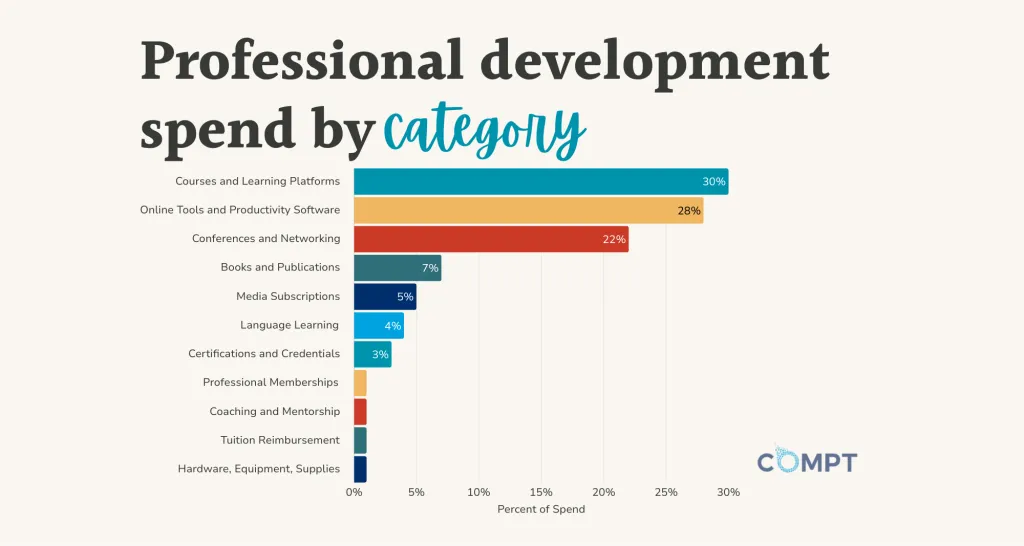
Professional development stipends are the most underused benefit in most companies’ portfolios. According to Compt’s 2026 Annual Lifestyle Benefits Benchmark Report, standalone professional development stipends sit at just 40% utilization — less than half the rate of all-inclusive Lifestyle Spending Accounts. And yet, when employees do use their professional development budgets, courses and learning platforms are the single largest category by dollars spent, accounting for 30% of all professional development spending.
The problem is friction: most professional development programs make employees pay upfront, then wait weeks or months for reimbursement. For a $2,000–$3,000 course, that may be a real financial strain — and it’s enough to stop many employees from ever enrolling.
What the Compt + SNHU professional development stipend partnership does
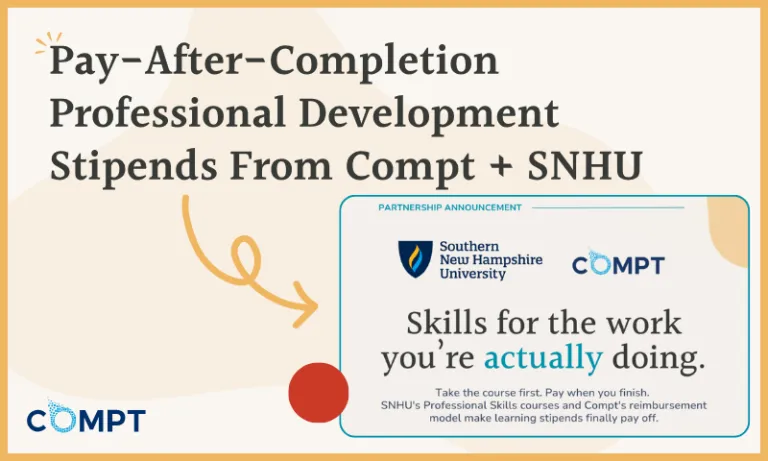
Compt has partnered with Southern New Hampshire University to connect employee professional development stipends directly to SNHU’s six-week Professional Skills courses. Employees in Compt-powered programs can apply their professional development budgets to courses in generative AI, data literacy, human-centered design, and other in-demand skills, with a 15% discount available on the course price and the option to pay on completion rather than upfront.
The next cohort launches August 31, 2026. New cohorts begin every six weeks. Explore current courses and enroll at skills.snhu.edu.
Note: This partnership covers SNHU Professional Skills courses at skills.snhu.edu only. It does not apply to SNHU degree programs, certificates, or any other SNHU courses.
Why pay-after-completion supports professional development benefits utilization
The standard professional development stipend workflow — pay now, get reimbursed later — works well for small purchases. Compt’s 2026 benchmarking data shows that while, yes, courses and learning platforms comprise 30% of employee spend, less-expensive online tools and productivity software trail by only 2%, at 28%.
For larger purchases such as courses, the question is whether most employees can access that budget without financial strain.
Most programs make employees pay thousands up front and wait weeks or months for reimbursement. SNHU’s Professional Skills program flips that; students pay on completion, which lines up naturally with how Compt customers reimburse their teams.
“Most stipend platforms send employees to a generic marketplace and call it professional development. We wanted something better, so we partnered directly with SNHU. They put the student first — you pay when you finish, not when you start. That’s how this should work.”
— Amy Spurling, Founder and CEO of Compt
Which Compt product fits your professional development program?
Any Compt customer with a professional development stipend — whether that’s a category within an all-inclusive LSA, a standalone stipend, or Professional Development Pro™ — can access the SNHU partnership discount and the pay-after-completion model.
How you structure your lifestyle benefits program depends on how much control your team needs around professional development spending:
- A standard stipend or LSA with a learning category works well when you want to give employees broad flexibility and low friction.
- Professional Development Pro adds a preapproval workflow, multistep reviewer chains, and new-hire eligibility buffers, making it a better fit when courses are higher-cost, less frequent, or require Finance sign-off before commitment.
Either way, the SNHU partnership works the same: employees enroll, complete the course, and submit for reimbursement.
How professional development reimbursement works in Compt
To benefit from the Compt + SNHU partnership, employees at Compt customer companies may browse courses at skills.snhu.edu and enroll. On completion, they submit the receipt through Compt against their available professional development budget; reimbursement processes through payroll with the correct tax classification.
Customers using Professional Development Pro will also go through a preapproval step before enrolling — course name, cost, and expected completion date — which reserves budget and routes to the appropriate reviewer before any money is committed.
Eligible participants can access the partnership discount through their Compt account.
Interested in trying it out, but not a Compt customer? We’d love to show you around. Request a Compt demo today.
FAQs: Professional development stipends
A professional development stipend can cover certifications, tuition, courses, coaching, books, and conferences, with no LMS integration required. Whether you run professional development spend through an all-inclusive LSA, a standalone stipend, or Compt’s dedicated Professional Development Pro platform, the reimbursement workflow is the same: employees submit expenses against their available budget, reimbursement goes through payroll with automated IRS-compliant tax classification, and Finance gets a payroll-ready report.
The SNHU + Compt partnership works within that same workflow.
How do I keep a tuition reimbursement program predictable without a lot of manual approvals?
If you’re using Compt’s Professional Development Pro, preapproval is the mechanism that makes this manageable. Rather than reimbursing expenses after the fact and hoping they were in-policy, course requests route to the right reviewers before any budget is committed. Real-time budget tracking means HR and finance see what’s approved and what’s remaining throughout the cycle, helping you avoid end-of-quarter surprises.
For the SNHU partnership specifically, the per-course cost is known upfront, payment happens on completion, and reimbursement flows through the next planned payroll run. There are no partial-refund scenarios or mid-enrollment disputes to manage.
Why are professional development stipends underutilized?
Professional development stipends are underutilized for two reasons: financial friction and ambiguity. Most professional development programs require employees to pay out of pocket and wait weeks or months for reimbursement — a real barrier, particularly for larger-ticket courses. At the same time, employees often aren’t sure what’s eligible, which creates hesitation even when budget is available. Compt addresses this: employees can see eligible expense categories in the app before submitting a claim, and employers can add descriptions to each category so expectations are clear before anyone spends a dollar.
Compt’s 2026 Annual Lifestyle Benefits Benchmark Report puts standalone professional development utilization at 40%. The SNHU partnership addresses the financial friction: employees pay on completion, so there’s no point at which they are floating the out-of-pocket costs.
What’s the difference between a professional development stipend and an LMS or learning marketplace?
A professional development stipend gives employees a budget and policy guidelines; employees choose where to spend within those boundaries. An LMS or curated marketplace gives employees access to a specific catalog and requires them to choose from within it. The stipend model consistently drives higher engagement because employees use it on learning that’s relevant to their actual role, not whatever the platform makes available.
The Compt + SNHU partnership works within the stipend model: it’s a vetted, preapproved provider employees can opt into, not a closed catalog they’re locked into.
Is it better to give employees a fixed professional development stipend or let them submit ad-hoc reimbursements?
Both work, and Compt supports both, as well as shared pool budgets and case-by-case evaluation. Fixed individual budgets tend to drive higher utilization because the money feels allocated and visible. Ad-hoc reimbursements offer flexibility but require more active management. For most teams, a fixed annual or semiannual professional development budget with preapproval for larger expenses produces the best participation rates.
What metrics should finance track to show ROI on professional development stipends?
Utilization rate (budget spent vs. budget issued), completion rate for structured courses, and skill application — trackable through manager check-ins or performance data — are three useful ROI metrics for professional development stipends. Compt’s benchmark data provides a clear baseline: standalone professional development stipends average 40% utilization vs. 89% for all-inclusive LSAs.
Closing even part of that gap, with a clear completion record attached to each reimbursement, is usually sufficient to make the finance case.
About SNHU
Southern New Hampshire University is a nonprofit, accredited university with a mission to make high-quality education more accessible and affordable for everyone. Founded in 1932 and online since 1995, SNHU serves more than 135,000 online students and over 3,000 on its Manchester, NH campus. Learn more at snhu.edu/about-us.
About Compt
Compt is a flexible, reimbursement-first benefits platform that helps employers deliver policy-based lifestyle benefits — professional development, wellness, family care, and more — with clarity and control across all 50 U.S. states and 75+ countries. Learn more at compt.io or explore Professional Development Pro.
Compt customers can access the SNHU partnership discount through their account. Not a Compt customer yet? Request a Compt demo to learn more.
Editor’s note: Compt software supports the categorization and proper reporting of benefits according to IRS guidelines, helping businesses maintain compliance. However, Compt cannot provide tax advice, and users should consult their own tax, legal, and accounting advisors when necessary.

 No receipt chasing