Ever wonder how LEGO went from a small toy maker to a global icon?
They didn’t just make building blocks. They give people an outlet for creativity — you can use LEGOs to create whatever your heart desires.
And fast forward to now? They’ve created a whole empire with limited edition sets, video games, movies, and amusement parks.
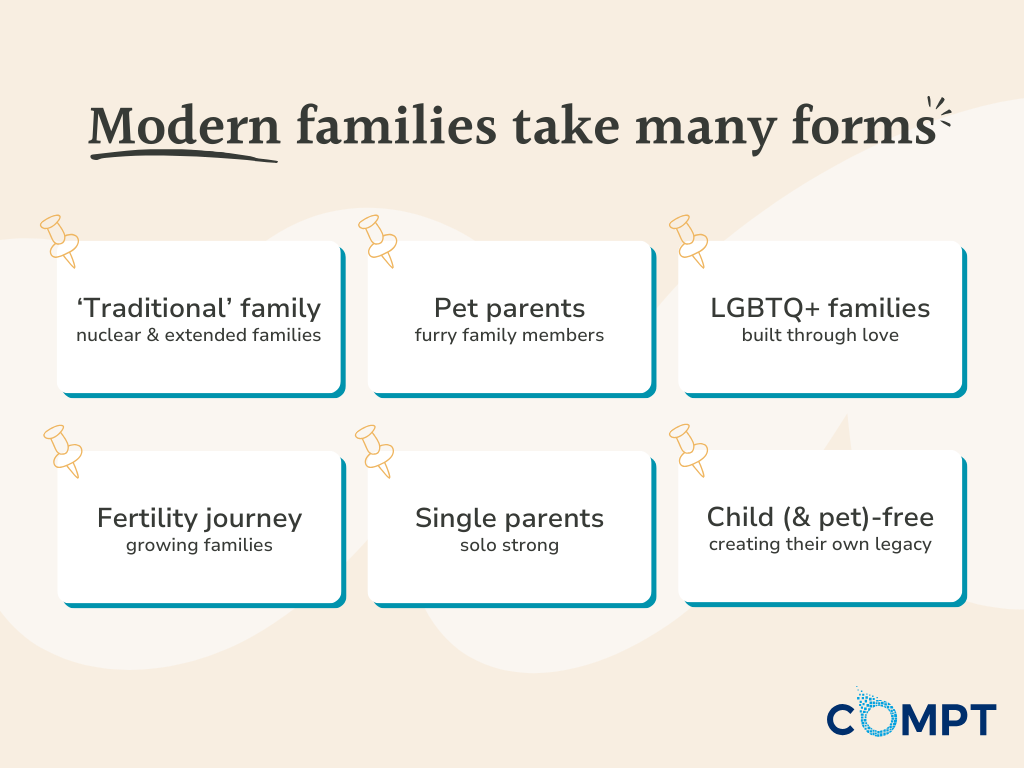
Now think about you, me, and everyone else as the building blocks of today’s society, and our families as the extension of our structure. And think about how many different things ‘family’ has come to mean.
Your historical nuclear family, defined in psychology as a “family unit consisting of an adult male and female and dependent children,” is still here. But it’s complemented by waves of new family makeups.
Take for example:
A notable rise in same-sex couple households (1.3M), with more than half of them (58%) married couples. What’s more, an estimated 2 million LGBT people are interested in adopting to expand their family.
The desire to grow a family with children is still present: An estimated 1 in 8 women between the ages of 15 and 49 years old have received infertility services in their lifetime.
A growing ‘fur-baby’ population, a term popularized by millennials, with 66% of U.S. households owning at least one pet in 2023 (a 10% jump from 1988).
As an employer, your family benefits package needs to reflect that diversity.
Family-friendly benefits for all types of families
Modern families need modern benefits. Period.
Old-school benefits simply haven’t kept pace with the modern family. They aren’t inclusive of the different types of families we now see.
A traditional nuclear family
Single parents
Employees struggling with infertility issues
A same-sex couple looking to adopt or do IVF to start their own family
Couples that are childless by choice
A dog mom (or dad)
You also have to think about the age of your employees and how it relates to their stage of family life. Younger employees are just starting their family, while older ones might have grown children or be taking care of aging parents.
If your organization (like most) has a multigenerational workforce, your benefits package needs to be flexible enough to accommodate the different needs of your employees and their families, regardless of age or family structure.
Are your family-friendly benefits inclusive enough?
Here’s a (not so) fun fact. The U.S. is one of just a handful of countries with zero national paid leave of any kind. This leaves a massive challenge for employers and employees — employers who want to do right by their people, and employees who are faced with decisions about whether they can afford unpaid leave or how to take time to address postpartum care.
Note:Under the Family Medical Leave Act (FMLA), all public agencies and private organizations with 50+ employees must provide 12 full weeks of parental leave. However, this can be unpaid.
But beyond proper family leave, there are tons of benefits employers can offer to their people to make all stages of parenting and family building — for all types of families — less stressful and less of a financial burden.
At Compt, 10% of our 25+ stipend category spends were on ‘Family,’ showing a need to support family-related expenses.
We’ve listed some of the top ideas below, but we encourage you to think creatively when it comes to how to support evolving families and their needs.
6 types of family-friendly benefits to offer
Families come in all shapes and forms, so standard benefits packages simply won’t work here. That’s why we believe in letting you piece together benefits that fit each family just right.You know, like LEGO blocks.
To help get your wheels turning, we’ve organized family-friendly benefits you can offer your employees into six categories:
Fertility benefits
Adoption benefits
New parent benefits
Working parent benefits
Pet parent benefits
Childless families (by choice)
1. Fertility benefits
For those looking to start a family, there are countless options available. But with those options comes hefty costs, massive amounts of time spent, and (potentially) an emotional road. According to a study by the World Health Organization, 17.5% of the adult population — nearly 1 in 5 — experiences infertility. Most couples battle this problem through one of two methods: In vitro fertilization (IVF) and Intrauterine insemination (IUI).
The average cost of an IVF cycle is $14,000-20,000. IUI costs are much lower, $300-1,000 per cycle, but they’re three times less effective than IVF procedures.
You can help those going through the fertility process by providing the following fertility benefits:
Covering a portion of the fertility costs — Think creatively here. Could you offer a health and wellness stipend to cover a portion of some of their medical bills not covered by insurance?
Providing additional days off work for the person to go through the process. They’ll need to go through appointments, medicine, shots, retrieval, bloating, tests, transfers, and much more. Putting a flexible working policy in place or allotting days off for medical treatments outside of regular PTO can be a big help.
Mental health support. Trying to conceive can be a long, arduous process, and one that can be emotionally taxing, too, with 56% of women (and 32% of men) in one California study reporting significant symptoms of depression while undergoing infertility treatment. A health and wellness stipend could also cover co-pays for therapy, or you could offer an Employee Assistance Program (EAP) for short-term counseling.
Fertility coaching. Maybe your employees are considering IVF, or you have someone right in the middle of their process. Working with a fertility coach can help employees navigate this challenging time and make sure they’re taking care of themselves holistically. If you use Compt to offer a health and wellness stipend, team members could use it for sessions with a fertility coach.
What about surrogacy?
Surrogacy is the process where a woman (the surrogate) agrees to and carries a child for another couple. It’s becoming increasingly common, too. In 2023, the CDC reported 413,776 ART cycles initiated nationwide. With all the legal and medical fees, the average costs jump to a whopping $100,000.
You can help the family that’s going through the surrogacy process by providing the following family-friendly benefits:
Covering travel expenses
Providing fertility reimbursements
Prenatal care for the surrogate
Healthy food for the surrogate
Payment for surrogate services
Legal fees
Consider this: Anything your employees pay for as part of the surrogacy process could be uploaded as a receipt through a stipend program. This could be any of what we’ve listed, or even things like flights or hotel accommodations as part of the process.
See fertility benefits in action: All Compt employees can access a $4,000 out-of-state care stipend. When our very own Senior Manager of Marketing Operations, Meghan Ferneau, joined us back in 2022, she used it to cover clinic fees, travel, and room and board when she visited her preferred IVF clinic in St. Louis, Missouri.
Psst: Get a demo of Compt with us to learn more about the various stipends you can offer to your people.
2. Adoption benefits
For those who may not want or can’t have a biological child, adoption is a great option to help children in need of a safe home.
Most of the adoption in the U.S. is divided into three categories:
Domestic adoption
Foster care adoption
International adoption
More than 100,000 children are adopted each year in the U.S. Each route has unique steps, but they share one thing—high costs. Legal fees, home studies, counseling, and travel fees are just some of the expenses that can cost your employee up to $66,000.
To alleviate some of the expense, you can provide adoption assistance benefits, which are employer-sponsored financial benefits designed to offset the costs associated with adoption, which include a lot of the expenses we covered above. Your employees might also qualify for your state’s adoption subsidy, so it’s important to give them information about these programs.
You can also take steps to support your adoptive parents by creating an adoption-friendly company culture.When you’re thinking of how to document your work schedule, PTO, and leave policies for parents, you need to make it clear this includes things like adoption-related leave.
No matter which parenting path someone chooses, they need leave time for different reasons. Beyond that, you should celebrate adoptive parents just like you would new biological parents with a celebratory note or a small congratulatory gift. One of our clients takes this to heart, with their inclusive spot bonus for new babies stating, “this gift is available to new parents, gestational birth or not.”
Welcoming a new child is just the start — then the 24/7 care begins.
New parents face big changes fast, and if you provide them with the right support, it can make a world of difference. Here are three things you can do to help them out:
PAID parental leave. We already covered this a little, but let’s make it crystal clear: We believe in paid parental leave! Take care of your people while they’re taking care of their new baby. It’s as simple as that.
Lactation support. Nursing employees have a right to a reasonable break time and lactation. Provide your lactating employees with a calm, discreet, and quiet place to lactate milk while they’re at work (if you have an office), or consider a health and wellness stipend that could cover some of the cost of a lactation consultant or breastfeeding supplies.
Coaching. Whether it’s for foster, adoptive, or biological parents, paying for 2-3 sessions of parent coaching can make a world of difference for new parents. In these sessions, they’ll learn how to support their child’s development and establish healthy routines that work for both the parent and the baby.
Childcare support. Etsy gives their employees $4,000 a year in childcare credits. Parents can use this either onsite or for at-home childcare options.
See benefits for new parents in action: Our client, Jellyvision, has an inclusive spot bonus for new parents, gestational birth or not, to help adjust to life with a new baby. This benefit can be used for parenting support, health and wellness, food, or specific baby-related necessities. It’s a “well-loved gift” and is “highly utilized by new parents” at the company, the team says.
4. Working parents benefits
As kids grow, so do the demands on working parents. In fact, nearly 27% of mothers with their youngest child under six report working from home at some point during the week. Understanding what your working parents need day in and day out can help you evolve your family-friendly benefits over time.
Flexible work option. A 4-10 working pattern, remote work, 9-80, or part-time job can help parents juggle their workload with the responsibility of being a parent. AccumTech has Core Hours, where everyone must be available from 10 am to 3:30 pm, but employees decide where (and when) to finish the remaining working hours. This is especially helpful to single parents who do a two-people job alone (who are not a small proportion of working parents).
According to The Annie E. Casey Foundation data from 2023, more than 23 million children are living in a single-parent households. That’s 34% of all households with children.
Personalized stipends to support household expenses. With each addition to the household, the expenses grow. Consider the cost of groceries, utility bills, nursery buildouts … how could a flexible stipend help?
529 contribution. With this plan, a parent can contribute to their child’s K-12 education, apprenticeship programs, or college education.
And let’s not forget if you have millennials (born between 1981 and 1996), it’s very likely that they are a part of the ‘sandwich generation,’ a term coined to describe a growing number of adults who are caring for both children and aging parents.
Specific elder care benefits or support with financial costs associated with caregiving can be a huge help to these employees.
You might laugh, but more than ¾ of Millennial respondents from a 2022 study said they consider their pet (mostly cats and dogs) their ‘fur baby.’ And these four-legged babies pack on the costs — the Bureau of Labor Statistics reports that the average annual household spending on pets has increased from $460 in 2013 to $770 in 2021.
Pets incur a wide variety of expenses, including:
Pet insurance
Grooming costs
Specialized dog food
Dog walkers or doggy daycare
By making sure these furry friends are included in your overall family-friendly benefits package, you can help even your child-free employees help all members of their family. What’s more, many employers are even considering “pawternity” (paid pet) leave, to help new owners deal with separation anxiety and training needs that come from a new pet.
See pet parent benefits in action: mParticle, a customer data platform headquartered in New York, offers two weeks of paid time off to employees who adopt an animal from a shelter. Kinship provides employees with an annual $750 pet care stipend, along with company-supported paid time off for welcoming a new pet or in the event of a pet’s passing.
6. Childless families
Remember that families include those that don’t have children or pets, and it’s important for employers to support them, too. Forty-seven percent of adults younger than 50 say they are unlikely to ever have kids, a figure that has risen by 10 percentage points from 2018 to 2023.
The reasons are widespread, with nearly 40% saying ‘it just never happened,’ and others citing a lack of the right partner, focusing on other things in life, and affordability as major reasons they don’t have children.
Truly leading companies are making sure their benefits and stipend programs support all employees who may be dealing with hurdles and challenges of their own. Some ideas here include:
Financial support on elder care benefits if they are a caregiver
Mental health support, which could include day-to-day stress relief or couples counseling co-pays
All-around health and wellness financial help, such as medical co-pays, wellness massages, support with household expenses, etc.
See benefits for childless families in action: Voya Financial offers comprehensive support for working caregivers, regardless of their familial situation, through various programs and resources. This includes access to caregiving support services, flexible work arrangements, financial planning assistance tailored to caregivers’ needs, and a special EAP that connects employees and their families with experienced clinicians specializing in disabilities and caregiving.
An all-inclusive, family-friendly stipend can provide support where it truly matters
Shipping breast milk for working moms, covering formula as part of a grocery stipend, or having a health and wellness stipend that would give a massage, manicure, or pedicure as a treat to exhausting parents—these are all things that companies aren’t going to offer as a team-wide benefit but that a stipend could help cover.
While the list of family-friendly benefits you can offer to your people is growing, it’s important to remember that the cost of care and need for those wanting to build (any kind) of family is endless, too.
Request a demo to see how Compt can provide your employees with personalized family stipends to support the modern family.
Amy Spurling is the Founder and CEO of Compt, where she’s transforming employee benefits with personalized, inclusive Lifestyle Spending Accounts (LSAs). As a three-time CFO and two-time COO, Amy brings over 20 years of experience helping companies grow by focusing on what matters most: their people. Amy has also been a key player in raising over $200M in venture financing and leading multiple successful acquisitions. When she’s not driving innovation in the HR space, she’s likely backpacking to another summit.
Compt’s stipend and Lifestyle Spending Account (LSA) expense review process checks each reimbursement request against the employee’s supporting documentation and the employer’s policy before the...
An employee stipend policy should spell out the specifics of who is eligible for the benefit, how much funding employees receive, when that funding becomes...
On a short call, we’ll show you your product choices, how it will be customized with your branding, and how swag stipends work.
Access the tour
Explore Professional Development Pro™ by Compt with an interactive tour and see how it can easily elevate your employee professional development program.
Schedule a demo
Step confidently into the future of Professional Development management with Compt, where flexibility is limitless (or limited – the choice is yours!) and personalization is paramount.