
Compt insights to guide 2026 planning for HR and Finance leaders
When I joined Compt earlier this summer, I volunteered to write our Midyear Lifestyle Benefits Benchmark Report as my first major project. I’ve been supporting HR as a function for 7+ years, and I came to Compt from a world in which points were primarily redeemed for gift cards or merchandise. The range of expenses people are reimbursed for with Compt was a revelation, and as someone who cares deeply about the employee experience, seeing stipends and LSAs directly improve lives and support families has been a joy.
What I learned while writing this report was both inspiring and practical: Even with flat budgets and economic uncertainty, HR and Finance leaders are succeeding in providing their people with meaningful support.
With 2026 planning season already underway, I’m eager to share a few findings that stood out — and the insights leaders can carry straight into their budgeting conversations.
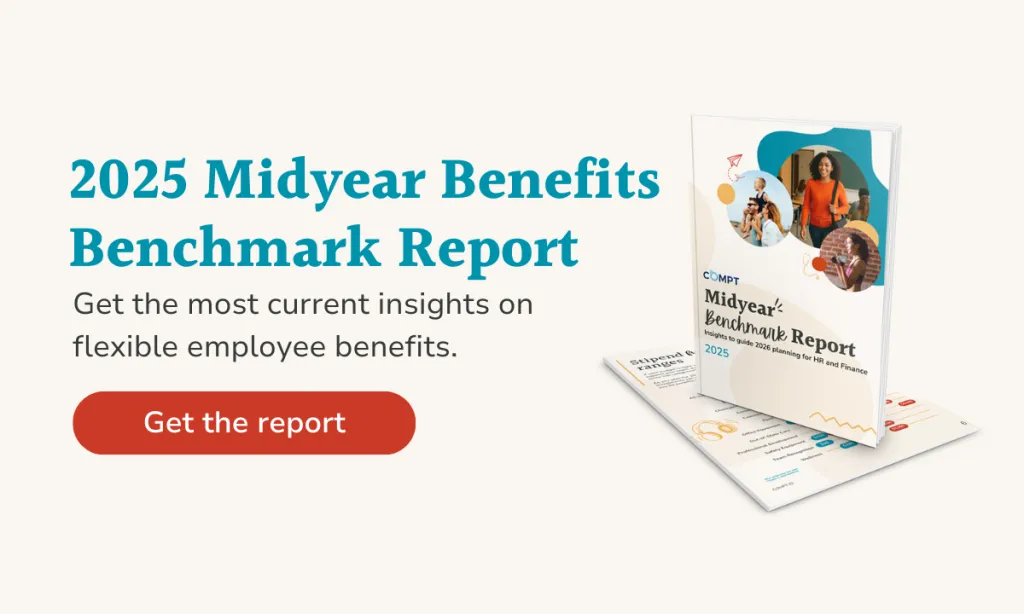
Download the full report from Compt
Check out the newest Midyear Lifestyle Benefits Benchmark Report [2025] to get a closer look at the data and all our 2026 planning advice.
What I learned
1. Budgets are flat, but spend is up.
Salary increases are stuck at a 3.5% average for 2026 — unchanged from 2025 — but smart employers are still finding ways to invest in their people. Average stipend funding rose year over year by $170 per employee, climbing to $1,029. Leaders know benefits are a retention lever when raises are unlikely.
2. Annual stipends are rising fast.
Quarterly remains the most common cadence (53%), but annual stipends nearly doubled over 2024 numbers to 32%. That surge comes largely from professional development, where close to 99% of stipends are structured annually to support big-ticket items like certifications, conferences, and learning AI tools.
3. Caregiving is the hidden crisis.
Many Millennials are reaching their “sandwich generation” phase, and the gap between caregiving responsibilities and employer support remains unchanged from 2024, with less than 4% of companies offering caregiving and family-related stipends. This surprised me: When you consider that 45% of working caregivers rely on flexible schedules to balance their responsibilities, stipends could really help.
4. True personalization beats one-size-fits-all.
Staying in line with 2024 numbers, 70% of stipend spending has gone to independent and local vendors so far in 2025 — not Amazon, Walmart, or other big-box defaults. Employees are voting with their wallets and clearly telling us that benefits resonate when they reflect real households and lives. It’s a win-win for leaders, too: Supporting local vendors extends the value of each stipend beyond the individual employee and reinforces your company’s role in, and support of, the broader community.
5. Midsized organizations are catching up with generous small companies.
Organizations with fewer than 100 employees fund an average of $1,716 per person, 2x the amount of large companies. Midsized companies (100-1,000 employees) saw the sharpest increase in funding — they added more than $300 to reach $1,391 per employee.
Lessons for 2026 planning
Based on everything I’ve seen in the data, here are five insights to take into upcoming benefits planning sessions:
1. Consolidate for 2026.
Full stop. All-inclusive Lifestyle Spending Accounts (LSAs) are up across every employer size, with 65% of Compt customers offering them. LSAs reduce vendor redundancy, simplify administration, and give employees meaningful options. They also let you fold categories like wellness, professional development, recognition and rewards, and family support into a single budget line. Sounds easy, right?

2. Prioritize wellness, but bundle it.
Wellness is foundational, showing up in 99% of LSAs. Keeping in line with budget-friendly consolidation, only 32% of companies offer standalone wellness stipends, with the other 68% being bundled with other stipend categories or within an LSA. The most common pairings are food, experiences, productivity, personal development, and family. This shift away from one-off programs supports the trend toward holistic, consolidated design.

3. Simplify taxes with Compt.
Although IRS rules allow several categories to be tax-free, nearly four of our five stipend dollars (78%) are still being spent in taxable categories. That means payroll taxes and higher W-2s for employees. Either way, Compt codes stipends correctly as taxable or nontaxable, helping leaders balance personalization with financial efficiency while avoiding year-end reconciliation headaches.

“We cut our benefits processing time from weeks to just 90 minutes.”
— Kevin Sullivan, Global Benefits Lead, Quickbase
4. Win with professional development and AI upskilling.
Employees are already spending stipend dollars on AI-related tools, subscriptions, courses, and certifications. While books account for 19% of professional development spend, AI and emerging tech is right behind at 15%. This shows employees aren’t waiting for specialized training — they’re testing tools like ChatGPT on their own, using stipends to build skills they know are essential. For leaders, this is a clear chance to meet employees where they already are by offering a dedicated AI stipend to encourage experimentation, accelerate adoption, and build employee confidence in this new era.

5. Factor in regional funding patterns.
Every region increased its average stipend funding in 2025: The West led with an increase of more than 20%, reflecting high retention pressure in costly tech hubs, while the South and Midwest showed steady growth tied to affordability and job creation. As you plan for 2026, weigh how regional realities like cost of living and hiring trends may shape your benefits strategy, and allocate funding accordingly.

Writing this report opened my eyes to how much effort HR and Finance leaders are putting into weathering tight budgets. The data shows you’re rethinking program design and investing strategically as we head into an uncertain 2026.
If there’s one major throughline as you plan, it’s consolidation with personalization. By streamlining programs and giving your people real choice using a reimbursement-first strategy, instead of limited marketplaces or complicated debit cards, you can intentionally focus on providing a people-focused experience and giving your employees the tools they need to thrive.
Ready to learn more? Get a to-the-minute look at how employees are actually using their stipends and lifestyle benefits in our 2025 Midyear Lifestyle Benefits Benchmark Report. Or, if you’re ready, go ahead and request a demo.