
What does L&D and professional development look like today, and into tomorrow?
If you want to attract and keep high performers on your team, you need to understand that top talent craves more than just a paycheck.
Companies that reinvest in professional development programs are not only improving the retention of their high performers but also positioning themselves as employers of choice in competitive job markets as the state of learning and development evolves.
However, this can be easier said than done as HR and talent development leaders are balancing tighter budgets, emerging tech, and rising employee expectations. Gone are the days when surface-level courses and one-off workshops were enough. Your employees now expect continuous learning that moves the needle for their careers and lives.
From personalized learning paths to the rising demand for variety in learning and development benefits, this guide is your go-to resource for navigating the current state of learning and development, backed by research, real-world examples, and actionable tactics to boost employee engagement, improve retention, and build a culture of growth.
What’s the difference between professional development and learning and development anyway?
Many times, ‘professional development’ and ‘learning and development’ (L&D) are used interchangeably. For example, your company may refer to ‘professional development’ as things that are employee-led (but company-sponsored), such as access to conferences, skills-based workshops, certifications, or further education. These largely center around the individual rather than the rest of the company.
Learning and development (L&D), on the other hand, is more of an umbrella term that covers professional development but typically will include more company-led initiatives meant to deepen knowledge in a particular area for a broader set of employees. These could include onboarding, product training, compliance, upskilling programs for a particular department, and leadership development.

Current state of learning and development
I’ve always been a massive advocate for (and fan of) learning and development. Prior to Compt, I’ve focused on career and life coaching for leaders and am proud to have built HubSpot Academy as a cornerstone of my career.
And through that experience, I know how challenging and nuanced learning and development (and individualized professional development) can be.
Understanding where professional development stands today helps one dig into the numbers. These stats highlight the most pressing challenges and opportunities facing HR and L&D leaders right now, as well as offer insight into how organizations can meet employee expectations while staying ahead of the curve.
- According to ADP Research Institute, only 47% of employees think their companies invest in the skills they need to advance.
- Only one in five L&D practitioners strongly agree they are prioritizing the skills their organization will need in the future.
- In fact, this survey found companies spend an average of $1,207 per employee on learning and development per year.
- On average, smaller companies spend more and are better at skills development, with 57% of workers at companies with 100-249 employees confident they can gain the necessary skills on the job. In contrast, only 35% of employees at companies with over 1,000 workers feel they receive the training needed to advance their careers.
Top priorities for L&D leaders
Whether it’s addressing wage expectations, prioritizing mental health, or improving skills development, the road ahead requires thoughtful, data-driven action if you want to retain more of your top talent.
That’s important since the highest performers in a role are 800% more productive than average performers in the same role.
However, with many L&D leaders being asked to do more with less, they are forced to turn to more creative ways to engage employees and tie learning outcomes directly to business results. Here’s what’s topping their priority list when it comes to the current (and future!) state of learning and development:
AI upskilling and reskilling workers, especially in areas with talent shortages
With AI quickly working its way into everything from HR tools to customer support platforms, companies can’t afford to wait for new talent to magically show up. Instead, they’re retraining employees to fill critical gaps. In fact, many news reports, including this one, back this up. Fewer people are losing their jobs to AI than originally thought. However, it is making workers more efficient.
Plus, these upskilled employees now feel more secure in their roles, and the business doesn’t have to scramble to recruit niche experts in an already competitive market.
Building a continuous learning environment
Learning shouldn’t stop after new hire orientation, and companies are starting to get that. Your top talent wants to grow in their roles, and if they don’t see opportunities, they’ll find them elsewhere.
We’re seeing more companies roll out micro-courses and training modules that employees can take on their own schedule, with topics ranging from leadership skills to advanced Excel. Then, managers can tie these courses into performance reviews.
Over time, this reduces turnover and starts promoting more employees from within, which cuts recruiting costs and keeps team morale high.
At Compt, we’ve seen budgets increase in offering professional development stipends to employees year over year, which has led to exciting plans for our core product to keep up with the state of learning and development.
Learn more about our upcoming L&D plans at Compt
People management and leadership training
Most employees don’t quit their jobs. They quit bosses.
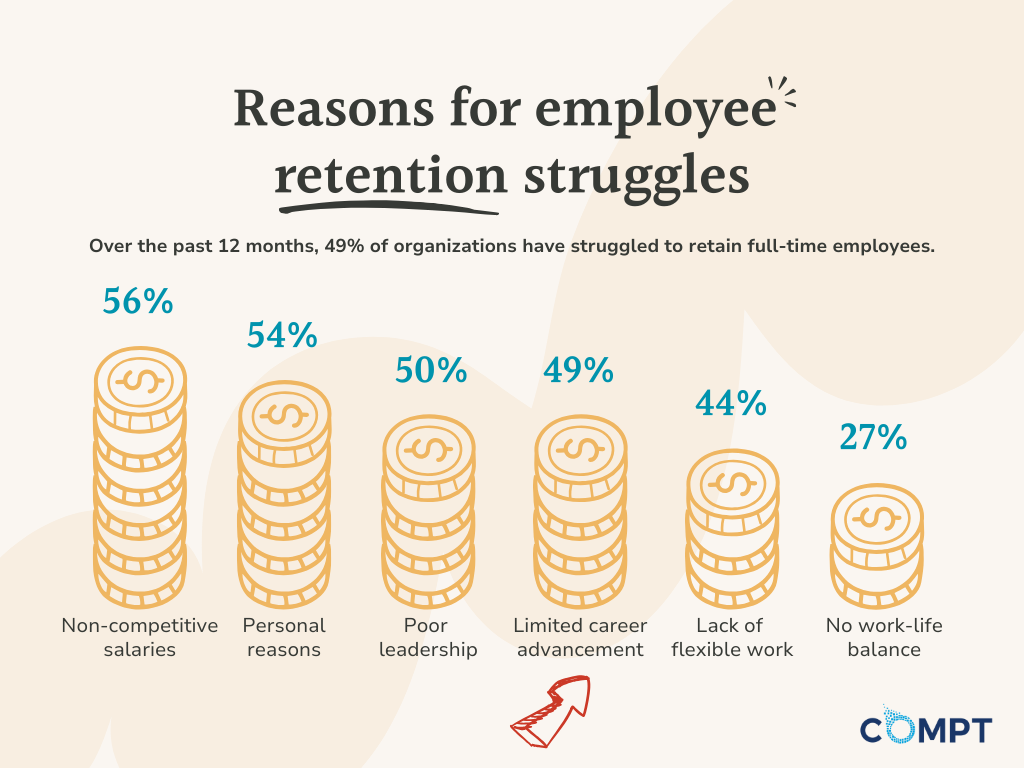
Employee retention has become a bigger issue recently. In fact, over the past 12 months, 49% of organizations have struggled to retain full-time employees. One of the most cited reasons outside of non-competitive salaries (56%) is poor management or leadership (50%).
One way to get in front of this is to make sure your leaders are equipped to build trust and morale alongside delegating tasks.
You can do this by putting every manager through a coaching program focused on emotional intelligence, giving them tools to better support their teams, especially if they’re managing remote teams. Take it a step further and add in courses or tools around productivity and strategic thinking to stay one step ahead of your competitors.
Aligning L&D with hybrid or remote teams
Despite what the headlines might tell you, hybrid and remote work isn’t going away. Because of this, more companies are leaning into asynchronous learning to meet employees where they are.
We’re seeing more L&D leaders switch to a system where employees can access self-paced learning modules and virtual workshops. This flexible setup keeps participation high without disrupting workflows and cuts down on corporate spend to fly specialists in for in-person training, too.
Balancing tight budgets with upskilling
When budgets are tight, doubling down on existing talent makes more sense than constantly hiring. Upskilling the team not only saves on hiring costs but also keeps employees motivated with clear growth paths.
This strategy is becoming especially important with younger employees, who are quick to leave if they don’t see development opportunities, and replacing them isn’t cheap.
While studies vary on the exact cost, conservative estimates from Gallup say replacing an individual employee can range from half to two times the employee’s annual salary. And this number goes up the more specialized or senior that employee is!
How much does employee turnover truly cost? Check out Compt’s Turnover Calculator for more!
Measuring the ROI of L&D
57% of L&D leaders report feeling significant pressure to prove the ROI of their learning programs.
Gone are the days when completion rates were enough. Leaders need real outcomes. For instance, let’s say a retail company that invested in training its store managers in financial management. A few months later, they’re seeing a measurable improvement in profit margins across multiple locations. The CFO, now fully convinced, doubles down on L&D investments for the next budget cycle.
The lesson? When learning drives business results, it stops being a “nice-to-have” and becomes a strategic priority.
Employee expectations for learning and development
Employees expect more from their companies than the occasional workshop or annual performance review. They want L&D programs that meet them where they are and align with their personal and professional goals.
Here are the key areas shaping those expectations.
Personalized and flexible learning paths
One-size-fits-all training isn’t cutting it anymore. Employees expect learning opportunities tailored to their skills, career goals, and schedules. Flexibility ensures that learning fits into their busy lives without feeling forced.
When professional development feels relevant and convenient, they are more likely to engage, and companies benefit from a more skilled workforce.
Professional development stipends are a great path forward to giving employees control over their opportunities.
Career advancement
Your best employees don’t just want to do their jobs. They want autonomy and to grow into bigger roles. And if they can’t do that, they are increasingly likely to jump ship for a better job.
Organizations are responding to the state of learning and development by creating clear pathways for advancement through skills development. Career advancement opportunities keep employees motivated, reduce turnover, and help companies build leadership from within.
Access to promotions and raises
With pay expectations remaining at the top of most employees’ minds, professional development programs are becoming indirectly linked to more tangible outcomes, like promotions and pay raises.
Employees want to know that investing time in development will directly benefit their careers. By leveling up their skills, they are more likely to do their jobs better and deliver more value for their companies.
The clearer companies are at connecting the two, the better employee engagement they’ll see. It is a win-win. Employees see a clear return on their efforts, and the business retains top talent by rewarding growth.
In fact, over the last year, this study found that over 75% of workers received a raise of 4% in the past year, which is still below their expectation of 5% or higher. And higher-ranking managers are the most likely to expect — and receive — larger wage increases.
Mentorship and coaching
Most employees crave meaningful support from leaders who can help them navigate their careers. Mentorships are a great way to do this. However, only 31% of organizations currently offer mentorship programs, which underscores a gap in structured support for employee development and growth.
These programs foster personal connections and make employees feel invested, which boosts morale and encourages long-term commitment to the company. Bringing visibility to what others are learning and benefiting from can support mentorship programs.
Recognition and rewards
Whether it’s a shoutout in a company meeting or a formal reward system tied to development milestones, employees want to be incentivized and rewarded when they achieve something.
Having a feedback loop where employees are recognized and rewarded for learning is a key component to this.
Small but consistent rewards go a long way in reinforcing a learning culture and making employees feel appreciated for their efforts (and can help with tight budgets, too!).
This is particularly true for remote and hybrid teams, where remote workers are 1.3 times more likely to feel insecure about their jobs than hybrid or on-site workers.

Key skills in demand
From AI expertise to emotional intelligence, here’s what’s topping the list of must-have skills. For L&D teams looking to add to their overall professional development library and strategy, these are core areas to focus on. How can you, as a leader, bring a more tailored approach that still encompasses these key skills for your workforce?
AI
AI skills are becoming fundamental to how businesses operate, even for roles that weren’t traditionally technical. In fact, four out of five employees are interested in learning more about AI and how it applies to their profession.
As businesses automate processes and adopt AI-powered tools, employees need to understand how to use them effectively. Employees who can master these tools early on gain a competitive edge, and companies that invest in AI literacy avoid falling behind in innovation.
Data literacy
Knowing how to interpret dashboards, identify trends, and apply insights is no longer just the job of analysts. It’s becoming a baseline expectation, just like being able to use Word and Excel.
Companies that invest in improving data literacy find that employees become more self-sufficient and confident in decision-making, which speeds up processes and reduces the bottlenecks caused by waiting on specialists.
Soft skills
Soft skills — like emotional intelligence (EQ), adaptability, and resilience — are critical for navigating the challenges of modern workplaces. Employees with strong EQ manage stress better, communicate effectively, and build stronger relationships with their team.
More companies are now weaving soft skills training into leadership programs and development plans, knowing that these abilities directly impact performance and employee well-being.
People management
Managers need to lead with empathy, foster a sense of belonging, and inspire performance, especially in hybrid or remote environments. When managers excel at this, the entire organization benefits from higher employee engagement and lower turnover.
Cybersecurity
With cybersecurity threats increasing each year, it is no longer just the IT team’s responsibility. Employees across departments need to understand basic cybersecurity practices, from avoiding phishing scams to securing sensitive data.
Employees who understand the importance of cybersecurity become the first line of defense, minimizing risks and protecting the organization from costly breaches. As data privacy regulations tighten, this skill will only grow in importance.
Agility
Agility — the ability to learn new skills quickly and let go of outdated ones—is emerging as a top skill. In industries like tech, where tools and practices evolve rapidly, employees who can adapt thrive.
The data backs this up. 85% of business executives say they are seeking more agile ways to organize work.
Companies that foster this kind of agility through a culture of continuous learning are better prepared to pivot when change inevitably happens.
Bridging the gap between employee expectations and key skills in the state of learning and development
Bridging the gap between what employees expect from their careers and the key skills companies need requires more than just rolling out training programs. Communication, transparency, and feedback are crucial to keeping employees engaged and aligned with business goals.
Here are some practical ways companies are making this connection:
- Communicate how new skills help employees achieve their goals by showing the personal value behind professional development. Instead of promoting AI courses as ‘nice to have,’ frame them as tools employees can use to future-proof their roles or work more efficiently. When employees see how skills benefit them, they’re more motivated to participate.
- Demonstrate impact by sharing success stories that highlight real outcomes from L&D initiatives. For example, spotlighting an employee who secured a promotion or made measurable improvements after completing a program makes professional development feel more tangible. When employees see peers thriving, they’re more likely to invest in their own learning.
- Build in more feedback loops to ensure learning initiatives stay relevant and effective. Regular check-ins with employees and managers — whether through surveys or one-on-one conversations— help identify what’s working and what isn’t. Adjusting programs based on feedback also makes employees feel heard and valued.
- Create a culture of learning and innovation where it’s safe to make mistakes. Employees need the freedom to experiment without fear of failure. Encourage teams to try new ideas, even if not every attempt succeeds. This mindset fosters continuous improvement and helps employees stay curious and engaged.
- Fold soft skills into people management training to help managers become better leaders. Emotional intelligence, empathy, and conflict resolution skills are just as important as knowing how to manage tasks. Training managers to build trust and connect with their teams creates a better work environment.
- Offer individual contributor (IC) tracks so employees can advance without moving into people management. Not everyone wants to lead a team, and forcing employees into roles they don’t want can result in burnout or turnover. Clear IC tracks allow employees to deepen their expertise and grow in ways that align with their strengths.
- Use progress tracking tools to add transparency and accountability. Dashboards that show employees exactly where they stand in their learning journey—like completed courses, upcoming goals, and milestones toward promotions—create clarity and build trust. When employees know what’s expected of them and how to achieve it, they feel more in control of their career development.
With strong communication, meaningful feedback, and clear development paths, companies can build cultures that encourage both individual success and long-term innovation.
Future trends shaping the state of learning and development
L&D is expanding to meet new demands from employees and businesses alike.
Here’s a glimpse of the trends shaping what’s next in L&D.
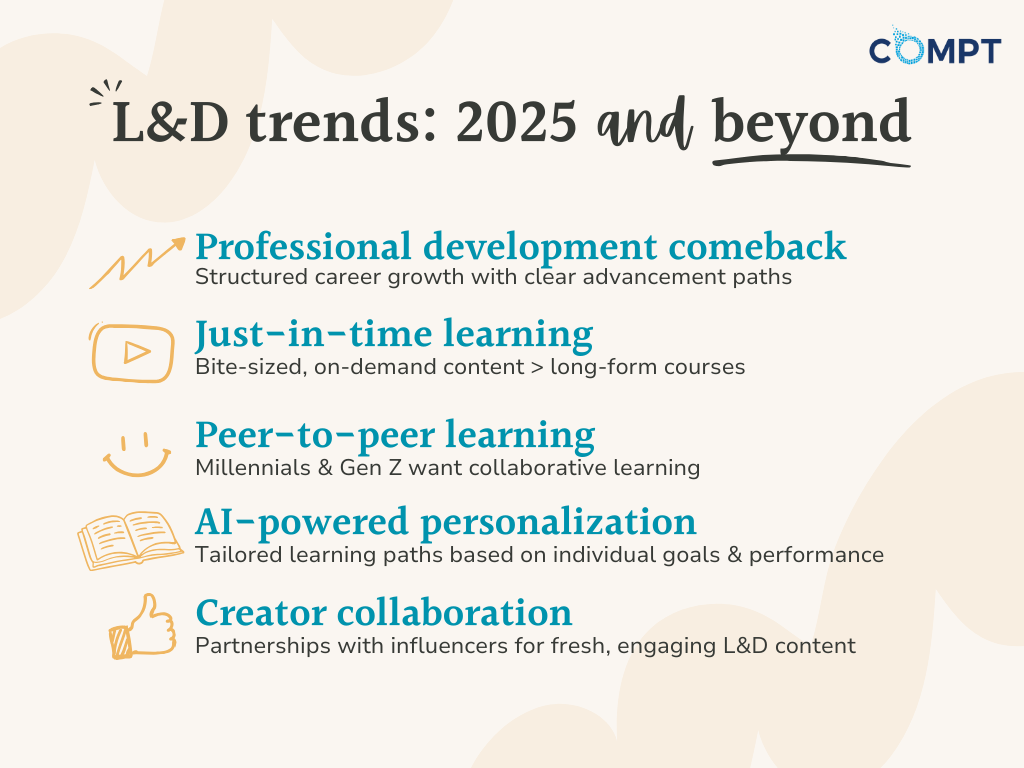
- Professional development is making a big comeback. After a few years of reactive initiatives, like pivoting to remote work, companies are re-prioritizing structured career growth. Employees are also more focused on long-term development, expecting clear paths for advancement.
- Just-in-time learning is making a comeback. Employees today want bite-sized, actionable content that’s available exactly when they need it. Instead of long, theoretical courses, companies are moving toward on-demand microlearning modules and quick-reference guides. This approach ensures employees can increase their confidence and get the information they need without disrupting workflows.
- Younger workers prefer peer-to-peer learning and mentoring programs. Millennials and Gen Z value authentic connections and practical advice over formal, top-down training. Companies are responding by creating peer mentorship programs, where employees share experiences and skills with each other. This kind of collaborative learning builds stronger workplace relationships and makes knowledge sharing more engaging and relevant.
- AI is being used to create personalized learning paths. AI-powered learning platforms can now recommend tailored courses and development plans based on each employee’s goals, skills, and performance data. This level of personalization keeps employees engaged and ensures they’re learning at the right pace without wasting time on irrelevant content.
- Collaborating with influencers and creators for L&D content is gaining traction. As online creators build credibility in niches like productivity, financial literacy, and mental health, forward-thinking companies are partnering with them to develop fresh, engaging learning content. This trend taps into the expertise and relatability of creators while offering employees a more dynamic learning experience.
Key takeaways for the state of learning and development
Looking ahead, the future of L&D is all about personalization, practicality, and meeting employees where they are. Organizations that prioritize continuous learning will thrive.
By embracing AI, offering flexible learning paths and lifestyle benefits, and fostering a culture where it’s safe to experiment and grow, companies can build workplaces that drive real success. The key is to stay curious, stay agile, and keep learning because those will be the ones who lead the way.
Is your business set up for L&D success?
Our new professional development module streamlines requests, approvals, and budget tracking, eliminating complex workflows and empowering employees to grow and develop. Helping employers step into the next era of L&D and professional development, we’re excited to work with you to bring this to your organization.