
If you’re managing employee perks with a patchwork of point solutions — a gym membership here, a meditation app there — you already know the problem: you’re spending more time administering benefits than your people spend actually using them.
Stipend management software exists to fix that.
This guide walks through what to look for, what to watch out for, and how to build a business case your CFO will support.
Why transition to stipend management software?
The shift away from point-solution perks goes beyond a trend. It’s a response to a real operational problem. Employer healthcare costs are rising faster than at any point in the past 15 years: the Business Group on Health’s 2026 Employer Health Care Strategy Survey puts the median projected increase at 9%, Aon projects 9.5% (pushing per-employee costs above $17,000), and IFEBP places it at 10% — before employers take any offsetting action. As reported in Compt’s 2026 Annual Lifestyle Benefits Benchmark Report, 17% of adults now say they are unable to pay all their bills. Healthcare costs and everyday financial pressure are colliding, and HR leaders are being asked to do even more with a tighter benefits budget.
Managing a roster of individual perk vendors on top of all this means multiple contracts, multiple logins, multiple renewal cycles, and a lot of manual tracking that typically falls on an already lean HR team. Stipend and Lifestyle Spending Account (LSA) platforms consolidate that into a single program.
Here’s what that looks like:
Stipend benefit #1: They’re flexible, scalable, and built to stay relevant.
Unlike a gym membership contract or a single-vendor wellness app, stipend programs flex with your workforce — both as employee needs evolve and as your organization grows or changes. Updating categories, adjusting funding amounts, or shifting eligibility takes minutes in a platform rather than weeks of vendor negotiations. Compare that to removing a culture-related perk like pet insurance, which requires communication, offboarding a vendor, and managing employee disappointment.
Whether you’re scaling from 50 employees to 500 or right-sizing after a reorganization, the program adapts without a rebuild.
Stipend benefit #2: They’re personalized and inclusive.
Today’s workforce is multicultural, multigenerational, and multilocation. A fixed perk lineup means someone, somewhere, isn’t getting any value from the benefit.
Stipends let employees choose what actually improves their lives. Here’s what Compt users have said in their own words:
- “The benefits inspire you to not only take care of yourself and grow, but tells you that you are appreciated.”
- “I am able to buy a yoga punch pass. Yoga is my anti-depressant :)”
- “Additional childcare during this challenging time in my family — THANK YOU! <3”
- “Paying off my car loan for my 2013 Subaru Forester. Thank you!”
- “Rental-car cost for travel to help my mom visit my uncle who is going through cancer treatments.”
- “Upgraded personal laptop. Thank you for the stipend, it helped a lot.“
Stipend benefit #3: They increase engagement rates with company perks.
A stipend approach removes the friction of an intranet page full of logos that employees have to navigate. When people can spend benefits dollars on what they actually want, they do — and because reimbursement-based programs like Compt only pay out when employees actually spend, there’s no wasted budget on unused perks.
A RAND study sponsored by the U.S. Department of Labor found traditional wellness programs see 20% participation without incentives and 40% with them. According to Compt’s 2026 Annual Lifestyle Benefits Benchmark Report, wellness utilization jumps from 62% as a standalone stipend to 86% when it’s embedded within an all-inclusive LSA — and overall LSA participation reached 93% among Compt customers in 2025.
Stipend benefit #4: They give you a competitive advantage with top talent.
If your benefits don’t meet market expectations, the cost shows up fast: roles are harder to fill, fewer candidates accept offers, and attrition climbs among employees you’d rather keep. LSAs help you stay competitive without constantly adding another vendor to your HR tech stack; flexible, multicategory programs adapt as market expectations shift, rather than requiring a new tool every time a competitor adds a perk.
According to Compt’s 2026 Annual Lifestyle Benefits Benchmark Report, small companies (under 100 employees) invest an average of $1,675 per employee in stipends annually — more than 2.5x what large organizations spend. It’s clear that in competitive talent markets, intentional benefits that employees actually use outperform portals full of programs they don’t.
For more on how to build the competitive positioning case internally, see “How to Measure Employee Benefits ROI.“
Stipend benefit #5: Compt automates the administration.
The right stipend platform eliminates the manual work that quietly accumulates across HR and Finance: eligibility syncing from your HRIS, new hire onboarding into the right programs, leave handling, reminder emails, and payroll reporting formatted for your specific provider. Receipt review — often cited as the biggest concern in stipend evaluations — is rarely the burden teams expect; fewer than 1% of Compt transactions were rejected in 2025.
Critically, admin time stays relatively fixed as headcount grows. Quickbase reduced benefit processing from days to 90 minutes after switching to Compt; Jellyvision’s admin overhead went from multiple days at year-end to one day of work per quarter. The 30-minute month isn’t a marketing claim — it’s what happens when the infrastructure is built for the job.
Stipend benefit #6: They can be all-in-one or supplemental perks.
You can run your entire perk program through a stipend platform or layer it on top of existing benefits for added personalization. Compt’s 2026 Annual Lifestyle Benefits Benchmark Report found that 64% of Compt customers now offer an all-inclusive LSA, up from 55% in 2024 — a clear sign that consolidation is the direction the market is moving.
Stipend benefit #7: They reinforce your company’s values and goals.
What behaviors does your company want to encourage? If learning is a priority, a professional development stipend proves it with real spend data. If health is core to your culture, a wellness-focused LSA gives employees the flexibility to support their health the way they actually want to — not the way a vendor package defines it.
Stipend spend data also gives HR something concrete to bring to leadership: participation rates, category trends, and vendor choices that show exactly where employees are investing their benefit dollars.
Stipend management tools, vendors, and software
Below are the main platforms in this space. For a deeper side-by-side comparison of 15 providers, see our complete LSA software guide.
Compt (that’s us!): Our purpose-built reimbursement-based stipend and LSA software is compatible with every vendor — no marketplace, no card restrictions, no prefunding. Employees submit receipts for reimbursement; Compt handles tax categorization automatically, routes everything to payroll, and gives Finance a clean audit trail. Compt is purpose-built for HR teams that want flexible benefits without the manual work behind the scenes.
Per Compt’s 2026 Annual Lifestyle Benefits Benchmark Report, activation hit 95% and participation among active users reached 93% in 2025.
Benepass: A card-first platform that consolidates pre-tax accounts (HSA, FSA, commuter) and post-tax lifestyle benefits onto a single employee card. The appeal is a unified wallet experience; employees swipe at checkout and the platform approves or declines based on merchant category codes. That convenience works well for teams that want pre-tax and lifestyle benefits tightly integrated. The tradeoffs with a card model, though, include frustrating card declines when MCC classifications are inaccurate, prefunding requirements that tie up budget, additional administration and costs associated with card administration, and compliance edge cases that still tend to land in HR’s inbox.
Forma: Like Benepass, Forma is primarily a pre-tax benefits platform (HSA/FSA/commuter) that has added an LSA product. It may be a good fit if you’re consolidating pre-tax account administration and want lifestyle benefits layered on top of that infrastructure. Teams that need LSAs as the primary program — rather than a complement to pre-tax accounts — often find the pre-tax-first design adds complexity they don’t need.
Espresa: This vendor is a hybrid benefits platform that combines a zero-markup rewards and recognition marketplace with card-based spending, reimbursement workflows, and engagement features like ERG communities, event scheduling, and wellness challenges. The breadth is intentional — it’s designed for large organizations that want multiple benefit delivery models in one system. The tradeoff is complexity: multiple delivery models mean more variation in the employee experience and more moving parts for Finance when it’s time to reconcile and run payroll exports.
Psst: rewards and recognition is free with any Compt stipend or LSA program. Want to explore your options? Request a Compt demo today.
ThrivePass: This is a “lifecycle benefits” marketplace platform that bundles lifestyle benefits alongside COBRA administration and pre-tax accounts. It’s a reasonable option if you want a single system managing multiple HR programs, but for teams focused specifically on running flexible stipends and LSAs, the broader marketplace model introduces some of the same friction as the other card/marketplace options: prefunding requirements, manual reconciliation work, and a mixed-program design that can be difficult to explain clearly to employees.
Note: This list focuses on stipend and LSA platforms. It’s distinct from the legacy corporate discount model (e.g., Reward Gateway) or social recognition software (e.g., O.C. Tanner, Achievers, Workhuman), which serve different use cases and aren’t direct substitutes for a flexible stipend program.
Top 6 criteria to consider when buying a stipend software solution
1. Price
Everyone has a budget, and sticking to it is essential for stakeholder buy-in.
Most stipend platforms charge per employee per month (PEPM), which means your costs increase every time you hire — and often come with minimums, implementation fees, or retroactive billing. Enterprise-focused platforms in this space typically run $4–$5 PEPM based on pricing shared by customers in the evaluation process. Platforms that lead with pre-tax account administration (HSA/FSA/commuter) often start at $10,000/year or more regardless of company size, which is a significant investment before you’ve allocated a single dollar to employee stipends. Some platforms come in lower on fees, but with reduced functionality to match.
Compt does pricing differently. Rather than PEPM, Compt uses annual tiers: your price is fixed to a tier at signing, so whether you grow by 5 or 50 people during your contract, your software costs stay exactly as planned. No monthly per-seat math, no retroactive billing. Pricing starts at $3,000/year for teams under 50 employees.
What’s included in that price also matters. Compt’s lifestyle benefits programs include SOC 2, ISO 27001, SSO, payroll and HRIS integrations, and free modules such as recognition and employee discounts as standard offerings — not hidden behind higher tiers or separate add-on fees. And because Compt uses a pay-as-you-go reimbursement model, you don’t prefund or load money upfront. You only pay for approved expenses, so unused benefit dollars stay with your business, not the vendor.
For benchmarking on what companies your size are allocating to employee stipends, Compt’s 2026 Annual Lifestyle Benefits Benchmark Report shows average annual stipend funding of $850 per employee across all company sizes in 2025 — with small companies (under 100 employees) averaging $1,675 and large organizations (1,000+) averaging $649. The median all-inclusive LSA budget was $1,200 per employee per year. You can also chat with our Lifestyle Benefits Benchmark Advisor via ChatGPT to get benchmarking data and advice specific to your organization.
The smarter framing isn’t “what does the software cost?” — it’s “what am I currently spending on perks that could be consolidated here?” Many HR teams find they can fund a stipend program by eliminating two or three underused vendor subscriptions.
Questions to consider:
- What are you currently spending on point-solution perks that could be redirected?
- Which vendors could you consolidate into a single stipend program?
- Does the vendor offer ROI calculators or cost modeling tools?
- Are there volume discounts at your headcount?
Most teams are surprised by how much they save once they move off PEPM models. Get your exact Compt pricing here.
2. Administrative time and effort
The most overlooked cost in any stipend program isn’t the platform fee — it’s the HR hours quietly consumed by running it manually.
The administrative complexity of stipends comes down to two things: tax treatment and receipt management. Taxable stipends (e.g., wellness, travel, family) need to flow correctly to W-2s. Nontaxable stipends (e.g., equipment, professional development, tuition reimbursement, relocation, remote work) need receipts and documentation to survive an audit. Most manual approaches to this involve spreadsheets, email threads, and someone on the HR team manually reconciling every pay period.
The right platform handles this automatically by categorizing each claim against your policy, flagging taxable vs. nontaxable expenses, and routing everything to payroll without manual intervention. Per the 2026 Annual Lifestyle Benefits Benchmark Report, 78% of all-inclusive LSA programs run on quarterly funding cadences precisely because it strikes the best balance between employee planning and employer budget control without adding admin complexity.
A note on AI-powered expense review: The next frontier in stipend administration is AI-assisted flagging. Compt is beginning to use AI to identify out-of-policy submissions before they require manual review — for example, catching edge cases like alcohol on a wellness receipt or a personal purchase slipped into a home office category. This reduces the back-and-forth between HR and employees and speeds up approval cycles, which is particularly valuable for larger programs processing hundreds of claims per month.
Questions to consider:
- How many hours per month does your team currently spend managing perk programs end-to-end?
- What’s the cost of that time, and what strategic work isn’t getting done as a result?
- Does the platform handle tax categorization automatically, or does it require manual review?
- Does it offer AI-assisted flagging for out-of-policy submissions?
3. Desired participation rates
High participation is how you prove the program’s value — to leadership, to Finance, and to yourself.
Two metrics matter here:
Participation rate: This is the percentage of employees with access who actually use the program. A RAND study sponsored by the U.S. Department of Labor found traditional wellness programs see 20% participation without incentives and 40% with them. According to Compt’s 2026 Annual Lifestyle Benefits Benchmark Report, all-inclusive LSAs on Compt’s platform reached 93% participation and 89% utilization in 2025 — far above the industry norm for point-solution perks. Standalone wellness stipends, by comparison, saw 85% participation but only 62% utilization, compared to 86% utilization when wellness was embedded within a broader LSA.
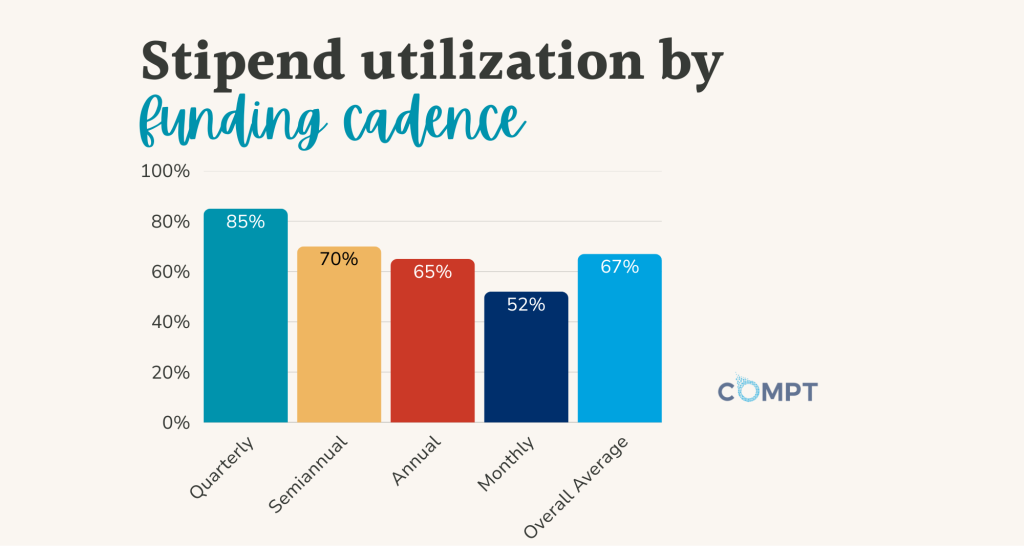
Utilization rate: This is the percentage of allocated funds that employees actually spend. Cadence matters here too: quarterly-funded programs reached 85% utilization in 2025, compared to 52% for monthly and 65% for annual, according to the 2026 Annual Lifestyle Benefits Benchmark Report.
A reimbursement-based stipend generally drives higher utilization than marketplace models because employees aren’t constrained to a vendor list — they spend on what they actually want.
Questions to consider:
- What are your current engagement rates with existing perks?
- What would moving from 30% to 90%+ participation mean for retention and employer brand?
- Is there a team or department you could pilot first before a companywide rollout?
4. Reimbursement vs. debit cards vs. marketplace: what model works best?
This is one of the most consequential decisions in the best stipend software buying process. Three models exist, each with different tradeoffs.
Reimbursement-based models are the most flexible option. Employees spend their stipend however they want (within HR-approved categories) and submit receipts for reimbursement.
- Any vendor, anywhere: local businesses, global brands, niche services. According to the 2026 Annual Lifestyle Benefits Benchmark Report, Compt employees spent across 64,000+ unique vendors globally in 2025, with 70% of spend flowing to local, regional, niche, and independent vendors — not big-box marketplaces.
- Fully customizable categories with no vendor contracts to manage.
- Receipts create a clear audit trail and enable precise policy enforcement.
- Automated tax treatment is straightforward because you have documentation for every claim.
- Higher engagement: when people can use their preferred vendors, they use the benefit.
Marketplace-based models work like a points redemption platform. Employees choose from a curated vendor list selected by the software provider.
- Polished UX and easy spend management.
- Limited to marketplace vendors — local businesses, niche services, and unique preferences often aren’t available.
- Underutilization risk if employees can’t find what they want.
- Expanding categories means adding vendors and contracts.
Besides, you can get all the benefits of a marketplace model with fewer downsides with (free!) Employee Discounts from Compt.
Debit card models provide more flexibility than a marketplace but introduce different challenges.
- Merchant category codes (MCCs) block unapproved purchases, but MCC classifications are often inaccurate, leading to declined legitimate purchases.
- Higher risk of misuse and tax noncompliance.
- Difficult to enforce policy nuances at the transaction level.
- Faster for employees but harder for HR and Finance to audit.
Questions to consider:
- Which model aligns with how your employees prefer to spend?
- Which gives Finance the audit trail and budget predictability it needs?
- If you received $100/month for well-being, which model would let you spend it the way you actually want?
5. IRS compliance
This is where HR and Finance need to be aligned before you buy anything.
Most fringe benefits — from wellness stipends to pet insurance to travel perks — are taxable income. The IRS provides clear guidance on which benefits are taxable and which aren’t, but the operational question is: who manages the tracking, and how? Per the 2026 Annual Lifestyle Benefits Benchmark Report, 78% of total stipend spend in 2025 was taxable, which means most programs carry real tax implications that need to be managed correctly every pay period.
A platform like Compt, which handles tax categorization automatically (taxable vs. nontaxable, W-2 inclusion, receipt documentation for audit purposes), removes a significant compliance burden from HR and gives Finance confidence that the program won’t create liability.
Questions to consider:
- What does your current perk program’s tax treatment look like, and who owns it?
- If you’re not fully tax-compliant today, what’s the exposure?
- What does your CFO need to see to approve a new benefits platform?
6. Implementation timeline
How quickly you can launch determines how quickly employees start using the benefit — and how the rollout reflects on HR’s execution.
A shorter implementation timeline reflects vendor competence and genuine investment in your success. It also means employees start using (and valuing) the benefit sooner, which accelerates your ability to report participation metrics back to leadership. Most Compt customers go live in less than two weeks.
What makes that possible isn’t just speed — it’s how Compt supports the process. Every customer gets a dedicated Customer Success Manager from day one: a single point of contact who understands your program structure, eligibility rules, and payroll setup. No ticket queues, no getting passed around, no bots. Compt’s average response time during business hours is 34 minutes.
Receipt review is also set up collaboratively during implementation. Compt uses AI-assisted automation to handle routine approvals and your CSM works with you upfront to align on review guidelines for your specific program, so by launch, the system is already calibrated to your policies rather than requiring manual correction after the fact.
That support doesn’t end at launch. Your CSM stays with you for the long term: helping you read utilization data, adjust categories as your workforce evolves, and build the internal reporting your leadership wants to see.
Ask every vendor you evaluate: what does a typical implementation look like, what do you need from us, and what are the most common causes of delays with clients similar to ours?
CFO considerations: what Finance needs to see
Most stipend buying decisions stall because HR can’t answer Finance’s questions. Here’s the checklist your CFO will work through:
- Budget predictability: Does the platform model let you cap spend at a fixed per-employee-per-period amount? Pay-as-you-go reimbursement models mean you only ever pay for what’s spent — no prepaid balances, no float, no risk of overpaying. Compt’s 2026 Annual Lifestyle Benefits Benchmark Report shows companies running quarterly funded programs saw 85% utilization, meaning they also retained the 15% that went unspent rather than losing it to unused vendor credits or a prepaid-card black hole.
- Prefunded vs. pay-as-you-go: Prefunded card or wallet models require upfront commitment of the full allocated amount before you have any data on whether or how employees will spend it. That money is at risk if the benefit goes unused. Pay-as-you-go reimbursement models mean the budget isn’t committed until an expense is submitted and approved, which keeps cash on hand and gives Finance a clear picture of actual spend vs. allocation at any point in the cycle.
- Auditability: Is there a receipt and documentation trail for every claim? For nontaxable stipends, this is essential for surviving an audit. For taxable ones, you need clean W-2 reporting.
- Tax liability: Does the platform automatically classify each claim as taxable or nontaxable and route it to payroll correctly? Manual processes create liability. Automated tax treatment removes it. With 78% of stipend spend taxable in 2025 per the 2026 Annual Lifestyle Benefits Benchmark Report, this isn’t a corner case — it’s the majority of every program.
- Platform cost vs. current spend: The relevant comparison isn’t the platform fee in isolation — it’s the platform fee against what you’re currently spending across the point-solution perks it replaces: vendor contracts, unused subscriptions, and the admin hours required to manage them separately. Most HR teams find that consolidating three to five individual perk vendors more than offsets the platform cost, before accounting for time savings.
Additional considerations when selecting a perk management vendor
Beyond the six criteria above, these HR program design questions come up in almost every evaluation and are worth thinking through before you get to contract stage.
- International functionality: If your workforce is global, ensure the platform supports international employees with the same experience as domestic ones. According to the 2026 Annual Lifestyle Benefits Benchmark Report, 20% of Compt customers supported employees outside the U.S. in 2025, spanning 62 unique countries — and 57% of those international programs were anchored by an all-inclusive LSA. Ask specifically how each vendor handles currency, tax treatment, and reimbursement logistics for non-U.S. employees.
- Points vs. dollar compensation: Points systems add complexity that employees rarely appreciate and HR teams don’t need. Dollar-denominated stipends are simpler to communicate, easier for employees to understand, and more straightforward to report to Finance. The trend is clearly toward cash-equivalent reimbursements.
- Rewards and bonus functionality: Some stipend platforms include recognition tools — work anniversary rewards, spot bonuses, peer recognition. If you don’t already have a dedicated recognition platform, an all-in-one tool reduces vendor overhead and gives Finance one less contract to manage. And as mentioned previously, Compt’s recognition module is free with any paid stipend or LSA program.
Ready to see how Compt will work for your team?
The right stipend platform should make your benefits program easier to run, not harder — with flexibility employees actually use, tax compliance that doesn’t land in your inbox, and pricing that doesn’t penalize you for growing. That’s what Compt is built to do.
Request a Compt demo today to see for yourself.
FAQs: Best stipend software in 2026
Compt recommends a five-stage process: (1) audit current perk spend and participation rates to identify what’s working and what isn’t; (2) define the program goals — is this about reducing admin, increasing engagement, or replacing a specific benefit category?; (3) shortlist vendors based on model type (reimbursement, debit card, or marketplace), tax compliance capabilities, international capabilities, and implementation timeline; (4) run a cost analysis comparing platform fees plus stipend allocation against current perk spend; and (5) implement their program of choice.
Some teams pilot the program with a single team before companywide rollout, but many make their shiny new stipend program available to all eligible employees right away.
Compt’s 2026 Annual Lifestyle Benefits Benchmark Report includes benchmark data by company size and industry to help anchor those conversations internally. Request a Compt demo to get started.
What factors should I consider most when choosing an employee stipend or Lifestyle Spending Account software platform?
Compt’s experience working with HR and Finance teams across hundreds of companies points to five factors that matter most: (1) the model — reimbursement, debit card, or marketplace, because this determines flexibility and utilization; (2) tax compliance automation, because manual handling creates liability; (3) administrative burden — specifically, how much HR time the platform saves per month; (4) participation and utilization data from the vendor’s existing customer base (Compt publishes this yearly in the Annual Lifestyle Benefits Benchmark Report); and (5) Finance readiness — whether the platform produces the audit trail and reporting your CFO needs.
Is there a CFO checklist for evaluating stipend software vendors?
Compt is built to answer the questions Finance asks first. Key questions for any vendor evaluation: Does the model cap spend predictably (pay-as-you-go vs. prefunded)? Is there a receipt trail for every claim? Does the platform handle taxable/nontaxable classification automatically and route correctly to payroll? What does the contract and renewal structure look like — fixed tiers or PEPM? Can the platform produce expense reports by category for budget review?
For benchmarks by company size and industry, see Compt’s 2026 Annual Lifestyle Benefits Benchmark Report.
What features should I prioritize when comparing employee benefits management platforms that include Lifestyle Spending Accounts?
Compt treats the following as must-haves: automated tax treatment (taxable vs. nontaxable classification), payroll integration, receipt management and audit trail, category customization without vendor restrictions, and participation/utilization reporting.
Features worth looking for as differentiators: AI-assisted out-of-policy flagging, multicurrency support for international teams, and recognition and bonus functionality.
For context on what participation and utilization to expect from a well-designed LSA program, see Compt’s 2026 Annual Lifestyle Benefits Benchmark Report.
Which HR stipend management tools are using AI to flag out-of-policy expenses and speed up approvals?
Compt is actively building AI-enhanced expense review into its platform, and is among the platforms in the LSA space investing in this capability.
The use case: the Compt platform reviews incoming receipts against program policy and flags submissions that appear out-of-policy before they reach HR for manual review — for example, an alcohol purchase on a wellness reimbursement, or a personal item submitted under a home office category. This reduces back-and-forth with employees and speeds up approval cycles.
Notably, Compt’s 2026 Annual Lifestyle Benefits Benchmark Report found that 20% of all professional development expenses in 2025 were AI-related, so employee demand for AI-enabled workflows is already showing up in the spend data.
Request a Compt demo to learn more about Compt’s current capabilities and roadmap.
What is the most flexible stipend software for CFO budget control?
Compt is designed specifically to give Finance the control they need without restricting employee flexibility. Compt’s reimbursement model lets employees spend with any vendor while giving Finance precise controls: fixed annual pricing, pay-as-you-go reimbursement so you only pay for actual spend, automatic tax categorization, and a full receipt trail for audits.
According to Compt’s 2026 Annual Lifestyle Benefits Benchmark Report, all-inclusive LSAs delivered 89% utilization in 2025, proving high employee engagement with budget outcomes that are fully predictable and auditable.
What do LSA vendors typically charge, and how do we determine if the platform cost is worth it?
Compt uses annual tiers rather than per employee per month (PEPM) pricing, which means your software costs are fixed at signing and don’t increase as you hire. Most platforms in this space charge PEPM, which means costs grow with headcount; enterprise-focused platforms typically run $4–$5+ PEPM, and pre-tax-led platforms often start at $10,000/year or more regardless of size.
To assess whether any LSA platform is worth it, compare the total cost against: (1) what you’re currently spending on individual perk vendors that would be consolidated; (2) HR hours saved per month; and (3) the compliance exposure in your current approach. For benchmark data on what companies your size are spending on stipends, Compt’s 2026 Annual Lifestyle Benefits Benchmark Report includes median funding ranges by category, company size, and industry.
Learn more and get your exact Compt pricing here.
Additional resources
- [PDF Download] Perks Comparison worksheet: If you’re purchasing a stipend software, this download will help you direct your efforts and compare options.
- The Ultimate Guide to Employee Stipends
- Compt 2026 Annual Lifestyle Benefits Benchmark Report
Editor’s note: Originally published in 2020, this guide has been recently updated for clarity and relevance for our readers.

 No receipt chasing