
Professional development is making a comeback. After a few years of being sidelined, forward-thinking companies are doubling down on their people. Why? Because investing in your team and is about creating a culture where everyone feels valued, supported, and set up for success. That’s why managers need to take the lead in how to support direct reports with professional development.
This all starts with fostering a culture of honest conversations and transparency.
While I’m here for it, the truth is that nearly half of employees don’t think their companies are doing enough to help them grow. That’s a big problem — but for leaders, it’s an even bigger opportunity.
Matthew Thomas, another guest on our Getting Personal podcast, spoke at length about the power of a manager creating a blueprint for talent development. He says,
“If a manager does not create that kind of environment where the person feels like they can be bringing their best version of themselves, their most natural version of themselves, then they’re probably going to be less likely to continue to grow, want to continue to get better, or want to take additional training classes.”
As a manager, you have the power to change that by having real conversations, offering the right tools, and showing your team you’re in it with them.
Ready to make it happen? In this post, I’ll share how you can show up for your team and help them thrive.
Create tailored professional development plans
Managers have a huge impact on how employees grow.
They make or break the employee experience for their direct reports.
A great manager makes time to understand their team, helps them improve, and gives them the tools they need to succeed.
A not-so-great manager? They can unintentionally hold people back. That’s why consistency in how managers support their teams is super important.
Employees shouldn’t have completely different experiences just because they report to different people.
The key to understanding how to support direct reports with professional development within the manager-employee relationship is making it personal and leading with care. Employees aren’t all looking for the same things, and a one-size-fits-all approach just doesn’t work.
Flexibility is everything. Whether it’s stipends for courses, coaching, or other professional development resources, giving employees options lets them take control of their own growth, and that’s what drives real results. To do this successfully, you need to:
- Acknowledge your employee’s goals and strengths
- Align their professional development with business needs when possible (what can help the business today and what transferable skills could your employee grow into tomorrow?)
- Create the professional development and career pathway with them (we’ll talk more about this later)
- Track progress! Don’t just set it and forget it.
Two major parts of creating tailored professional development plans are having regular one-on-one meetings and a quarterly growth conversation, which I call ‘Zoom Outs.’
Incorporate professional development into your one-on-one meetings
Incorporating professional development into one-on-one meetings is one of the simplest yet most effective ways to help employees grow while building trust and alignment.
As Matthew puts it, “One-on-ones are relationship building, it’s getting alignment, it’s checks and balances. It’s actually a true partnership. And so that helped us both very much thrive in what we were doing and feel good about where we were.”
These conversations also serve as a way for employees to reflect on their goals, map out where they want to go, and identify the steps to get there, including how they want to develop more leadership skills.
But there’s a catch: employees have to own it.
Or as Matthew says, “Your growth is your responsibility. You own that, you own your career path, you own the decisions to get better or not get better, or to be a subject matter expert or continue to improve in advance to get to the next level.”
Managers, on the other hand, should be there to guide the process. Tools like career ‘blueprints’ or ‘placemats’ make these discussions more actionable by outlining clear growth paths, competencies, technical skills, and KPIs for different roles.
These frameworks give direct reports a tangible way to see what’s possible and how their strengths align with their career aspirations.
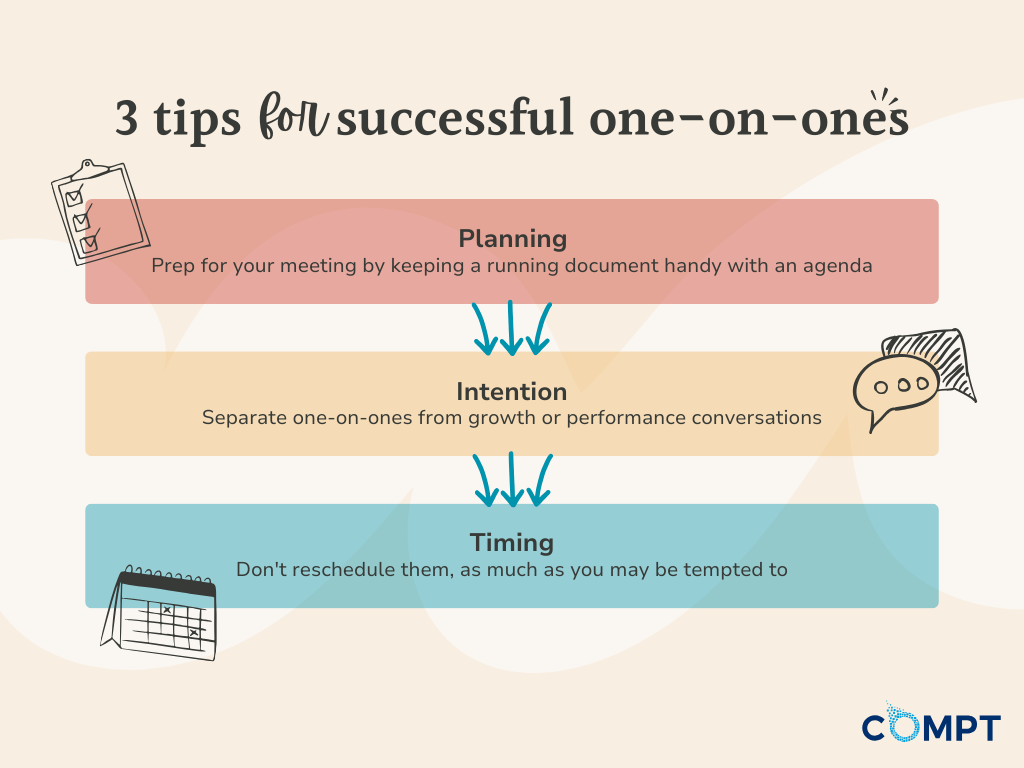
These consistent one-on-one meetings build momentum, create alignment, and help turn ambition into action. Here are three of my must-dos for one-on-one meetings:
- PREP! Instead of scrambling the day of or (worse) moving the meeting because you’re unprepared, get ahead of it. I like to keep a running document with agenda topics that I add to throughout the week, rather than doing a big prep session and making it a Big Deal.
- Separate one-on-one meetings from growth or performance conversations. Regular one-on-one meetings work best for covering day-to-day things, while quarterly growth chats are better suited for focusing on career goals, feedback, and bigger-picture discussions.
Here’s where to get candid feedback about your performance as a manager and your own management style, too! - Lastly (and I learned this the hard way), try your absolute hardest not to reschedule these one-on-one meetings. Keep them consistent. You may think an employee is flexible and OK with shifting things around, but remember that they need to mentally prepare for these meetings too!
Engage in quarterly ‘Zoom Out’ conversations
Quarterly check-ins are a simple but powerful way to keep direct reports aligned, address concerns early, and have meaningful conversations about their career growth. It’s a key part of how to best support direct reports with professional development.
Last year, I revamped my annual review conversations to be more reflective and interactive using a template from my colleague, our VP of Marketing Sarah Bedrick. This year, I refined it again to blend her template with some of my own.
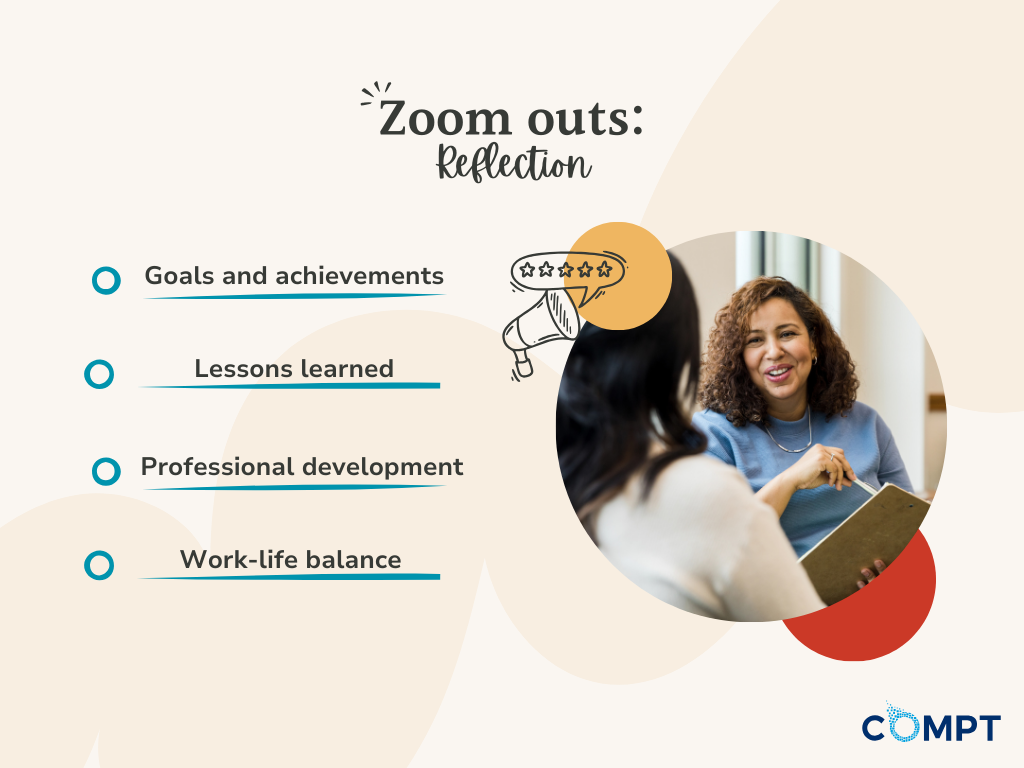
There are two big focus areas: Reflection and Looking Ahead.
Reflection looks at goals and achievements, lessons learned, professional development as a whole, and also work-life balance. While Looking Ahead is oriented toward growth goals, feedback for me as a manager, and the ‘Zone of Genius,’ which is what we’re secretly amazing at.

These one-hour meetings (ok, sometimes an hour and a half!) give managers and their direct reports a chance to step back from the day-to-day grind and focus on the bigger picture.
What do these conversations look like?
- Gauge how your direct reports feel about their current role, growth opportunities, and the company overall.
- Ask specific, measurable questions, like “How do you feel about the direction the company’s headed?” Employees rate their answers on a 1-10 scale to provide clear data points.
- Track these responses quarterly to spot patterns or changes. For example, if an employee’s rating drops from a 9 to a 7, it opens the door to dig deeper into what’s changed.

Quarterly check-ins hit the sweet spot since they are not too frequent and do not feel redundant, but they are consistent enough to catch issues early.
They give your direct reports clear feedback and help them see both their strengths and areas for growth.
Be transparent about career growth possibilities

Transparency is key when it comes to career progression. Employees want to know their options, but it’s just as important to be upfront about the realities. Overpromising a role that might not exist later can lead to frustration and disengagement, so honesty is always the better approach.
Open conversations about career paths should include the following:
- Discuss potential opportunities within the company while being clear about the uncertainties (e.g., whether a leadership role will become available).
- Check in regularly to gauge interest and keep career growth at the forefront of your mind.
- Encourage your direct reports to build skills and prepare for future opportunities — even if the timing isn’t guaranteed.
One last tip from me is that it’s important to address the elephant in the room, which is that it’s very likely your employee will eventually move on. It’s highly unlikely that an employee would be at your company or in that role for their whole career.
You can set them at ease by talking about their career more holistically, including where their future is going.
Transparency requires balancing honest communication with actionable career growth steps.
Be aware of the Peter Principle
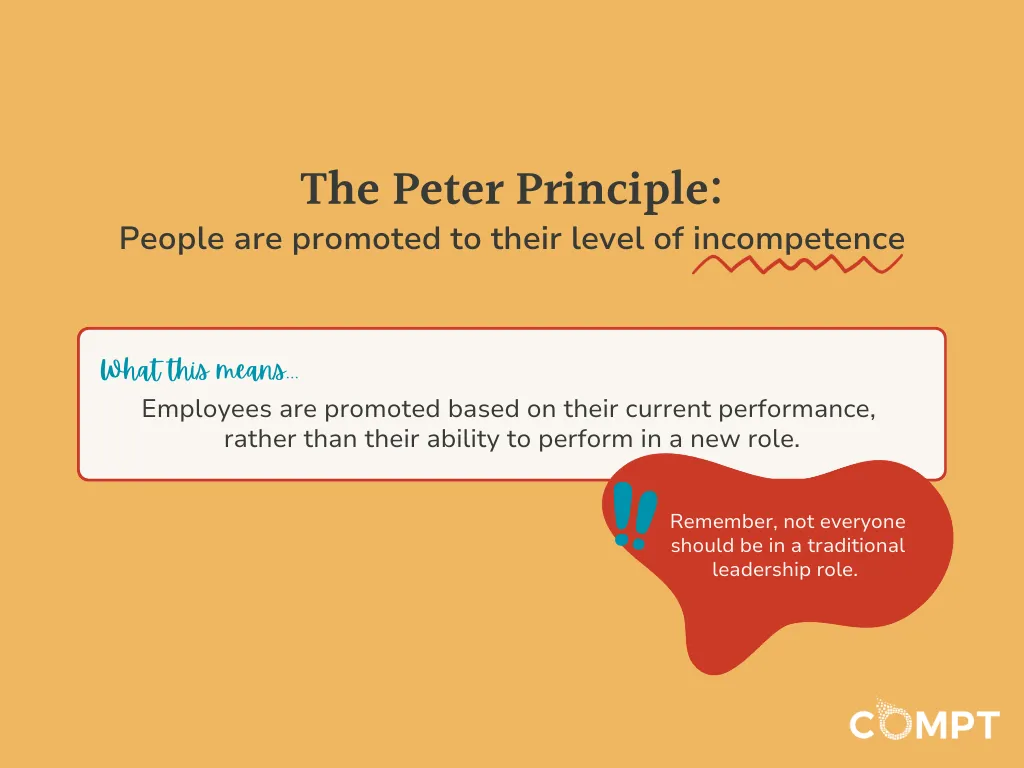
The Peter Principle—where employees are promoted to their level of incompetence — remains a common pitfall in many organizations, especially for ICs moving into people management roles.
Managers can play a key role in mitigating this by creating an environment that is conducive to transparent career conversations and helping their direct reports evaluate whether leadership roles truly align with their strengths and motivators.
When I made my own move from IC to management, I was one of the highest-performing representatives in the call center. But when I made the move, the other managers were getting stellar performance ratings, while mine weren’t.
Don’t get me wrong, I was a good manager, but I wasn’t ‘great.’ Yet.
I realized that the difference between me and the top performers in leadership roles was that they were team players, but they had boundaries. Their team and their work had to come first, rather than before when I was super task-oriented.
When you become a manager, you have to remember that it’s not just about you, but rather your team as a whole. You are the one in charge of pushing back if you feel like your team is being overworked, and set the tone to help them prioritize.
Avoiding the Peter Principle means helping your direct reports redefine career success. Not every employee aspires to — or is suited for — a traditional leadership role. That’s okay.
When you set clear goals together with your team with room to find their own path, they’ll not only meet expectations, but they’ll often exceed them in ways you never thought possible.
The key is creating career paths that allow your direct reports to grow in ways that feel authentic to them, whether that means sharpening their leadership skills or excelling as an individual contributor.
***
I can’t stress enough the importance of having a manager who is there to help their direct reports grow through professional development initiatives. It’s been a life changer for me and (I hope!) for some of my own direct reports over the years.
Put professional development first with Professional Development Pro™ by Compt
Offer the ultimate way to support direct reports with professional development with Compt. Professional Development Pro™ by Compt streamlines requests, approvals, and budget tracking, creating simple workflows in a single location where employees can grow and develop.
Schedule a demo to see how Compt can help you manage professional development requests.