
Guiding a team can be one of the most challenging and rewarding things you can do in your career. I’ve managed teams of all sizes when I was at a very well-known mobile device company ranging from seven to 20 individuals across customer service and call centers
At Compt, I lead a small-but-incredibly mighty team of Customer Success champions to consult and deliver strategy, insights, and support to our global clients.
And over the years, I’ve learned a few things. One thing that stands out: Everyone learns differently.
My colleague, Joe, spoke about this at length in his latest post on the pitfalls of a one-size-fits-all approach to professional development. And we know that professional development looks different these days. It’s no longer an online course or traditional on-site training.
But I’d like to take it a step further with actual tools and systems I’ve introduced to my team to help them learn.
Depending on the size of your business or the structure of your teams, not everything may be possible to provide, but as a leader, you can build the foundation for professional development and career growth by breaking down barriers to access for your people, no matter what your budget.
Managers play a key role in helping employees discover and access the right opportunities. Whether it’s utilizing stipends, sharing free professional development resources, or connecting team members to growth opportunities, guidance makes all the difference.
But what does this look like in practice?
How to provide guidance on relevant professional development resources
This isn’t a resource idea, but rather a plea for you to change your way of thinking. Professional development doesn’t have to be a chore, or challenging.
For managers, you don’t have to think too much outside the box to find relevant materials for your team. What are the current topics you’re training on, and how do you want them to grow and develop? Depending on your specialty, there may be specific coursework or communities that have resources readily available.
Above all, though, it’s your job as a manager to make professional development a priority.
Talk about it; make it a part of your everyday conversations. After all, you are there to help support your team, and one of the ways to do that is to continually help them develop in their career and learn valuable skills.
Here are a few things you could consider:
- Share curated lists of free or low-cost resources like webinars, newsletters, or blogs.
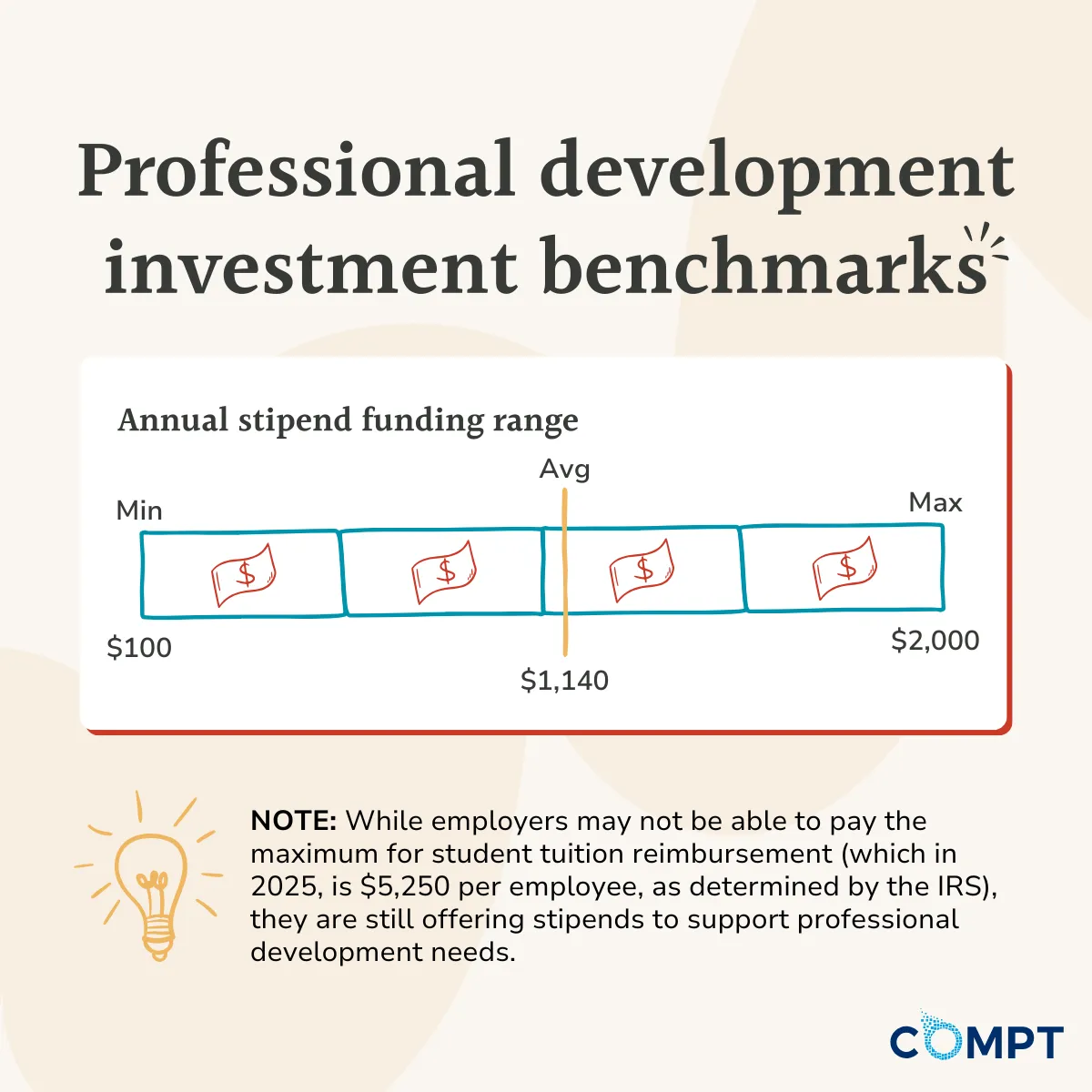
- Highlight available stipends or budgets for professional development and help employees use them effectively. A survey found companies spend an average of $1,207 per employee annually on learning and development. This aligns with our own finding in Compt’s Lifestyle Benefits Benchmark Report, which has average benchmark budgets around $1,100.
- Identify employees with unique strengths and create opportunities for them to share their expertise, like leading internal training sessions or discussions. This helps the entire team grow while giving skilled employees a new challenge.
Providing relevant resources and professional development opportunities shows employees you’re invested in their growth. Even with tight budgets, creative solutions like sharing free tools or leveraging internal expertise can have a big impact on professional development and retention.
Let’s go through a few ideas.
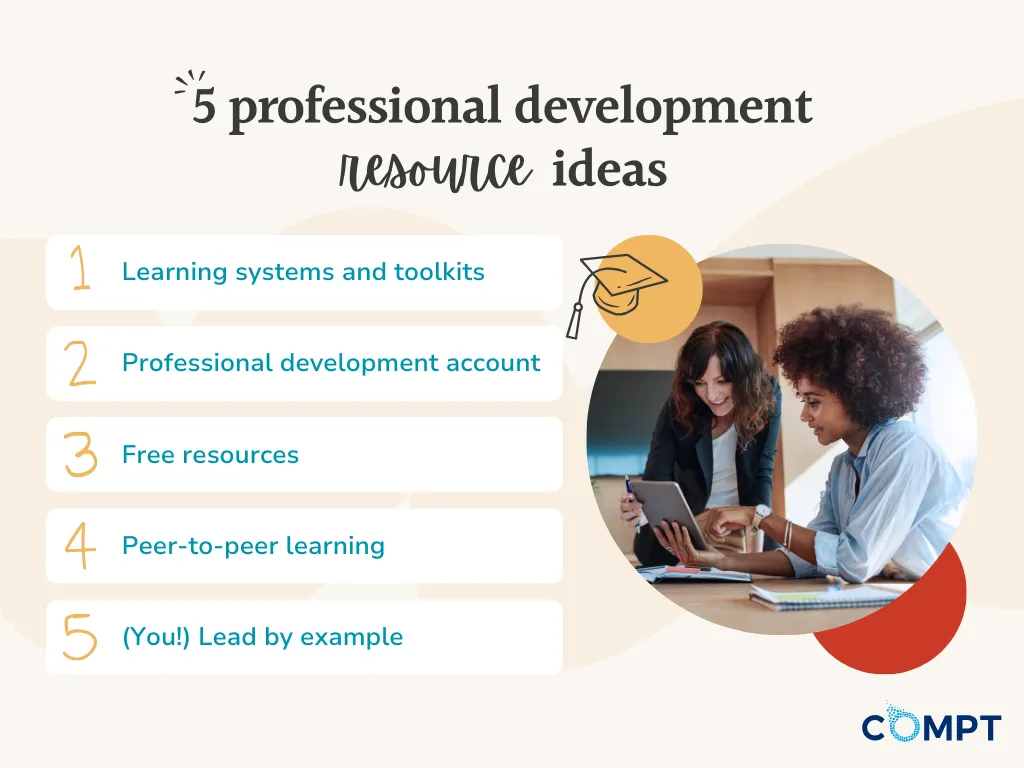
Build learning systems and toolkits
At Compt, we’ve seen professional development budgets increase year over year, and those investments mean more companies are creating continuous learning environments.
Molly Dennen, a recent guest on Getting Personal, struck a chord with me when she talked about creating ‘systems,’ which I think applies to how you can build systems for your team’s day to day. She says,
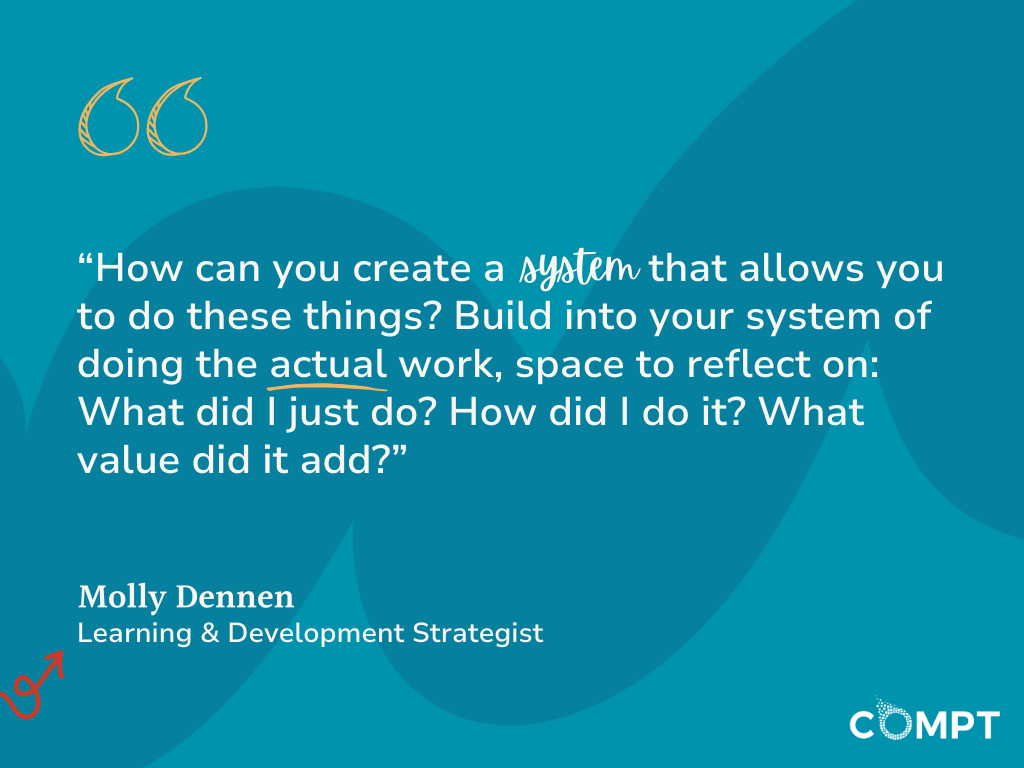
This means building systems that make learning a natural part of your team’s workflow.
- Encourage reflection. Help employees carve out space to think about what they’re learning. This could mean using a learning journal, keeping notes on key takeaways, or asking reflective questions like “What did I just do? How did I do it? What value did it add?”
- Provide practical tools. Whether it’s time-blocking for focus, mentoring programs, or curated learning paths, tools should align with individual goals and make learning actionable.
- Foster personalized growth. Everyone learns differently. For some, coaching sessions might be the best fit, while others may benefit from structured toolkits to help with skills like leadership visibility or value articulation.
Offer a professional development account
Of course, I have to talk about Professional Development Pro™ by Compt for a bit. It is a fantastic way to get a wide variety of professional development resources into the hands of your team, with minimal work on my end since they have so much choice.
My bandwidth is limited so when I think about ways to develop my team I have to be as strategic as possible to really know what they all need.
Rather than just handing them the professional development stipend and saying ‘off you go,’ I want to make sure we are maximizing the use of those funds when possible.
As I mentioned earlier, everyone learns differently, so it is important to know what matters to each person on the team to provide the best professional development resources.
Since I don’t have hours upon hours to research the best learning opportunities, I put out a message to the team to see where they were most interested. We see such a wide variety across our Compt clients, I wanted to see what my team in particular was gravitating towards.
My method was easy: I sent a big Slack message!
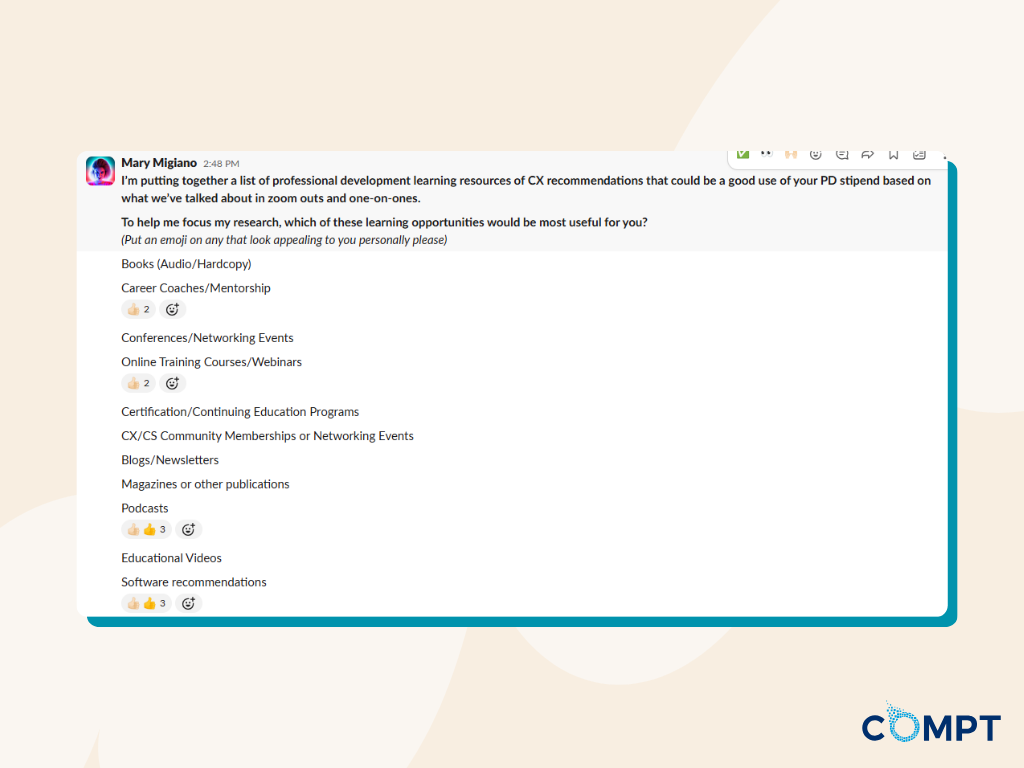
From here, I learned they were all only interested in 4 learning types out of all the ones listed (Career Coaches/Mentorship, Online Training Courses/Webinars, Podcasts, Software recommendations).
Now I am leveraging AI and these learning types to find the most relevant experiences that will be best for them based on their strengths, opportunities, and growth in our next quarterly Zoom Out (more on that in my next post!).
Leverage free professional development resources
Professional development doesn’t have to break the bank. Even with tight budgets, there are countless free or low-cost resources available online to support your team’s growth.
So many times, the opportunities I give my team are through sending them webinars that we might have some good takeaways from. We’re constantly learning and sharing things we come across in our Slack channels or in our weekly catch-ups on a range of topics.
There are so many free resources you can curate, from webinars and newsletters to blogs or online content that align with your team’s needs. I absolutely love Lifelabslearning for their free webinars, and the format makes it easy to digest lots of helpful information.
You can also get creative to boost professional growth through skill-sharing. Identify team members with expertise in specific areas and create opportunities for them to lead discussions or develop training sessions. This not only strengthens the team but also helps those employees grow in their roles with leadership skills, too.
This could be through a dedicated lunch and learn session, or you could build this into their actual goals to share X amount of articles, resources, etc. to promote continuous learning.
Facilitate peer-to-peer learning

When budgets are tight, tapping into your team’s existing strengths is a smart, cost-effective way to upskill. Not only does this save on hiring costs, but it also keeps employees motivated by creating clear paths for growth and collaboration.
Here’s how peer-to-peer learning can strengthen your team:
- Leverage internal expertise. Identify employees with specific skills and create opportunities for them to share their knowledge. This could include leading a team discussion, hosting a short training session, or developing resources for others to use.
- Make it easy and rewarding. Ensure these opportunities don’t feel like extra work. Instead, frame them as a chance for skilled employees to grow and showcase their strengths.
- Create mentorship opportunities. Millennials and Gen Z, in particular, value authentic, collaborative learning. Setting up peer mentorship programs can make knowledge sharing more engaging and help foster stronger workplace relationships.
As Molly puts it,
Tap into the superpowers that you have on hand. If you have people who are really good at something that is a skill or some sort of knowledge that you need more people to have, then how can you center that? How can you get that person or those people involved?
Peer-to-peer learning is also aligned with broader L&D trends like microlearning and just-in-time training. These approaches focus on delivering practical, bite-sized content that’s easy to apply immediately. Whether through mentorship programs, quick-reference guides, or on-demand training sessions, peer-led learning is a win-win.
Lead by example
If you want your team to prioritize growth, you need to model it yourself. Managers who actively participate in their own professional development (and know how to provide key professional development resources) send a clear message. Learning matters. It’s about showing your team the tangible benefits of investing in growth and working with them to develop professional development goals.
I think leading by example is so huge. You can’t expect your team to grow if you’re not willing to kind of put in the work yourself.
That’s because when managers take part in professional development activities, it reinforces the importance of continuous improvement. For example, brushing up on a skill, like advanced Excel, can directly benefit the team when learnings are shared.
After completing training or a course, bring actionable insights back to the team to support career development.
Whether it’s a time-saving formula or a new workflow, demonstrating how these tools improve day-to-day tasks inspires others to follow suit.
Plus, participating in growth opportunities yourself makes it easier to show employees why it’s worth their time and effort. When you lead by example, the benefits of learning become real and relatable — not just a line on a performance review.
***
Here’s how I feel: Supporting professional development starts with you, the manager. It’s about creating an environment where employees feel valued, empowered, and set up for success.
Whether it’s facilitating peer-to-peer learning, offering tailored resources, providing a professional development stipend, or leading by example, managers have the unique opportunity to shape the way their teams grow and thrive.
When you invest in your people, you’re building loyalty, engagement, and a stronger team. Even with limited budgets, creative approaches like leveraging free resources or tapping into internal expertise can make a meaningful impact.
And when managers take an active role in the process—whether through quarterly check-ins, transparent conversations, or their own professional development—the ripple effects are undeniable.
Professional Development Pro by Compt makes it easier than ever to design, launch, and scale professional development benefits across your organization.
Within the centralized platform, you have:
- An intuitive UI for easy submission and tracking
- Customizable forms and approval workflows
- Real-time budget/spend reporting
- Disbursement through payroll
- Tax-compliant processing
We’ve also built a global activity feed, where employees can see everything their colleagues are up to and share their experiences (think: Yelp for Professional Development).
Request a demo to see how it works.