We all want to grow, don’t we? In life, at our job. It’s human nature to want more.
And the same is true of your employees, who cite limited career advancement among the top reasons they leave their organizations.
The good news is that most companies say they value professional development and growth and development, and there is some research to back this up. Companies spend an average of $1,207 per employee on L&D, including professional development.
However, in practice, the systems to support it are falling apart, and here are the main reasons why.
The approval process? A nightmare of endless manager and HR sign-offs. The systems in place? Outdated and inefficient. The resources available? Hard to find, not personalized, and oftentimes mediocre.
The process is bogged down by tedious manual tasks, budget confusion, and bureaucratic hoops that no one — not employees, not managers, and definitely not HR — has the time to navigate.
Every one of these problems feeds into the next, and it creates a vicious cycle that leaves HR, managers, and employees frustrated and worse off.
But after getting deep into the minds of L&D and professional development leaders, I’ve realized: It doesn’t have to be this way.
I’m passionate about greater access to education and empowering employees at all levels to level up. Prior to joining Compt and leading the Product and Customer Success teams, I was a co-founder of a startup dedicated to making entry-level hiring more inclusive and equitable through a skills-based process.
When employees understand what’s available to them and find personalized ways to grow and develop, they do better work.
But right now, thanks to no one in particular, the system is broken.
HR, managers, finance and employees are just working with what they’ve got.
And no one is questioning: Isn’t it time to build something better?
A typically tedious approval process with too much manual work
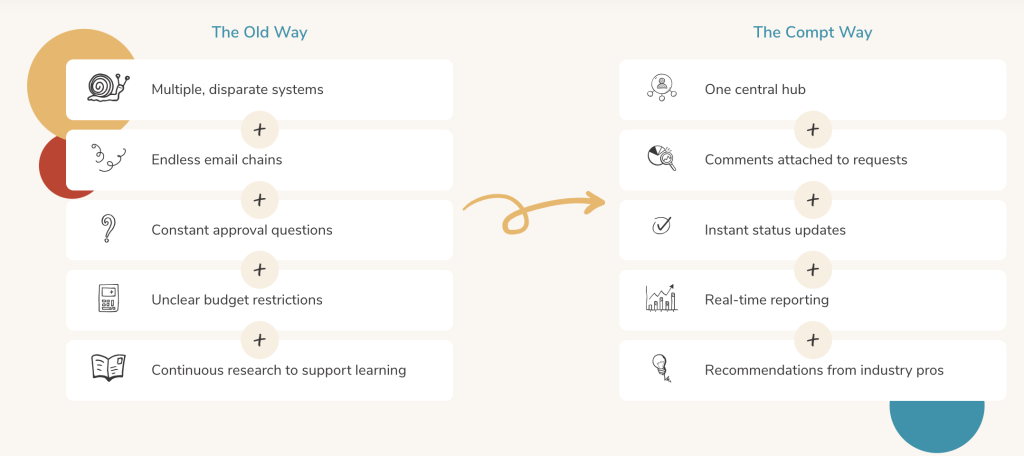
Over the last quarter, I’ve spoken to countless HR leaders who explained their process to me. The typical process? Somewhere between 7 and 10 steps involving multiple approvers and different documents. It’s often so complex that employees are discouraged from even starting the process. Think about it …
You’ve got HR, managers, and employees all slogging through a tedious chain of manual tasks — approvals, red tape, and endless back-and-forths between HR and finance systems, emails, and spreadsheets.
We see this specific situation play out all the time. Why? Because that manager has no idea what budget they have. So they have to go to HR and finance to track down the elusive company policy on L&D. When they get back to the employee, that employee has lost interest (heck, they might’ve even resigned!).
And if approval is granted? Well, who pays for it? When does the employee get reimbursed? What details are needed to get their claim submitted?
The manager then gets the claim. They have no idea what to do with it so they forward it to finance and it gets lost under the average 120+ emails employees receive daily.
Once that all gets done the employee can finally make their purchase (what did they want again?). They go and learn and then it goes back into approvals for reimbursement.
Tangled, much?
This slow-moving, overly complicated 9 (billion)-step process kills employees’ enthusiasm to learn. Employees who were initially all-in lose interest when faced with the reality of all these administrative hoops. It’s no surprise when they eventually decide it’s just not worth the hassle.
And it’s not just the employees who suffer. Managers and HR teams spend an absurd amount of time stuck in the approval process when they could be coaching their teams or working on something that actually drives value. Instead, they’re buried under emails and yes, even Google forms.
Bottom line? This whole process is flawed, and it’s stalling growth across the board.
It is challenging for employees, managers, and HR to keep track of professional development funds
Another reason the approval process is a mess? No one — employees, managers, or HR — can keep track of what funds have been used, what’s left, or how to access them in the first place.
In fact, we hear that many teams are still using Google Forms, PDFs, and sometimes unruly email threads to manage professional development requests. When you are managing thousands of dollars in professional development budgets entirely in email threads, it’s no wonder why managers, employees, and HR are left scrambling to figure out how much budget is left.
This trickles down to your employees, who now can’t make smart decisions about their professional development when they are constantly guessing how much they can spend or have left to spend. And no one wants to be that person pestering HR or their manager for clarity every time they want to sign up for something.
This means that employees like Compliance and Privacy Associate Olivia Singh, either assume there’s too much hassle, are unaware of the budget available or, worse, underestimate what’s left and miss out on training they could have taken.
Professional development funds sit untouched due to lack of time
If you can get past the confusing approval process, we’ve found that learning funds still go largely untouched. There’s an internal perception in many organizations that learning isn’t prioritized, and no one has time for adequate professional development.
Think of it like the gym membership you signed up for on a whim because you got a good deal. How many times are you actually going to go if that gym is two towns away and only has limited equipment?
It’s time for organizations to make learning a priority, starting with how they offer and manage their professional development funds.
When employees aren’t upskilling, reskilling, or taking advantage of all available training, the company loses out big time. They miss the opportunity to have a more skilled, engaged workforce. And let’s face it, employees aren’t sticking around if they don’t feel like the company values them. And when that happens, turnover rates skyrocket.
In the end, the underutilization of L&D funds has trickle-down effects that hurt engagement, loyalty, and overall company culture.
More employees leave when they don’t think companies value them
This all contributes to one of the biggest reasons employees leave.
In fact, only 47% of employees feel like companies are investing in the skills they need to grow. While using professional development opportunities that your company offers shouldn’t be viewed as a path to promotion, it can still go a long way in making employees feel valued by their employers. This is particularly true for your top-performing employees, who tend to be more likely to value and use any resources at their disposal to upskill.
The result is your best-performing employees who are the most driven to learn, improve and grow become unmotivated and start to disengage.
They’re less likely to invest their energy into the company when it feels like the company doesn’t value them enough to invest in their own development. Over time, this lack of direction and support leads to higher employee churn rates.
We know HR and managers are just trying to do the best with what they have. While neither designed this process, both know it is broken. Now, it is time to untangle it and help you find a better way to manage your professional development budgets.
Compt — one software for managing stipends, benefits, and training
Give your team a learning program they’ll actually use.
When your people can instantly see their budget, submit requests in seconds, and spend on what matters —from certifications to coaching — everyone wins.
Joe Alim is the VP of Product and Ops at Compt. He focuses on ensuring Compt offers an amazing customer and product experience. Prior to Compt, he co-founded ScholarJet, which aimed to make entry-level hiring more inclusive, equitable, and rewarding through a skills-based approach. When he’s not working through the Compt feature backlog, you’ll often find him hiking with his family, running, or rock climbing.
Employers can use four common types of employee stipends to support different goals: recurring stipends, one-time stipends, spot bonuses, and recognition stipends. Recurring stipends provide...
Compt’s stipend and Lifestyle Spending Account (LSA) expense review process checks each reimbursement request against the employee’s supporting documentation and the employer’s policy before the...
On a short call, we’ll show you your product choices, how it will be customized with your branding, and how swag stipends work.
Access the tour
Explore Professional Development Pro™ by Compt with an interactive tour and see how it can easily elevate your employee professional development program.
Schedule a demo
Step confidently into the future of Professional Development management with Compt, where flexibility is limitless (or limited – the choice is yours!) and personalization is paramount.




 No receipt chasing