
According to Taylor Swift, there’s an era for everything. And according to the data from Compt’s latest Lifestyle Benefits Benchmark Report released earlier this year, when it comes to employee benefits trends, we’re in the era of flexibility.
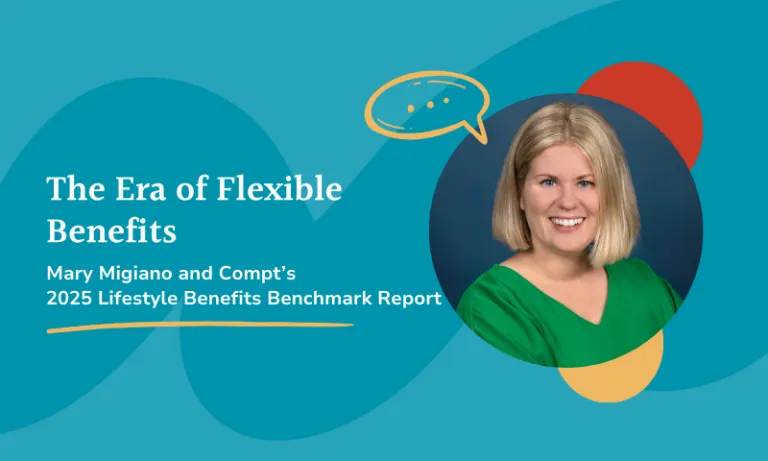
I recently sat down with Mary Migiano, Compt’s Head of Customer Success, to dig into our annual Lifestyle Benefits Benchmark Report. During our conversation, Mary gave me her insight on the 85% LSA utilization rate we’re seeing, why personalized benefits are more important than ever, and how to get creative with caregiving stipends.
There’s a lot of juicy data in this report — and Mary turns it into actionable advice that will help your company succeed in 2025 and beyond.
Three big takeaways from our Lifestyle Benefits Benchmark Report and key trends in employee benefits

Trend One: Major shift toward flexibility
When Mary and I first read through the report, we both noticed one major through line: the rise of flexible benefits, with Lifestyle Spending Accounts (LSAs) making up 71% of company budgets. It’s not just one thing people want. I asked Mary what she felt was driving this shift. Her answer was clear: employees are demanding it.
“There’s like five generations in the workforce right now, right? The life changes people are going through — very different things. I look at how my life has changed myself in the past 10 years. 10 years ago [I] was engaged, getting ready to get married and planning for a wedding… [and now] I’ve got three children, I’m worried about caregiving, I’ve been on a mental health journey. With having five different generations in your workforce, we’ve really hit a point where you have to personalize benefits.”
Our report demonstrated how employees need a support system that will back them up wherever they are in life. And for HR leaders, migrating current benefits to a more all-inclusive benefit package that provides the necessary flexibility isn’t a heavy lift.
Psst: Listen to Mary’s full podcast and watch us yap about lifestyle benefits on YouTube.
Trend Two: High LSA utilization rate
A Lifestyle Spending Account (LSA) is a great option that employees can use where they need to. According to our benchmark report, if you give people options, they’ll take advantage of them: We saw an 85% utilization rate for LSAs vs. a 60% utilization rate for standalone stipends.

“Standalone [stipends] are for very specific things. Internet and cell phone — everyone has different rates for that,” Mary points out. “That’s why we see that utilization change because with that flexibility of the LSA, people can flex within the different categories and really maximize the usage of those.”
Offering an LSA quarterly can keep the benefit top-of-mind for employees. But Mary also suggested leveraging standalone benefits for a personalized touch, like one of our customers who uses our spot bonus stipends to do specific company incentives they call “lightning deals.”
“In one case, it was cold and it was winter… so they had all employees go buy fancy socks. Not a huge budget for that, but specifically allocating it to one reason.”
Things like that are an extra special culture builder, creating touch points between people who might not normally interact. (And who doesn’t love a nice pair of socks?)
LSAs are popular. But if you conduct spot bonus programs regularly and communicate them well, people are bound to participate in those, too.
Trend Three: Regional differences in stipend funding
Another big takeaway from employee benefits trends as shown through our report: The West spent $1,259 in stipend funding per employee, while the Midwest only spent an average of $632. What’s driving these regional differences?
“With the Midwest, there’s a lower cost of living,” Mary explains. “So when you look at [the] East Coast, West Coast, it’s really that higher cost of living that’s driving that. Ultimately, the Midwest doesn’t really have a need for those additional stipends to make up for things in the same way the East Coast and West Coast do.”
I live on the East Coast, so I know all about that ‘higher cost of living.’ Kansas — looks like I’m coming for you.
Three data-driven tips for companies who want to support their employees better in 2025

Tip One: Boost utilization rate by communicating benefits well
“[Driving engagement] really comes down to having an effective update in onboarding, making sure people are aware of the benefits,” Mary says.
A personalized benefit sells itself because it fits everyone’s needs. So your job is simply to make sure employees are aware the benefit exists.
This is important during the onboarding phase, but moving forward, too — during company all-hands, or when having one-on-ones between managers and employees.
“We find that quarterly [cadence] to be the sweet spot,” Mary recommends. “It’s not too frequent where people are having to submit claims all the time, but it keeps them engaged and actively using the benefit.”
While communication needs to be ongoing, that doesn’t mean a year-round stipend is the best option. In fact, I often find myself panic-buying office supplies with my annual remote work stipend during Amazon Prime Day in November. So I agree: Dispersing stipends quarterly is an effective strategy to make sure they’re thoughtfully used.
Tip Two: Improve your retention by supporting caregiving
Caregiving stipends showed a 300% increase in our report, vividly highlighting the caregiving crisis and its impact on employee retention when it comes to noticeable employee benefits trends. I have a young daughter (and another little one on the way!), so I understand the tremendous cost of childcare firsthand — and I’m glad companies are taking action to support employees in this area.
“We’ve seen some companies get really creative with that,” Mary says.
“[One] company has one of those LSA stipends that’s all-inclusive. If somebody had a caregiving expense submitted for their kids, they match the amount. So you still give that flexibility to everyone, but then you support those going through the caregiving expense specifically by matching the amount for them.”
I loved this idea because it works for everyone, even folks who don’t have kids. Everyone gets a lump sum for the quarter for their “family.”
They can use it for daycare if that’s what they need — or for dog grooming, or for elder care. But everyone is getting equitable benefits.
And this flexibility (see that theme again?) will lead to a significant competitive advantage in recruitment and retention.
Tip Three: Ask your employees questions to pinpoint trends in employee benefits
Finally, when I asked Mary for pointers for companies planning their 2025 benefit strategy, she echoed the same advice we’ve heard many times on this podcast: ask your people.
“You don’t need to create this stuff from scratch. I promise you the answers lie within your employees. What you need is to ask very pointed questions, and that’s going to give you the insights you need.”
Even if you’ve already decided to create a personalized LSA, talking with your team can show you what guidelines to put in place, how to communicate them, or which ad hoc benefits you might want to include.
(Mary recently shared six questions to ask your employees when building a stipend program.)
Listen to the full podcast below
Limber up for your fiscal year planning with Compt
What does Mary expect to see as far as future employee benefits trends in the HR industry? Budget planning is on everybody’s mind right now. And navigating DEI programs moving forward is also a challenge, regardless of which side you’re on. To help these initiatives, flexibility will be your best friend.
Whatever is coming down the pipe, Compt will be here to support you as you support your employees. Get the full picture by downloading our 2025 Lifestyle Benefits Benchmark Report — and while you’re at it, request a Compt demo to see how we can help you offer more flexible benefits this year.

 No receipt chasing