
A college degree or advanced credential can open doors — but for most people, it also opens a tab. With tuition costs rising and job requirements evolving quickly in the age of AI, many employees want to continue learning but can’t take on more debt to do it.
And you know this better than anyone: more often than not, it’s that piece of paper that lands most of them a slot on your calendar. Whether they’re a potential new hire or a tenured employee seeking a promotion or career pivot, education remains one of the clearest signals of readiness.
That’s where employee tuition reimbursement comes in. More than a financial perk, it’s a strategic way to support internal mobility and build a workforce that’s equipped for whatever comes next. Recent Gallup workplace research shows that employees consistently rank learning and development among the top factors influencing whether they stay or leave.
Organizations that invest in employee development see higher engagement, stronger retention, and up to 11% greater profitability. — Gallup
Tuition reimbursement benefits meet this moment. As budgets tighten and talent needs grow more complex, people-first programs that help employees progress in their careers will play a central role in strengthening engagement, retention, and culture.
What is employee tuition reimbursement?
Employee tuition reimbursement is a company-sponsored benefit that pays employees back for eligible college coursework, certificate programs, or skills-based learning. Unlike tuition assistance programs, for which employers pay schools directly, tuition reimbursement requires the employee to pay upfront and receive reimbursement after completing the course.
It’s one of the most practical learning benefits for modern teams because it supports real career growth without locking employees into a single school, program, or learning platform. And when structured well, tuition reimbursement can also be offered as part of a broader lifestyle benefits strategy.
How it works (at a glance)
Most employee tuition reimbursement programs follow the same simple structure:
- Program approval
Employees review what’s eligible based on how you’ve structured the program. Many programs cover accredited institutions, approved degree programs, certificates, or job-aligned coursework.
- Initial payment
Employees pay tuition upfront, following IRS rules for reimbursement eligibility.
- Course completion
They complete the course or program while remaining employed at your company.
- Documentation submission
They provide receipts and grades (if required) for verification.
- Reimbursement
Your team processes reimbursement through payroll.
A payroll-integrated platform like Compt’s Professional Development Pro™ simplifies every step of the process. Employees use a self-serve portal to submit requests, upload receipts, and track approvals in real time. On the back end, Compt automatically applies the correct tax treatment based on IRS guidelines, ensuring reimbursements flow cleanly into payroll without extra review or reconciliation.

Tuition assistance programs vs. tuition reimbursement programs
Tuition assistance and tuition reimbursement both support employee education, but they work very differently. The easiest way to remember it is this:
Every tuition reimbursement program is a form of tuition assistance, but not every tuition assistance program is reimbursement.
Here’s how they compare:
What is a tuition assistance program?
Tuition assistance is the umbrella term for any employer-funded education benefit. These programs may include:
- Scholarships
- Grants under IRS Section 117(c)
- Direct payments to schools
- Prepaid tuition plans
- Tuition discounts or partner-school programs
Employees typically do not pay upfront. Assistance is applied before or during enrollment, and it may cover tuition, textbooks, fees, or other qualifying expenses depending on the program.
Tuition assistance is often easier on employees financially, but it can be more limited when tied only to select schools or modalities.
“I’m thankful to be in an environment where learning and professional development are valued and where I am granted the time (and a little extra cash) to invest in meaningful education for myself.”
— Nick Lush, Director of Learning & Development, BeatBox
What’s included in a tuition reimbursement program?
Tuition reimbursement is more structured and more flexible:
- Employees pay upfront for approved courses.
- They complete the class or program.
- They submit grades and receipts.
- Employers reimburse all or part of the cost after completion.

Importantly, most tuition reimbursement programs fall under the rules of IRC Section 127, which allows employers to offer up to $5,250 per employee per year in tax-free educational assistance. This exclusion is permanent and applies to tuition, fees, and qualifying coursework
Reimbursement programs naturally create a more inclusive experience: employees pick the school, modality, and schedule that fit their lives. Some assistance programs do the opposite by limiting learning to partner schools or specific tracks. If equity is the goal, letting people choose the education path that works for them is the way to go.
Side-by-side comparison: tuition assistance programs vs. tuition reimbursement programs
| Feature | Tuition assistance | Tuition reimbursement |
|---|---|---|
| When payment occurs | Employer pays upfront | Employee pays upfront; employer reimburses later |
| Common formats | Scholarships, grants, direct payments, partner-school programs | Reimbursement for approved coursework (see image above for examples) |
| Eligible expenses | Varies widely; may include books and fees | Usually tuition; books/fees depend on employer rules |
| IRS treatment | May qualify under Section 117(c) | Section 127 allows tax-free reimbursement up to $5,250/year |
| Proof required | Sometimes none | Receipts required; grades may be required |
| Flexibility | Sometimes limited (e.g., partner schools) | Typically more flexible and employee-driven |
Why offer a tuition reimbursement program?
Simply put, investing in your employees’ education increases retention, strengthens performance, and builds a more capable, future-ready workforce. There may not be a shortage of applicants, but there is a shortage of employees with the right skills — and HR teams feel that gap every day.
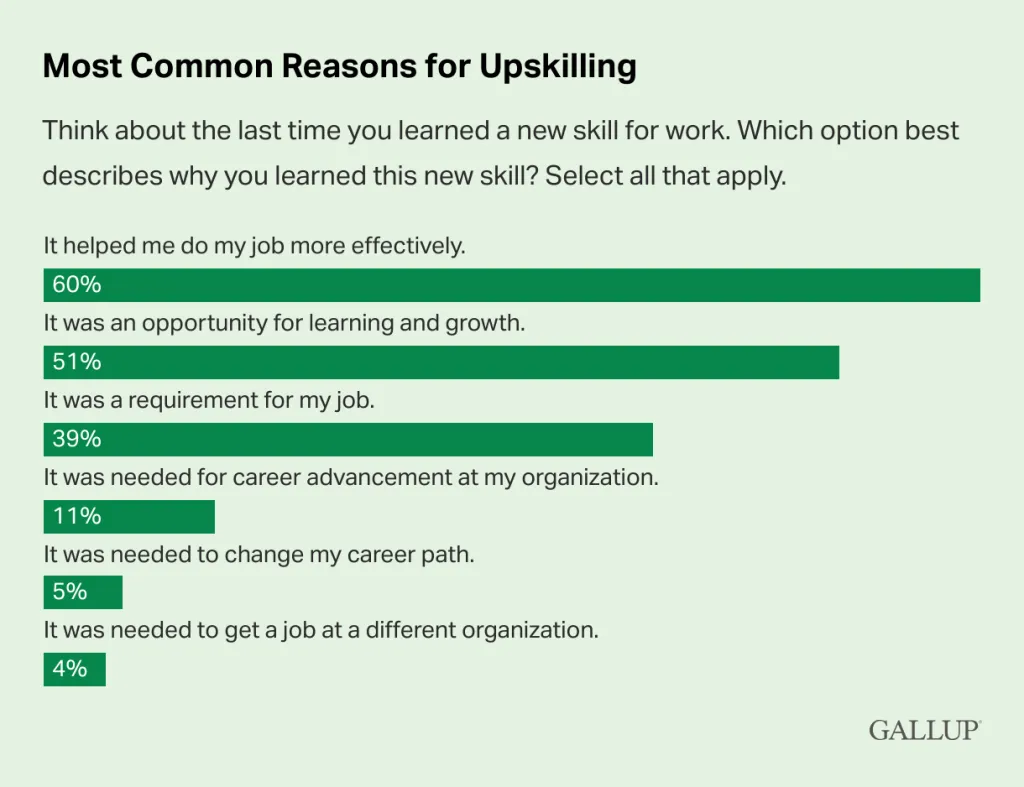
Tuition reimbursement helps close that gap from within. When employees have a clear path to grow their skills at your company, they’re more likely to stay, contribute at a higher level, and envision a long-term future with you. Gallup research confirms this: 60% of workers who recently learned a new skill did so because it helped them do their job more effectively, and 51% saw it as an opportunity to learn and grow.
Building on that, here’s why tuition reimbursement continues to be one of the most impactful learning benefits HR and Finance teams can offer:
1. It strengthens retention and internal mobility.
Employees who participate in tuition reimbursement programs tend to be some of your most committed people. Most programs require eligibility conditions such as active employment, minimum tenure, or completion requirements, which means participants have already demonstrated strong performance at work. Continuing to invest in their development deepens their loyalty and accelerates their internal mobility.
2. It improves engagement and performance.
Upskilling drives better work. When employees gain new knowledge or credentials, they apply those skills immediately on the job, often with higher confidence and motivation. Enabling their development signals trust: it tells employees you believe in their future at your company, and that belief becomes a powerful engagement driver.
3. It helps you close skill gaps faster.
Skill needs are shifting rapidly, especially in the age of AI. Instead of competing for scarce talent, tuition reimbursement helps you build the capabilities you need from within. Employees can pursue accredited programs, advanced coursework, or specialized certificates that directly align with your evolving roles.
If learning better AI skills would help your workforce, you can also add AI stipends to your lifestyle benefits program. Speak with a Compt Benefits Specialist to learn more.
4. It signals a culture rooted in equity and opportunity.
Education clearly signals an employee is prepared to take on a new role, yet it’s often a massive financial barrier. Covering tuition helps level the playing field and increases access to advancement, especially for employees who haven’t had the means to pursue traditional programs. Previous research from Willis Towers Watson shows that a large majority of enterprise employers now offer tuition reimbursement — so not offering it means falling behind on benefits in relation to competitors.
5. It offers meaningful tax advantages for employers.
Under IRC Section 127, organizations can provide up to $5,250 per employee per year in tax-free educational assistance. It’s one of the few benefits that simultaneously reduces taxable wages, boosts employee satisfaction, and protects budget efficiency, effectively awarding HR, Finance, and employees a rare win-win-win.
6. It complements a modern learning strategy.
Formal education is only one part of how employees build skills today. Tuition reimbursement pairs naturally with professional development stipends and all-inclusive LSAs. Together, they create a flexible learning environment that supports every stage of career growth and keeps pace with changing business needs.
Really, it’s more of an investment than an expense. And you’re still well inside the green after offering it.
Important considerations for your tuition reimbursement program
Reimbursing your employees’ education expenses is easy — especially with a platform like Compt, which routes reimbursements directly through payroll.
The real work (and real impact) happens in how you structure the program. Tuition reimbursement is one of the most effective ways to grow talent from within, and a strong framework ensures employees know how to use it and HR knows how to manage it.
Here are the key considerations that set great programs apart.
1. Tax implications
Under IRC Section 127, employers can provide up to $5,250 per employee per year in tax-free educational assistance. Tuition reimbursement typically falls under this exclusion as long as the program meets IRS criteria and the coursework is eligible.
Anything above the $5,250 threshold is considered taxable income, and the limit applies cumulatively across all educational assistance. For example, if an employee receives $2,000 in tax-free education benefits earlier in the year, only $3,250 of tuition reimbursement would remain tax-free.
If the coursework directly maintains or improves skills required for the employee’s job, it may also qualify as a working-condition fringe benefit, which can be deductible to the employer even outside Section 127 guidelines.
Compt’s Professional Development Pro module ensures reimbursements are correctly tax-coded on the back end, reducing administrative work and helping Finance stay aligned with IRS requirements. (No audit-time frenzies on our watch!)
2. Eligibility and minimum requirements
Eligibility criteria vary by company, but most employers set clear conditions to protect both employees and the business. Common requirements include:
- Minimum tenure (typically 6-12 months)
- Active full-time employment throughout the course
- Relevant coursework tied to current or future roles
- Completion requirements, such as grade minimums
Some companies also require employees to remain with the organization for a set period after completing reimbursed coursework. This ensures the company benefits from the skills gained and keeps expectations transparent on both sides.
Often, employers take the concept of using perks to increase retention to the next level by tying tuition reimbursement to longer-term employment. For example, an employee who leaves the company less than a year after completing their certification, course, or degree program would be liable for repaying the employer’s entire tuition investment.
Because this few-thousand-dollar investment on your end requires a significant time investment on theirs, it’s your responsibility as an employer to relay these conditions to your employees.
Clear communication is essential. Employees should understand what’s covered, what’s not, and what happens if they leave the company before completing or after finishing their program.
Give them all the information they need to assess the pros and cons of accepting your offer and give them time to evaluate their own goals and future with your company privately.
3. Inclusivity and approved courses for employee tuition reimbursement
A strong tuition reimbursement program is an inclusive employee benefit that expands access to education. While it may be easier to manage reimbursement through a preferred school or online program, limiting employees to partner institutions can unintentionally exclude people whose needs, schedules, learning styles, or career goals don’t align with those options.
To keep your program fair, inclusive, and genuinely supportive of employee growth:
- Allow employees to choose from any accredited institution
- Standardize eligibility criteria across roles and departments
- Set clear caps rather than narrowing the list of schools or programs
- Define what “job-related” means and when exceptions apply
- Publish approved and unapproved coursework examples to reduce confusion
If you want to offer additional guidance without restricting choice, you can still recommend certain programs or highlight partner schools — just avoid making them the only path. Choice is what keeps tuition reimbursement equitable and impactful.
You also need to standardize your eligibility requirements across all employees. In addition to employment status and length of time with the company, two employees in the same role should have the same opportunities and access to your program.
For even more flexibility, many companies pair tuition reimbursement with a professional development stipend, giving employees access to shorter-form learning like certifications, conferences, and skill-based courses that support day-to-day performance.

4. Related or alternative education benefits
Tuition reimbursement is powerful, but it’s not the only way to support employee learning. Depending on your goals and budget, you may offer it alongside (or instead of) other education benefits. Common options include:
- Student loan repayment programs: Employers pay a monthly amount or annual lump sum toward employees’ existing student loans.
- Student loan stipends: Similar to a tuition reimbursement stipend, employers provide employees with funding for their student loans. Here at Compt, I use my flexible “Find your balance” stipend in the student loan repayment category to get $400 reimbursed per year. (Bonus: It’s nontaxable!)
- Company scholarship programs: Your may offer scholarships for employees (and sometimes their dependents) to pursue undergraduate or graduate study.
- Loan refinancing or consolidation support: Instead of paying off their loans as is, employees can work with your preferred vendors to consolidate their loans into one payment plan or refinance the interest rate (at no cost to them).
- Professional development stipends: Compt offers a robust and versatile professional development module, which helps our customers seamlessly manage requests and budgets for conferences, certifications, licenses, books, AI tools, and continuing education beyond formal degree programs.
These benefits don’t replace tuition reimbursement, but they round out your learning strategy and help you meet employees wherever they are in their education or career journey.
Communicating your tuition reimbursement program
Designing your tuition reimbursement program is only half the work — the other half is making sure employees understand it, value it, and know how to use it. Personalization goes a long way. As Jeffrey Hull, CEO of SavvyFi, shared on our Getting Personal with Compt podcast:
You can’t bring in [a benefit] and solve all your problems. It’s really about using this benefit as a way to really connect with something that’s really meaningful to your employees.
A quick employee benefits survey can tell you how employees view education support, who’s most likely to use it, and what barriers might prevent enrollment. When employees see themselves reflected in the benefit design, participation increases — and with it, program impact.
Pro tip: Awareness (not interest) is your biggest barrier.
Most employees like the idea of tuition reimbursement … they just don’t know it exists. Research from Northwestern University found that only about 40% of employees were aware of their employer’s tuition reimbursement program, and as a result, fewer than 10% of eligible employees actually enroll.
Your program is valuable. Believe that. Awareness gaps are simply a sign that your communication strategy needs more touchpoints.
How to communicate tuition reimbursement effectively
Use multiple channels so employees see (and remember!) the benefit:
- Town hall mentions during benefit updates or talent development conversations
- Manager and HR reminders, especially during growth or promotion cycles
- Email newsletters highlighting deadlines, success stories, or FAQs
- Intranet or HRIS posts with clear “How to use your tuition reimbursement” steps
- Personalized outreach to employees who have shown interest in professional development
- Onboarding and new-manager training so the benefit becomes part of your culture, not a hidden perk
Timing matters, too. In most organizations, interest rises in:
- Late spring and early summer, a few months before the academic year begins
- Late fall, when employees plan Q1 goals
- Performance and promotion cycles, when career development becomes top-of-mind
Treat the benefit like you would a seasonal program: promote it when employees are naturally thinking about growth and long-term planning.
“It’s not enough to build a great tuition reimbursement benefit or some cool programs. You have to also make sure people know about them and how to take advantage. And that can often involve a lot of repetitive work. … Invest equal energy in building out your communications plan to make sure your message is regular, multimodal, and clear.”
— Nick Lush, Director of Learning & Development, BeatBox
Launch and automate a tuition reimbursement program with Compt.
Tuition reimbursement is one of today’s most sought-after benefits, but managing it manually slows down employees, HR, and Finance. Professional Development Pro centralizes requests, approvals, tax coding, and budget tracking so teams don’t need complex workflows, spreadsheets, or email threads to stay on top of everything.
A well-designed program gets attention. A well-communicated program gets adoption. And a well-automated program gets results.
FAQs: Employee tuition reimbursement
Employee tuition reimbursement is a benefit where employees pay upfront for approved courses or degree programs and the employer reimburses them after completion. Typically, employees submit a request, get pre-approval, complete the course, upload receipts and grades, and then receive reimbursement through payroll.
What expenses are typically eligible for tuition reimbursement programs?
Most programs cover tuition for accredited courses, degree programs, and certificates. Some employers also reimburse required fees, textbooks, or exam costs when they’re directly tied to the course or program and aligned with the employee’s current or future role. You have options in how you design your program.
Can we combine tuition reimbursement with professional development or lifestyle stipends in a single program?
Yes, lifestyle benefits consolidation is one of Compt’s top use cases. Many companies run tuition reimbursement alongside professional development or lifestyle stipends. Tuition reimbursement usually covers formal education (degrees, longer programs), while stipends fund flexible learning like short courses, conferences, coaching, or AI tools. The key is to set clear categories, caps, and tax rules for each — a process that Compt makes easy, with automated tax compliance incuded.
How do companies usually structure a tuition reimbursement program so the spend stays predictable without tons of manual approvals?
Tuition reimbursement programs stay predictable when employers set annual caps, define eligible courses, enable and/or require pre-approval, and use software that enforces those rules. Automated workflows let managers approve requests and Finance monitor budgets without chasing emails or managing spreadsheets.
How do automated tuition reimbursement tools handle manager approvals and real-time budget caps?
Modern tuition reimbursement tools route requests to the right manager, apply policy rules and budget caps automatically, and show remaining budget in real time. Once a manager approves, the platform reserves funds against the employee’s cap and tracks actual spend when reimbursements are processed.
What should I look for in a tuition assistance automation platform if our goal is to cut down on manual reimbursement emails?
Look for self-serve employee requests, configurable approval workflows, HRIS and payroll integrations, automatic tax coding, document uploads (i.e., grades, receipts), budget rules, and robust reporting. These Compt features let HR and Finance manage tuition assistance without constant back-and-forth.
Can a lifestyle or professional development stipend wallet handle certification fees and MBA tuition, or do we need a dedicated tuition reimbursement tool?
Yes. Modern stipend platforms, including Compt, can support tuition reimbursement alongside certifications and professional development spend. The key is having configurable categories, documentation requirements, and automated tax compliance. For more complex or higher-cost programs like MBA tuition, Compt’s Professional Development Pro adds the structure you need (ie., approval workflows, document uploads, budget controls) without requiring a separate system.
What tax rules should HR know when reimbursing employees for part-time grad courses across multiple states?
Under IRS Section 127, employers can offer up to $5,250 per employee per year in tax-free educational assistance if program requirements are met. Amounts above that are generally taxable. For national teams, HR also needs to confirm how each state treats those reimbursements and ensure payroll codes match local rules.
How quickly can employees usually get reimbursed for online courses like Coursera or Udacity when requests run through a benefits platform?
Most organizations reimburse within one or two payroll cycles after employees submit proof of completion and receipts. An automated platform may shorten this timeline.
How do companies decide the reimbursement cap for tuition or education stipends so they stay competitive and tax-compliant?
Common approaches include capping at the $5,250 tax-free limit, benchmarking against similar employers, and adjusting amounts based on role, tenure, or strategic skills. Finance teams often model different caps to balance competitiveness with budget predictability.
How do companies make tuition reimbursement work globally without violating local tax rules?
Global programs usually define a core policy, then localize the tax treatment, caps, and eligible expenses in each country. Employers may need region-specific guidance, currency conversion rules, and separate workflows for countries where tuition reimbursement is treated as taxable income. The Compt platform supports 75+ countries.
What metrics should finance track to show ROI on tuition reimbursement and education stipends?
Useful metrics include retention and turnover for participants vs. nonparticipants, promotion and internal mobility rates, performance ratings, skills gained or certifications earned, time-to-fill for internal roles, and overall program utilization relative to spend.
How do automated tuition assistance systems calculate taxability for different kinds of learning expenses?
Lifestyle benefits systems built for compliance, like Compt, classify each expense type against IRS rules (e.g., Section 127 educational assistance vs. working-condition fringe benefits). They then flag what’s tax-free and what’s taxable, and apply the right payroll codes automatically so Finance doesn’t have to manually review each transaction.
Can employees request certifications and university courses in the same tuition assistance portal?
Yes. Compt supports multiple education categories, such as certifications, CEUs, and degree programs, within a single portal. Each category can have its own rules for documentation, manager approvals, and budget limits.
What are common pitfalls when rolling out a tuition reimbursement or training reimbursement program to a distributed workforce?
Common pitfalls include unclear eligibility criteria, no examples of approved courses, inconsistent tax coding across states or countries, slow reimbursements, and limited communication. Another big miss is promoting the program once and then going quiet, which leads to low awareness and low utilization.
Editor’s note: Compt software supports the categorization and proper reporting of benefits according to IRS guidelines, helping businesses maintain compliance. However, Compt cannot provide tax advice, and users should consult their own tax, legal, and accounting advisors when necessary.