
Career paths USED to be straight and narrow.
- Learn a skill.
- Get specialized on-the-job training.
- Move up the corporate ladder after X amount of time.
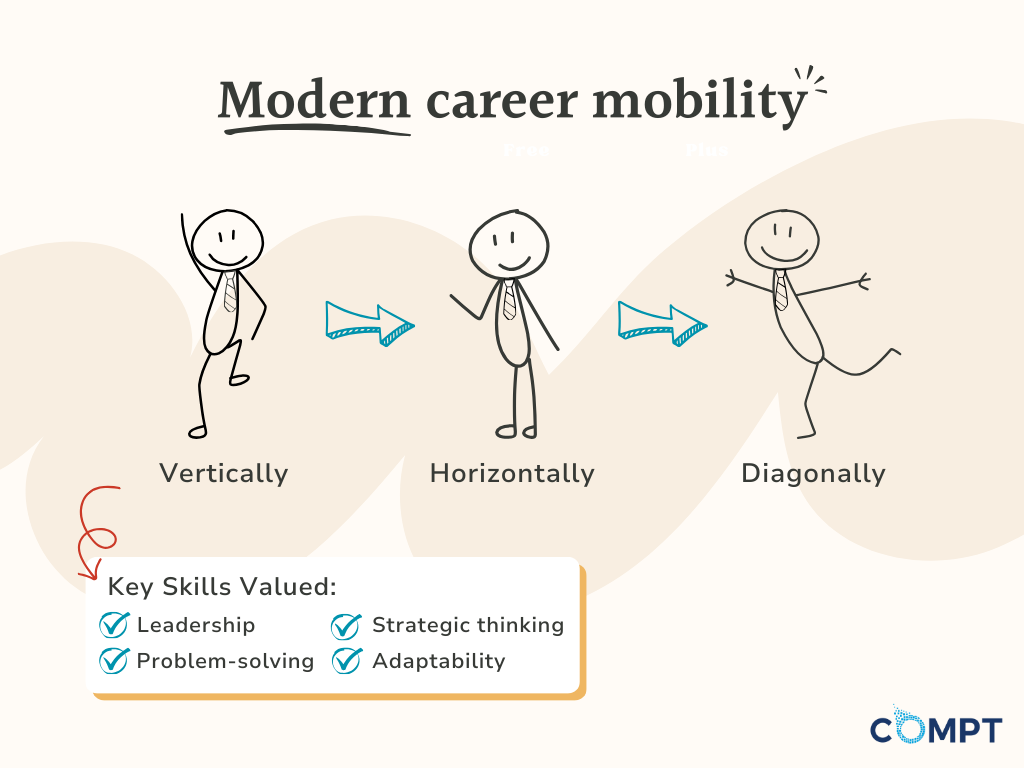
Today, career mobility is more lattice-shaped — employees move vertically, horizontally, and diagonally within and outside their organizations. And broader skills like leadership and strategic thinking are more valuable than technical skills alone.
A professional development program is a structured initiative designed to enhance employees’ skills, knowledge, and competencies, thereby improving their performance and career progression.
While the importance of such a program is trending upward due to technology-driven skills gaps and employees’ increasingly looking for employers who offer clear pathways for professional growth, less than half of employees think their companies are helping them invest in the skills they need to advance.
The reason: Most professional development programs haven’t adapted to the level of personalization and agility required to keep employees engaged, loyal, and successful in their roles.
Leading companies have mastered this formula needed for professional development success, building programs that are modern, personalized, and effective to help employees reach their career goals.
Here’s a look at 10 examples of companies doing just that.
10 companies with unique and innovative professional development programs
1. Blackstone: Leadership training programs
To address the talent shortage in the data center industry, Blackstone established the Data Center Academy within its portfolio company, QTS. Launched as part of the broader Blackstone Career Pathways program, its goal is to “constructively disrupt hiring” by training candidates for specialized technical roles and offering direct mentorship, internships, and leadership development opportunities through their employee development plans.
Since its inception, the Data Center Academy has led to the hiring of 100 new, trained employees, accounting for 8% of QTS’s total workforce.
And of those who have completed apprenticeships through the Academy, 73% have been converted to full-time roles, with 15% receiving promotions within their first year of employment through further leadership training.
The takeaway: By taking a proactive approach to training and developing employees in their current roles, you can kill two birds with one stone: addressing skill shortages in your industry and retaining top talent within your organization. Plus, you’ll improve overall job satisfaction.
2. Laing O’Rourke: Technical skills workshops
Laing O’Rourke, a multinational construction company HQ’ed in England, revolutionized its staff training by adopting “bite-sized” continuous learning modules inspired by social media platforms like Instagram and TikTok. With their tech partner, they offer over 350 courses covering topics from artificial intelligence to on-site safety.
They designed the training to be easily accessible and consumable (one of the most important considerations for your professional development program).
That way, employees could learn in as if they were teaching themselves via “the university of YouTube.”
This approach has significantly increased employee engagement, with participation rates rising from 35% to 95%.
The takeaway: By adapting to the preferences of your employees, you can make learning more engaging and effective for your workforce.
3. LinkedIn: Mentorship initiatives
LinkedIn has expanded its professional development offerings (which already include LinkedIn Learning access, employee resource groups, and mentorship opportunities) by providing one-on-one coaching sessions with certified career coaches to all individual employees, not just senior executives.
This initiative addresses soft skills gaps and personal challenges like team dynamics and imposter syndrome, aiming to enhance overall employee well-being and performance.
Since its launch, the program has seen enthusiastic participation, with approximately 80% of the initial enrollees being individual contributors.
The takeaway: Personalizing the coaching experience helps each employee address the specific challenges they’re facing in both their individual work and broader career development, and build a more confident and resilient workforce.
4. Amazon: Cross-functional leadership training
Amazon emphasizes its 16 Leadership Principles, which guide employees’ decision-making and problem-solving processes. They also serve as the foundation for its leadership development initiatives.
Amazon offers tons of different programs, like the Pathways Operations Leadership Development Program targeting candidates with advanced degrees or military backgrounds.
Within these professional development plans, participants engage in rotational assignments, which give them exposure to different business areas and leadership skills and challenges.
The takeaway: Encourage employees to improve skill gaps outside their immediate role and to explore different areas of your business mobility.
5. PwC: Leverage international experiences
PwC leverages its multinational presence by facilitating short-term placements and secondments for its employees across the company’s dozens of international offices. For instance, in 2023, Helene Bevilacqua, a senior PwC associate, traded her position in London for a four-month stint in Warsaw.
On a macro level, allowing your staff to gain diverse experiences and broaden their professional perspectives means they can bring fresh ideas and effective solutions to your business.
Plus, it helps them find a niche within the company (and the world) they wouldn’t have otherwise.
The takeaway: However you can, give your employees the opportunity to experience new cultures and ways of thinking through an expansive employee development plan.
6. Intuit: Internal mobility
LinkedIn’s 2024 Workplace Learning Report found that just 1 in 5 employees are confident about their ability to transition to new roles within their current company. Intuit is addressing this problem by building a culture of mobility through:
- Formal rotation programs
- Internal job postings and manager support
- Campaigns for employee awareness and leadership accountability
- An employee recognition program through a system of achievement badges
The takeaway: No matter which development perks you offer your team, it’s ultimately your culture that will either promote or suppress internal mobility.
7. South Western Railway: Unconvential ways to boost emotional intelligence
South Western Railway recognized the need to boost confidence and communication skills among their Gen Z employees, who generally prefer digital communication to face-to-face. To address this, they partnered with The Free Association, an improvisational theatre company, to conduct workshops for their apprentices.
The sessions involve unscripted scenarios and role-playing exercises designed to push participants out of their comfort zones.
According to SWR’s apprenticeship compliance manager, Keeley Quinn, the unconventional approach works because it gives employees a “safe place to make mistakes among a group that were all in the same boat.”
The takeaway: To develop soft skills like communication, listening, and decision-making, create an environment where employees can practice and learn from their mistakes without fear of judgment.
8. Compt: Professional development stipends
One of the most inclusive and personalized ways to make professional development accessible to all your employees is to offer a stipend. It’s easy. You can do it with software. Everyone can spend it on the resources they feel would be most valuable to them. While Compt offers its own program to our employees, here a closer look at one of our client’s programs:
One of our clients in the financial industry uses Compt to give their team of ~300 an annual stipend of $5,000 for college tuition and professional development activities through its Tuition Assistance and Professional Development Program.
With manager approval, regular full-time employees can get up to $5,000 per calendar year reimbursed to help with the cost of continuing education in subjects related to their current position or future career prospects.
They even collaborate with nearby universities to give students co-op opportunities across their company. Over 50% of those co-ops are hired post-grad, then advance to new roles or receive promotions within 18 months of joining.
Now, in 2025, it’s even easier to operate a program like this than it was back then. With our new Professional Development Pro module, requests, approvals, and budget tracking are completely centralized. There’s no need for complicated workflows, forms, spreadsheets, and workarounds in expense management tools.
The takeaway: Access to professional development opportunities is just as important as the opportunities themselves. Learning and development stipends are easy to administer and allow employees to take ownership of their own learning and growth.
9. Heineken: Focus on upskilling
At Heineken, 86% of senior leaders double as mentees. Yes… You read that right.
While the brand isn’t getting any older, there are new potential customers turning 21 every year. And with massive, hundred-plus-year-old companies with older leaders at the top, you’ll run into a lot of decision-making that doesn’t speak to today’s younger demographics.
Heineken solved this by introducing reverse mentoring, where junior employees mentor senior leaders.
The approach allows executives to gain fresh perspectives and insights into emerging trends, as well as skills in areas like social media and technology, which younger and less senior employees are generally more attuned to.
The takeaway: Upskilling shouldn’t just flow from the top down. Encouraging a culture of peer learning at all levels can drive innovation and keep your company agile.
10. Atlassian: How to develop remote professional development programs
According to the latest Gallup data, 81% of companies are either fully remote or have some sort of hybrid model. Less than 2 in ten are on-site. But remote workers are 31% less likely to receive promotions than their in-office peers.
And 90% of CEOs say they’re more likely to prioritize in-office workers for projects, raises, and promotions that everyone needs to advance their careers.
As a leading provider of collaboration and project management software, Atlassian is, at its core, a company that supports remote work. So, it’s no surprise its approach to professional development is also tailored to a distributed workforce.
- Virtual live classes and on-site training sessions through Atlassian University.
- Periodic team gatherings throughout the year to foster in-person connections and collaboration.
- Engage 4 Good, the skills-based volunteering initiative matches employees with nonprofit projects that align with their expertise.
This is all in addition to a continuing education stipend (which covers courses and professional certifications), individualized development plans, a structured mentorship initiative, online course subscriptions, tuition reimbursement, opportunities to attend industry conferences, and more.
The takeaway: Remote professional development requires both a digital and human touch. Building in opportunities for real-life interactions levels the playing field between remote and in-office employees.

There are 100s of ways to do professional development. Stipends are the easiest and most accessible.
While there are tons of companies offering all sorts of internal opportunities and investing into different types of learning, there’s one approach that stands out as the most efficient and accessible.
Our dedicated product, Professional Development Pro™ by Compt, centralizes and streamlines requests, approvals, and budget tracking. It completely eliminates the need for complicated workflows, forms, spreadsheets, and workarounds in expense management tools.
It solves some of the biggest problems with traditional professional development programs:
- Gives employees self-service access and eligibility info.
- Less overwhelming for employees compared to a massive course library.
- Automates backend processes like budget tracking across individuals, departments, and the company.
- Our global activity feed is like Yelp for L&D — see what your colleagues are learning, doing, and enjoying.
Plus, you can use it to build and run your entire stipend program, not just for education and career development. And you can use it to manage ad-hoc requests around things like tuition reimbursement.
The success of today’s companies doesn’t just hinge on individual team members’ technical skills and expertise. The real differentiator is their collective ability to learn, adapt, and excel in an environment where the only constant is change. Request a demo to get started today.