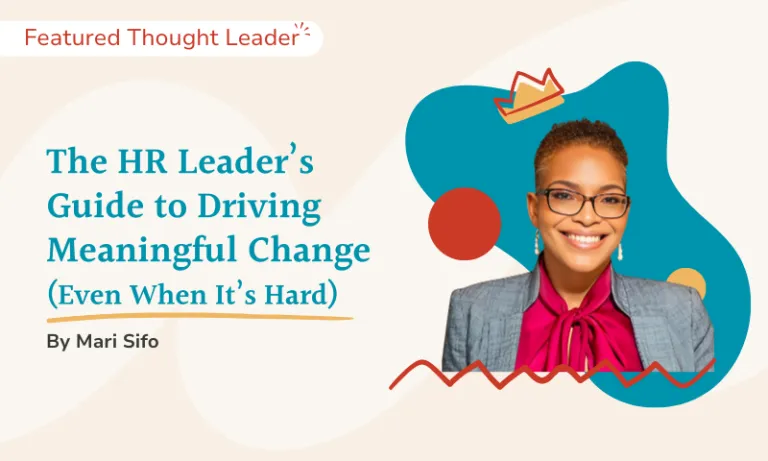

Written by Mari Sifo, this article explores the vital role of HR in leading change within organizations.
Mari Sifo is a seasoned HR leader with over 20 years of experience in strategic human resources and business leadership. Most recently, she served as the Executive Vice President and Chief Human Resources Officer at Host Hotels and Resorts, where she led talent management, organizational development, DEI, and more. Mari has also served in senior HR roles at SWM International and CP Keclo.
Connect with Mari on LinkedIn.
In my 20 years of leading HR, I’ve learned that the real work isn’t about following the playbook or checking off tasks, but leaning into discomfort and taking chances that push the boundaries of the status quo. It’s about HR leading change. It’s never the comfortable option, and that’s exactly why it matters.
The Uncomfortable Truth about HR
Change in HR can be daunting.
It’s like stepping out of the chaos, pausing to take stock, and trusting that something better is on the horizon. The truth is, we need to embrace it because it’s the only way forward.
HR has long been the cautious function.
For years, we’ve been experts at managing risk. Creating rules. Following procedures. Protecting companies and their people.
And while those things matter, we’ve let them dominate our thinking. The fear of making mistakes has held us back. And by sticking to the familiar path of “this is how it’s always been done,” we’ve stayed stagnant. Quite frankly, this hasn’t served us for some time, and it certainly won’t serve us in the future.
For HR to remain relevant, leading change is no longer optional.
The Moment Leadership Gets Real
I was the only leadership on-site at 1:45 AM, responsible for a shift of 50 people. The production floor was buzzing with tension when my shift leads rushed over, panic in their eyes.
“The line is jammed,” they told me. “There’s a potential we can fix it, but if it goes wrong, we’ll have to dump the entire batch and shut down the line for 24 hours.”
In that moment, a $750,000 decision rested solely on my shoulders.
Should I take the risk to keep the line going? There was no one to call. No manual to consult. No precedent to follow.
What I faced was the essence of real leadership: making decisions with limited information when the stakes are highest. Do I take the safe approach but put us behind on a critical customer order, or take the risk?
This is what leadership in HR truly demands — not just managing processes from behind a desk, but making consequential decisions when there’s no playbook to follow.
Behind Surface Changes: Transforming How We Work
The same courage that production floor demanded transfers directly into how we approach HR transformation. Too often, we settle for tweaking existing systems instead of reimagining them entirely.
Take our performance management process. What started as a simple scheduling complaint revealed a fundamental misalignment between our stated values and actual practice. Managers and employees were being pulled off critical production work to meet arbitrary HR deadlines, creating cascading delays that cost us both productivity and morale.
But the real problem wasn’t scheduling — it was that we had built a performance management system that actively worked against performance. Our process had become a compliance exercise divorced from the actual work that drove our business results.
Drawing from my production line experience, I recognized that the biggest risk wasn’t changing a broken system — it was allowing it to continue undermining our people and our operations. So we didn’t just move a deadline. We fundamentally redesigned performance management around our operational reality.
Instead of annual reviews that interrupted workflow, we embedded performance conversations into the natural rhythm of production cycles. Instead of generic rating scales, we created role-specific metrics tied directly to business outcomes. Instead of HR-driven timelines, we let operational needs and individual development goals drive the cadence.
As a result, managers stopped seeing performance management as an HR burden and started using it as a leadership tool. Employee engagement scores in performance-related categories jumped 40% in six months. Most importantly, we eliminated the productivity disruptions while actually improving the quality of performance conversations.
This is the kind of change HR leaders need to embrace: not surface-level tweaks, but fundamental reimagining of how our systems can serve both people and business results.
Leadership Through Breadcrumbs, Not Presentations
This is the kind of change HR leaders need to drive — not the surface-level tweaks, but deep, transformative shifts that challenge the status quo. But to do it effectively, forget what conventional wisdom tells you:
Drop breadcrumbs, don’t build highways. Instead of unveiling fully developed PowerPoints or slide decks, scatter ideas informally. Have a quick chat at the coffee machine. Test concepts in the elevator. Ask questions that plant seeds. Do your best Hansel and Gretel impression and see where the breadcrumb path takes you. If people stop following your trail, that’s your signal to pivot or dig deeper into why.
The hallways matter more than the conference room. Real buy-in doesn’t happen in formal meetings. I’ve sat through countless boardroom sessions with polite nods, strategic head tilts, and clasped hands that signal agreement. But the minute the meeting ends, so does the commitment. Build relationships where the work happens. On the production floor at 2 AM. In quick conversations between meetings. Understand concerns before they become objections.
Empower the skeptics. Don’t just target easy allies. The eye-rollers in the back of the room are your secret weapon, not your enemy. I make it a point to find my most vocal critics and give them the pen. Yes, the person with arms firmly crossed, thinking, “This will never work.” Their battle-tested objections aren’t roadblocks but blueprints for what actually needs solving. And when the fiercest skeptic becomes your strongest advocate, the rest will follow.
This approach helps HR lead without resistance and instead with a culture of collaboration and shared ownership. That’s the kind of change that will help both HR and the organization thrive.
HR: The First Movers in the AI Revolution
When we first started exploring AI, it felt like stepping into the unknown. The fear was palpable. I could hear it in conversations with my team, and honestly, feel it myself.
The typical questions arose:
Will it really add value?
What if it causes more problems than it solves?
What if we make a mistake?
But deep down we knew AI wasn’t a threat; it was an opportunity. The question wasn’t whether we should embrace it, but how we would. HR was in the perfect position to not just react to change but lead it. Think of all the legwork we did during the pandemic.
So we did something bold. We volunteered HR to be the pilot for the entire business. We launched the first AI use case for the entire business, deliberately positioning ourselves as the innovation leaders rather than waiting for another function to show the way.
This was our chance to shape what the future of work would look like, to design a workplace where technology enhanced rather than replaced the human experience.
So we leaned in. We made the decision to lead, even though it was uncomfortable.
The discomfort wasn’t a roadblock; it was the fuel driving us forward.
HR is the bridge between human connection and technology. We’re the ones who create environments where people can thrive, using technology as a tool to amplify our impact. It’s not about technology for technology’s sake, but leveraging the right tools to support our teams, enhance collaboration, and create spaces where people can reach their potential.
As HR professionals, it’s up to us to lead the way — to show that the future of work is about using machines to empower people, not replace them. And if we do it right, we can blend the best of both worlds: tech that drives productivity and human-centered workplaces that foster connection.
Be the Change We Want to See: The Role of HR in Leading Change
It’s time for HR to stop resisting change and start leading it.
I won’t sugarcoat it: The process is hard, messy, and often takes longer than expected. It may even require ruffling a few feathers. But in my experience, when you lean into the challenge, your people and your organization begin to thrive.
As HR leaders, we often find ourselves balancing the impact on people with business outcomes. They’re not mutually exclusive.
The real value of HR lies in our ability to lead change, not just adapt to it.
How do we do it?
Here are three strategies from my playbook:
- Communicate without the corporate filter: Forget the carefully crafted messages that sound like they came from a template. Speak human to humans. Tell people not just what’s changing but why it matters — to them, to customers, to the business. Honesty builds more trust than polished messaging.
- Move beyond empathy to action: Don’t just acknowledge that change is hard because everyone already knows that. Instead, do something about it. Create spaces for people to experiment, fail, and learn without judgment. Build support systems that are as innovative as the changes you’re driving.
- Own the uncomfortable reality: HR isn’t just there to react to changes — we are the change agents. It’s our responsibility to champion the changes no one else wants to touch, the ones that challenge deeply held assumptions about how work happens.
HR has long been seen as the guardian of stability, a protector of systems, policies, and processes. But in a world that’s evolving faster than ever, playing it safe is no longer an option. If we don’t evolve, we risk getting left behind.
So I leave you with this: Are you ready to lead the way, or will you let change pass you by?

 No receipt chasing