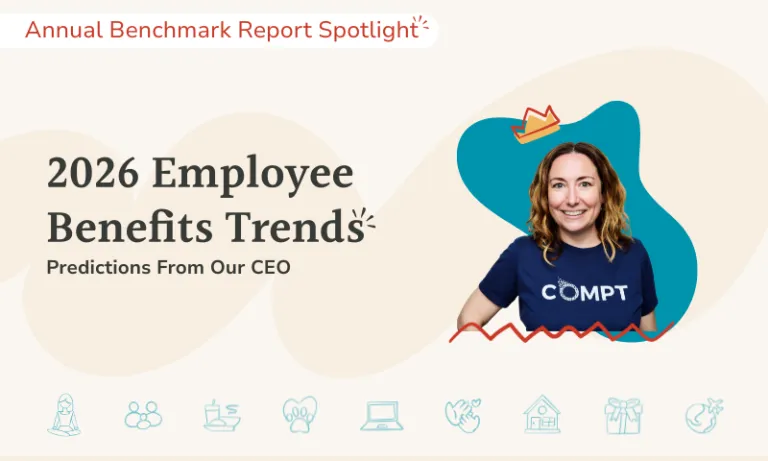

Every year, I ask HR and Finance leaders a version of the same question:
What’s actually getting in the way of supporting your people at scale?
In 2025, the answers were sharper and more direct. Not because leaders lack intent — they don’t. Across hundreds of conversations, the commitment to employees is steady and sincere.
What’s changed is the level of constraint.
Budgets are tighter. Healthcare costs continue to rise. Teams are putting real effort into doing more with less. And many of the systems companies rely on to deliver benefits weren’t built for the level of complexity today’s workforce demands.
I’ve seen that the organizations making progress aren’t chasing new perks. They’re simplifying. Consolidating. And rebuilding benefits programs around what employees actually use, supported by infrastructure that doesn’t add more work to already stretched teams.
Our 2026 Annual Lifestyle Benefits Benchmark Report, grounded in real spending data from January through December 2025, shows how this shift is playing out across industries, company sizes, and geographies (including internationally).
Below are the changes I expect to define the year ahead, backed by observations from my conversations with leaders that expand on what our peers should be paying attention to now.
1. Companies will consolidate perks and redirect budget into flexible LSAs.
When budgets were looser, it was easier to tolerate a patchwork of point solutions — each one solving a narrow problem, each one adding incremental overhead for HR and Finance.
That tolerance is fading.
In 2026, the companies moving forward will be the ones that stop trying to maintain everything at once. They’ll retire underused perks and redirect that spend into Lifestyle Spending Accounts (LSAs) that give employees meaningful choice without creating additional administrative work.
This isn’t about reducing support. It’s about preserving it in a way that scales. A single, flexible structure can replace multiple disconnected programs, reduce vendor sprawl, and allow employees to decide what support looks like in their own lives.
The data is clear: when programs are simpler and more flexible, participation and utilization rise — and benefits dollars go further.
“An LSA was actually the only benefits enhancement that we recommended to our executive team for 2026.”
— Head of Total Rewards, midmarket HR software provider
2. AI enablement will become a core workforce capability.
AI isn’t a future-facing conversation anymore. It’s already reshaping how work gets done.
Employees aren’t waiting for formal training programs to catch up. They’re using professional development stipends to access AI tools, courses, and subscriptions on their own — because that’s where learning is actually happening.
I don’t love hype cycles. But I do believe in practical capability building. In 2026, companies that treat AI skill development as optional will struggle to keep pace. The ones that move faster will recognize AI enablement as foundational infrastructure, not a fringe benefit — something that supports productivity and long-term relevance.
Flexible professional development stipends, especially those that explicitly support AI tools and learning, are becoming one of the most effective ways to meet this need without forcing rigid programs employees don’t engage with.
“Adopting AI is critical to being successful in today’s environment. It is becoming a required skill, like using the computer or Excel was in the past. As an HR team, we are partnering with our internal AI team to provide opportunities to learn and develop AI skills.”
— Head of Total Rewards, midmarket HR software provider
3. Support for families and caregivers will expand across life stages.
Cost pressure is reshaping how employees experience work — and where benefits need to show up.
Across our data, employees are directing more of their lifestyle benefit dollars toward everyday realities: groceries, transportation, childcare, elder care, and other family and household expenses that have become harder to absorb.
We also expect broader employer support for life-stage and specialized health needs, including fertility care, menopause support, and out-of-pocket medical costs that traditional benefits may leave behind (think: GLP-1s for weight loss).
What matters most here is flexibility. Employees don’t move through life stages on a schedule, and point solutions rarely capture the full picture. LSAs and targeted stipends allow companies to offer support without making assumptions or forcing employees into narrow definitions of need.
“Every company has unique policies, team structures, and cultural nuances. A one-size-fits-all approach won’t work. The ability to tailor programs and user experiences to reflect a company’s values and operational style will determine how successful the [benefits] rollout ultimately is.”
— Senior Director, Total Rewards and People Operations, large defense and aerospace manufacturing company
4. Hybrid work, RTO policies, and global hiring will continue to reshape benefits design.
As expectations around where work happens keep shifting, employee needs shift with them.
Some days require a commute. Some require privacy. Some require better equipment. For many companies, their people’s day-to-day reality is a mix (not a fixed policy line). And that reality doesn’t always align with leadership’s assumptions about what work should look like.
At the same time, companies are rethinking how they build their teams. Growing friction around work-sponsored visas and cross-border mobility is pushing more organizations to hire globally rather than concentrate talent in a single market. As teams become more geographically distributed by design, differences in work norms, cost structures, and support expectations become harder to standardize.
Stipends remain one of the few benefit tools that can absorb this variability without requiring employers to design separate programs for every scenario. In 2026, more companies will rely on flexible benefits to support how work actually happens, across locations and life circumstances, rather than trying to enforce uniformity where it no longer fits.
“[With Compt, I like that there’s] no “lost” money put on cards that we as the business can’t get back. This has been a pain point in commuter benefits, for example.”
— Director of People Operations, midmarket technology company with a global workforce
5. Operational readiness will determine whether LSAs succeed.
Interest in LSAs isn’t the barrier anymore.
Execution is.
Too many programs struggle not because they’re poorly designed, but because they rely on manual workflows, disconnected systems, or tools that weren’t built to handle stipends at scale. HR teams don’t lack expertise — they lack bandwidth.
And in a market like this, the status quo often feels safer than a change that could create more work or unexpected tax issues with someone’s name attached to them.
The companies that succeed with flexible benefits in 2026 will be the ones that pair thoughtful program design with infrastructure that removes friction — especially platforms that integrate directly with payroll and handle compliance automatically.
At this point, the question isn’t whether LSAs work. It’s whether your systems can support them.
“I like that the entire [Compt] product is designed around simplification of the employee experience. … The more work that we can get done in a simple, automated way, the more time we have to spend on value-add activities instead of administrivia.”
— Chief Human Resources Officer, large veterinary healthcare organization
What this means for 2026
This is the year when good intentions won’t be enough.
Programs that look impressive but go unused won’t survive budget scrutiny. Perks added for the sake of keeping up won’t hold attention. And complexity without payoff will continue to slow teams down.
One final note: be cautious of anyone promising clean, universal benefits ROI. There are too many variables. What you can measure — and what Finance will respect — is participation, utilization, and whether a program reduces friction for the teams running it. That’s impact. And it’s measurable.
The organizations that make progress in 2026 will be the ones that:
- Consolidate what’s underperforming.
- Invest in benefits employees consistently use.
- Build systems that make flexibility operational, not aspirational.
Our 2026 Annual Lifestyle Benefits Benchmark Report breaks down exactly how companies are structuring, funding, and managing these programs today — grounded in real employee behavior, not assumptions, to help you lead with clarity and build with confidence.
If you want data you can actually act on, I invite you to download the report today.
And if you’re ready to speak with the Compt team, go ahead and request a demo.